In mathematics, an expression can sometimes be replaced by another expression without changing the value of the result. This may seem surprising at first, especially when the two expressions look completely different. The reason is that the two expressions are mathematically equivalent. When this equivalence is true for every allowed value of the variables, the relationship is called an identity.
An identity is more than an equation that happens to work for a particular value. It is a statement that remains true for all values for which the expressions are defined. Because both sides always have the same value, one expression can be used in place of the other during calculations, simplification, expansion, or problem solving.
Understanding why identities can replace expressions is an important foundation for algebra. It helps explain why formulas can be rearranged, why complicated expressions can be simplified, and why different-looking mathematical forms can represent exactly the same quantity.
What Is a Mathematical Identity?
An identity is an equation that is true for every value of its variable or variables for which both sides are defined.
For example:
(a + b)² = a² + 2ab + b²
This is an identity because it is true for all values of a and b.
Try using a = 2 and b = 3:
(2 + 3)² = 25
and
2² + 2(2)(3) + 3² = 4 + 12 + 9 = 25
Both expressions give the same value.
Now choose different values, such as a = 5 and b = 1:
(5 + 1)² = 36
and
5² + 2(5)(1) + 1² = 25 + 10 + 1 = 36
The relationship continues to work.
This is what makes an identity different from an ordinary equation that may only be true for certain values.
Why Can One Expression Replace Another?
The basic reason is equality.
When two expressions are equal, they represent the same mathematical value under the conditions where that equality is valid. Therefore, replacing one with the other does not change the value of the larger expression.
Consider:
x² − 9 = (x − 3)(x + 3)
This is an identity.
Suppose we have the expression:
x² − 9 + 5
Using the identity, we can replace x² − 9 with (x − 3)(x + 3):
(x − 3)(x + 3) + 5
The appearance of the expression has changed, but its value has not.
For example, if x = 7:
x² − 9 + 5 = 49 − 9 + 5 = 45
Using the replacement:
(7 − 3)(7 + 3) + 5 = 4 × 10 + 5 = 45
The result remains 45.
The replacement works because the identity guarantees that the two expressions have exactly the same value.
An Identity Represents the Same Quantity in Different Forms
One useful way to understand identities is to think of them as different descriptions of the same quantity.
For example:
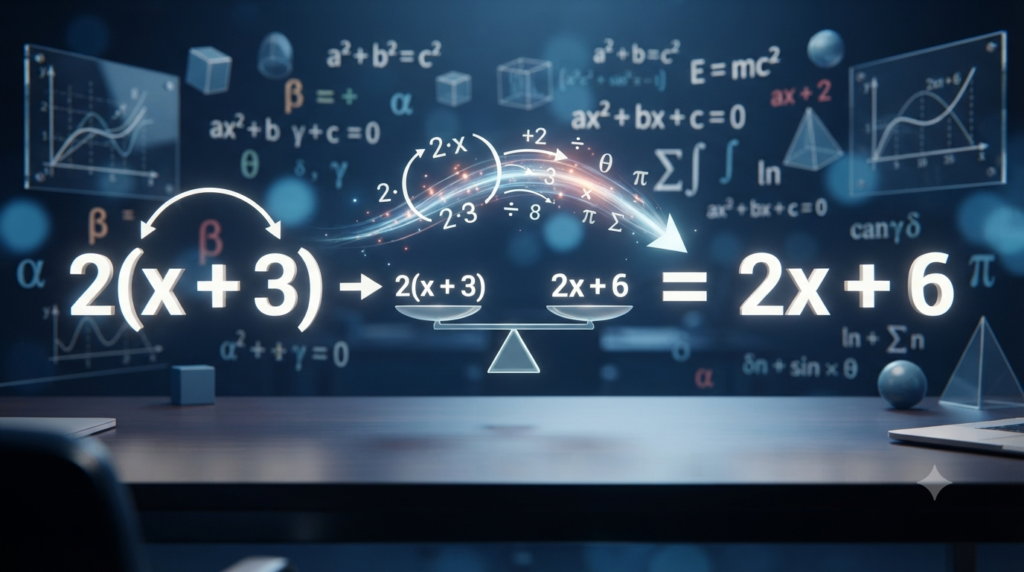
2(x + 3)
and
2x + 6
look different, but they represent the same quantity.
The distributive property gives:
2(x + 3) = 2x + 6
So if an expression contains 2(x + 3), we can replace it with 2x + 6.
For example:
2(x + 3) + 4
can become:
2x + 6 + 4
and then:
2x + 10
Nothing about the mathematical value has changed. Only the form has changed.
This distinction is important:
Changing the form does not necessarily mean changing the value.
An identity allows us to change the form while preserving the value.
Equality Is the Key Principle
The replacement of an expression is based on a fundamental property of equality called the substitution property of equality.
If:
A = B
then wherever A occurs in a mathematical expression, B can be substituted for A, provided the substitution is valid.
For example, if:
x + 2 = 7
then an expression such as:
3(x + 2)
can be rewritten as:
3(7)
because x + 2 and 7 have the same value under the given condition.
The same idea applies to identities, but with an important difference.
An identity such as:
(x + 2)² = x² + 4x + 4
is true for every allowed value of x.
Therefore, we can replace one side with the other whenever that part of the expression appears.
Identities Are True for All Allowed Values
The word identity is important because it tells us that the relationship is universally true within its domain.
Consider:
x + 5 = 10
This is not an identity. It is true only when:
x = 5
But:
(x + 5)² = x² + 10x + 25
is an identity because it is true for every real value of x.
This difference explains why an identity can be used as a general replacement rule.
An identity does not depend on finding one special value of a variable. Instead, it establishes that two expressions are equivalent throughout their entire allowed domain.
What Does “Without Changing Its Value” Really Mean?
Suppose we have two expressions:
A
and
B
and an identity tells us:
A = B
This means that whenever the identity applies, the numerical value represented by A is exactly the same as the numerical value represented by B.
The expressions may have different structures, but their values match.
For example:
(x + 4)²
and
x² + 8x + 16
are different-looking expressions.
However:
(x + 4)² = x² + 8x + 16
So replacing one with the other does not change the value.
If x = 6:
(6 + 4)² = 100
while:
6² + 8(6) + 16 = 36 + 48 + 16 = 100
Both forms describe the same quantity.
Identities Make Algebraic Simplification Possible
One of the most common uses of identities is simplification.
Consider:
(x + 5)² − x²
Using the square identity:
(x + 5)² = x² + 10x + 25
we can replace the squared expression:
x² + 10x + 25 − x²
The x² terms cancel:
10x + 25
Therefore:
(x + 5)² − x² = 10x + 25
The original expression may be easier to understand geometrically or structurally, while the simplified form may be easier to calculate.
The identity allows us to move between these forms without changing the quantity represented.
Identities Can Expand Expressions
An identity can also be used in the opposite direction.
For example:
x² + 6x + 9 = (x + 3)²
Suppose we have:
x² + 6x + 9
We can recognize the identity and replace it with:
(x + 3)²
This process is called factorization.
The expression becomes shorter and may reveal useful information that was not obvious before.
For example, the value of:
x² + 6x + 9
may not immediately show that it is always a perfect square. Writing it as:
(x + 3)²
makes that structure clear.
Thus, identities are useful not only for simplifying expressions but also for discovering their structure.
The Value Does Not Depend on the Form
A central idea in algebra is that a mathematical quantity can have many equivalent forms.
For example:
1/2
and
0.5
represent the same number.
Similarly:
2(x + 4)
and
2x + 8
represent the same algebraic quantity.
Likewise:
x² − 16
and
(x − 4)(x + 4)
represent the same quantity.
The form can change depending on what we want to do.
If we want to expand an expression, one form may be useful. If we want to factor it, another form may be better. If we want to calculate a value, a third form may be more convenient.
An identity provides the mathematical justification for moving between these equivalent forms.
Why This Does Not Violate the Rules of Mathematics
It is important to understand that we are not simply changing an expression whenever we want.
A replacement is allowed because the two expressions have been proven equal.
For example:
(a + b)² = a² + 2ab + b²
has a mathematical basis. It can be derived using multiplication:
(a + b)(a + b)
Multiplying each term gives:
a² + ab + ab + b²
Combining like terms gives:
a² + 2ab + b²
Therefore:
(a + b)² = a² + 2ab + b²
Once this relationship is established, either expression can replace the other.
So the replacement is not an arbitrary shortcut. It follows directly from a proven equality.
Identities and Algebraic Formulas
Many familiar formulas in mathematics are based on identities.
For example, the distance formula, area formulas, algebraic expansions, and trigonometric relationships often involve equivalent mathematical expressions.
Consider the identity:
a² − b² = (a − b)(a + b)
Suppose we need to calculate:
101² − 99²
Using the original form requires calculating two squares:
101² − 99²
But the identity allows us to replace the expression:
(101 − 99)(101 + 99)
This becomes:
2 × 200 = 400
The identity has not changed the answer. It has simply provided a more convenient form.
This is one reason identities are so powerful in mathematical problem solving.
Identities Can Reveal Hidden Patterns
An expression may hide a useful pattern until it is rewritten.
Consider:
x² − 10x + 25
At first, it appears to be a three-term quadratic expression.
Using the identity:
a² − 2ab + b² = (a − b)²
we can rewrite it as:
(x − 5)²
Now its structure becomes much clearer.
The expression is a perfect square, and this information can be useful in equations, graphs, algebraic proofs, and other calculations.
Therefore, an identity is not merely a tool for shortening an expression. It can help us see mathematical relationships that are hidden in another form.
Identities Must Be Used Within Their Conditions
Although identities allow replacement, we must still pay attention to restrictions.
For example:
1/x = 1/x
is meaningful only when:
x ≠ 0
Similarly, an expression involving a square root, denominator, or logarithm may have restrictions on the values that can be used.
Consider:
(x² − 1)/(x − 1) = x + 1
This relationship is valid when:
x ≠ 1
because the original expression has a denominator of x − 1, which cannot be zero.
So when replacing expressions using an identity or equivalent relationship, we must respect the original domain.
Identity Versus Equation
An identity and an equation both use the equality sign, but they serve different purposes.
An identity is true for every allowed value of the variable.
Example:
(x + 2)² = x² + 4x + 4
An equation may be true only for particular values.
Example:
x + 2 = 7
The second statement is true only when:
x = 5
This difference is important because identities act like general mathematical rules, while equations are often used to find unknown values.
Identity Versus Approximation
An identity also should not be confused with an approximation.
For example:
π ≈ 3.14
is an approximation, not an identity.
The values are close, but they are not exactly equal.
By contrast:
(x + 1)² = x² + 2x + 1
is an exact identity.
When we replace one side of an identity with the other, the value remains exactly unchanged, not merely approximately unchanged.
A Simple Way to Think About Identities
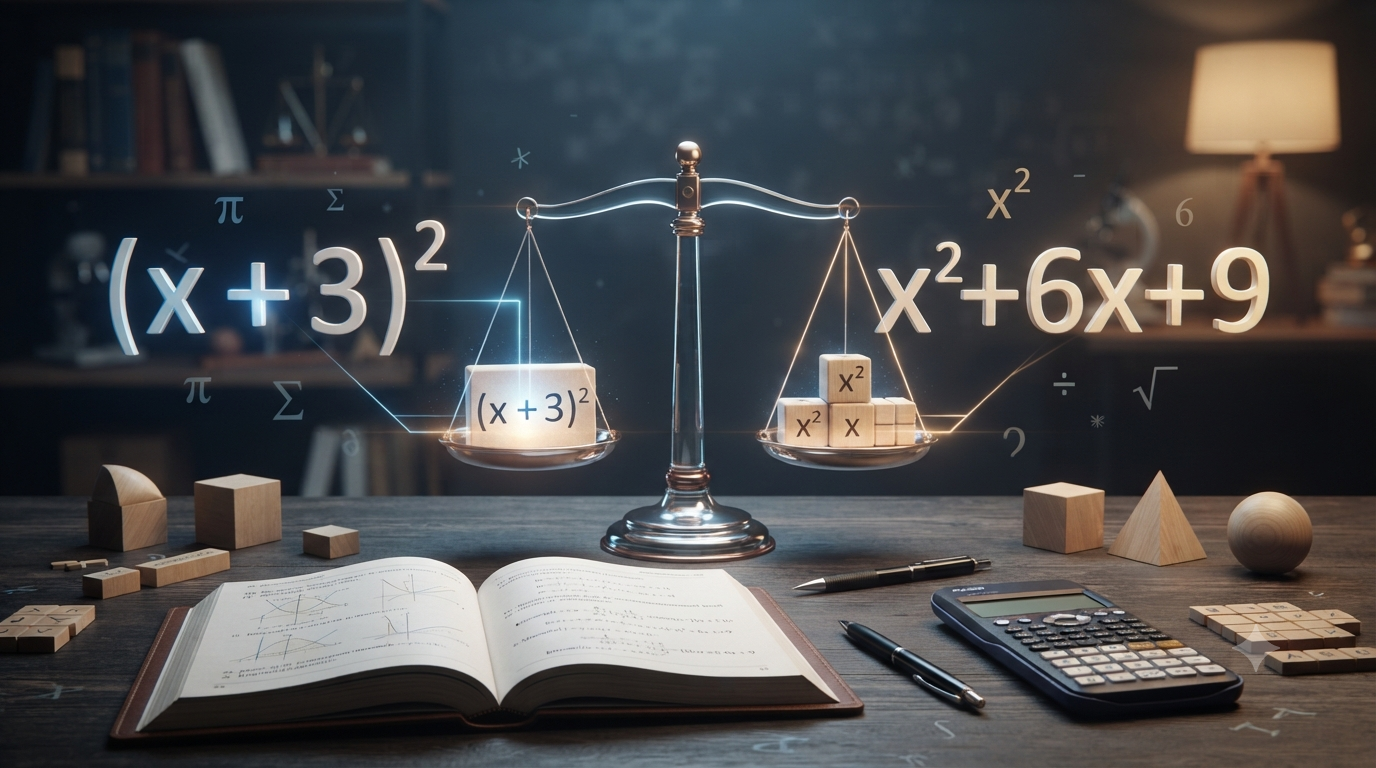
A useful way to understand an identity is to imagine two different routes to the same destination.
Suppose one route takes a straight road and another route takes several smaller roads. The routes look different, but if they reach exactly the same destination, choosing one instead of the other does not change the destination.
In algebra, the two routes are different expressions.
The identity proves that they represent the same mathematical quantity.
For example:
(x + 3)²
and
x² + 6x + 9
look different, but they always lead to the same value.
Therefore, we can choose whichever form is more useful for the task.
Why Identities Are Important in Mathematics
Identities are important because mathematics often requires us to transform expressions without changing what they represent.
They help us:
simplify complicated expressions,
expand brackets,
factor algebraic expressions,
calculate values more efficiently,
prove mathematical statements,
rearrange formulas,
identify patterns,
solve equations,
simplify fractions,
work with functions,
understand relationships between quantities.
Without identities, many algebraic transformations would be difficult to justify.
An identity gives us a reliable rule for changing the appearance of an expression while preserving its mathematical meaning.
Conclusion
An identity can be used in place of another expression without changing its value because an identity establishes that the two expressions are exactly equal for every allowed value of their variables. The expressions may look different, but they represent the same mathematical quantity.
For example:
(x + 3)² = x² + 6x + 9
means that either expression can replace the other whenever the identity applies. The replacement changes only the form, not the value.
This idea is one of the foundations of algebra. It explains why we can expand, factor, simplify, and rearrange mathematical expressions while preserving their meaning. Once you understand identities as different forms of the same quantity, many algebraic transformations become much easier to understand and use.
FAQs
1. What is a mathematical identity?
A mathematical identity is an equation that remains true for every value of its variables for which the expressions are defined. It shows that two different-looking expressions always have the same value. For example, (x + 2)² = x² + 4x + 4 is an identity because it works for every allowed value of x. An identity is different from an ordinary equation, which may be true only for particular values. Because both sides of an identity are always equal, one expression can be replaced by the other without changing the mathematical value of a larger expression.
2. Why can one expression be replaced by another using an identity?
One expression can be replaced by another because an identity proves that both expressions have exactly the same value. If A = B is an identity, then A and B are equivalent for every allowed value of the variables. Therefore, whenever A appears inside a larger expression, B can take its place without changing the result. For example, x² − 9 can be replaced by (x − 3)(x + 3) because these expressions are identical. The replacement changes the form of the expression, but not the quantity it represents.
3. Does replacing an expression using an identity change its value?
No. Replacing an expression using a valid identity does not change its value. The purpose of an identity is to show that two expressions represent exactly the same quantity. For example, 2(x + 3) and 2x + 6 have the same value for every value of x. If x = 4, both expressions give 14. Therefore, either form can be used depending on what is more convenient. Although the appearance or structure of the expression changes, its mathematical value remains exactly the same.
4. What is the difference between an identity and an equation?
An identity is true for every allowed value of its variables, while an equation may be true only for certain values. For example, (x + 3)² = x² + 6x + 9 is an identity because it works for every value of x. In contrast, x + 3 = 10 is an equation that is true only when x = 7. Identities are commonly used to transform or replace expressions because their equality is universally valid within the given domain. Equations, on the other hand, are often used to find unknown values.
5. How does the substitution property support identities?
The substitution property of equality states that if two quantities are equal, one can replace one with the other without changing the value of an expression. For example, if A = B, then an expression containing A can use B instead. An identity provides a particularly strong form of this idea because the equality remains true for every allowed value of the variables. For example, a² − b² = (a − b)(a + b) allows either form to replace the other. This property is one of the basic reasons algebraic simplification and transformation work.
6. Can identities be used to simplify algebraic expressions?
Yes. Identities are frequently used to simplify algebraic expressions. For example, consider (x + 5)² − x². Using the identity (x + 5)² = x² + 10x + 25, the expression becomes x² + 10x + 25 − x². The x² terms cancel, leaving 10x + 25. The identity allows the original expression to be transformed into a simpler form without changing its value. This is useful because different forms of the same expression can make calculations, factorization, comparison, or further algebraic operations much easier.
7. Can an identity be used in reverse?
Yes. An identity can generally be used in either direction because both sides represent the same value. For example, the identity x² + 6x + 9 = (x + 3)² can be used from left to right to factor the expression, or from right to left to expand it. If an expression contains x² + 6x + 9, it can be replaced by (x + 3)². Similarly, (x + 3)² can be replaced by x² + 6x + 9. The choice depends on which form is more useful.
8. Are identities always valid for every possible value?
Identities are valid for every value within their appropriate domain, but some expressions have restrictions. For example, an expression containing a variable in the denominator cannot be used when that denominator is zero. Consider (x² − 1)/(x − 1) = x + 1. This relationship is valid when x ≠ 1, because the original expression is undefined at x = 1. Therefore, when using an identity or equivalent expression, it is important to consider restrictions such as zero denominators, square roots, and logarithms. The domain must remain valid during the replacement.
9. Why are identities important in algebra?
Identities are important because they allow mathematicians to transform expressions without changing their values. They are used in expansion, factorization, simplification, formula manipulation, and mathematical proofs. For example, a² − b² = (a − b)(a + b) can turn a difficult calculation into a much simpler one. Identities also help reveal patterns that may not be obvious in the original form. By learning common identities, students can recognize equivalent expressions quickly and choose the most useful form for a particular problem. This makes algebraic calculations more efficient, organized, and easier to understand.
10. What is the main idea behind replacing one expression with another?
The main idea is that mathematical value and mathematical form are not always the same thing. Two expressions can look completely different while representing exactly the same quantity. An identity proves this equivalence. For example, (x + 4)² and x² + 8x + 16 have different forms, but they always have the same value for every allowed x. Therefore, one can replace the other without changing the result. This ability to change form while preserving value is fundamental to algebra and allows expressions to be simplified, expanded, factored, and manipulated effectively.