Formulas are one of the most useful tools in science and mathematics because they allow us to describe relationships between different quantities in a compact way. However, a formula can look perfectly reasonable and still contain a mistake. A missing factor, an incorrect exponent, or the wrong physical quantity can easily lead to an incorrect result. One simple way to detect many such mistakes is to check the dimensional consistency of the formula.
Dimensional consistency means that the dimensions of the quantities on both sides of an equation must be the same. For example, if one side of a physical equation represents length, the other side must also have the dimensions of length. Similarly, quantities that are added or subtracted must have the same dimensions.
Dimensional analysis cannot prove that a formula is completely correct, but it can quickly reveal many possible errors. It is especially useful when deriving equations, checking calculations, solving physics problems, and reviewing formulas before using them.
What Is Dimensional Consistency?
Every physical quantity can be expressed in terms of fundamental dimensions such as mass, length, time, electric current, temperature, amount of substance, and luminous intensity. In mechanics, the most commonly used fundamental dimensions are mass, length, and time.
These are usually represented by:
Mass = [M]
Length = [L]
Time = [T]
For example, velocity is distance divided by time. Therefore, its dimensions are length divided by time.
Text block:
Velocity = distance / time
[v] = [L] / [T]
[v] = [LT⁻¹]
Acceleration is the change in velocity per unit time, so its dimensions are:
Text block:
[a] = [LT⁻¹] / [T]
[a] = [LT⁻²]
Force is mass multiplied by acceleration:
Text block:
[F] = [M][LT⁻²]
[F] = [MLT⁻²]
These dimensional expressions allow us to compare different parts of a formula without depending on the particular units being used.
An equation is dimensionally consistent when both sides have identical dimensions.
Why Must Both Sides of a Formula Have the Same Dimensions?
Consider a simple equation for distance:
Text block:
s = vt
Here, s represents distance, v represents velocity, and t represents time.
The dimensions of the right-hand side are:
Text block:
[vt] = [LT⁻¹][T]
[vt] = [L]
The left-hand side also has dimensions of length:
Text block:
[s] = [L]
Therefore:
Text block:
[s] = [vt]
[L] = [L]
The equation is dimensionally consistent.
This requirement comes from the basic meaning of an equation. An equation states that two physical quantities are equal. If the quantities have different dimensions, they cannot represent the same physical quantity.
For example, saying that a length is equal to a time would be physically meaningless. A quantity measured in metres cannot be directly equal to a quantity measured in seconds.
How Dimensional Consistency Can Reveal a Mistake
Suppose someone proposes the following formula for distance travelled by an object:
Text block:
s = ut + at²
At first glance, this may look reasonable because it contains familiar quantities from motion. Let us check its dimensions.
The first term is:
Text block:
[ut] = [LT⁻¹][T]
[ut] = [L]
The second term is:
Text block:
[at²] = [LT⁻²][T²]
[at²] = [L]
Both terms have dimensions of length. Therefore, the right-hand side has dimensions of length, which agrees with the dimension of s.
So the formula is dimensionally consistent.
However, dimensional consistency does not tell us whether the numerical coefficient should be 1, 1/2, 2, or another dimensionless number. The familiar equation is:
Text block:
s = ut + ½at²
Both equations have exactly the same dimensions. Dimensional analysis alone cannot identify the missing factor of ½.
This is an important limitation. Dimensional consistency can detect some mistakes, but it cannot guarantee that a formula is correct.
Example of a Formula That Fails the Dimensional Test
Consider the proposed equation:
Text block:
s = ut + at
Let us examine the dimensions.
The first term has dimensions:
Text block:
[ut] = [L]
The second term has dimensions:
Text block:
[at] = [LT⁻²][T]
[at] = [LT⁻¹]
Now we have:
Text block:
[L] + [LT⁻¹]
These quantities do not have the same dimensions.
A length cannot be added to a velocity. Therefore, the formula is dimensionally inconsistent and must contain an error.
This is a very useful way of identifying mistakes. We do not even need to insert numerical values into the formula. The dimensional check immediately tells us that something is wrong.
Dimensional Consistency and Addition
One of the most important rules of dimensional analysis is that quantities being added or subtracted must have the same dimensions.
Consider:
Text block:
A + B = C
For this equation to be meaningful:
Text block:
[A] = [B] = [C]
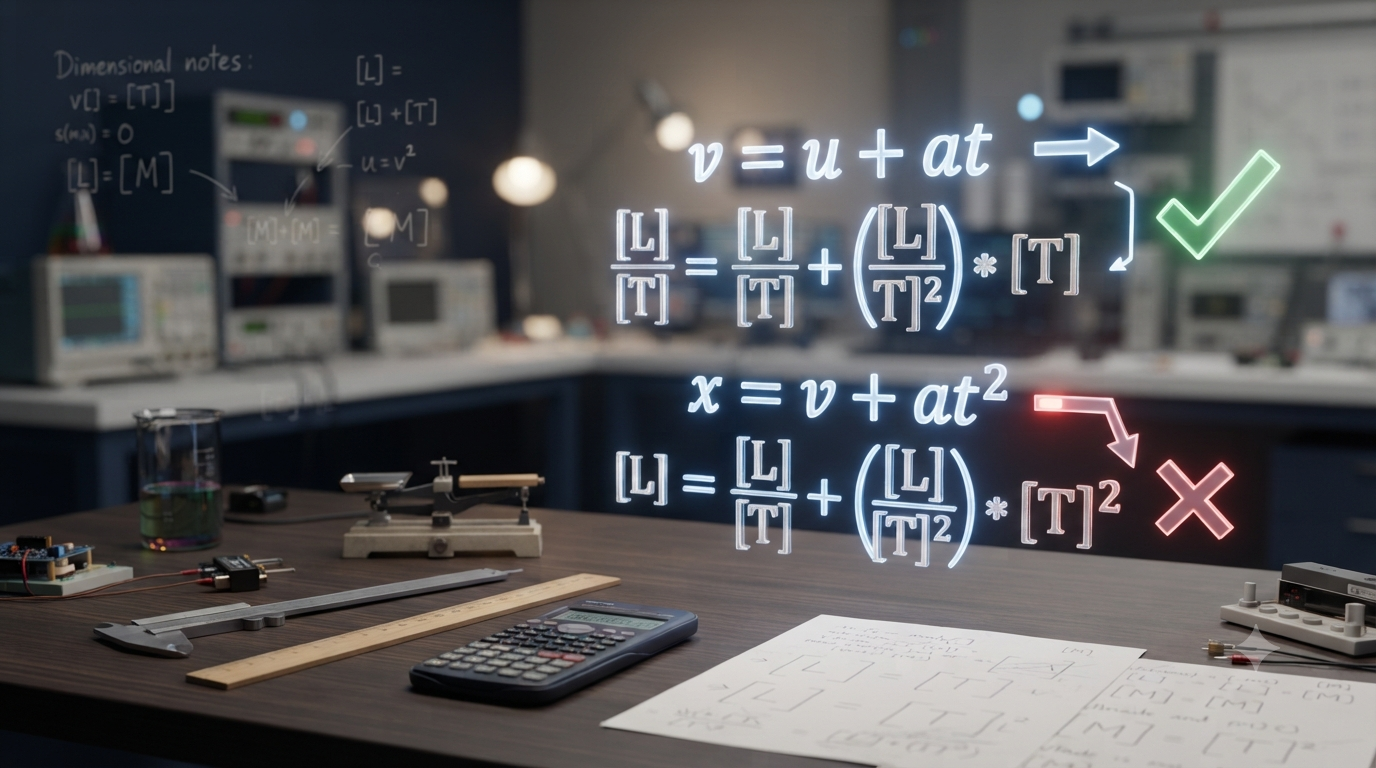
For example, in the equation:
Text block:
v = u + at
velocity, initial velocity, and acceleration multiplied by time must all have dimensions of velocity.
The dimensions are:
Text block:
[v] = [LT⁻¹]
[u] = [LT⁻¹]
[at] = [LT⁻²][T]
[at] = [LT⁻¹]
Therefore, all three terms are dimensionally compatible.
But if someone writes:
Text block:
v = u + at²
then:
Text block:
[at²] = [LT⁻²][T²]
[at²] = [L]
The equation would then attempt to add length to velocity:
Text block:
[LT⁻¹] + [L]
That is not dimensionally valid.
This makes dimensional consistency a quick error-detection tool when working with equations containing several terms.
Checking Both Sides of an Equation
Another powerful use of dimensional consistency is checking whether the left-hand side and right-hand side of an equation represent the same type of quantity.
Consider the formula:
Text block:
v² = u² + 2as
The left-hand side has dimensions:
Text block:
[v²] = [LT⁻¹]²
[v²] = [L²T⁻²]
Now check the terms on the right.
For u²:
Text block:
[u²] = [L²T⁻²]
For as:
Text block:
[as] = [LT⁻²][L]
[as] = [L²T⁻²]
The dimensionless number 2 does not affect the dimensions.
Therefore:
Text block:
[u²] = [2as] = [L²T⁻²]
The equation is dimensionally consistent.
Now imagine someone accidentally writes:
Text block:
v² = u² + 2a + s
The dimensions of the terms would be different:
Text block:
[v²] = [L²T⁻²]
[u²] = [L²T⁻²]
[a] = [LT⁻²]
[s] = [L]
The terms on the right cannot be added together because they do not share the same dimensions. This immediately indicates that the formula is incorrect.
Detecting Incorrect Powers and Exponents
Dimensional analysis can also help identify errors involving powers.
Suppose a formula is proposed for kinetic energy:
Text block:
K = ½mv
The dimensions of the right-hand side are:
Text block:
[mv] = [M][LT⁻¹]
[mv] = [MLT⁻¹]
But energy has dimensions:
Text block:
[Energy] = [ML²T⁻²]
The dimensions do not match.
Therefore, the formula cannot represent kinetic energy.
The correct expression is:
Text block:
K = ½mv²
Now:
Text block:
[mv²] = [M][LT⁻¹]²
[mv²] = [ML²T⁻²]
This matches the dimensions of energy.
Here, the missing square on velocity is detected immediately through dimensional analysis.
Detecting Missing or Extra Variables
Dimensional consistency can also help determine whether an important variable has been omitted.
For example, suppose someone proposes that the distance travelled under constant acceleration is:
Text block:
s = u + at²
The dimensions are:
Text block:
[u] = [LT⁻¹]
[at²] = [L]
These cannot be added.
The dimensional check shows that something is wrong. The initial velocity must be multiplied by time if it is intended to contribute to a distance:
Text block:
ut
This gives:
Text block:
[ut] = [L]
The check therefore helps identify the type of correction needed, even though it does not necessarily tell us the complete correct equation.
Finding Errors in Derived Formulas
Dimensional analysis is particularly useful when deriving formulas step by step.
Suppose a student derives a formula for pressure and obtains:
Text block:
P = F × A
Pressure is defined as force divided by area:
Text block:
P = F / A
The dimensions of force are:
Text block:
[F] = [MLT⁻²]
Area has dimensions:
Text block:
[A] = [L²]
Therefore, the correct dimensions of pressure are:
Text block:
[P] = [MLT⁻²] / [L²]
[P] = [ML⁻¹T⁻²]
If we use multiplication instead:
Text block:
[F A] = [MLT⁻²][L²]
[F A] = [ML³T⁻²]
This is clearly not the dimension of pressure.
The dimensional check therefore exposes the mistake immediately.
Dimensional Consistency Can Check Units Too
Dimensions and units are closely related, although they are not exactly the same thing.
For example, distance can be measured in metres, kilometres, centimetres, or miles. These are different units of the same dimension.
Similarly, velocity may be measured in metres per second or kilometres per hour. Both have the same dimension:
Text block:
[velocity] = [LT⁻¹]
When checking a formula, we can use dimensions to determine whether the units on both sides are compatible.
Consider:
Text block:
s = vt
If velocity is measured in metres per second and time is measured in seconds:
Text block:
(m/s) × s = m
The result has the unit of length, which agrees with s.
This is another practical way to catch mistakes during numerical calculations.
Dimensionless Quantities and Numerical Constants
Not every part of a formula carries dimensions. Some quantities are dimensionless.
Numbers such as 2, 3, ½, π, and many mathematical constants have no physical dimensions.
For example:
Text block:
F = ma
and
Text block:
F = 2ma
have the same dimensions.
The factor 2 changes the numerical value but does not affect dimensional consistency.
This explains why dimensional analysis cannot determine every part of a formula. It can verify the dimensions of physical quantities, but it cannot determine dimensionless numerical constants.
For example, dimensional analysis cannot distinguish between:
Text block:
s = ut + ½at²
and
Text block:
s = ut + at²
Both are dimensionally consistent.
To determine the correct numerical factor, we need another method, such as mathematical derivation, experimental evidence, or the laws of physics.
What Dimensional Analysis Can and Cannot Detect
Dimensional consistency is powerful, but it has clear limitations.
It can often detect:
An incorrect physical quantity
A missing variable
An extra variable
An incorrect power
An incorrect multiplication or division
An incompatible term in an addition or subtraction
A mismatch between the two sides of an equation
Some mistakes in derived formulas
Some unit-conversion errors
However, it cannot generally detect:
Wrong dimensionless numerical constants
Incorrect signs
Missing dimensionless factors
Some incorrect relationships between quantities
Whether a dimensionally correct formula actually describes the physical situation
For example:
Text block:
E = mc²
and
E = 2mc²
are dimensionally consistent, even though they do not represent the same equation.
Therefore, dimensional consistency should be considered a filter for detecting errors, not a complete proof of correctness.
A Simple Method for Checking a Formula
When you suspect that a formula may contain an error, follow a simple sequence.
Step 1: Identify the physical quantity on the left
Determine what the left-hand side represents.
For example, if:
Text block:
Q = …
and Q represents energy, identify the dimensions of energy.
Text block:
[Q] = [ML²T⁻²]
Step 2: Write the dimensions of every variable
Replace each physical quantity with its dimensional expression.
For example:
Text block:
[v] = [LT⁻¹]
[a] = [LT⁻²]
[m] = [M]
Step 3: Simplify each term
Work through multiplication, division, and powers carefully.
Step 4: Check terms being added or subtracted
Every term in a sum or difference must have the same dimensions.
Step 5: Compare both sides
The final dimensions on the left and right must be identical.
If they are different, the formula contains an error.
Why This Method Is So Useful
One major advantage of dimensional consistency is that it is fast. A complicated-looking formula can often be checked in a few steps without knowing the numerical values of the variables.
It is also independent of the particular system of units. Whether you use metres and seconds or centimetres and minutes, the underlying dimensions remain the same.
This makes dimensional analysis useful for students, teachers, engineers, scientists, and anyone working with physical formulas.
It is particularly valuable when a formula has been copied from notes, rearranged during a calculation, or derived from several equations. Instead of immediately calculating numbers, you can first ask a simple question:
Do the dimensions make sense?
If they do not, there is no need to continue the calculation until the mistake is corrected.
Conclusion
Dimensional consistency provides a simple and powerful way to identify many mistakes in physical formulas. By comparing the dimensions of both sides of an equation and checking that terms being added or subtracted have the same dimensions, we can quickly detect errors involving missing variables, incorrect powers, incompatible terms, and incorrect mathematical operations.
However, dimensional consistency is not a complete test of a formula. A formula can be dimensionally correct and still be physically wrong, especially when the error involves a numerical constant, sign, or dimensionless factor. For this reason, dimensional analysis should be used together with mathematical derivation, physical reasoning, experimental evidence, and other methods of verification.
The main idea is simple: a valid physical equation must be dimensionally consistent. Whenever the dimensions do not match, the formula cannot be correct as written. This makes dimensional analysis one of the quickest first checks for finding mistakes before they affect a larger calculation.
FAQs
1. What is dimensional consistency in a formula?
Dimensional consistency means that both sides of a physical equation have the same dimensions. It also requires that quantities being added or subtracted have identical dimensions. For example, in the equation s = vt, distance has the dimension [L], while velocity multiplied by time has the dimension [LT⁻¹][T] = [L]. Therefore, the equation is dimensionally consistent. Dimensional consistency is an important principle in physics because different physical quantities cannot be directly equated or added when their dimensions are different. Checking dimensions provides a quick way to identify many errors in formulas without substituting numerical values.
2. How can dimensional analysis identify a mistake in a formula?
Dimensional analysis identifies mistakes by comparing the dimensions of different parts of an equation. First, write the dimensions of every physical quantity in the formula. Then simplify the dimensions on each side and compare the results. If the dimensions are different, the formula contains an error. For example, if a formula for distance contains the term at instead of at², its dimensions would be [LT⁻¹], which represents velocity rather than distance. The mismatch immediately reveals the problem. This method is especially useful for detecting incorrect powers, missing variables, inappropriate operations, and terms that cannot logically be combined.
3. Why must both sides of a physical equation have the same dimensions?
Both sides of a physical equation must have the same dimensions because an equation represents equality between physical quantities. Quantities with different dimensions cannot represent the same physical quantity. For example, a distance has dimensions [L], while velocity has dimensions [LT⁻¹]. Therefore, an equation stating that distance equals velocity would not be physically meaningful. Dimensional equality ensures that the relationship is physically possible from a basic dimensional perspective. This principle also allows equations to remain meaningful when units are changed, such as converting metres to kilometres or seconds to hours, because the underlying dimensions remain unchanged.
4. Can dimensional consistency prove that a formula is completely correct?
No, dimensional consistency cannot prove that a formula is completely correct. It can only show that the formula is dimensionally possible. For example, s = ut + at² and s = ut + ½at² have the same dimensions, even though the second equation is the standard equation for uniformly accelerated motion. Dimensional analysis cannot determine the numerical factor ½ because numerical constants such as 2 and ½ are dimensionless. Similarly, dimensional analysis may not detect an incorrect sign or an incorrect physical relationship. Therefore, dimensional consistency should be used as an initial error-checking method rather than complete proof of correctness.
5. What types of mistakes can dimensional consistency detect?
Dimensional consistency can detect several common types of mistakes in physical formulas. These include incorrect powers of variables, missing or extra variables, inappropriate multiplication or division, and terms with incompatible dimensions being added or subtracted. It can also reveal when the dimensions on the two sides of an equation do not match. For example, if a formula attempts to add acceleration to velocity, the dimensional mismatch immediately shows that something is wrong. Dimensional analysis is especially helpful when deriving equations or checking formulas copied from notes. However, it cannot generally detect errors involving dimensionless constants, signs, or other purely numerical factors.
6. Can dimensional analysis detect a missing variable?
Yes, dimensional analysis can sometimes reveal that a variable is missing from a formula. Suppose someone writes s = u + at² for distance. The dimension of u is [LT⁻¹], while at² has the dimension [L]. These terms cannot be added because their dimensions are different. This suggests that the expression is incomplete or incorrectly written. Multiplying u by time gives [LT⁻¹][T] = [L], making it dimensionally compatible with at². However, dimensional analysis does not always uniquely identify which variable is missing. It indicates that the formula is inconsistent and can help narrow down the possible correction.
7. Can dimensional analysis detect an incorrect exponent?
Yes, dimensional analysis can often detect an incorrect exponent. The power of a physical quantity directly affects its dimensions. For example, kinetic energy is proportional to mv². The dimensions of mv² are [M][LT⁻¹]² = [ML²T⁻²], which are the dimensions of energy. If velocity were used without the square, mv would have dimensions [MLT⁻¹], which do not represent energy. Therefore, comparing the expected dimensions with the calculated dimensions can reveal an incorrect exponent. This is particularly useful when checking formulas involving squared, cubed, or inverse quantities and when reviewing equations derived during physics calculations.
8. Why cannot dimensional analysis determine numerical constants?
Dimensional analysis cannot determine numerical constants because ordinary numerical factors have no physical dimensions. Numbers such as 2, 3, ½, and π are dimensionless. For example, both s = ut + at² and s = ut + ½at² are dimensionally consistent because the factor ½ does not change the dimensions of at². To determine the correct numerical constant, another method is required, such as mathematical derivation, experimentation, or applying a physical law. This limitation is important because a dimensionally consistent formula is not necessarily correct. Dimensional analysis checks the structure of physical dimensions, not every numerical detail of an equation.
9. What is the difference between dimensional consistency and unit consistency?
Dimensional consistency concerns the fundamental nature of physical quantities, while unit consistency concerns the specific measurement units used for those quantities. For example, metres and kilometres are different units, but both represent the dimension of length [L]. Similarly, metres per second and kilometres per hour both represent velocity and have the dimension [LT⁻¹]. A formula should be dimensionally consistent regardless of the unit system used. Unit consistency also requires that calculations use compatible units. Dimensional analysis provides a deeper check because it focuses on the fundamental dimensions rather than the particular units selected for measurement.
10. Why is dimensional consistency useful when checking physics formulas?
Dimensional consistency is useful because it provides a quick and simple first check before performing detailed calculations. It can reveal many common mistakes without requiring numerical values. By checking dimensions, you can identify incompatible terms, incorrect powers, missing factors involving physical quantities, and mismatches between the two sides of an equation. This is particularly valuable when deriving formulas, rearranging equations, solving numerical problems, or reviewing calculations. However, dimensional consistency has limitations and cannot guarantee that an equation is completely correct. The best approach is to use dimensional analysis together with mathematical reasoning, physical principles, and experimental evidence when necessary.