Area is one of the most useful concepts in geometry. It tells us how much surface is covered by a two-dimensional shape. From calculating the floor area of a room to finding the size of a plot, designing objects, solving geometry problems, and studying more advanced mathematics, area formulas are used in many situations.
Different two-dimensional shapes have different formulas for finding their area. Some formulas are simple, such as the area of a square, while others require specific measurements such as the base and height of a triangle or the radius of a circle.
In this article, you will learn the area formulas for common two-dimensional shapes, understand what each symbol represents, and see how these formulas are applied in practical calculations.
What Is Area?
Area is the amount of two-dimensional space enclosed by a shape. It describes the size of a surface rather than the distance around it.
For example, a rectangular table has a certain length and width. Multiplying these two measurements gives the area of its top surface.
Area is always expressed in square units because two dimensions are involved. Common units include:
square millimetres (mm²)
square centimetres (cm²)
square metres (m²)
square kilometres (km²)
square inches (in²)
square feet (ft²)
If the dimensions are measured in centimetres, the calculated area will normally be expressed in square centimetres.
Area of a Square
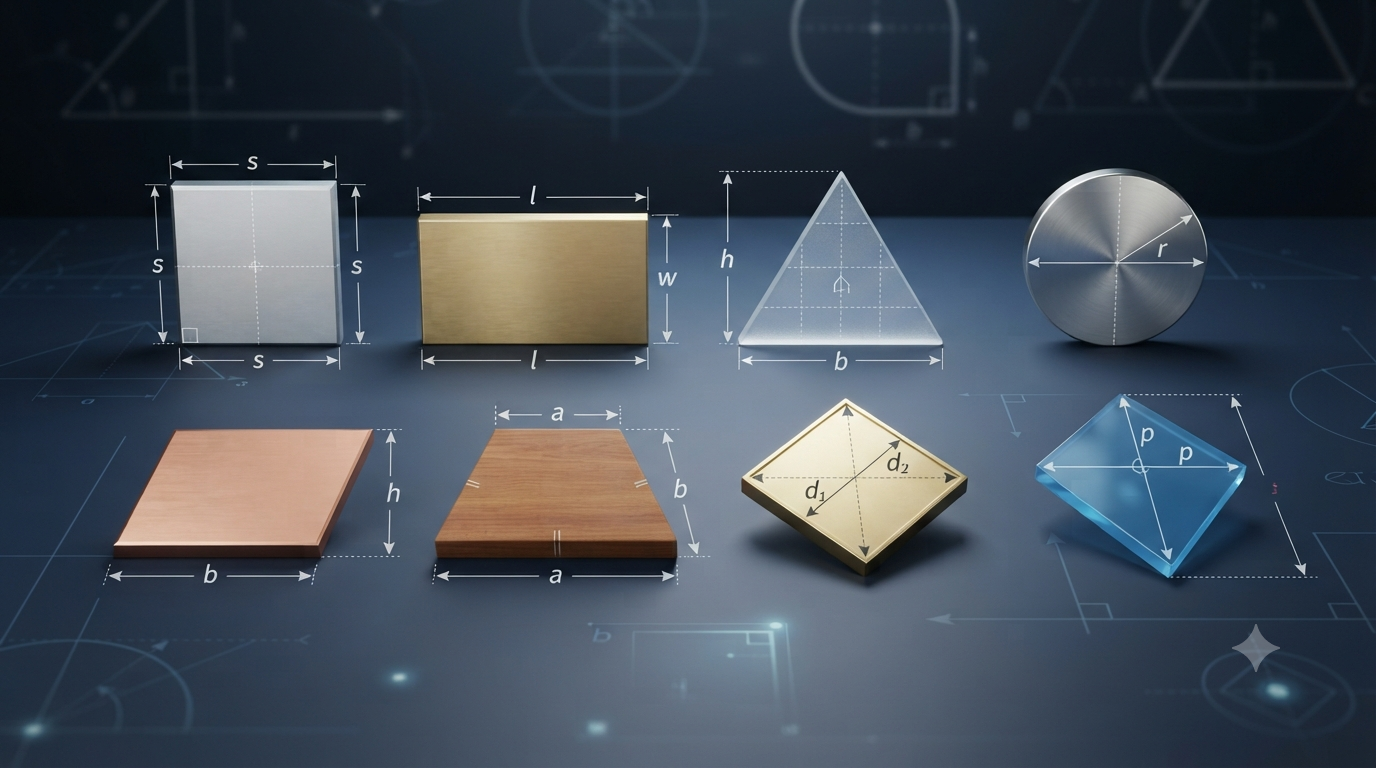
A square is a four-sided shape with four equal sides and four right angles.
If the side length of a square is a, its area is:
Area = a²
Here, a represents the length of one side.
For example, if a square has a side length of 6 cm:
Area = 6² = 36 cm²
Therefore, the area of the square is 36 cm².
The square area formula works because both the length and width of a square are equal.
Area of a Rectangle
A rectangle has two pairs of equal sides and four right angles. Its area is calculated by multiplying its length by its width.
Area = l × w
Where:
l = length
w = width
For example, consider a rectangle with a length of 12 m and a width of 5 m.
Area = 12 × 5 = 60 m²
Therefore, the area is 60 m².
This is one of the most commonly used area formulas because many everyday surfaces, such as floors, walls, books, screens, and tables, can be approximated as rectangles.
Area of a Triangle
A triangle is a three-sided polygon. Its area depends on its base and the perpendicular height corresponding to that base.
The formula is:
Area = ½ × b × h
Where:
b = base
h = perpendicular height
For example, if the base of a triangle is 10 cm and its perpendicular height is 8 cm:
Area = ½ × 10 × 8
Area = 40 cm²
Therefore, the triangle has an area of 40 cm².
The height must be measured perpendicular to the chosen base. It is not necessarily the same as one of the triangle’s sloping sides.
Area of a Parallelogram
A parallelogram is a quadrilateral in which opposite sides are parallel and equal in length.
Its area is calculated using the base and perpendicular height:
Area = b × h
Where:
b = base
h = perpendicular height
For example, if a parallelogram has a base of 15 cm and a height of 7 cm:
Area = 15 × 7 = 105 cm²
Therefore, the area is 105 cm².
The perpendicular height is important. The slanted side of a parallelogram should not automatically be used as the height.
Area of a Trapezium
A trapezium is a quadrilateral with one pair of parallel sides. In some countries, this shape is called a trapezoid.
If the two parallel sides have lengths a and b, and the perpendicular height is h, the area is:
Area = ½(a + b)h
Where:
a = length of the first parallel side
b = length of the second parallel side
h = perpendicular height
For example, suppose the parallel sides are 8 cm and 14 cm, and the height is 5 cm.
Area = ½(8 + 14) × 5
Area = ½ × 22 × 5
Area = 55 cm²
Therefore, the area is 55 cm².
Area of a Rhombus
A rhombus is a quadrilateral with four equal sides. Its opposite sides are parallel, and its diagonals intersect at right angles.
The area can be calculated using its diagonals:
Area = ½ × d₁ × d₂
Where:
d₁ = length of the first diagonal
d₂ = length of the second diagonal
For example, if the diagonals of a rhombus are 12 cm and 10 cm:
Area = ½ × 12 × 10
Area = 60 cm²
Therefore, the area is 60 cm².
A rhombus can also be treated as a parallelogram, so its area can be found using the base and perpendicular height when those measurements are available.
Area of a Kite
A kite is a quadrilateral with two pairs of adjacent equal sides. Its area can be calculated from the lengths of its diagonals.
Area = ½ × d₁ × d₂
Where:
d₁ = length of one diagonal
d₂ = length of the other diagonal
For example, if the diagonals are 16 cm and 9 cm:
Area = ½ × 16 × 9
Area = 72 cm²
Therefore, the kite has an area of 72 cm².
The same diagonal-based formula is used for both rhombuses and kites when the required diagonal measurements are known.
Area of a Circle
A circle is a curved two-dimensional shape in which every point on the circumference is the same distance from the centre.
That distance is called the radius, represented by r.
The area of a circle is:
Area = πr²
Where:
r = radius
π (pi) ≈ 3.14159
For example, if a circle has a radius of 7 cm:
Area = π × 7²
Area = 49π cm²
Using π ≈ 3.14159:
Area ≈ 153.94 cm²
Therefore, the area is approximately 153.94 cm².
If the diameter is given instead of the radius, first remember that:
r = d/2
So the area can also be written as:
Area = π(d/2)²
or
Area = πd²/4
Area of a Semicircle
A semicircle is half of a circle. Therefore, its area is half the area of a complete circle.
Area = ½πr²
Where r is the radius.
For example, if the radius is 10 cm:
Area = ½ × π × 10²
Area = 50π cm²
Using π ≈ 3.14159:
Area ≈ 157.08 cm²
Therefore, the area is approximately 157.08 cm².
Area of a Quadrant
A quadrant is one-fourth of a circle. It is formed by two perpendicular radii and the corresponding quarter of the circumference.
Its area is:
Area = ¼πr²
For example, if the radius is 8 cm:
Area = ¼ × π × 8²
Area = 16π cm²
Using π ≈ 3.14159:
Area ≈ 50.27 cm²
Area of a Regular Polygon
A regular polygon has equal side lengths and equal interior angles. Examples include regular pentagons, hexagons, and octagons.
For a regular polygon, the area can be calculated using:
Area = ½ × perimeter × apothem
Where:
perimeter = total distance around the polygon
apothem = perpendicular distance from the centre to a side
Since the perimeter of a regular polygon is:
P = ns
the formula can also be written as:
Area = ½ × n × s × a
Where:
n = number of sides
s = side length
a = apothem
For example, if a regular polygon has a perimeter of 30 cm and an apothem of 4 cm:
Area = ½ × 30 × 4
Area = 60 cm²
Area of an Equilateral Triangle
An equilateral triangle has three equal sides and three equal angles. If each side has length a, its area is:
Area = (√3/4)a²
For example, if the side length is 8 cm:
Area = (√3/4) × 8²
Area = 16√3 cm²
Approximately:
Area ≈ 27.71 cm²
This formula is a special form of the general triangle area formula.
Heron’s Formula for a Triangle
When the three side lengths of a triangle are known but its height is not, Heron’s formula can be used to find its area.
First calculate the semiperimeter:
s = (a + b + c)/2
Then calculate the area:
Area = √[s(s − a)(s − b)(s − c)]
Here, a, b, and c are the three side lengths.
For example, consider a triangle with sides 5 cm, 6 cm, and 7 cm.
First:
s = (5 + 6 + 7)/2 = 9 cm
Then:
Area = √[9(9 − 5)(9 − 6)(9 − 7)]
Area = √(9 × 4 × 3 × 2)
Area = √216
Area ≈ 14.70 cm²
Heron’s formula is especially useful when the perpendicular height is not directly available.
Area of a Sector of a Circle
A sector is a portion of a circle enclosed by two radii and an arc. If the central angle is θ degrees, the area is:
Area = (θ/360°)πr²
Where:
θ = central angle in degrees
r = radius
For example, if a sector has a radius of 6 cm and a central angle of 90°:
Area = (90/360) × π × 6²
Area = 9π cm²
Area ≈ 28.27 cm²
A 90-degree sector is a quarter of a circle, which is why its area is one-fourth of the full circle’s area.
Area of a Regular Hexagon
A regular hexagon has six equal sides. Its area can be found using:
Area = (3√3/2)a²
Where a is the side length.
For example, if each side is 6 cm:
Area = (3√3/2) × 6²
Area = 54√3 cm²
Area ≈ 93.53 cm²
A regular hexagon can also be divided into six equilateral triangles, which provides a useful way to understand where the formula comes from.
Area of Composite Shapes
Not every figure encountered in geometry will be a simple standard shape. Some shapes are made by combining two or more familiar shapes. These are called composite shapes.
To find the area of a composite shape, divide it into simpler shapes whose areas can be calculated using known formulas.
For example, an irregular figure might be divided into:
a rectangle
a triangle
a semicircle
Calculate the area of each part separately and then combine the results.
If all the parts are added together:
Total Area = Area₁ + Area₂ + Area₃
If a section has been removed from a larger shape:
Remaining Area = Larger Area − Removed Area
This method is useful for floor plans, land measurements, engineering designs, and many geometry problems.
Common Area Formulas at a Glance
The most frequently used area formulas can be summarized as follows:
| Shape | Area Formula |
|---|---|
| Square | A = a² |
| Rectangle | A = l × w |
| Triangle | A = ½bh |
| Parallelogram | A = bh |
| Trapezium | A = ½(a + b)h |
| Rhombus | A = ½d₁d₂ |
| Kite | A = ½d₁d₂ |
| Circle | A = πr² |
| Semicircle | A = ½πr² |
| Quadrant | A = ¼πr² |
| Regular polygon | A = ½Pa |
| Equilateral triangle | A = (√3/4)a² |
| Circle sector | A = (θ/360°)πr² |
Here, the letters represent the measurements required by each formula.
How to Choose the Correct Area Formula
Choosing the correct formula becomes easier when you first identify the shape and the measurements provided.
Start by identifying whether the figure is a square, rectangle, triangle, circle, or another standard shape. Then check which measurements are available.
For example:
If you know the side of a square, use A = a².
If you know the length and width of a rectangle, use A = lw.
If you know the base and perpendicular height of a triangle, use A = ½bh.
If you know the radius of a circle, use A = πr².
If you know the diagonals of a rhombus or kite, use A = ½d₁d₂.
If the shape is irregular, consider dividing it into simpler shapes.
Always check that the measurements use compatible units before calculating the area.
Area and Perimeter Are Different
Area and perimeter are related to the size of a shape, but they measure different things.
Area measures the surface enclosed by a two-dimensional shape.
Perimeter measures the total distance around the outside of the shape.
For example, a rectangle with length 10 cm and width 4 cm has:
Area = 10 × 4 = 40 cm²
Its perimeter is:
Perimeter = 2(10 + 4) = 28 cm
Notice that the units are different. Area uses square units, while perimeter uses ordinary length units.
Understanding this difference is important because confusing area and perimeter can lead to using the wrong formula or unit.
Importance of Area Formulas in Real Life
Area formulas are not limited to classroom geometry. They are used in many practical situations.
Architects use area calculations when planning buildings and rooms. Construction workers calculate areas to determine how much flooring, paint, tiles, or other materials are needed. Farmers and land surveyors use area measurements to describe fields and plots of land.
Area is also important in science and engineering. Scientists may calculate the surface area of objects, while engineers use geometric areas when designing structures, machines, pipes, panels, and other systems.
Even simple activities such as buying carpet for a room or determining how much grass seed is needed for a garden require an understanding of area.
Tips for Solving Area Problems
A few simple habits can make area calculations more reliable.
First, identify the shape before selecting a formula. Next, write down the known measurements and make sure they are expressed in compatible units.
Pay particular attention to height in triangle and parallelogram problems. The height used in these formulas is generally the perpendicular height, not simply a sloping side.
For circles, check whether the problem provides the radius or diameter. If the diameter is given, divide it by 2 before using the standard circle area formula.
Finally, include the correct square unit in the answer. A numerical value without an appropriate unit does not completely describe an area measurement.
Conclusion
Area formulas provide a systematic way to calculate the amount of surface enclosed by two-dimensional shapes. The basic formulas for squares, rectangles, triangles, parallelograms, circles, trapeziums, rhombuses, kites, and other common shapes form an important foundation of geometry.
The key is not simply to memorize every formula, but to understand which measurements each formula requires and why the formula works. Once these relationships become familiar, more complicated figures can often be solved by dividing them into simpler shapes.
Whether you are studying geometry, working with measurements, designing a space, or simply trying to understand the mathematics behind everyday objects, knowing common area formulas gives you a practical and useful mathematical tool.
FAQs
1. What is the area of a two-dimensional shape?
The area of a two-dimensional shape is the amount of surface enclosed within its boundaries. It measures how much space a flat shape covers. Because area involves two dimensions, such as length and width, it is expressed in square units. Common units include square centimetres (cm²), square metres (m²), and square kilometres (km²). Different shapes have different formulas for calculating their area. For example, the area of a rectangle is found by multiplying its length by its width, while the area of a circle is calculated using πr². Understanding area is an important part of geometry and practical measurement.
2. What is the formula for the area of a square?
The area of a square is calculated using the formula A = a², where a represents the length of one side. Since all four sides of a square are equal, its length and width have the same measurement. For example, if a square has a side length of 9 cm, its area is 9 × 9 = 81 cm². The answer is expressed in square units because area measures a surface. The square area formula is useful for calculating the size of square-shaped floors, tiles, gardens, boards, and other surfaces.
3. How do you calculate the area of a rectangle?
The area of a rectangle is calculated by multiplying its length by its width. The formula is A = l × w, where l is the length and w is the width. For example, if a rectangular room is 8 metres long and 5 metres wide, its area is 8 × 5 = 40 m². The result represents the amount of surface enclosed by the rectangle. Before calculating, make sure the length and width are expressed in compatible units. The rectangle area formula is widely used for rooms, floors, fields, tables, screens, and many other rectangular surfaces.
4. What is the formula for the area of a triangle?
The area of a triangle is calculated using the formula A = ½ × b × h, where b is the base and h is the perpendicular height. For example, if a triangle has a base of 12 cm and a perpendicular height of 7 cm, its area is ½ × 12 × 7 = 42 cm². The height must be measured at a right angle to the selected base. It should not automatically be confused with a sloping side of the triangle. This formula works for different types of triangles, including scalene, isosceles, and right triangles.
5. How is the area of a circle calculated?
The area of a circle is calculated using the formula A = πr², where r is the radius and π is approximately 3.14159. The radius is the distance from the centre of the circle to its circumference. For example, if the radius is 5 cm, the area is π × 5² = 25π cm², or approximately 78.54 cm². If the diameter is provided instead, divide it by 2 to obtain the radius. The circle area formula is commonly used when calculating the surface area of circular objects such as discs, plates, wheels, and round gardens.
6. What is the area formula for a parallelogram?
The area of a parallelogram is calculated using A = b × h, where b is the base and h is the perpendicular height. For example, if the base of a parallelogram is 10 cm and its perpendicular height is 6 cm, the area is 10 × 6 = 60 cm². The perpendicular height is important because the sloping side is not necessarily the height. A parallelogram has opposite sides that are parallel and equal. Its area formula is similar to that of a rectangle because both shapes can have the same base and perpendicular height.
7. What is the formula for the area of a trapezium?
The area of a trapezium is calculated using A = ½(a + b)h, where a and b are the lengths of the two parallel sides and h is the perpendicular height between them. For example, if the parallel sides measure 8 cm and 12 cm and the height is 5 cm, the area is ½ × (8 + 12) × 5 = 50 cm². In some countries, the same shape is called a trapezoid. The formula works by using the average length of the two parallel sides and multiplying it by the perpendicular height.
8. How do you find the area of a rhombus or kite?
The area of a rhombus or kite can be calculated using the lengths of its two diagonals. The formula is A = ½ × d₁ × d₂, where d₁ and d₂ represent the two diagonals. For example, if the diagonals are 14 cm and 8 cm, the area is ½ × 14 × 8 = 56 cm². A rhombus has four equal sides, while a kite has two pairs of adjacent equal sides. Using the diagonal formula is particularly useful when the diagonal measurements are known and the base and perpendicular height are not readily available.
9. What units are used to measure area?
Area is measured using square units because it describes the surface covered by a two-dimensional shape. Common metric units include square millimetres (mm²), square centimetres (cm²), square metres (m²), and square kilometres (km²). For larger areas, such as land, hectares or square kilometres may be used. In other measurement systems, square inches, square feet, and square miles are common. It is important to use compatible units when calculating area. If the dimensions are given in metres, the resulting area will normally be in square metres. Always include the appropriate square unit with the final answer.
10. How can you find the area of an irregular or composite shape?
An irregular or composite shape can often be divided into simpler shapes whose areas are easier to calculate. For example, a complex figure might be separated into rectangles, triangles, circles, or other familiar shapes. Calculate the area of each section separately and then add the areas together. If a part has been removed, subtract its area from the larger shape. The general idea is Total Area = sum of the required component areas. This method is useful for floor plans, gardens, buildings, land plots, and geometric diagrams. Carefully identify each section and use the appropriate area formula for it.