
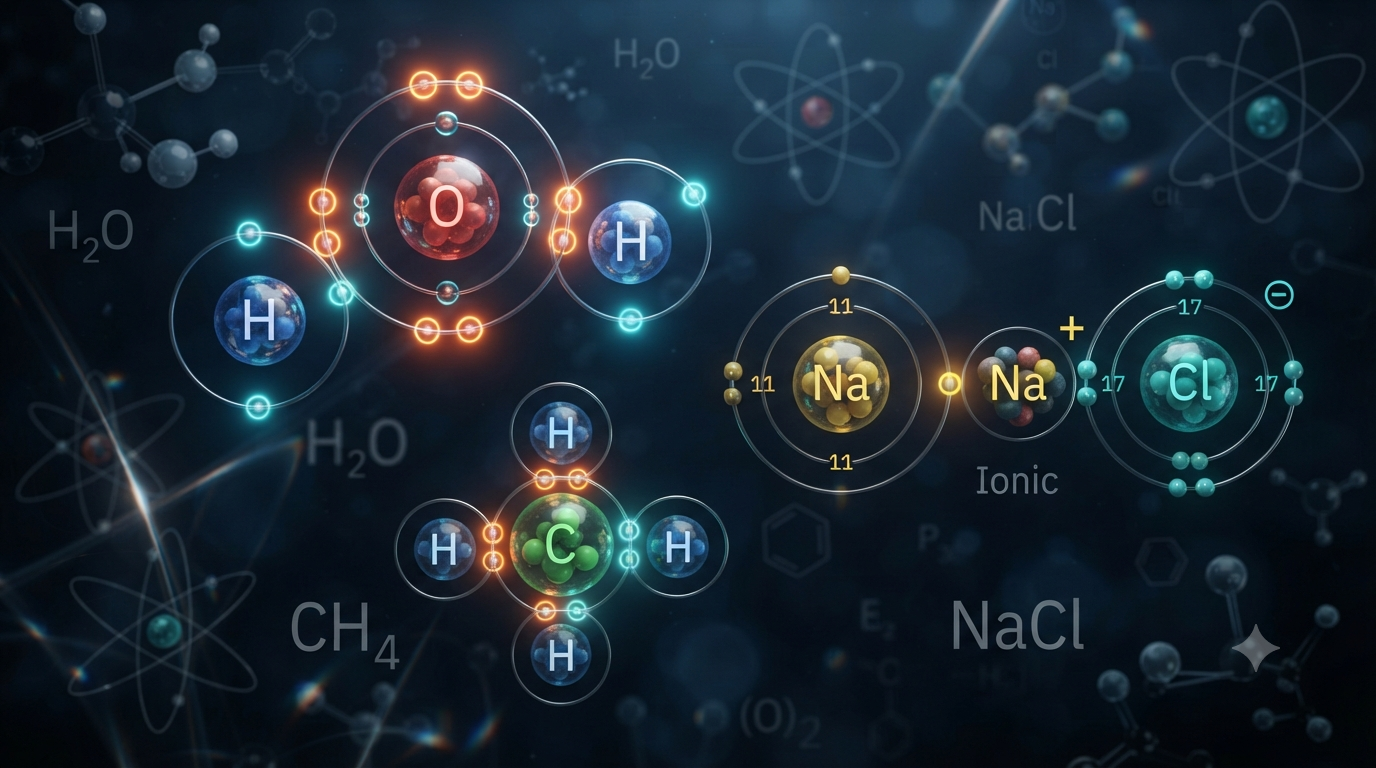
Writing the formula of a molecular compound is an important skill in chemistry. A chemical formula tells us which elements are present in a compound and how many atoms of each element are joined together. For molecular compounds, the formula is based on the actual number of atoms in a molecule rather than on the balancing of ionic charges. This makes molecular formulas different from formulas of ionic compounds.
Molecular compounds usually form when two or more nonmetal elements share electrons through covalent bonds. Examples include water (H₂O), carbon dioxide (CO₂), ammonia (NH₃), and sulfur dioxide (SO₂). To write their formulas correctly, you need to identify the elements, understand their typical bonding patterns, and use the appropriate prefixes when naming the compound.
What Is a Molecular Compound?
A molecular compound is a substance made of atoms that are connected by covalent bonds. Covalent bonding occurs when atoms share electrons. Molecular compounds commonly form between nonmetal elements.
For example, hydrogen and oxygen combine to form water. Each water molecule contains two hydrogen atoms and one oxygen atom, so its molecular formula is H₂O.
Similarly, carbon dioxide contains one carbon atom and two oxygen atoms, giving it the formula CO₂.
Unlike ionic compounds, molecular compounds generally do not consist of a repeating lattice of positive and negative ions. Instead, they exist as individual molecules.
How Molecular Formulas Represent Compounds
A molecular formula provides two basic pieces of information:
The chemical symbols show which elements are present.
The subscripts show the number of atoms of each element.
For example, consider NH₃.
N represents nitrogen, while H represents hydrogen. The subscript 3 means that each molecule contains three hydrogen atoms. Because nitrogen has no subscript, it represents one nitrogen atom.
Therefore, NH₃ contains:
1 nitrogen atom
3 hydrogen atoms
A subscript applies only to the element symbol immediately before it.
Step 1 Identify the Elements
The first step is to determine which elements make up the molecular compound.
For example, suppose you need to write the formula for carbon dioxide. The name contains carbon and oxygen, so the formula must contain C and O.
Carbon → C
Oxygen → O
At this stage, you know the elements but not yet the number of atoms of each element.
Another example is nitrogen monoxide. The elements are nitrogen and oxygen.
Nitrogen → N
Oxygen → O
The next step is to determine how many atoms of each element are needed.
Step 2 Understand Covalent Bonding
Atoms in molecular compounds share electrons to become more stable. Many nonmetal atoms tend to form a characteristic number of covalent bonds.
For example, hydrogen generally forms one bond, oxygen generally forms two bonds, nitrogen commonly forms three bonds, and carbon commonly forms four bonds.
These patterns can help you understand formulas, especially when you are working with simple molecular compounds.
Consider water. Oxygen commonly forms two covalent bonds, while each hydrogen forms one bond. Therefore, one oxygen atom can bond with two hydrogen atoms.
The resulting formula is H₂O.
However, bonding patterns should not be treated as an absolute rule for every compound. Elements can form multiple compounds with different bonding arrangements, so the compound’s name and chemical information are important.
Step 3 Use Prefixes in Molecular Compound Names
One of the most useful methods for writing molecular formulas is recognizing prefixes in the compound’s name.
Molecular compounds often use prefixes to tell you exactly how many atoms of each element are present.
| Prefix | Number |
|---|---|
| mono- | 1 |
| di- | 2 |
| tri- | 3 |
| tetra- | 4 |
| penta- | 5 |
| hexa- | 6 |
| hepta- | 7 |
| octa- | 8 |
| nona- | 9 |
| deca- | 10 |
For example, carbon dioxide contains the prefix “di-” before oxide. This tells you that there are two oxygen atoms.
Carbon → C
Dioxide → O₂
Therefore:
CO₂
Similarly, dinitrogen monoxide contains two nitrogen atoms and one oxygen atom.
Dinitrogen → N₂
Monoxide → O
Therefore:
N₂O
Step 4 Write the Correct Subscripts
Once you identify the prefixes, convert them into subscripts.
For example, consider sulfur trioxide.
Sulfur has no prefix, so it represents one sulfur atom.
Trioxide contains the prefix “tri-“, meaning three oxygen atoms.
Therefore:
Sulfur → S
Oxygen → O₃
Formula:
SO₃
Now consider dinitrogen tetroxide.
“Di-” means two nitrogen atoms.
“Tetra-” means four oxygen atoms.
Therefore:
N₂O₄
The subscripts are important because changing them changes the identity of the compound.
Step 5 Know When Mono- Is Used
The prefix “mono-” means one. However, when naming molecular compounds, mono- is often omitted from the first element.
For example, CO is called carbon monoxide rather than monocarbon monoxide.
Carbon → C
Monoxide → O
Formula:
CO
On the other hand, mono- may appear before the second element when there is one atom of that element.
Examples include:
Carbon monoxide → CO
Nitrogen monoxide → NO
Sulfur monoxide → SO
This naming convention helps distinguish molecular compounds with different numbers of atoms.
Step 6 Apply the Prefixes Carefully
A common mistake is to ignore the prefixes or assume that the elements always combine in a simple one-to-one ratio.
For example, nitrogen dioxide is not NO. The prefix “di-” tells you that there are two oxygen atoms.
Nitrogen → N
Dioxide → O₂
Therefore:
NO₂
Similarly, dinitrogen monoxide is not NO. The prefix “di-” applies to nitrogen, while “mono-” applies to oxygen.
Dinitrogen → N₂
Monoxide → O
Therefore:
N₂O
The position of each prefix matters.
Common Molecular Compounds and Their Formulas
Several molecular compounds appear frequently in chemistry.
Water → H₂O
Carbon dioxide → CO₂
Carbon monoxide → CO
Ammonia → NH₃
Methane → CH₄
Sulfur dioxide → SO₂
Sulfur trioxide → SO₃
Nitrogen dioxide → NO₂
Dinitrogen monoxide → N₂O
Dinitrogen dioxide → N₂O₂
Dinitrogen tetroxide → N₂O₄
These examples show why understanding the naming system is useful when writing molecular formulas.
Molecular Compounds vs Ionic Compounds
It is important not to use the same method for every type of compound.
Molecular compounds are generally made from nonmetals and use covalent bonding. Their names commonly contain numerical prefixes such as di-, tri-, and tetra-.
Ionic compounds usually contain a metal and a nonmetal, or involve polyatomic ions. Their formulas are generally determined by balancing electrical charges rather than by using prefixes.
For example, carbon dioxide is a molecular compound, so its name directly indicates the number of oxygen atoms.
CO₂
Sodium chloride is an ionic compound. Its formula is NaCl, and the formula comes from the charges of sodium and chloride ions rather than from prefixes.
Knowing whether a compound is molecular or ionic is therefore an important first step.
Common Mistakes When Writing Molecular Formulas
Several errors can occur when writing formulas.
One common mistake is forgetting a subscript. Writing CO instead of CO₂ changes carbon dioxide into carbon monoxide.
Another mistake is placing a subscript on the wrong element. In dinitrogen tetroxide, the formula is N₂O₄, not NO₄ or N₄O₂.
Some learners also try to use ionic charge rules for molecular compounds. This can produce incorrect formulas because molecular compounds are named and represented differently.
Another mistake is changing the order of the elements. The formula should follow the conventional order represented by the compound’s name.
A Simple Method to Follow
When writing a molecular formula from its name, use this sequence:
Identify the elements in the compound.
Look for numerical prefixes.
Convert each prefix into the corresponding number.
Write the chemical symbols in the correct order.
Add the appropriate subscripts.
Omit a subscript of 1 because it is never written.
Check the formula against the compound’s name.
For example:
Dinitrogen pentoxide
Dinitrogen → N₂
Pentoxide → O₅
Formula → N₂O₅
This method works well for many basic molecular compounds.
Why Molecular Formulas Matter
Chemical formulas are more than abbreviations. They provide information about the composition of substances and allow scientists to communicate chemical information precisely.
From a formula such as CO₂, we can determine that each molecule contains one carbon atom and two oxygen atoms. The formula can also be used when discussing chemical reactions, calculating molecular masses, determining the proportions of elements, and understanding how substances interact.
Learning to write molecular formulas therefore provides a foundation for more advanced topics such as chemical equations, stoichiometry, molecular structure, and chemical reactions.
Conclusion
Writing formulas for molecular compounds becomes much easier when you understand how chemical names communicate the number of atoms in each molecule. Start by identifying the elements, recognize the numerical prefixes, and convert those prefixes into subscripts. Remember that prefixes such as mono-, di-, tri-, and tetra- provide important information about the composition of the compound. It is also important to distinguish molecular compounds from ionic compounds because their formulas are determined using different methods. With regular practice, names such as carbon dioxide, sulfur trioxide, and dinitrogen tetroxide can quickly be converted into accurate chemical formulas.
FAQs
1. What is a molecular compound?
A molecular compound is a substance made when atoms, usually nonmetals, share electrons through covalent bonds. These shared electrons hold the atoms together in individual molecules. A molecular formula shows which elements are present and how many atoms of each element are contained in one molecule. For example, water has the formula H₂O, meaning each molecule contains two hydrogen atoms and one oxygen atom. Carbon dioxide has the formula CO₂, containing one carbon atom and two oxygen atoms. Molecular compounds include many familiar substances such as water, ammonia, methane, and carbon dioxide. Understanding their formulas helps describe their composition and chemical behavior.
2. How do you write a formula for a molecular compound?
To write a molecular formula, first identify the elements named in the compound. Then look for numerical prefixes such as mono-, di-, tri-, and tetra-. These prefixes indicate the number of atoms of each element. Write the correct chemical symbols in the same general order as the compound name and use subscripts to show the number of atoms. For example, carbon dioxide contains carbon and oxygen. The prefix “di-” indicates two oxygen atoms, giving the formula CO₂. If an element has only one atom, its subscript is not written. Finally, check that every prefix in the name is correctly represented in the formula.
3. What do prefixes mean in molecular compound names?
Prefixes in molecular compound names indicate how many atoms of an element are present in a molecule. Common prefixes include mono- for one, di- for two, tri- for three, tetra- for four, penta- for five, hexa- for six, and hepta- for seven. For example, sulfur dioxide contains two oxygen atoms because “di-” means two, giving SO₂. Sulfur trioxide contains three oxygen atoms, giving SO₃. These prefixes are especially useful because they allow you to determine the molecular formula directly from the compound’s name. Learning the common numerical prefixes makes writing molecular formulas much faster and more accurate.
4. Why is the prefix mono- sometimes omitted?
The prefix mono- means one, but it is commonly omitted from the name of the first element in a molecular compound. For example, CO is called carbon monoxide rather than monocarbon monoxide. The word “monoxide” still tells us that there is one oxygen atom. This naming convention makes molecular compound names shorter and easier to use. However, mono- can be used with the second element when necessary. For example, nitrogen monoxide has the formula NO. When converting a name into a formula, remember that the absence of a prefix on the first element generally means there is one atom of that element.
5. What is the difference between molecular and ionic compounds?
Molecular and ionic compounds are formed through different types of chemical bonding and are represented using different methods. Molecular compounds generally form between nonmetal elements through covalent bonding, where atoms share electrons. Their names commonly use prefixes such as di-, tri-, and tetra-. Ionic compounds usually contain positively charged ions and negatively charged ions, often involving a metal and a nonmetal. Their formulas are determined by balancing electrical charges rather than using numerical prefixes. For example, CO₂ is a molecular compound, while NaCl is an ionic compound. Identifying the type of compound is important before deciding how to write its formula.
6. What does a subscript mean in a molecular formula?
A subscript tells you how many atoms of the element immediately before it are present in one molecule. For example, in H₂O, the subscript 2 means there are two hydrogen atoms. Oxygen has no subscript, so there is one oxygen atom. Similarly, CO₂ contains one carbon atom and two oxygen atoms. A subscript of 1 is never written. Changing a subscript can change the identity of a compound because it changes the ratio of atoms. Therefore, subscripts must be placed carefully when writing molecular formulas. They provide essential information about the composition of each molecule.
7. How do you write the formula for dinitrogen tetroxide?
To write the formula for dinitrogen tetroxide, first identify the numerical prefixes. “Di-” means two, so dinitrogen represents two nitrogen atoms. “Tetra-” means four, so tetroxide represents four oxygen atoms. The chemical symbols are N for nitrogen and O for oxygen. Therefore, the formula is N₂O₄. The prefix information gives the subscripts directly, so there is no need to balance ionic charges. This example demonstrates why recognizing prefixes is important when writing molecular formulas. Always examine each part of the compound’s name carefully to determine the correct number of atoms before writing the final formula.
8. Do you use charge balancing when writing molecular formulas?
Generally, charge balancing is not the method used to write formulas for molecular compounds. Molecular compounds consist of atoms connected by covalent bonds rather than oppositely charged ions. Their names often provide the required atom numbers through prefixes. For example, nitrogen dioxide is written as NO₂ because “di-” indicates two oxygen atoms. In contrast, charge balancing is commonly used for ionic compounds such as magnesium chloride. Confusing these two methods can lead to incorrect formulas. Before writing a formula, determine whether the compound is molecular or ionic. For molecular compounds, pay particular attention to the numerical prefixes in the name.
9. What are some common examples of molecular formulas?
Many familiar substances are molecular compounds. Water has the formula H₂O, carbon dioxide is CO₂, carbon monoxide is CO, ammonia is NH₃, and methane is CH₄. Other examples include sulfur dioxide (SO₂), sulfur trioxide (SO₃), nitrogen dioxide (NO₂), dinitrogen monoxide (N₂O), and dinitrogen tetroxide (N₂O₄). These formulas show the number and type of atoms present in each molecule. Studying common examples can help you recognize patterns between compound names and formulas. However, it is still important to analyze the name carefully because similar elements can form different compounds with different numbers of atoms and therefore different formulas.
10. What is the easiest way to learn molecular formulas?
The easiest way to learn molecular formulas is to understand the naming system instead of memorizing every formula individually. Begin by learning common element symbols and numerical prefixes such as mono-, di-, tri-, tetra-, and penta-. Then practice converting compound names into formulas by identifying each prefix and writing the appropriate subscript. For example, sulfur trioxide becomes SO₃ because “tri-” means three oxygen atoms. Practice with different examples and always check whether the number of atoms matches the name. Regular practice helps you recognize patterns and makes writing molecular formulas more natural, accurate, and efficient.
Related Posts
What Is Valency in Chemistry?
Valency is one of the basic concepts in chemistry that helps us understand how atoms combine with one another to […]
Read MoreHow Valency Helps in Writing Chemical Formulas

Writing a chemical formula is not simply a matter of putting element symbols together. A correct formula must show how […]
Read MoreHow to Write Formulas Using Valency

Writing chemical formulas becomes much easier when you understand valency. A chemical formula tells us which elements are present in […]
Read MoreHow to Write Formulas for Molecular Compounds
Writing the formula of a molecular compound is an important skill in chemistry. A chemical formula tells us which elements […]
Read MoreHow to Write Formulas for Ionic Compounds

Writing formulas for ionic compounds is an important skill in chemistry because a chemical formula tells us which ions are […]
Read MoreHow to Write Simple Chemical Formulas

Chemical formulas are a simple way to represent substances using symbols and numbers. Instead of writing the full name of […]
Read MoreChemical Formula vs Chemical Equation

Chemistry uses symbols, numbers, and formulas to describe substances and chemical changes. Two important ways of representing chemical information are […]
Read MoreWhat Is a Condensed Chemical Formula?

A condensed chemical formula is a convenient way of writing the structure of an organic compound without drawing every bond […]
Read MoreWhat Is a Structural Formula?

A structural formula is a way of representing a chemical compound by showing how its atoms are arranged and connected […]
Read MoreMolecular Formula vs Empirical Formula

Chemical formulas give us a simple way to represent substances using the symbols of elements and numbers. However, not all […]
Read MoreWhat Is an Empirical Formula?

An empirical formula is a simple way of representing the composition of a chemical compound. It shows the simplest whole-number […]
Read MoreWhat Is a Molecular Formula?

A molecular formula is a way of representing a substance using chemical symbols and numbers. It tells us which elements […]
Read MoreHow to Calculate the Total Number of Atoms in a Formula

Chemical formulas provide a compact way to show which elements are present in a substance and how many atoms of […]
Read MoreHow to Count Atoms From a Chemical Formula

Chemical formulas provide a compact way to describe what a substance is made of. A formula tells us which elements […]
Read MoreSubscripts vs Coefficients in Chemical Formulas

Chemical formulas may look like simple combinations of letters and numbers, but every symbol and number has a specific meaning. […]
Read MoreWhat Do Coefficients Mean in Chemistry Formulas?

When you look at a chemical equation, you may notice numbers written before chemical formulas. These numbers are called coefficients. […]
Read MoreHow to Read Subscripts in Chemical Formulas

Chemical formulas are a simple way to represent substances using symbols and numbers. When you look at a formula such […]
Read MoreHow to Identify Elements in a Chemical Formula

Chemical formulas provide a simple way to describe the substances that make up the world around us. A formula may […]
Read MoreHow Elements Are Represented in Chemical Formulas

Chemistry deals with many different substances, from the oxygen we breathe to the water we drink and the minerals found […]
Read MoreChemical Symbols and Their Role in Chemistry Formulas

Chemistry is often described as the science of matter, but understanding chemistry also means learning how scientists communicate information about […]
Read MoreHow Chemical Formulas Represent Substances

Chemical formulas are one of the simplest ways scientists communicate information about matter. A substance may contain millions or billions […]
Read MoreWhat Is a Chemical Formula in Chemistry?

Chemistry is the study of substances, their properties, and the changes they undergo. To describe these substances clearly, chemists need […]
Read MoreBasic Types of Chemistry Formulas Explained

Chemistry formulas are one of the simplest ways scientists describe substances, reactions, and relationships between different particles. A formula can […]
Read MoreHow to Read and Understand Chemistry Formulas

Chemistry formulas may look like a collection of letters, numbers, and symbols, but they are actually a simple language used […]
Read MoreWhat Are Chemistry Formulas and Why Are They Important?

Chemistry is the science of substances, their properties, and the changes they undergo. To describe these substances clearly, chemists use […]
Read MoreHow to Verify an Answer Using Units

In physics, getting a numerical answer is only part of solving a problem. The next question is whether that answer […]
Read MoreHow to Check Whether a Physics Formula Is Correct

A physics formula is more than a collection of symbols and numbers. It represents a relationship between physical quantities and […]
Read MoreHow to Avoid Unit Conversion Mistakes in Physics

Unit conversion is one of the most common sources of mistakes in physics. A formula may be correct, the calculation […]
Read MoreHow to Avoid Sign Errors in Physics Calculations
Physics calculations are not only about choosing the correct formula and putting numbers into it. The signs of physical quantities […]
Read MoreCommon Mistakes When Using Physics Formulas

Physics formulas help us describe motion, forces, energy, electricity, heat, waves, and many other phenomena using mathematical relationships. A formula […]
Read More