Physics formulas are more than mathematical expressions. They describe relationships between physical quantities, and units help us understand what those quantities actually represent. When you see a formula such as v = s/t, the symbols tell you how to calculate velocity, while the units tell you what kind of quantity you are dealing with and whether the result makes physical sense.
Understanding units in physics formulas can make calculations easier, reduce mistakes, and help you recognize incorrect answers. You do not always need to memorize every unit separately. Instead, you can learn how units are connected to physical quantities and how they behave when formulas involve multiplication, division, powers, or conversions.
Why Are Units Important in Physics Formulas?
A physical quantity always needs a numerical value and a unit. For example, saying that a car travels at 60 is incomplete. We need to know whether the speed is 60 km/h, 60 m/s, or another unit.
Units provide meaning to numbers in physics. They allow measurements to be compared and help us understand the physical meaning of a calculated result.
Consider the formula:
v = s/t
Here, v represents velocity, s represents displacement, and t represents time. If displacement is measured in metres and time in seconds, then the unit of velocity becomes metres per second, written as m/s.
The formula and the units work together. If the numbers are correct but the units are handled incorrectly, the final answer can still be wrong.
Identify the Physical Quantity First
Before looking at the unit, identify what each symbol represents.
For example, in:
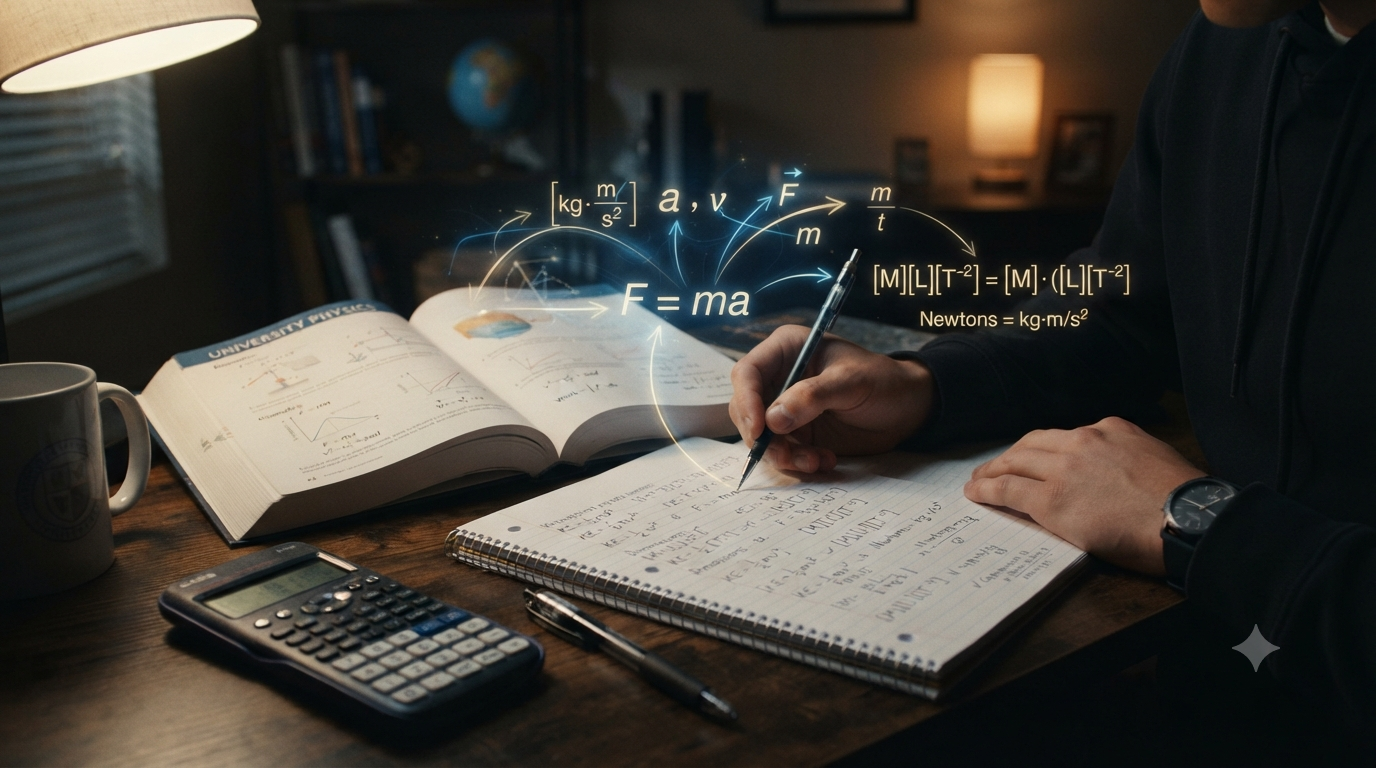
F = ma
F is force, m is mass, and a is acceleration.
The standard SI units are:
Force → newton (N)
Mass → kilogram (kg)
Acceleration → metre per second squared (m/s²)
The formula tells us that force depends on mass and acceleration. The units show the relationship more clearly:
N = kg × m/s²
This means that a newton is not an unrelated unit. It is a derived unit built from SI base units.
Understand SI Base Units
The International System of Units, or SI system, provides a standard way to measure physical quantities.
Some important SI base units include:
Length → metre (m)
Mass → kilogram (kg)
Time → second (s)
Electric current → ampere (A)
Temperature → kelvin (K)
Amount of substance → mole (mol)
Luminous intensity → candela (cd)
Many physics units are derived from these base units.
For example, velocity has the unit m/s, while acceleration has the unit m/s².
Understanding base units makes it easier to understand unfamiliar derived units.
Learn How Units Behave in Multiplication
When physical quantities are multiplied, their units are multiplied as well.
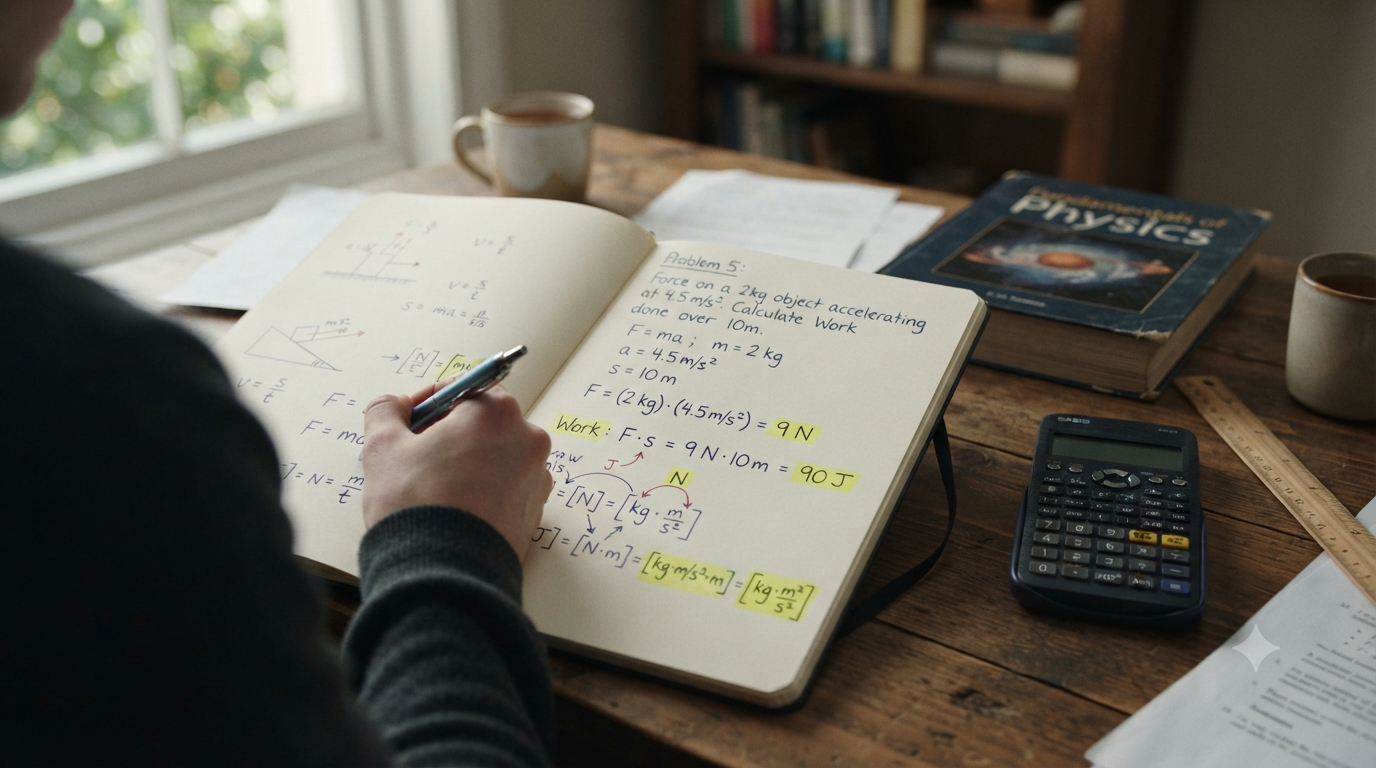
Consider the formula for work:
W = Fd
If force is measured in newtons and displacement is measured in metres:
W = N × m
The resulting unit is newton-metre, which is called a joule (J):
1 J = 1 N × m
This shows how a formula can help you understand the unit of a physical quantity.
Another example is momentum:
p = mv
Mass has the unit kg and velocity has the unit m/s.
Therefore:
p = kg × m/s
So the SI unit of momentum is:
kg·m/s
The important idea is simple: when quantities are multiplied, their units are multiplied too.
Learn How Units Behave in Division
Units are also divided when physical quantities are divided.
For example:
v = s/t
Displacement has the unit m, while time has the unit s.
Therefore:
v = m/s
So velocity is measured in metres per second.
Power provides another useful example:
P = W/t
Work is measured in joules and time in seconds.
Therefore:
P = J/s
A joule per second is called a watt (W):
1 W = 1 J/s
By following the units through the formula, you can often determine the correct unit without memorizing it.
Pay Attention to Powers of Units
Units can be raised to powers just like numbers and variables.
Consider the formula for area:
A = l × b
If both length and breadth are measured in metres:
A = m × m = m²
Therefore, area is measured in square metres.
For volume:
V = l × b × h
The three lengths each have the unit metre:
V = m × m × m = m³
Therefore, volume is measured in cubic metres.
Powers are especially important when dealing with quantities such as area, volume, acceleration, density, and many scientific equations.
Understand Derived Units
Some units have special names, but they can also be expressed using base units.
For example:
1 N = 1 kg·m/s²
Similarly:
1 J = 1 kg·m²/s²
and:
1 W = 1 kg·m²/s³
Understanding these relationships can help you check whether a formula is dimensionally consistent.
Suppose you calculate energy and your final unit becomes kg·m²/s². That may initially look unfamiliar, but it is exactly equivalent to a joule.
This is why learning the structure of units is often more useful than memorizing unit names alone.
Use Units to Check a Formula
Units can be used as a quick test for whether a physics equation is possible.
Consider the formula:
v = u + at
The units of u are m/s.
For at:
a × t = m/s² × s = m/s
Both terms have the same unit, so they can be added.
This is important because quantities with different units generally cannot be added directly. You cannot meaningfully add 5 metres to 3 seconds because they represent different types of physical quantities.
Unit checking can therefore reveal mistakes before you complete a calculation.
Convert Units Before Substituting Values
Another important skill is unit conversion.
Suppose a formula requires velocity in metres per second, but the given speed is in kilometres per hour. You should convert the speed before putting it into the formula.
For example:
72 km/h = 20 m/s
If you use 72 directly where the formula expects metres per second, the numerical result will be incorrect.
The same principle applies to length, mass, time, temperature, and other quantities.
Always check the units required by the formula before substituting numerical values.
Watch for Squared and Cubed Conversions
Unit conversion becomes especially important when quantities are squared or cubed.
For example:
1 m = 100 cm
But:
1 m² = 10,000 cm²
And:
1 m³ = 1,000,000 cm³
The conversion factor must also be squared or cubed when the physical quantity has a power.
This is a common source of mistakes in physics calculations.
Use Units to Understand the Final Answer
Do not ignore the unit after completing a calculation. The unit is part of the answer.
Suppose you calculate:
F = 50 N
The number 50 alone does not tell you what has been calculated. The unit N tells you that the result represents force.
Similarly:
m = 2 kg
represents mass, while:
E = 500 J
represents energy.
Writing the correct unit makes your answer clearer and allows you to check whether it is physically reasonable.
A Simple Method for Reading Units in Any Formula
Whenever you encounter a physics formula, follow these steps:
Identify the physical quantity represented by each symbol.
Write the unit of every known quantity.
Substitute the values along with their units.
Multiply or divide the units according to the formula.
Apply powers to the units when necessary.
Cancel common units where appropriate.
Convert the final unit into a standard or familiar form.
Check whether the final unit matches the physical quantity being calculated.
For example, using:
ρ = m/V
If mass is 10 kg and volume is 2 m³:
ρ = 10 kg / 2 m³
ρ = 5 kg/m³
The final unit confirms that the result represents density.
Common Mistakes With Units
Several mistakes appear frequently when solving physics problems.
One common mistake is leaving units out during calculations. This makes it harder to identify errors.
Another is mixing different unit systems without conversion. For example, using kilometres with seconds when the rest of the calculation requires metres and seconds can produce an incorrect result.
A third mistake is forgetting powers during conversion. Square and cube units require special attention.
Students and other learners may also confuse units with physical quantities. For example, metre is a unit of length, while length is the physical quantity.
Keeping these distinctions clear makes physics formulas easier to understand.
Conclusion
Understanding units in physics formulas is an essential skill because units connect mathematical calculations with physical reality. They tell us what a number represents, help us derive unfamiliar units, and provide a powerful way to check formulas and calculations.
Instead of memorizing every unit separately, learn how units behave when quantities are multiplied, divided, squared, or cubed. Always track units through your calculations and convert them when necessary. With regular practice, units become more than labels attached to answers. They become a useful tool for understanding formulas, detecting mistakes, and thinking more clearly about physics.

FAQs
Units are important because they give meaning to numerical values in physics. A number without a unit may not tell us what physical quantity it represents. For example, 20 could represent metres, kilograms, seconds, or another measurement. Units also help us check whether a calculation is correct. When solving a formula, the units of the quantities must combine correctly to produce the expected unit. They can also reveal mistakes in unit conversion or formula application. By tracking units throughout a calculation, you can understand the physical meaning of the answer and determine whether the result is reasonable.
A unit is a standard reference used to measure a physical quantity. For example, metre is a unit of length, kilogram is a unit of mass, and second is a unit of time. Physics uses standardized units so measurements can be compared consistently. The SI system provides internationally accepted units for scientific measurements. Units can be either base units or derived units. For example, metre and second are SI base units, while metre per second is a derived unit used for velocity. Units are an essential part of measurements because they communicate what a numerical value actually represents.
Units follow the same mathematical operations as the quantities in a formula. When quantities are multiplied, their units are multiplied. When quantities are divided, their units are divided. Powers also apply to units. For example, in v = s/t, displacement has the unit metre and time has the unit second. Therefore, velocity has the unit m/s. Similarly, in A = l × b, multiplying two metre measurements gives m². By carrying units through every step of a calculation, you can determine the correct unit of the final answer and identify possible mistakes.
SI units are internationally standardized units used to measure physical quantities. SI stands for the International System of Units. Important SI base units include metre (m) for length, kilogram (kg) for mass, second (s) for time, ampere (A) for electric current, kelvin (K) for temperature, mole (mol) for amount of substance, and candela (cd) for luminous intensity. Many other physics units are derived from these base units. For example, velocity uses m/s, acceleration uses m/s², and force uses the newton, which can be expressed as kg·m/s².
Units can help determine whether both sides of a physics equation are consistent. This process is related to dimensional analysis. For example, consider v = u + at. Both v and u have units of m/s. Acceleration has units of m/s², and multiplying it by time in seconds gives m/s. Therefore, all terms being added have the same unit. If an equation tries to add quantities with incompatible units, it indicates that something may be wrong. Unit checking is therefore a useful way to identify errors before or during a physics calculation.
Some derived units have special names because they are used frequently in physics. Giving them short names makes equations and measurements easier to write and understand. For example, force has the derived unit newton (N). One newton is equivalent to kg·m/s². Energy and work are measured in joules (J), where 1 J = 1 N·m. Power is measured in watts (W), where 1 W = 1 J/s. Even when a special unit name is used, it still has a connection to SI base units. Understanding this connection helps explain where derived units come from.
Units sometimes need to be converted because a formula or calculation may require a particular unit system. For example, if velocity needs to be expressed in metres per second but the given value is in kilometres per hour, the value must be converted before substitution. Using an unconverted value can produce an incorrect answer even when the mathematical steps are correct. Unit conversion creates consistency between the quantities in a formula. Before solving a problem, check the units of all given values and convert them into compatible units when necessary.
Squared and cubed units represent quantities such as area and volume, and their conversion factors must also be squared or cubed. For example, 1 m = 100 cm, but 1 m² = 10,000 cm² because the conversion factor is applied twice. Similarly, 1 m³ = 1,000,000 cm³ because the factor is applied three times. Forgetting this can lead to large errors. Understanding powers in units is particularly important when working with area, volume, density, and equations involving squared or cubed physical quantities.
Yes. Units provide a quick way to identify many calculation mistakes. Suppose a problem asks you to calculate speed, but your final answer has the unit kilograms. That immediately suggests an error because speed should have a unit such as m/s or km/h. Units can also reveal incorrect conversions, missing factors, or inappropriate formulas. However, correct units do not guarantee that the numerical answer is correct. Units are one part of checking a solution. You should also verify the formula, arithmetic, given values, and whether the final result is physically reasonable.
The easiest approach is to treat units as part of the calculation rather than as labels added at the end. First, identify the physical quantity represented by each symbol. Then write the unit beside every known value. Substitute the values into the formula while keeping their units, and perform the same multiplication, division, or powers on the units. Finally, simplify and check the resulting unit. Practicing this method with formulas such as v = s/t, F = ma, W = Fd, and ρ = m/V makes unit handling much easier and more intuitive.
Related Posts
What Do Coefficients Mean in Chemistry Formulas?
When you look at a chemical equation, you may notice numbers written before chemical formulas. These numbers are called coefficients. […]
Read MoreHow to Read Subscripts in Chemical Formulas
Chemical formulas are a simple way to represent substances using symbols and numbers. When you look at a formula such […]
Read MoreHow to Identify Elements in a Chemical Formula
Chemical formulas provide a simple way to describe the substances that make up the world around us. A formula may […]
Read MoreHow Elements Are Represented in Chemical Formulas
Chemistry deals with many different substances, from the oxygen we breathe to the water we drink and the minerals found […]
Read MoreChemical Symbols and Their Role in Chemistry Formulas
Chemistry is often described as the science of matter, but understanding chemistry also means learning how scientists communicate information about […]
Read MoreHow Chemical Formulas Represent Substances
Chemical formulas are one of the simplest ways scientists communicate information about matter. A substance may contain millions or billions […]
Read MoreWhat Is a Chemical Formula in Chemistry?
Chemistry is the study of substances, their properties, and the changes they undergo. To describe these substances clearly, chemists need […]
Read MoreBasic Types of Chemistry Formulas Explained
Chemistry formulas are one of the simplest ways scientists describe substances, reactions, and relationships between different particles. A formula can […]
Read MoreHow to Read and Understand Chemistry Formulas
Chemistry formulas may look like a collection of letters, numbers, and symbols, but they are actually a simple language used […]
Read MoreWhat Are Chemistry Formulas and Why Are They Important?
Chemistry is the science of substances, their properties, and the changes they undergo. To describe these substances clearly, chemists use […]
Read MoreHow to Verify an Answer Using Units
In physics, getting a numerical answer is only part of solving a problem. The next question is whether that answer […]
Read MoreHow to Check Whether a Physics Formula Is Correct
A physics formula is more than a collection of symbols and numbers. It represents a relationship between physical quantities and […]
Read MoreHow to Avoid Unit Conversion Mistakes in Physics
Unit conversion is one of the most common sources of mistakes in physics. A formula may be correct, the calculation […]
Read MoreHow to Avoid Sign Errors in Physics Calculations
Physics calculations are not only about choosing the correct formula and putting numbers into it. The signs of physical quantities […]
Read MoreCommon Mistakes When Using Physics Formulas
Physics formulas help us describe motion, forces, energy, electricity, heat, waves, and many other phenomena using mathematical relationships. A formula […]
Read MoreHow to Study Physics Formulas Step by Step
Physics formulas are an important part of learning physics, but simply memorizing them is not enough. A formula represents a […]
Read MoreHow to Organize Physics Formulas for Easy Revision
Physics becomes much easier when formulas are organized in a clear and meaningful way. Many learners struggle not because they […]
Read MoreHow to Build a Physics Formula Sheet
Physics involves many formulas, and remembering all of them can become difficult as you move from basic concepts to more […]
Read More