The periodic table is one of the most important tools in chemistry. It organizes all known chemical elements in a systematic way, making it easier to understand their properties, characteristics, and relationships. Every element in the periodic table is represented by a small box containing important information. Although these boxes may look simple, each one provides several details that help identify and understand an element.
When you look at an element’s box, you will usually find its atomic number, chemical symbol, element name, and atomic mass. Depending on the periodic table, additional information such as electron configuration, oxidation states, or element classification may also be included.
Understanding these details is essential for learning chemistry because they help explain how atoms are structured, how elements behave, and how they interact with other elements.
In this article, we will explore the different pieces of information presented in an element’s periodic table box and understand what each one represents.
1. What Is an Element’s Periodic Table Box?
An element’s periodic table box is a small section that represents one chemical element. Each element has its own individual box, which contains information used to identify and describe it.
For example, the periodic table box for carbon contains the following basic information:
Atomic Number: 6
Chemical Symbol: C
Element Name: Carbon
Atomic Mass: Approximately 12.011 u
Each of these values has a different meaning and provides useful information about the element.
The arrangement of information may vary depending on the periodic table design. However, the four basic details mentioned above are commonly found in most standard periodic tables.
2. Atomic Number
The atomic number is one of the most important pieces of information in an element’s periodic table box. It represents the number of protons present in the nucleus of an atom.
Every chemical element has a unique atomic number. This number determines the identity of an element.
For example:
Hydrogen has an atomic number of 1.
Carbon has an atomic number of 6.
Oxygen has an atomic number of 8.
Sodium has an atomic number of 11.
Iron has an atomic number of 26.
This means that every carbon atom contains 6 protons, while every oxygen atom contains 8 protons.
Why Is the Atomic Number Important?
The atomic number helps identify an element because no two different elements have the same number of protons.
It also provides information about the number of electrons in a neutral atom.
In a neutral atom:
Number of Protons = Number of Electrons
For example, a neutral sodium atom has an atomic number of 11. Therefore, it contains 11 protons and 11 electrons.
However, when an atom gains or loses electrons and becomes an ion, the number of electrons changes while the number of protons remains the same.
The atomic number also determines the position of an element in the periodic table.
3. Chemical Symbol
The chemical symbol is a short abbreviation used to represent a chemical element. It usually consists of one or two letters, although a few officially recognized symbols contain three letters.
Chemical symbols make it easier to write chemical formulas, equations, and scientific expressions without repeatedly using the complete names of elements.
Some common examples include:
H – Hydrogen
O – Oxygen
C – Carbon
N – Nitrogen
Na – Sodium
Cl – Chlorine
Fe – Iron
Au – Gold
Ag – Silver
Ca – Calcium
Rules for Writing Chemical Symbols
Chemical symbols follow specific capitalization rules.
The first letter of a chemical symbol is always written in uppercase.
If a symbol contains a second or third letter, those letters are written in lowercase.
Chemical symbols are standardized and used internationally.
For example:
Correct: Na
Incorrect: NA or na
Similarly, the symbol for chlorine is Cl, not CL or cl.
Why Do Some Symbols Look Different from Element Names?
Some chemical symbols are derived from Latin or historical names rather than modern English names.
For example:
| Element | Symbol | Origin |
|---|---|---|
| Sodium | Na | Natrium |
| Potassium | K | Kalium |
| Iron | Fe | Ferrum |
| Copper | Cu | Cuprum |
| Silver | Ag | Argentum |
| Gold | Au | Aurum |
| Lead | Pb | Plumbum |
These traditional symbols are internationally accepted and help maintain consistency in scientific communication.
4. Element Name
The element name identifies the chemical element represented by the box.
Every element has an officially recognized name. For example, the element with the symbol O is called Oxygen, while the element with the symbol Fe is called Iron.
Element names are generally written below or beside the chemical symbol in a periodic table box.
Some element names are based on:
Scientists and researchers
Countries or geographical locations
Mythological characters
Planets and astronomical objects
Minerals and naturally occurring substances
Historical and scientific terms
For example, Einsteinium was named after the scientist Albert Einstein, while Polonium was named after Poland.
Why Is the Element Name Important?
The element name helps readers identify the substance represented by its chemical symbol.
Although symbols are useful in chemical equations, element names make scientific information easier to read and understand, particularly for beginners.
5. Atomic Mass
Atomic mass is another important value commonly displayed in an element’s periodic table box.
The atomic mass shown in most periodic tables represents the weighted average mass of the naturally occurring isotopes of an element, based on their relative abundances.
It is generally expressed in unified atomic mass units (u).
For example:
Hydrogen: Approximately 1.008 u
Carbon: Approximately 12.011 u
Nitrogen: Approximately 14.007 u
Oxygen: Approximately 15.999 u
Sodium: Approximately 22.990 u
Why Is Atomic Mass Usually a Decimal Number?
Many elements exist naturally as mixtures of different isotopes.
Isotopes are atoms of the same element that contain the same number of protons but different numbers of neutrons.
Because these isotopes have different masses and may occur in different proportions in nature, the periodic table generally displays a weighted average rather than the mass of a single isotope.
For example, naturally occurring chlorine consists mainly of two isotopes:
Chlorine-35
Chlorine-37
Their different natural abundances contribute to chlorine’s average atomic mass of approximately 35.45 u.
Is Atomic Mass the Same as Mass Number?
No. Atomic mass and mass number are related but different concepts.
Mass Number:
The mass number is the total number of protons and neutrons in the nucleus of a particular atom.
Mass Number = Number of Protons + Number of Neutrons
Atomic Mass:
Atomic mass generally refers to the weighted average mass of an element’s naturally occurring isotopes.
For example, carbon has three commonly discussed isotopes: carbon-12, carbon-13, and carbon-14. The standard atomic weight of carbon is approximately 12.011 u, while the mass number of carbon-12 is exactly 12.
6. Electron Configuration
Some periodic tables also include the electron configuration of an element.
Electron configuration describes how electrons are distributed among the different energy levels and orbitals of an atom.
It provides important information about the arrangement of electrons and helps explain the chemical properties of elements.
For example:
Hydrogen: 1s¹
Carbon: 1s² 2s² 2p²
Oxygen: 1s² 2s² 2p⁴
Sodium: 1s² 2s² 2p⁶ 3s¹
The electron configuration helps determine how an atom interacts with other atoms and whether it tends to gain, lose, or share electrons during chemical reactions.
Importance of Electron Configuration
Electron configuration is particularly useful for understanding:
The arrangement of electrons in an atom.
The number of valence electrons.
Chemical bonding.
Reactivity of elements.
The position of elements in the periodic table.
For example, sodium has one electron in its outermost occupied energy level. It commonly loses this electron to form a positively charged sodium ion (Na⁺).
7. Valence Electrons
Valence electrons are the electrons present in the outermost occupied electron shell of an atom.
They play an important role in chemical bonding and determine many of the chemical properties of an element.
Some periodic tables provide the number of valence electrons or include information that helps readers determine it.
For example:
Hydrogen: 1 valence electron
Carbon: 4 valence electrons
Nitrogen: 5 valence electrons
Oxygen: 6 valence electrons
Neon: 8 valence electrons
For main-group elements, the group number can often help determine the number of valence electrons.
For example, elements in Group 1 generally have one valence electron, while elements in Group 17 generally have seven.
However, transition elements have more complicated electron arrangements, so their valence electrons cannot always be determined using the same simple group-number rule.
Why Are Valence Electrons Important?
Valence electrons help explain why certain elements react with one another.
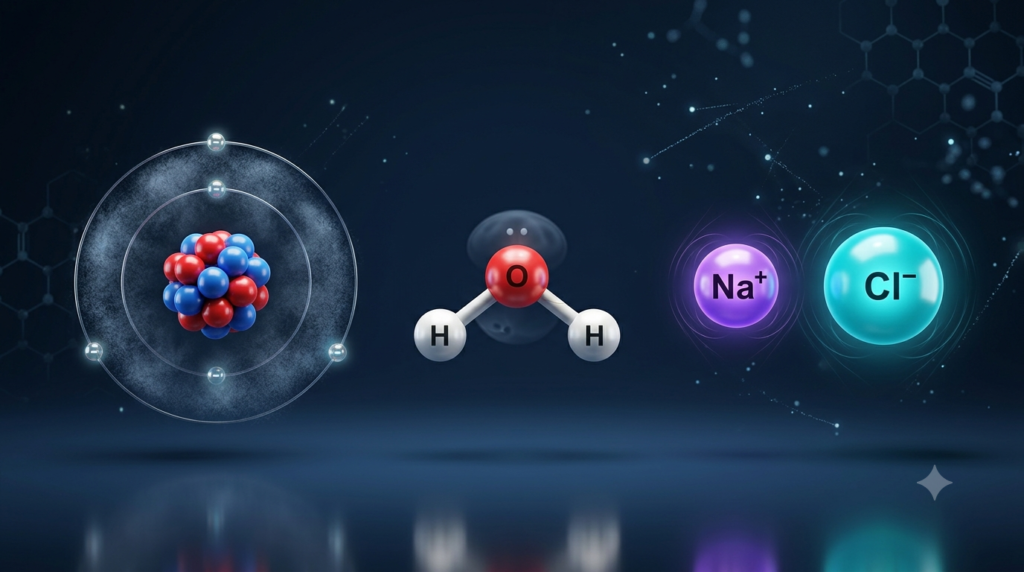
For example, sodium has one valence electron, while chlorine has seven. Sodium can transfer its outer electron to chlorine, forming sodium chloride (NaCl).
This interaction illustrates how valence electrons contribute to chemical bonding.
8. Element Group and Period
Although group and period numbers are not always printed inside an element’s box, they are important parts of the periodic table that help describe an element’s position.
What Is a Group?
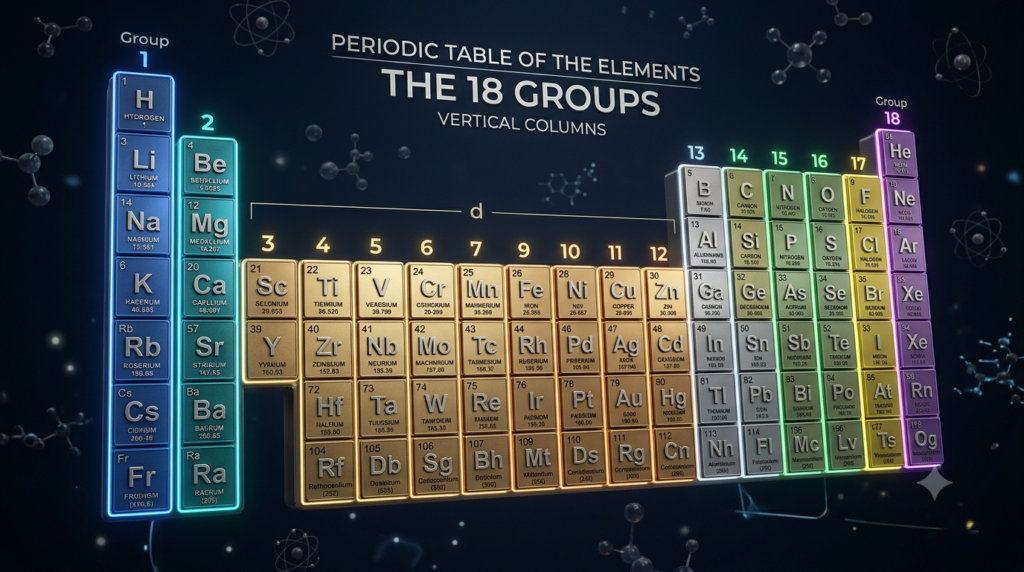
A group is a vertical column in the periodic table.
The modern periodic table contains 18 groups, numbered from 1 to 18.
Elements in the same group often have similar chemical properties because they generally have similar outer electron configurations.
For example:
Group 1: Alkali metals
Group 2: Alkaline earth metals
Group 17: Halogens
Group 18: Noble gases
What Is a Period?
A period is a horizontal row in the periodic table.
The modern periodic table contains seven periods.
The period number generally indicates the highest occupied principal energy level in the ground-state electron configuration of an element.
For example, sodium is located in Period 3, meaning its ground-state electron configuration includes electrons in three principal energy levels.
Why Are Groups and Periods Important?
Groups and periods help organize elements according to their atomic structure and chemical properties.
They also make it easier to identify trends such as atomic radius, electronegativity, ionization energy, and metallic character.
9. Element Classification
Many periodic tables use different colours to indicate the classification of elements.
These colours help readers quickly identify whether an element belongs to a particular category.
Common classifications include:
Metals
Metals are generally good conductors of heat and electricity. They are often shiny, malleable, and ductile.
Examples include:
Iron
Copper
Aluminium
Gold
Sodium
Most elements in the periodic table are metals.
Nonmetals
Nonmetals generally have properties different from metals. Many are poor conductors of heat and electricity, although their physical properties vary.
Examples include:
Oxygen
Nitrogen
Carbon
Sulfur
Chlorine
Metalloids
Metalloids have properties that are intermediate between metals and nonmetals.
Examples commonly include:
Boron
Silicon
Germanium
Arsenic
Antimony
Tellurium
Silicon is particularly important because of its use in semiconductor technology.
Why Are Colours Used?
Colours make the periodic table easier to understand visually.
For example, one colour may represent metals, another may represent nonmetals, and a different colour may represent metalloids.
However, colour schemes are not universal. Different periodic tables may use different colours and classification systems.
Therefore, always check the legend or key provided with a periodic table before interpreting its colours.
10. Oxidation States
Some detailed periodic tables include the common oxidation states of elements.
An oxidation state is a number assigned to an atom in a chemical substance according to a set of chemical rules. It helps describe the electron distribution associated with chemical bonding and redox reactions.
For example:
Sodium: +1
Magnesium: +2
Aluminium: +3
Oxygen: Usually −2
Chlorine: Commonly −1, +1, +3, +5, and +7
An element may have more than one possible oxidation state.
For example, iron commonly shows oxidation states of +2 and +3.
Why Are Oxidation States Important?
Oxidation states help chemists understand chemical reactions, identify oxidation and reduction processes, and write chemical formulas.
They are particularly useful when studying transition metals and compounds involving multiple elements.
11. How to Read a Periodic Table Box Correctly
Understanding an element’s box becomes easier when you know where to look for each piece of information.
Consider the element oxygen as an example.
Its basic periodic table information is:
Atomic Number: 8
Chemical Symbol: O
Element Name: Oxygen
Atomic Mass: Approximately 15.999 u
From these details, we can understand several important facts.
Oxygen has 8 protons because its atomic number is 8.
A neutral oxygen atom has 8 electrons.
Its chemical symbol is O.
Its average atomic mass is approximately 15.999 u.
It belongs to Group 16 and Period 2.
Its ground-state electron configuration is 1s² 2s² 2p⁴.
It has 6 valence electrons.
This example shows how a small periodic table box can provide a starting point for understanding an element’s atomic structure and chemical behaviour.
12. Why Does Information in Periodic Table Boxes Matter?
The information presented in periodic table boxes is useful for several reasons.
Identifying Elements: The atomic number, symbol, and name help identify each element accurately.
Understanding Atomic Structure: Atomic number, atomic mass, and electron configuration provide information about the structure of atoms.
Predicting Chemical Behaviour: Electron configuration and valence electrons help explain how elements form chemical bonds and participate in reactions.
Understanding Periodic Trends: The position of an element helps chemists compare its properties with those of other elements.
Writing Chemical Formulas: Chemical symbols are used to represent elements in chemical formulas and equations.
Learning Chemistry More Easily: Understanding each part of an element’s box provides a strong foundation for studying atomic structure, chemical bonding, chemical reactions, and other chemistry topics.
Conclusion
Every element’s periodic table box contains valuable scientific information. The atomic number identifies the element by showing its number of protons, while the chemical symbol provides a short representation of its name. The element name makes identification easier, and atomic mass gives information about the average mass of its naturally occurring isotopes.
Additional details such as electron configuration, valence electrons, group, period, oxidation states, and element classification provide a deeper understanding of an element’s atomic structure and chemical properties.
By learning how to interpret these details, anyone can use the periodic table more effectively. What may initially look like a collection of numbers and symbols becomes a useful guide to understanding the elements that make up the world around us.
FAQs
1. What information is included in an element’s periodic table box?
An element’s periodic table box commonly includes its atomic number, chemical symbol, element name, and atomic mass. These details help identify the element and provide basic information about its atomic structure. Some detailed periodic tables also display electron configuration, oxidation states, and other properties. The arrangement of information may differ depending on the periodic table design. By understanding these details, students and chemistry learners can identify elements, understand their characteristics, and learn how atoms are organized in the periodic table.
2. What does the atomic number in a periodic table box represent?
The atomic number represents the number of protons present in the nucleus of an atom. Every chemical element has a unique atomic number that determines its identity. For example, carbon has an atomic number of 6, meaning every carbon atom contains six protons. In a neutral atom, the number of electrons is also equal to the atomic number. The atomic number is important because it helps identify elements and determines their positions in the periodic table.
3. What is the difference between atomic number and atomic mass?
Atomic number and atomic mass describe different properties of an element. The atomic number represents the number of protons in an atom’s nucleus, while atomic mass generally represents the weighted average mass of an element’s naturally occurring isotopes. Atomic number is always a whole number, whereas atomic mass is commonly a decimal value. For example, carbon has an atomic number of 6 and an average atomic mass of approximately 12.011 u. Both values are important for understanding atomic structure and identifying elements.
4. Why do some chemical symbols have two letters?
Some chemical symbols contain two letters because a single letter may not uniquely represent every element. The first letter is always written in uppercase, while the second letter is written in lowercase. For example, calcium is represented by Ca, chlorine by Cl, and sodium by Na. Some symbols are also derived from Latin or historical element names. These standardized abbreviations make chemical formulas and equations shorter and easier to understand while maintaining consistent scientific communication worldwide.
5. Why is atomic mass shown as a decimal number?
Atomic mass is often displayed as a decimal because most elements naturally occur as mixtures of different isotopes. Isotopes are atoms of the same element that contain equal numbers of protons but different numbers of neutrons. Each isotope has a different mass and may occur in a different natural proportion. The atomic mass shown in the periodic table is generally the weighted average of these isotope masses. For example, chlorine has an average atomic mass of approximately 35.45 u.
6. What is the meaning of the chemical symbol in the periodic table?
A chemical symbol is a short abbreviation used to represent a chemical element. It usually contains one or two letters and is internationally standardized. For example, H represents hydrogen, O represents oxygen, and Fe represents iron. Chemical symbols are used in chemical formulas, equations, and scientific calculations. They make it easier to communicate chemical information without repeatedly writing complete element names. Learning common chemical symbols is an important part of understanding the periodic table and basic chemistry.
7. What is electron configuration in an element’s periodic table box?
Electron configuration describes how electrons are arranged in the energy levels and orbitals of an atom. It provides information about the distribution of electrons around the nucleus. For example, the electron configuration of oxygen is 1s² 2s² 2p⁴. Understanding electron configuration helps explain the number of valence electrons, chemical bonding, and the reactivity of elements. Some detailed periodic tables include electron configurations directly in their element boxes, while others provide this information separately.
8. What do the different colours in periodic table boxes represent?
Different colours in periodic table boxes usually represent the classification of chemical elements. For example, colours may distinguish metals, nonmetals, and metalloids. Some periodic tables also use separate colours for alkali metals, transition metals, halogens, noble gases, and other element families. These colours make it easier to recognize groups of elements with similar characteristics. However, colour schemes are not universal. Therefore, readers should always check the legend or colour key provided with a particular periodic table.
9. How can you find the number of electrons using an element’s atomic number?
You can determine the number of electrons in a neutral atom by looking at its atomic number. The atomic number represents the number of protons, and a neutral atom contains an equal number of protons and electrons. For example, oxygen has an atomic number of 8, so a neutral oxygen atom contains eight electrons. However, when an atom becomes an ion by gaining or losing electrons, its electron count changes. Its atomic number remains unchanged because the number of protons does not change.
10. Why is it important to understand the information in a periodic table box?
Understanding the information in a periodic table box helps build a strong foundation in chemistry. Each box provides useful details about an element’s identity, atomic structure, and properties. The atomic number identifies the element, the chemical symbol represents its name, and atomic mass provides information about its isotopes. Additional details such as electron configuration and oxidation states help explain chemical bonding and reactions. Learning to read these boxes makes it easier to study elements, understand chemical formulas, and explore more advanced chemistry topics.