Limits are one of the most important concepts in calculus because they help us understand how a function behaves as its input approaches a particular value. Before learning derivatives, continuity, or integrals, it is essential to become familiar with the language and notation used to describe limits. At first, these symbols may look complicated, but each one has a specific meaning that becomes easier to understand with practice.
The language of limits allows mathematicians to describe approaching values, changing quantities, and the behavior of functions near a particular point. It also helps explain situations where a function may not be defined at a point but still approaches a predictable value nearby. In this beginner-friendly guide, you will learn the meaning of limit notation, the role of important symbols, the difference between approaching and reaching a value, and how to interpret simple limit expressions. By understanding these fundamentals, you can build a strong foundation for studying calculus.
What Is a Limit in Mathematics?
A limit describes the value that a function approaches as its input approaches a particular number.
In calculus, a function connects an input value to an output value. For example, when a function takes the input 2 and produces the output 5, we can say that the function has a value of 5 at that input. However, a limit focuses on what happens to the output when the input gets closer and closer to a specified number.
Consider the function:
f(x) = x + 3
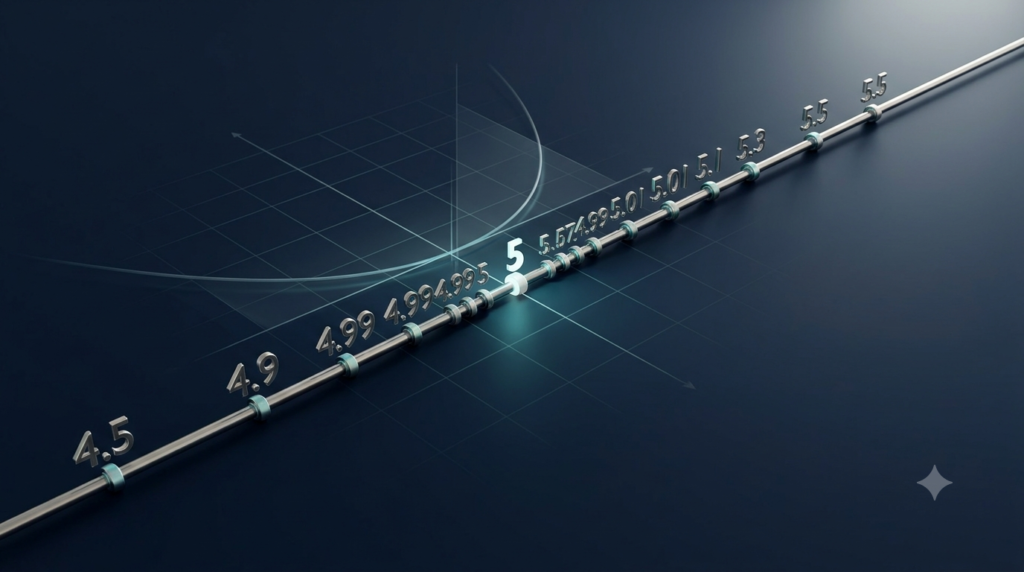
As x approaches 2, the output approaches 5. This can be understood by examining a few nearby values.
When x = 1.9, f(x) = 4.9.
When x = 1.99, f(x) = 4.99.
When x = 2.01, f(x) = 5.01.
When x = 2.1, f(x) = 5.1.
As the input gets closer to 2, the output gets closer to 5. Therefore, the limit of the function as x approaches 2 is 5.
This idea is the foundation of limit notation. Instead of describing the behavior in a long sentence, mathematicians use a compact expression to communicate it clearly.
Understanding the Standard Notation of Limits
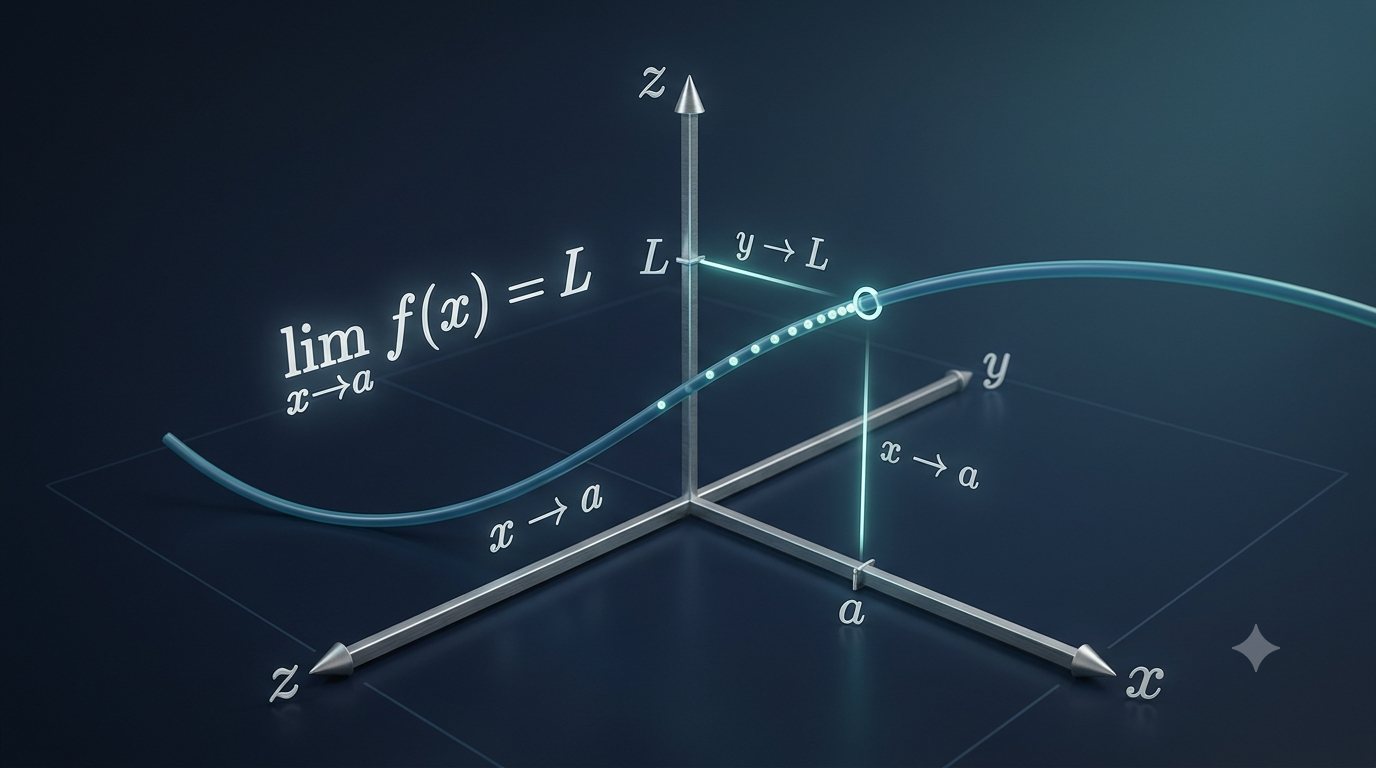
The standard notation for a limit is:
limₓ→ₐ f(x) = L
This expression is read as “the limit of f of x as x approaches a is L.”
Each part has a specific meaning.
The Symbol lim
The symbol lim is an abbreviation for the word limit. It tells us that we are examining the behavior of a function near a particular input value.
When you see this symbol in a mathematical expression, your attention should turn to what the function approaches rather than simply what its value is at a single point.
The Variable x
The letter x represents the input variable of the function. It is the quantity that changes or moves closer to a specified value.
For example, in the expression below, x is the variable being examined.
limₓ→₂ (x + 3) = 5
This means that we are studying what happens to x + 3 as x approaches 2.
The variable does not have to be x. Depending on the problem, mathematicians may use t, h, or another letter. The meaning of the notation remains the same.
The Arrow →
The arrow → means “approaches” or “tends toward” in limit notation.
For example:
x → 2
This means that x approaches 2. The value of x can be slightly less than 2 or slightly greater than 2, depending on the direction from which it approaches.
The arrow does not automatically mean that x equals 2. Instead, it describes the movement of the input toward that value.
The Number a
The number a represents the value that the input variable approaches.
In the expression below:
limₓ→₃ f(x)
The input x approaches 3. Therefore, 3 is the value being approached.
The number a is often called the point of approach. It identifies the location around which the behavior of the function is studied.
The Function f(x)
The expression f(x) represents the output of the function for a given input x.
When calculating a limit, we examine how these outputs behave as x approaches the specified number.
For example:
limₓ→₂ (x²) = 4
As x approaches 2, the output x² approaches 4.
The Symbol L
The letter L represents the value that the function approaches. It is called the limit.
In the expression:
limₓ→ₐ f(x) = L
The function f(x) approaches L as x approaches a.
The value of L does not always have to equal the actual function value at a. In some situations, the function may be undefined at that point, yet the limit can still exist.
Why Is Limit Notation Important?
Limit notation allows mathematicians to describe changing quantities precisely. It is especially useful when a function behaves differently near a point than it does at the point itself.
For example, a graph may contain a small gap at a particular location. Even if the function does not have a value at that point, the graph on either side may approach the same height. A limit helps us identify that height.
Limit notation is also essential for understanding several major ideas in calculus.
Derivatives: Limits help define the instantaneous rate of change of a function.
Continuity: Limits help determine whether a function behaves without a break at a point.
Integrals: Limits are involved in the development of definite integrals through sums of increasingly small parts.
Scientific applications: Limits help describe changing motion, growth, and other mathematical models.
Learning to read limit notation correctly makes these advanced topics easier to understand.
Understanding Left-Hand and Right-Hand Limits
A function may approach different values depending on whether the input approaches a point from the left or the right. These situations are described using one-sided limits.
Left-Hand Limit
A left-hand limit describes the behavior of a function when the input approaches a particular value from smaller values.
Its notation is:
limₓ→ₐ⁻ f(x)
The small minus sign above the arrow indicates that x approaches a from the left.
For example, when x approaches 3 from the left, the input might take values such as 2.9, 2.99, and 2.999.
These values are all less than 3, but they become increasingly close to it.
The left-hand limit focuses only on the behavior of the function on that side of the point.
Right-Hand Limit
A right-hand limit describes the behavior of a function when the input approaches a particular value from larger values.
Its notation is:
limₓ→ₐ⁺ f(x)
The small plus sign indicates that x approaches a from the right.
For example, when x approaches 3 from the right, the input might take values such as 3.1, 3.01, and 3.001.
These values are all greater than 3, but they become increasingly close to 3.
The right-hand limit examines the behavior of the function on this side.
Why Do One-Sided Limits Matter?
Left-hand and right-hand limits are useful when studying functions with jumps, breaks, or different rules on different intervals.
For an ordinary two-sided limit to exist as a finite number, both one-sided limits must exist and have the same value.
For example:
Left-hand limit = 4
Right-hand limit = 4
Since both sides approach the same value, the two-sided limit is 4.
However, if the left-hand limit is 4 and the right-hand limit is 7, the two-sided limit does not exist.
This distinction is important when analyzing graphs and piecewise functions.
Understanding the Difference Between a Limit and a Function Value
One of the most important ideas in calculus is that a limit and a function value are not always the same.
A function value tells us the output at a particular input. A limit tells us what the output approaches as the input gets closer to that point.
Consider the function:
f(x) = (x² − 4) ÷ (x − 2)
When x is not equal to 2, the expression can be simplified by factoring the numerator.
f(x) = (x − 2)(x + 2) ÷ (x − 2)
For x ≠ 2, this simplifies to:
f(x) = x + 2
As x approaches 2, the output approaches 4. Therefore:
limₓ→₂ [(x² − 4) ÷ (x − 2)] = 4
However, the original expression is undefined at x = 2 because its denominator becomes zero.
This example demonstrates that a limit can exist even when the function is not defined at the point being approached.
The limit describes nearby behavior, not necessarily the value at the point itself.
What Does It Mean When a Limit Does Not Exist?
A limit does not exist when the function fails to approach a single, well-defined value under the conditions being considered.
There are several common reasons for this.
Different Left-Hand and Right-Hand Limits
If a function approaches one value from the left and a different value from the right, the two-sided limit does not exist.
For example, a function might approach 2 from the left and 5 from the right. Since the two sides disagree, there is no single value that represents the two-sided limit.
Unbounded Behavior
A function may increase or decrease without bound as the input approaches a particular point.
For example:
limₓ→₀⁺ (1 ÷ x) = +∞
As x approaches zero from the positive side, the function values grow larger and larger.
In elementary calculus, infinity is not treated as an ordinary real number. This notation describes unbounded behavior rather than a finite limit.
Oscillating Behavior
Some functions continue to fluctuate as the input approaches a point, without settling toward one value.
If these oscillations do not approach a single number, the limit does not exist.
Recognizing these situations helps you understand why simply substituting a number into a function is not always enough to determine its limit.
Understanding Limits at Infinity
Limits can also describe what happens to a function when the input becomes extremely large or extremely negative.
When x Approaches Positive Infinity
The notation:
limₓ→∞ f(x) = L
means that the function approaches L as x increases without bound.
It does not mean that x reaches a final numerical value called infinity. Instead, it describes the behavior of the function for increasingly large positive inputs.
For example:
limₓ→∞ (1 ÷ x) = 0
As x becomes larger, the value of 1 ÷ x becomes smaller and closer to zero.
When x Approaches Negative Infinity
The notation:
limₓ→−∞ f(x) = L
describes the behavior of a function as x decreases without bound.
For example:
limₓ→−∞ (1 ÷ x) = 0
As x becomes increasingly negative, the value of 1 ÷ x approaches zero from the negative side.
Limits at infinity are useful for understanding long-term trends and the behavior of graphs far from the origin.
Common Symbols Used in Limits
The language of limits includes several symbols that appear repeatedly in calculus.
| Symbol | Meaning | Example |
|---|---|---|
| lim | Limit | limₓ→₂ f(x) |
| → | Approaches | x → 2 |
| x | Input variable | f(x) |
| f(x) | Function value | f(x) = x² |
| a | Point being approached | x → a |
| L | Limit value | limₓ→ₐ f(x) = L |
| ⁻ | Approach from the left | x → a⁻ |
| ⁺ | Approach from the right | x → a⁺ |
| ∞ | Positive infinity | x → ∞ |
| −∞ | Negative infinity | x → −∞ |
| ≠ | Not equal to | x ≠ 2 |
Understanding these symbols helps you read mathematical expressions without having to translate every expression into a long sentence.
How to Read and Interpret Limit Expressions
A useful way to learn limit notation is to read each expression from left to right and identify what it tells you.
Consider this example:
limₓ→₃ (2x + 1) = 7
You can interpret it in four steps.
Identify the limit symbol. The expression concerns the behavior of a function near a particular input.
Identify the variable. Here, x is the input being examined.
Identify the approaching value. The arrow indicates that x approaches 3.
Identify the result. The function 2x + 1 approaches 7.
The expression therefore means that as x gets closer to 3, the output of 2x + 1 gets closer to 7.
For this particular function, direct substitution also gives 7. However, the purpose of the limit notation is to describe the function’s behavior as the input approaches the specified point.
Practising this reading method can make more complicated limit expressions easier to understand.
Basic Rules That Help You Understand Limits
Once you understand the notation, a few fundamental rules can help you evaluate simple limits.
The Limit of a Constant
If a function always has the same value, its limit is that constant.
For example:
limₓ→₅ 8 = 8
The output remains 8 regardless of the input, so the limit is 8.
The Limit of the Input Variable
As x approaches a, the limit of x is a.
limₓ→₄ x = 4
The expression simply states that x approaches 4.
The Limit of a Polynomial
For polynomial functions, direct substitution can be used to evaluate limits because polynomials are continuous everywhere.
For example:
limₓ→₂ (x² + 3x) = 10
Substitute x = 2 into the expression.
2² + 3 × 2 = 4 + 6 = 10
Therefore, the limit is 10.
The Limit of a Quotient
For a quotient of two functions, direct substitution works when the denominator approaches a nonzero value and the relevant function limits exist.
For example:
limₓ→₂ [(x + 4) ÷ (x + 1)] = 2
Substituting x = 2 gives:
(2 + 4) ÷ (2 + 1) = 6 ÷ 3 = 2
These rules provide a starting point for solving limits. More complicated expressions may require factoring, simplification, or other methods.
Common Mistakes Beginners Should Avoid
Students often find limits confusing because the notation looks unfamiliar. Avoiding a few common mistakes can make learning much easier.
Confusing approaching with equalling: The notation x → a means that x approaches a. It does not necessarily mean that x equals a during the process.
Assuming every limit equals the function value: A function may be undefined at a point while its limit exists. Always distinguish between nearby behavior and the value at the point.
Ignoring one-sided limits: A two-sided limit cannot exist as a finite number if the left-hand and right-hand limits disagree.
Treating infinity as an ordinary number: Infinity describes unbounded behavior. It is not a real number that a variable reaches.
Substituting without checking: Direct substitution is useful for many functions, but it does not solve every limit problem. If substitution produces an indeterminate form such as 0 ÷ 0, further analysis is needed.
Memorizing symbols without understanding them: Learning what each symbol communicates is more useful than memorizing notation without understanding its meaning.
By focusing on these distinctions, beginners can develop a clearer understanding of the language of calculus.
Practical Applications of Limit Notation
Limits are not restricted to abstract mathematical exercises. They provide a foundation for understanding many real-world processes.
Motion and Instantaneous Speed
An object’s average speed describes the distance travelled over a period of time. Instantaneous speed describes how fast the object is moving at a particular moment.
Limits make it possible to develop the mathematical definition of instantaneous speed by considering average speed over shorter and shorter time intervals.
Population Growth
Scientists use mathematical models to study how populations change over time. Limits can help describe the long-term behavior of these models, including whether a quantity approaches a stable value.
Engineering and Technology
Engineers use calculus to study changing electrical signals, mechanical motion, fluid flow, and many other systems. Limits help establish the mathematical foundations for rates of change and continuous behavior.
Economics and Business
Limits contribute to the study of marginal quantities, such as marginal cost and marginal revenue. These concepts examine how a small change in one quantity affects another.
These applications show why understanding limit notation is an important step toward learning more advanced mathematics.
Conclusion
The language and notation of limits provide a simple but powerful way to describe how functions behave as their inputs approach particular values. The symbol lim identifies a limit, the arrow indicates the direction of approach, the variable represents the changing input, and the result describes the value the function approaches. One-sided limits, limits at infinity, and situations where a limit does not exist add further detail to this language.
For beginners, the most important distinction is that a limit describes nearby behavior rather than necessarily giving the function’s value at the point itself. Once this idea becomes clear, limit expressions become easier to read and interpret. A strong understanding of limit notation also prepares you to study continuity, derivatives, integrals, and the many practical applications of calculus.
FAQs
1. What is limit notation in calculus?
Limit notation is a mathematical way to describe the value a function approaches as its input gets closer to a particular number. The standard notation is limₓ→ₐ f(x) = L, which is read as “the limit of f of x as x approaches a is L.” Here, x represents the input variable, a is the value being approached, and L is the limit. This notation helps mathematicians describe function behavior precisely, even when the function is undefined at the point being approached. It is an essential foundation for understanding derivatives, continuity, and other calculus concepts.
2. What does the symbol lim mean in mathematics?
The symbol lim is an abbreviation for the word “limit.” It indicates that we are studying how a function behaves as its input approaches a particular value. For example, limₓ→₂ (x + 3) = 5 means that the expression x + 3 approaches 5 as x approaches 2. The symbol itself does not represent a number; the complete expression communicates the limiting behavior. Understanding this symbol is the first step toward reading limit expressions correctly and solving calculus problems. It helps transform a lengthy mathematical explanation into a short, standardized notation.
3. What does the arrow mean in limit notation?
The arrow symbol → means “approaches” or “tends toward.” In the expression x → 3, the input variable x approaches the value 3. This does not necessarily mean that x equals 3. Instead, x can take values increasingly close to 3 from either side. For example, values such as 2.9, 2.99, and 2.999 approach 3 from the left, while 3.1, 3.01, and 3.001 approach it from the right. The arrow helps explain which value the variable approaches and is an essential part of understanding the meaning of a limit.
4. What do the letters a and L represent in limit notation?
In the standard expression limₓ→ₐ f(x) = L, the letter a represents the input value that x approaches, while L represents the output value that the function approaches. For example, limₓ→₂ (x + 3) = 5 has a = 2 and L = 5. As x approaches 2, the function output approaches 5. These letters are placeholders, so different problems may use other numbers or symbols. Recognizing their roles helps beginners interpret mathematical expressions without confusion and understand the relationship between the approaching input and the resulting limit.
5. What is the difference between a limit and a function value?
A function value is the output obtained when a specific input is used, whereas a limit describes the output the function approaches as its input gets closer to a particular value. These two quantities can be equal, but they are not always equal. For example, a function may be undefined at x = 2 because its formula involves division by zero. Nevertheless, its outputs may approach 4 as x approaches 2. In that situation, the limit exists even though the function value does not. This distinction is important for understanding graphs, discontinuities, and many problems in calculus.
6. What are left-hand and right-hand limits?
A left-hand limit describes the behavior of a function as its input approaches a particular value from smaller values. It is written using a minus sign, as in limₓ→ₐ⁻ f(x). A right-hand limit examines the behavior as the input approaches from larger values, written as limₓ→ₐ⁺ f(x). These limits are particularly useful when studying functions with jumps or breaks. For a two-sided limit to exist as a finite number, both one-sided limits must exist and equal the same value. If they approach different values, the two-sided limit does not exist.
7. What does it mean when a limit does not exist?
A limit does not exist when a function fails to approach one definite value under the conditions being considered. This can happen when the left-hand and right-hand limits differ, when a function oscillates without settling toward a single value, or when its output grows without bound near a point. For example, if the function approaches 2 from the left and 5 from the right, its two-sided limit does not exist. Understanding these situations is important because substituting a number into a formula does not always reveal the behavior of the function near that point.
8. What does infinity mean in limit notation?
In limit notation, infinity describes behavior that continues without an upper or lower bound. For example, limₓ→∞ (1 ÷ x) = 0 means that the value of 1 ÷ x approaches zero as x becomes increasingly large. Infinity is not an ordinary real number that the variable reaches. Similarly, negative infinity describes a variable decreasing without bound. Limits involving infinity help mathematicians understand the long-term behavior of functions and identify horizontal asymptotes. They are useful in calculus, physics, engineering, and mathematical modeling, where quantities may continue changing as time or another variable increases.
9. Can a limit exist when a function is undefined at a point?
Yes, a limit can exist even when a function is undefined at the point being approached. This happens when the function’s values on either side approach the same number. Consider the function (x² − 4) ÷ (x − 2). At x = 2, the denominator becomes zero, so the original function is undefined. However, for x values other than 2, the expression simplifies to x + 2. As x approaches 2, the output approaches 4. Therefore, the limit is 4 even though the function has no defined value at that point. This illustrates the difference between a limit and a function value.
10. Why is learning limit notation important for beginners?
Learning limit notation gives beginners the foundation needed to understand several major concepts in calculus. It explains how functions behave near particular points and provides the mathematical basis for derivatives and continuity. Limits also contribute to the development of definite integrals and help describe changing quantities in science and engineering. Once learners understand symbols such as lim, the approach arrow, and one-sided limit notation, they can interpret mathematical expressions more confidently. Practising simple examples and learning the meaning of each symbol is more effective than memorizing expressions without understanding them. A strong foundation makes advanced calculus topics easier to study.