Mensuration is an important branch of mathematics that helps us measure the size, shape, area, and volume of different objects. It is closely connected to everyday activities, such as measuring the area of a room, calculating the amount of paint needed for a wall, determining the capacity of a water tank, or finding the amount of material required to make a box. These tasks may seem simple, but they all involve mathematical concepts related to mensuration.
By learning mensuration, we can understand how measurements work and how mathematical formulas can solve practical problems. It introduces us to important concepts such as length, perimeter, area, surface area, and volume. These concepts are useful not only in mathematics but also in fields such as architecture, engineering, construction, agriculture, and manufacturing.
Whether someone is measuring a small notebook or planning a large building, mensuration provides the tools needed to make accurate calculations. In this article, we will explore what mensuration means, its main concepts, the formulas used in calculations, and why it is important in everyday life.
What Is Mensuration in Mathematics?
Mensuration is the branch of mathematics concerned with measuring the dimensions and sizes of geometric figures and physical objects. It involves calculating quantities such as length, perimeter, area, surface area, and volume using measurements and mathematical formulas.
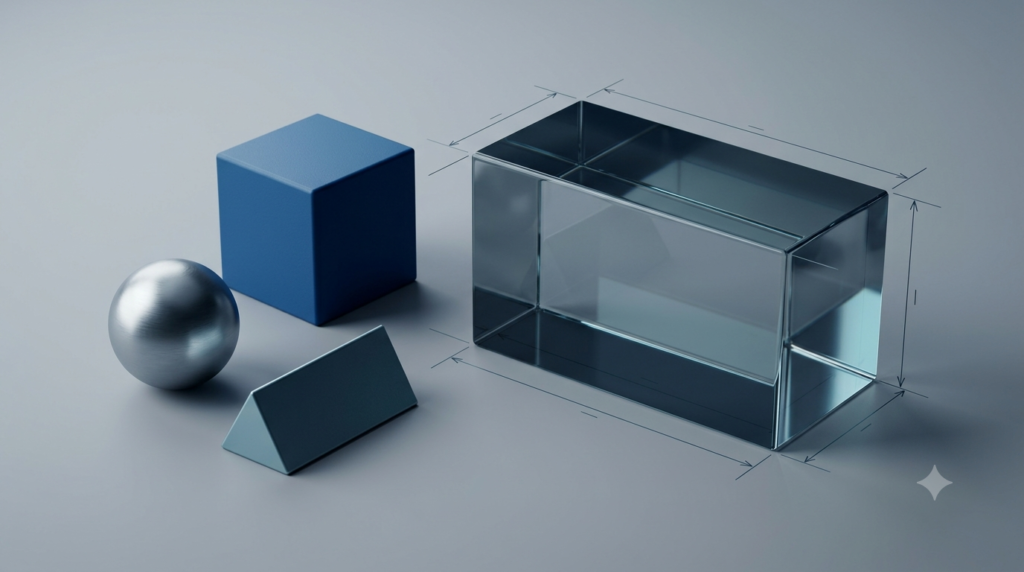
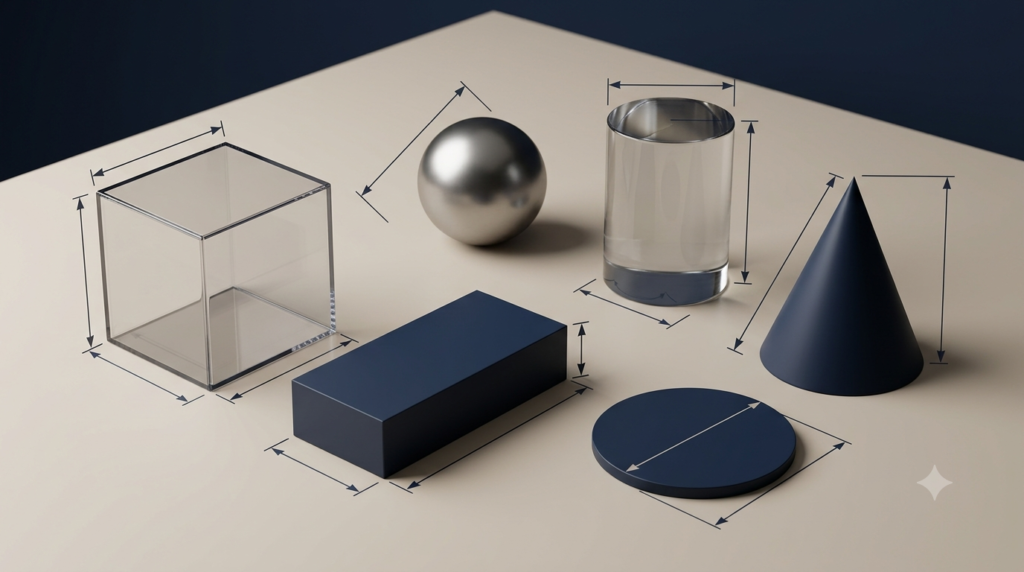
Mensuration mainly deals with two-dimensional (2D) shapes and three-dimensional (3D) objects.
Two-dimensional shapes have length and width but no thickness. Examples include squares, rectangles, triangles, and circles. Mensuration helps us calculate their perimeter and area.
Three-dimensional objects have length, width, and height or depth. Examples include cubes, cuboids, cylinders, cones, and spheres. Mensuration helps us calculate their surface area and volume.
For example, suppose you want to cover the floor of a rectangular room with tiles. You need to calculate the floor’s area to determine how many tiles are required. Similarly, if you want to fill a cylindrical water tank, you need to calculate its volume to understand how much water it can hold.
Both situations involve mensuration.
The main purpose of mensuration is to apply mathematical measurements to understand the size and capacity of objects accurately. Instead of estimating everything by sight, we can use measurements and formulas to obtain reliable results.
Understanding the Basic Concepts of Mensuration
To understand mensuration properly, it is important to learn the basic terms used in measurement. Each term represents a different property of a shape or object.
1. Length
Length is the measurement of how long an object is. It is one of the most fundamental quantities in mensuration.
For example, the length of a table may be 1.5 metres, while the length of a pencil may be 18 centimetres.
Length is commonly measured in millimetres, centimetres, metres, and kilometres, depending on the size of the object or distance being measured.
2. Perimeter
Perimeter is the total distance around the boundary of a two-dimensional shape. It tells us how long the outer edge of a shape is.
For example, if you want to put a fence around a rectangular garden, you need to calculate its perimeter.
Text block — Formula:
Perimeter of a rectangle = 2 × (Length + Breadth)
Perimeter of a square = 4 × Side
Perimeter of a triangle = Side 1 + Side 2 + Side 3
If a square has a side length of 5 metres, its perimeter is:
Perimeter = 4 × 5 = 20 metres
Therefore, 20 metres of fencing would be needed to cover the garden’s boundary, assuming no additional allowance is required.
3. Area
Area is the amount of surface covered by a two-dimensional shape. It helps us determine how much space a flat surface occupies.
For example, calculating the area of a floor tells us how much floor space is available. Similarly, the area of a wall helps us estimate the quantity of paint required to cover it.
Text block — Formula:
Area of a rectangle = Length × Breadth
Area of a square = Side × Side
Area of a triangle = ½ × Base × Height
Area of a circle = π × Radius²
Suppose a rectangular room is 6 metres long and 4 metres wide.
Area = 6 × 4 = 24 square metres
The floor has an area of 24 square metres. This measurement can help us estimate the number of tiles needed to cover the floor.
4. Surface Area
Surface area is the total area covering the outside of a three-dimensional object. It is especially useful when calculating how much material is needed to cover or manufacture an object.
For example, if you want to paint a box, you may need to calculate its surface area to estimate the amount of paint required.
A cube has six equal square faces.
Text block — Formula:
Total surface area of a cube = 6 × Side²
For a cube with a side length of 3 centimetres:
Total surface area = 6 × 3²
Total surface area = 6 × 9 = 54 square centimetres
Therefore, the total surface area of the cube is 54 square centimetres.
5. Volume
Volume measures the amount of three-dimensional space occupied by an object. It is also used to determine the capacity of containers that hold liquids, gases, or other materials.
For example, volume helps us calculate the amount of water a tank can hold or the space occupied by a storage box.
Text block — Formula:
Volume of a cube = Side³
Volume of a cuboid = Length × Breadth × Height
Volume of a cylinder = π × Radius² × Height
Suppose a rectangular storage box is 4 metres long, 3 metres wide, and 2 metres high.
Volume = 4 × 3 × 2 = 24 cubic metres
The box occupies 24 cubic metres of space.
Types of Mensuration
Mensuration is generally divided into two main categories based on the dimensions of the shapes being measured: plane mensuration and solid mensuration.
1. Plane Mensuration
Plane mensuration deals with two-dimensional shapes. These shapes have length and width but no thickness.
Common examples include:
Squares
Rectangles
Triangles
Circles
Parallelograms
Rhombuses
Trapeziums
Plane mensuration mainly involves calculating perimeter and area.
For example, a farmer may calculate the area of a rectangular field to estimate how much seed is needed. A homeowner may calculate the perimeter of a garden to determine the length of fencing required.
These calculations help people plan their work, use materials efficiently, and avoid unnecessary expenses.
2. Solid Mensuration
Solid mensuration deals with three-dimensional objects that have length, width, and height or depth.
Common examples include:
Cubes
Cuboids
Cylinders
Cones
Spheres
Hemispheres
Prisms
Pyramids
Solid mensuration involves calculating surface area and volume. Depending on the object, it may also involve curved surface area, lateral surface area, and total surface area.
For example, a cylindrical water tank can be studied using solid mensuration to determine its capacity. Similarly, the surface area of a spherical object can help estimate the material needed to cover it.
Plane mensuration focuses on flat shapes, while solid mensuration focuses on three-dimensional objects.
Important Formulas Used in Mensuration
Mensuration uses formulas to calculate measurements quickly and accurately. Each formula is designed for a particular shape or object.
The following are some commonly used formulas.
Formulas for Two-Dimensional Shapes
Text block — Plane mensuration formulas:
Square:
Perimeter = 4 × Side
Area = Side²
Rectangle:
Perimeter = 2 × (Length + Breadth)
Area = Length × Breadth
Triangle:
Perimeter = Side 1 + Side 2 + Side 3
Area = ½ × Base × Height
Circle:
Circumference = 2 × π × Radius
Area = π × Radius²
Parallelogram:
Area = Base × Perpendicular Height
Trapezium:
Area = ½ × (Sum of Parallel Sides) × Height
These formulas are useful for measuring flat surfaces and boundaries. However, it is important to use the correct measurements and units when applying them.
Formulas for Three-Dimensional Objects
Text block — Solid mensuration formulas:
Cube:
Total Surface Area = 6 × Side²
Volume = Side³
Cuboid:
Total Surface Area = 2 × (Length × Breadth + Breadth × Height + Height × Length)
Volume = Length × Breadth × Height
Cylinder:
Curved Surface Area = 2 × π × Radius × Height
Total Surface Area = 2 × π × Radius × (Radius + Height)
Volume = π × Radius² × Height
Sphere:
Surface Area = 4 × π × Radius²
Volume = ⁴⁄₃ × π × Radius³
Cone:
Curved Surface Area = π × Radius × Slant Height
Volume = ⅓ × π × Radius² × Height
These formulas are used in many practical situations, including construction, packaging, storage, and product design.
The symbol π (pi) represents the ratio of a circle’s circumference to its diameter. Its approximate value is 3.14, although more precise calculations may use additional decimal places.
Why Is Mensuration Important in Mathematics?
Mensuration is important because it connects mathematical concepts with real measurements. It helps us understand the physical world and solve problems involving space, dimensions, and materials.
1. It Helps Solve Everyday Problems
Many everyday activities require accurate measurements. When buying a carpet, arranging furniture, painting a wall, or choosing a storage container, we often need to calculate area, length, or volume.
For example, a person purchasing flooring material needs to know the area of the floor. Without this calculation, they may buy too much or too little material.
Mensuration makes these tasks easier by providing a systematic way to calculate the measurements required.
2. It Develops Mathematical Understanding
Learning mensuration strengthens our understanding of geometry, numbers, units, and mathematical relationships.
Students learn how the dimensions of a shape affect its area, perimeter, surface area, and volume. They also discover how changing one measurement can change the result.
For example, doubling the side length of a square makes its perimeter twice as large, but its area becomes four times as large.
This relationship helps learners understand how mathematical quantities behave and why formulas are important.
3. It Supports Construction and Architecture
Construction projects require accurate measurements at every stage. Architects, engineers, builders, and contractors use mensuration when planning buildings, designing rooms, estimating materials, and calculating storage capacities.
For example, calculating the floor area helps determine the amount of flooring material required. Calculating the volume of concrete needed for a particular structure helps with material planning.
Surface area calculations may also help estimate paint requirements for walls or protective coatings for structural components.
Accurate measurements can reduce material waste, control costs, and improve planning.
4. It Helps in Agriculture
Agriculture involves measuring land, planning irrigation, estimating resources, and managing storage.
Farmers may calculate the area of a field to estimate seed requirements or determine how much fertilizer should be applied over a particular area.
Mensuration can also help estimate the capacity of water tanks and the volume of storage spaces used for agricultural products.
By using measurements instead of rough guesses, farmers can make more informed decisions about the resources needed for their work.
5. It Is Useful in Manufacturing and Product Design
Manufacturers use mensuration to design products with specific dimensions. Items such as boxes, bottles, cans, furniture, and machine components must be measured carefully.
For example, a company producing cylindrical cans needs to consider their height, radius, surface area, and volume.
The volume determines how much material the container can hold, while the surface area helps estimate the material needed to manufacture it.
These calculations contribute to efficient product design, appropriate packaging, and effective use of raw materials.
6. It Improves Problem-Solving Skills
Mensuration encourages logical thinking. To solve a problem, learners must identify the shape, select the appropriate formula, substitute the correct values, and calculate the result.
They must also check whether the answer makes sense in the given situation.
For example, when calculating the amount of water a tank can hold, a student must distinguish between surface area and volume. Using an area formula instead of a volume formula would produce an incorrect result.
Working through such problems develops accuracy, reasoning, and confidence in mathematics.
Real-Life Applications of Mensuration
Mensuration is not limited to textbooks or examinations. It is used in many practical situations.
1. Interior Design
Interior designers measure rooms, floors, walls, and furniture to plan the use of available space. Area calculations help estimate flooring materials, wallpaper, and paint.
2. Packaging
Companies use mensuration to design containers that can hold particular quantities of products. Volume calculations help determine capacity, while surface area calculations help estimate packaging material.
3. Water Storage
Water tanks, swimming pools, and reservoirs are designed using measurements of length, width, depth, radius, or height.
For a rectangular swimming pool, the volume can be calculated by multiplying its length, width, and depth.
4. Transportation
Mensuration can be useful in designing vehicle components, estimating storage space, planning cargo arrangements, and determining the capacity of fuel tanks.
5. Gardening and Landscaping
Gardeners use area calculations to plan lawns, flower beds, and planting spaces. Perimeter calculations help determine the length of borders or fences around a garden.
6. Sports and Recreation
Sports facilities require accurate measurements. The dimensions and areas of playing fields, courts, and other recreational spaces are determined using geometric measurements.
These examples show that mensuration is a practical mathematical tool used across many activities and professions.
How to Solve Mensuration Problems
Solving mensuration problems becomes easier when you follow a clear method.
Step 1: Identify the Shape
First, determine whether the problem involves a two-dimensional shape or a three-dimensional object.
For example, a floor is a flat surface, while a water tank is a three-dimensional object.
Step 2: Identify What You Need to Calculate
Determine whether the question asks for perimeter, area, surface area, or volume.
Read the question carefully because these quantities measure different properties.
Step 3: Write Down the Given Measurements
List all the available dimensions, such as length, breadth, height, radius, or side length.
Make sure the measurements use compatible units before performing calculations.
Step 4: Select the Correct Formula
Choose the formula that matches the shape and the quantity you need to find.
For example, use the area formula for a rectangular floor and the volume formula for a rectangular tank.
Step 5: Substitute the Values
Replace the variables in the formula with the given measurements.
For a rectangle with a length of 8 metres and a breadth of 5 metres:
Text block — Calculation:
Area = Length × Breadth
Area = 8 × 5
Area = 40 square metres
Step 6: Write the Correct Unit
Always include the appropriate unit in your final answer.
Length is measured in units such as metres or centimetres. Area is expressed in square units, such as square metres, and volume is expressed in cubic units, such as cubic metres.
This final step is essential because a numerical answer without the correct unit may be incomplete or misleading.
Common Mistakes to Avoid in Mensuration
Although mensuration formulas are often straightforward, certain mistakes can lead to incorrect answers.
1. Using the Wrong Formula
Different shapes require different formulas. Before calculating, make sure the selected formula matches the shape and the quantity being measured.
2. Confusing Area and Perimeter
Area measures the surface covered by a shape, whereas perimeter measures the total distance around its boundary.
For example, a room’s floor area helps determine the quantity of flooring material, while its perimeter helps estimate the length of skirting around the edges.
3. Forgetting Units
Always write the correct units. Perimeter is expressed in linear units, area in square units, and volume in cubic units.
4. Mixing Different Units
Avoid multiplying measurements expressed in incompatible units without converting them first.
For example, convert centimetres to metres when necessary before calculating an area in square metres.
5. Using Incorrect Measurements
A small error in length, breadth, radius, or height can affect the final result. Measure carefully and check the values before substituting them into a formula.
6. Rounding Too Early
When calculations involve π or decimal measurements, avoid rounding intermediate values too early. Keep sufficient precision and round the final answer according to the requirements of the problem.
By avoiding these mistakes, learners can improve their accuracy and solve mensuration problems more confidently.
Tips for Learning Mensuration Effectively
Understanding mensuration requires more than memorizing formulas. It is helpful to connect each formula with the shape or object it represents.
Start by learning the basic properties of squares, rectangles, triangles, and circles. Once these concepts become clear, move on to cubes, cuboids, cylinders, cones, and spheres.
Practice solving simple problems before attempting more complicated questions. Drawing a diagram can also help you understand the dimensions provided in a problem.
Try measuring real objects around you. Calculate the area of a tabletop, the perimeter of a notebook, or the volume of a box. These activities make abstract mathematical concepts easier to understand.
Another useful technique is to maintain a formula sheet organized by shape and measurement type. Review the formulas regularly and solve different types of questions to understand when each formula should be used.
Most importantly, focus on understanding why a formula works rather than memorizing it without explanation. When you understand the relationship between dimensions and measurements, you can apply mensuration to unfamiliar problems more easily.
Conclusion
Mensuration is a fundamental branch of mathematics that helps us measure the dimensions, areas, surface areas, and volumes of geometric shapes and physical objects. It includes plane mensuration for two-dimensional shapes and solid mensuration for three-dimensional objects.
Its importance extends far beyond classroom learning. From calculating the area of a room and estimating construction materials to designing packaging and measuring water storage capacity, mensuration plays a valuable role in everyday life and many professional fields.
Learning mensuration also improves mathematical reasoning, problem-solving ability, and measurement skills. By understanding basic concepts, selecting the correct formulas, using appropriate units, and practicing real-life examples, anyone can develop a strong foundation in this subject.
Ultimately, mensuration helps us turn measurements into useful information, making everyday tasks more accurate, efficient, and manageable.
FAQs
1. What is mensuration in mathematics?
Mensuration is a branch of mathematics that deals with measuring the dimensions and sizes of geometric shapes and physical objects. It helps us calculate quantities such as length, perimeter, area, surface area, and volume. Mensuration covers both two-dimensional shapes, such as squares, rectangles, triangles, and circles, and three-dimensional objects, such as cubes, cuboids, cylinders, cones, and spheres. It uses mathematical formulas to solve measurement problems accurately. Mensuration is useful in everyday activities, including measuring rooms, calculating the area of land, estimating construction materials, and determining the capacity of containers.
2. Why is mensuration important in mathematics?
Mensuration is important because it connects mathematical concepts with practical measurements. It helps us determine the size of surfaces, the distance around shapes, and the space occupied by objects. These calculations are useful in construction, architecture, agriculture, manufacturing, interior design, and many other fields. Mensuration also develops logical thinking, problem-solving abilities, and numerical accuracy. For example, calculating the area of a floor helps determine how much flooring material is required. By learning mensuration, students develop essential mathematical skills that help them solve real-life problems and understand the relationship between geometric shapes and their measurements.
3. What are the main types of mensuration?
Mensuration is generally divided into two main types: plane mensuration and solid mensuration. Plane mensuration deals with two-dimensional shapes, such as squares, rectangles, triangles, and circles. It focuses mainly on calculating perimeter and area. Solid mensuration deals with three-dimensional objects, including cubes, cuboids, cylinders, cones, and spheres. It involves calculating surface area and volume. Plane mensuration helps measure flat surfaces and boundaries, while solid mensuration helps determine the external surface and space occupied by solid objects. Both types are important for understanding geometry and solving practical measurement problems.
4. What is the difference between area and perimeter?
Area and perimeter measure two different properties of a two-dimensional shape. Perimeter is the total distance around the boundary of a shape, while area is the amount of surface enclosed within that boundary. Perimeter is measured in linear units, such as centimetres or metres, whereas area is measured in square units, such as square centimetres or square metres. For example, the perimeter of a rectangular garden helps determine the length of fencing required, while its area indicates how much land it covers. Understanding this difference is essential for selecting the correct formula when solving mensuration problems.
5. What is the difference between surface area and volume?
Surface area measures the total area of the outer surfaces of a three-dimensional object, whereas volume measures the amount of three-dimensional space occupied by that object. Surface area is expressed in square units, such as square metres or square centimetres. Volume is expressed in cubic units, such as cubic metres or cubic centimetres. For example, surface area helps estimate the material needed to cover or paint a box, while volume helps determine how much the box can hold. Both measurements are important in packaging, construction, manufacturing, and the design of storage containers.
6. What are the basic formulas used in mensuration?
Mensuration uses different formulas depending on the shape and the quantity being measured. The area of a rectangle is calculated by multiplying its length by its breadth. The area of a square is its side multiplied by itself. The area of a circle is calculated using π × Radius². The volume of a cube is Side³, while the volume of a cuboid is Length × Breadth × Height. A cylinder’s volume is π × Radius² × Height. Learning these basic formulas helps students calculate measurements accurately and solve a wide variety of mathematical and practical problems.
7. Where is mensuration used in everyday life?
Mensuration is used in many everyday activities that involve measuring surfaces, boundaries, or three-dimensional objects. People use it when calculating the area of a room, determining the amount of paint needed for a wall, planning a garden, or measuring a storage container. Builders use mensuration to estimate construction materials, while farmers calculate field areas to plan planting and irrigation. Manufacturers use it to design packaging and determine container capacities. Even arranging furniture or selecting a carpet may require area calculations. These examples demonstrate how mensuration helps people make accurate decisions, reduce material waste, and use available space efficiently.
8. How is mensuration useful in construction and architecture?
Mensuration plays an important role in construction and architecture because buildings require accurate measurements and careful material planning. Architects and engineers use area calculations to determine floor sizes, room dimensions, and wall surfaces. Volume calculations help estimate the quantity of concrete needed for certain structures, while surface area calculations can help estimate paint or coating requirements. Perimeter calculations are useful for determining boundary lengths and other measurements around structures. Accurate mensuration can reduce material waste, control project costs, and improve planning. It also helps professionals design spaces that meet specific dimensional and practical requirements.
9. What units are used in mensuration?
The units used in mensuration depend on the quantity being measured. Length and perimeter are expressed in linear units, such as millimetres, centimetres, metres, and kilometres. Area is measured in square units, including square centimetres, square metres, and square kilometres. Volume is measured in cubic units, such as cubic centimetres and cubic metres. Liquid capacity may also be expressed in litres or millilitres. It is important to use compatible units when performing calculations. For example, dimensions should be converted to the required unit before calculating area or volume to avoid incorrect results.
10. How can beginners learn mensuration easily?
Beginners can learn mensuration more easily by understanding the basic properties of geometric shapes before memorizing formulas. Start with squares, rectangles, triangles, and circles, then progress to three-dimensional objects such as cubes, cuboids, cylinders, cones, and spheres. Practice calculating perimeter, area, surface area, and volume using simple examples. Drawing diagrams and labeling dimensions can make problems easier to understand. Measuring real objects, such as books, tables, and boxes, also connects mathematical concepts with everyday life. Regular practice, correct use of units, and understanding why formulas work will help beginners build confidence and improve their problem-solving skills.