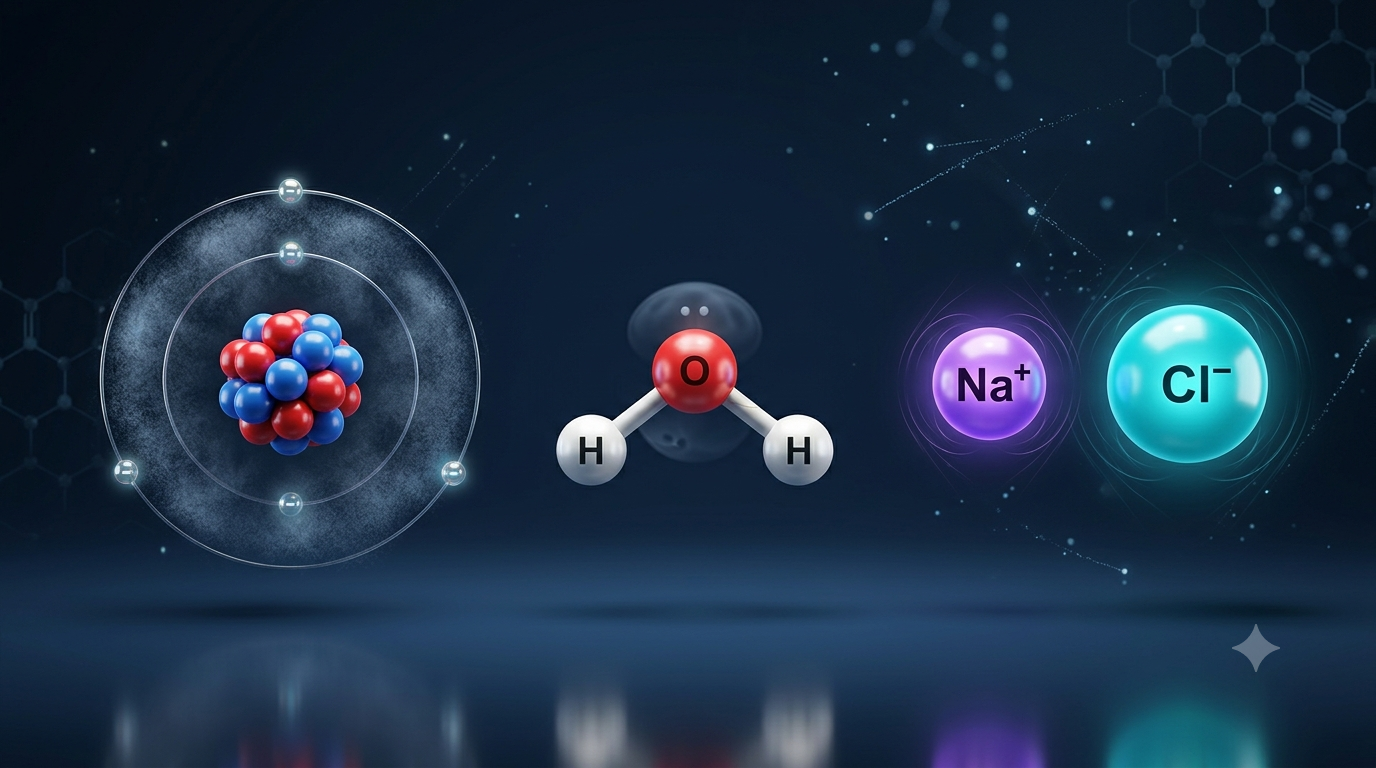
Everything around us is made of matter, including the air we breathe, the water we drink, the food we eat, and the objects we use every day. Although these materials may look completely different, they are all composed of extremely small particles. Understanding these particles helps us explain the properties of matter and the chemical changes that occur around us. Three of the most important basic chemical particles are atoms, molecules, and ions.
Atoms are the fundamental building blocks of chemical elements. Molecules form when two or more atoms are chemically bonded together, while ions are particles that carry an electrical charge. These particles play essential roles in chemical reactions, the formation of compounds, the behavior of gases, the properties of liquids, and many processes in living organisms. By learning about atoms, molecules, and ions, we can develop a strong foundation for understanding chemistry and the structure of matter.
What Are Atoms?
An atom is the smallest unit of a chemical element that retains the chemical identity of that element. All ordinary matter is made from atoms, although atoms can combine or become charged to form other chemical particles.
For example, iron objects contain iron atoms, copper wires contain copper atoms, and helium gas consists of helium atoms. Each element has its own type of atom, distinguished by the number of protons in its nucleus.
Atoms are incredibly small. Their diameters are typically on the order of 0.1 nanometres, although their sizes vary depending on the element and how atomic size is measured. Because atoms are so small, an enormous number of them can fit into even a tiny grain of material.
Structure of an Atom
An atom consists of a central nucleus surrounded by electrons. The nucleus contains protons and, in most atoms, neutrons. Electrons occupy regions around the nucleus described by atomic orbitals.
The three main subatomic particles have different properties.
Protons: Positively charged particles located in the nucleus.
Neutrons: Particles with no electric charge, usually located in the nucleus.
Electrons: Negatively charged particles found in atomic orbitals around the nucleus.
The nucleus contains nearly all the mass of an atom, while electrons occupy most of the space associated with the atom.
Text block: Properties of Subatomic Particles
Proton:
These relative masses are approximate. The actual masses of protons and neutrons are slightly different, and an electron is much lighter than either of them.
Atomic Number and Mass Number
The identity of an element depends on its number of protons. This number is called the atomic number and is represented by the symbol Z.
The total number of protons and neutrons in an atom’s nucleus is called the mass number, represented by A.
Text block: Atomic Structure Formulas
Atomic number (Z) = Number of protons
For example, a carbon-12 atom has 6 protons and 6 neutrons. Its atomic number is 6, and its mass number is 12. If the carbon atom is electrically neutral, it also contains 6 electrons.
Atoms of the same element can have different numbers of neutrons. These forms are known as isotopes. Carbon-12 and carbon-14 are examples of carbon isotopes.
Are Atoms Electrically Neutral?
A normal, electrically neutral atom contains equal numbers of protons and electrons. Since protons carry positive charges and electrons carry negative charges of equal magnitude, their charges cancel each other.
For example, a neutral sodium atom has 11 protons and 11 electrons. The total positive charge balances the total negative charge, making the atom electrically neutral.
However, atoms can gain or lose electrons during certain chemical processes. When this happens, they become ions, which have a net electrical charge.
What Are Molecules?
A molecule is a group of two or more atoms chemically bonded together that forms a distinct particle. The atoms may belong to the same element or to different elements.
Molecules are formed when atoms share or otherwise participate in chemical bonding. In many common molecular substances, the atoms are held together by covalent bonds, in which electrons are shared between atoms.
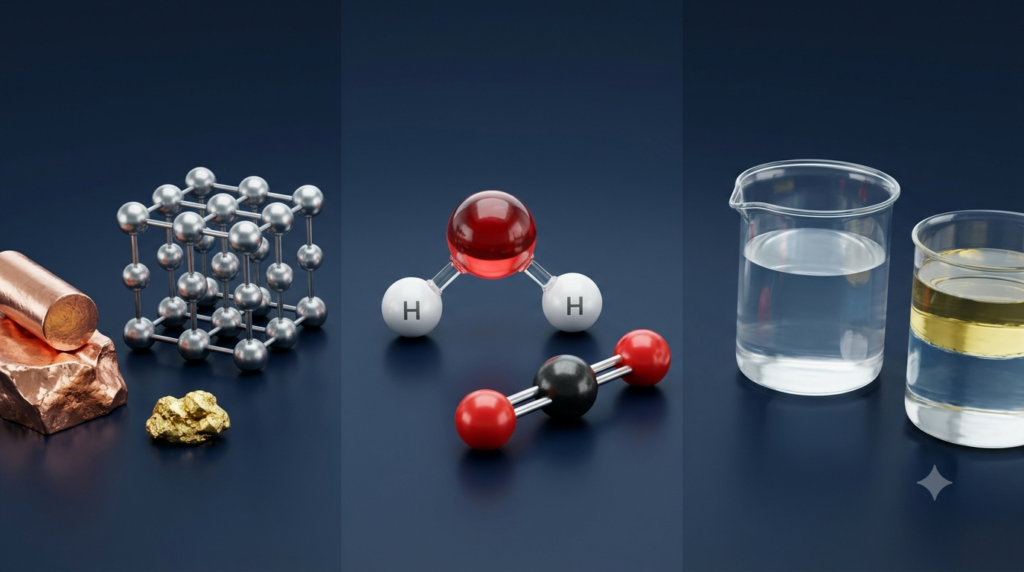
For example, an oxygen molecule contains two oxygen atoms bonded together. A water molecule contains two hydrogen atoms bonded to one oxygen atom.
Molecules are important because they help determine the chemical and physical properties of many substances.
Types of Molecules
Molecules can be classified according to whether they contain atoms of the same element or different elements.
1. Molecules of Elements
These molecules contain atoms of the same chemical element.
Examples include:
Hydrogen (H₂)
Oxygen (O₂)
Nitrogen (N₂)
Ozone (O₃)
Chlorine (Cl₂)
An oxygen molecule, O₂, consists of two oxygen atoms chemically bonded together. Ozone, O₃, contains three oxygen atoms. Although both substances contain only oxygen atoms, they have different molecular structures and properties.
2. Molecules of Compounds
These molecules contain atoms of two or more different elements chemically bonded together.
Examples include:
Water (H₂O)
Carbon dioxide (CO₂)
Methane (CH₄)
Ammonia (NH₃)
A water molecule contains two hydrogen atoms and one oxygen atom. Carbon dioxide contains one carbon atom and two oxygen atoms.
The atoms in these molecules are present in definite ratios, represented by their chemical formulas.
Chemical Formulas of Molecules
A chemical formula represents the elements present in a substance and, where appropriate, the number of atoms of each element in a molecule.
Subscripts are small numbers written to the lower right of element symbols. They indicate how many atoms of that element are represented in the formula.
For example, in H₂O, the subscript 2 indicates that there are two hydrogen atoms. Oxygen has no written subscript, meaning that one oxygen atom is present.
Text block: Common Molecular Formulas
Hydrogen = H₂
When a chemical formula has no subscript after an element symbol, the number of atoms of that element is understood to be one.
It is also important to distinguish between a subscript and a coefficient. A coefficient is written before a chemical formula and indicates the number of molecules or formula units represented.
Text block: Subscripts and Coefficients
H₂O = 1 water molecule
This distinction becomes particularly important when balancing chemical equations.
Do All Compounds Consist of Molecules?
No. Although many compounds consist of molecules, some compounds form extended structures rather than separate molecules.
For example, solid sodium chloride consists of a three-dimensional arrangement of sodium ions and chloride ions. It is not made up of separate NaCl molecules under ordinary solid-state conditions. Its formula, NaCl, represents the simplest whole-number ratio of sodium ions to chloride ions.
Similarly, many minerals and metals form extended structures. Their composition is represented by formulas or element symbols rather than by discrete molecules.
This distinction is important because the word molecule does not describe every type of chemical particle.
What Are Ions?
An ion is an atom or a group of atoms that carries a net electrical charge because electrons have been gained or lost, or because the group has a particular charged structure.
Ions are essential in chemistry, biology, electricity, and many industrial processes. They are found in salts, solutions, batteries, and living cells.
There are two main types of ions: cations and anions.
Cations: Positively Charged Ions
A cation is an ion with a positive electrical charge. It forms when an atom or group of atoms loses one or more electrons.
When an atom loses negatively charged electrons, it has more protons than electrons. This creates a net positive charge.
For example, a sodium atom has 11 protons and 11 electrons. When it loses one electron, it forms a sodium ion with 11 protons and 10 electrons.
Text block: Formation of a Sodium Ion
Sodium atom: Na
Other examples of cations include K⁺, Mg²⁺, Ca²⁺, and Al³⁺.
The charge indicates the difference between the number of protons and electrons. For instance, Mg²⁺ has a charge of +2 because it has two fewer electrons than protons.
Anions: Negatively Charged Ions
An anion is an ion with a negative electrical charge. It forms when an atom or group of atoms gains one or more electrons.
Because electrons carry negative charges, gaining electrons makes the particle negatively charged.
For example, a chlorine atom has 17 protons and 17 electrons. When it gains one electron, it forms a chloride ion with 17 protons and 18 electrons.
Text block: Formation of a Chloride Ion
Chlorine atom: Cl
Other examples of anions include O²⁻, S²⁻, and N³⁻. These ions have gained two, two, and three electrons, respectively, compared with their corresponding neutral atoms.
Monatomic and Polyatomic Ions
Ions can also be classified according to the number of atoms they contain.
Monatomic ions consist of a single charged atom. Examples include Na⁺, Cl⁻, Mg²⁺, and O²⁻.
Polyatomic ions consist of two or more atoms chemically bonded together that carry an overall electrical charge.
Common examples include:
Hydroxide (OH⁻)
Nitrate (NO₃⁻)
Sulfate (SO₄²⁻)
Carbonate (CO₃²⁻)
Ammonium (NH₄⁺)
A polyatomic ion behaves as a charged unit in many chemical reactions. For example, the ammonium ion carries a positive charge, while the sulfate ion carries a negative charge.
When writing chemical formulas containing polyatomic ions, parentheses are used when more than one copy of the entire ion is required.
Text block: Examples of Formulas Containing Polyatomic Ions
Sodium hydroxide = NaOH
In Ca(OH)₂, the subscript 2 outside the parentheses indicates that two hydroxide ions are present for every calcium ion.
Key Differences Between Atoms, Molecules, and Ions
Although atoms, molecules, and ions are related, they describe different types of chemical particles.
| Feature | Atoms | Molecules | Ions |
|---|---|---|---|
| Basic meaning | Units of elements | Chemically bonded groups of atoms | Charged atoms or groups of atoms |
| Electrical charge | Neutral if protons and electrons are equal | Often neutral, but molecular ions also exist | Positive or negative |
| Composition | Protons, neutrons in most nuclei, and electrons | Two or more chemically bonded atoms | One or more atoms with a net charge |
| Examples | He, Na, C | H₂O, O₂, CO₂ | Na⁺, Cl⁻, SO₄²⁻ |
| Formation | Atoms are the units of elements | Atoms combine through chemical bonding | Particles gain or lose electrons, or form charged groups |
One important point is that these categories are not always mutually exclusive in the broadest sense. A molecule may be neutral or charged. A charged molecule is often called a molecular ion. For example, NH₄⁺ is a polyatomic ion, and some molecular ions contain covalently bonded atoms.
The key is to identify what each term describes: an elemental unit, a bonded group of atoms, or a particle with a net electrical charge.
How Atoms, Molecules, and Ions Form Compounds
Chemical compounds form when atoms or ions combine in specific proportions. The nature of the bonding depends on the elements involved and their electronic structures.
Two important types of chemical bonding are ionic bonding and covalent bonding.
Ionic Bonding
Ionic bonding is the electrostatic attraction between oppositely charged ions. It commonly occurs when electrons are transferred from one atom to another, producing positive and negative ions.
Sodium chloride provides a familiar example. A sodium atom loses an electron to form Na⁺, while a chlorine atom gains an electron to form Cl⁻. These oppositely charged ions attract one another and form an ionic solid.
Text block: Simplified Formation of Sodium Chloride
Na → Na⁺ + e⁻
In solid sodium chloride, the ions form an extended crystal lattice. The formula NaCl indicates a one-to-one ratio of sodium ions to chloride ions.
Ionic compounds are often solids at room temperature and can conduct electricity when molten or dissolved in water, provided that their ions are free to move.
Covalent Bonding
Covalent bonding occurs when atoms share electron pairs. It is common between nonmetal atoms and produces many familiar molecules.
For example, hydrogen atoms combine to form H₂, while hydrogen and oxygen atoms combine to form H₂O.
Covalent substances may exist as gases, liquids, or solids, depending on their molecular structure and the forces between their particles.
Water molecules attract one another through intermolecular forces, including hydrogen bonding. These attractions help explain several of water’s unusual physical properties.
The Role of Chemical Particles in Everyday Life
Atoms, molecules, and ions are not merely theoretical concepts. They help explain many everyday experiences and important technological processes.
Water and Dissolved Substances
Pure water consists mainly of H₂O molecules under ordinary conditions. When table salt dissolves in water, its sodium and chloride ions separate and become surrounded by water molecules.
The resulting solution contains mobile ions, allowing it to conduct electricity more effectively than pure water.
Respiration and Photosynthesis
Oxygen molecules, O₂, are essential for aerobic cellular respiration in many organisms. During respiration, cells extract usable energy from nutrients through a series of chemical reactions.
Plants use carbon dioxide molecules, CO₂, and water in photosynthesis to produce sugars and release oxygen under suitable conditions. These processes involve changes in chemical bonds and the movement of atoms between substances.
Nerve Signals and Muscle Function
Ions such as Na⁺, K⁺, Ca²⁺, and Cl⁻ play important roles in the functioning of living cells. Differences in ion concentrations across cell membranes help generate electrical signals in nerve cells and support muscle contraction.
These biological processes demonstrate that charged particles are essential to life.
Batteries and Electrochemistry
Many batteries work through chemical reactions involving the transfer of electrons and the movement of ions. Electrons travel through an external circuit, while ions move through an electrolyte or other ion-conducting material.
Understanding atoms, molecules, and ions helps explain how batteries store and release energy and how electrochemical technologies operate.
Conservation of Atoms and Electrical Charge
Chemical reactions rearrange atoms and change how they are bonded. In ordinary chemical reactions, atoms are not created or destroyed; they are transferred between reactants and products.
For this reason, chemical equations must be balanced so that each element has the same number of atoms on both sides.
Electrical charge must also be conserved in a properly balanced chemical equation. The total charge of the reactants must equal the total charge of the products.
Text block: Example of a Balanced Chemical Equation
2H₂ + O₂ → 2H₂O
Both sides contain the same numbers of hydrogen and oxygen atoms. The equation represents two hydrogen molecules reacting with one oxygen molecule to form two water molecules.
In ionic reactions, balancing charge is equally important. For example, the total charge on both sides of an ionic equation must match, even if individual ions combine or separate.
Common Misconceptions About Atoms, Molecules, and Ions
Several misunderstandings can make introductory chemistry confusing.
Misconception 1: Every substance is made of molecules.
Not every substance consists of discrete molecules. Ionic solids such as sodium chloride form extended lattices, while metals contain extended structures of atoms and delocalized electrons.
Misconception 2: An atom becomes a different element when it gains or loses electrons.
An atom’s element identity depends on its number of protons, not its number of electrons. Losing or gaining electrons changes its charge but not its elemental identity. Changing the number of protons changes the element and requires a nuclear process rather than an ordinary chemical reaction.
Misconception 3: A molecule must contain different elements.
Molecules can contain atoms of the same element. Oxygen gas, O₂, and nitrogen gas, N₂, are familiar examples.
Misconception 4: A positive ion has gained protons during ordinary ion formation.
Most common ions form through the loss or gain of electrons. The number of protons normally remains unchanged during chemical ionization.
Misconception 5: The formula NaCl represents a separate NaCl molecule in solid table salt.
Solid sodium chloride contains a repeating ionic lattice. NaCl represents the simplest ratio of sodium ions to chloride ions rather than a discrete molecule.
Recognizing these distinctions makes chemical formulas, bonding, and reactions much easier to understand.
Conclusion
Atoms, molecules, and ions are fundamental concepts for understanding the composition and behavior of matter. Atoms are the units of chemical elements, molecules are groups of chemically bonded atoms, and ions are particles with a net electrical charge. Their structures and interactions explain how substances form, why materials have different properties, and how chemical reactions occur.
Atoms can combine through covalent bonding to form molecules or produce ions that attract one another through ionic bonding. Molecules and ions also participate in biological processes, electrical conduction, batteries, and countless industrial applications. Learning to interpret atomic symbols, chemical formulas, subscripts, coefficients, and ionic charges provides a strong foundation for further study. With these basic ideas in place, more advanced topics such as chemical equations, the periodic table, chemical bonding, acids and bases, and reaction calculations become easier to understand.
FAQs
1. What are atoms, molecules, and ions?
Atoms, molecules, and ions are three important types of chemical particles. An atom is the smallest unit of an element that retains its chemical identity. A molecule consists of two or more atoms chemically bonded together, such as H₂O or O₂. An ion is an atom or group of atoms with a net electrical charge because of an imbalance between protons and electrons. For example, Na⁺ is a positively charged ion, while Cl⁻ is a negatively charged ion. These particles form the basis of chemistry and help explain the composition, properties, and reactions of matter.
2. What is the main difference between an atom and a molecule?
The main difference is that an atom represents a single unit of an element, whereas a molecule contains two or more chemically bonded atoms. For example, helium (He) exists as individual atoms under ordinary conditions, while oxygen gas consists mainly of O₂ molecules containing two bonded oxygen atoms. Water (H₂O) is another example of a molecule because it contains two hydrogen atoms and one oxygen atom. Atoms can exist independently or combine with other atoms. Molecules may contain atoms of the same element or different elements, depending on the substance’s chemical composition.
3. How is an ion formed?
An ion forms when an atom or group of atoms develops a net electrical charge. This commonly happens when an atom gains or loses electrons during a chemical process. Losing electrons produces a positively charged ion called a cation, while gaining electrons produces a negatively charged ion called an anion. For example, a sodium atom loses one electron to form Na⁺, whereas a chlorine atom gains one electron to form Cl⁻. The number of protons usually remains unchanged during ordinary ion formation. Ions are important in chemical reactions, electrical conduction, biological processes, and the formation of ionic compounds.
4. What are cations and anions?
Cations and anions are the two main types of ions. A cation carries a positive charge because it has fewer electrons than protons. Examples include Na⁺, K⁺, Ca²⁺, and Mg²⁺. An anion carries a negative charge because it has more electrons than protons. Examples include Cl⁻, O²⁻, and S²⁻. Cations commonly form when atoms lose electrons, while anions commonly form when atoms gain electrons. Oppositely charged ions attract one another through electrostatic forces. This attraction helps form ionic compounds, such as sodium chloride, which is commonly known as table salt.
5. What is the difference between a molecule and an ion?
A molecule is a group of two or more chemically bonded atoms, while an ion is a particle with a net electrical charge. Many familiar molecules, including H₂O, CO₂, and O₂, are electrically neutral. Ions such as Na⁺ and Cl⁻ carry positive and negative charges, respectively. However, these categories can overlap because some bonded groups of atoms also carry an electrical charge. For example, NH₄⁺ is a polyatomic ion containing nitrogen and hydrogen atoms. Therefore, the main distinction is that the term molecule describes a bonded group of atoms, whereas ion describes a particle’s electrical charge.
6. What is the difference between an element and a compound?
An element is a pure substance consisting of atoms with the same number of protons. Examples include hydrogen, oxygen, iron, and copper. A compound is a substance formed when two or more different elements are chemically combined in definite proportions. Water (H₂O), for example, contains hydrogen and oxygen, while carbon dioxide (CO₂) contains carbon and oxygen. Some elements exist as molecules, such as O₂, but they still contain only one type of atom. Compounds may consist of discrete molecules or extended structures of ions or atoms. This distinction is essential for understanding chemical composition.
7. What do subscripts and coefficients mean in chemical formulas?
Subscripts and coefficients provide information about the numbers of atoms or particles represented by a chemical formula. A subscript appears after an element symbol and indicates the number of atoms of that element within the formula unit or molecule. For example, H₂O contains two hydrogen atoms and one oxygen atom. A coefficient appears before a formula and indicates how many molecules or formula units are represented. For example, 2H₂O represents two water molecules, containing four hydrogen atoms and two oxygen atoms altogether. Understanding this distinction is important when interpreting chemical formulas and balancing chemical equations.
8. Are all compounds made of molecules?
No, not all compounds consist of separate molecules. Many covalent compounds, such as water and carbon dioxide, exist as discrete molecules. However, ionic compounds such as sodium chloride form extended crystal lattices containing positively and negatively charged ions. In solid sodium chloride, NaCl represents the simplest whole-number ratio of sodium ions to chloride ions rather than an individual NaCl molecule. Some covalent substances, such as diamond and silicon dioxide in their common solid structures, form extended networks of bonded atoms. Understanding these different structures helps explain why substances have different melting points, hardness, electrical properties, and other characteristics.
9. Why are atoms, molecules, and ions important in everyday life?
Atoms, molecules, and ions are essential to nearly every physical, chemical, and biological process. Water molecules support life, oxygen molecules participate in cellular respiration, and carbon dioxide molecules are involved in photosynthesis. Ions such as sodium, potassium, calcium, and chloride help regulate nerve signals, muscle contraction, and fluid balance in living organisms. Chemical reactions rearrange atoms and change the bonds between particles, producing new substances. Ions also play important roles in batteries, electrolysis, and electrical conduction in solutions. Understanding these particles helps explain everyday materials, biological functions, energy production, and modern chemical technologies.
10. How do atoms, molecules, and ions participate in chemical reactions?
Atoms, molecules, and ions participate in chemical reactions by rearranging their connections and interactions to produce new substances. During ordinary chemical reactions, atoms are conserved, meaning that they are neither created nor destroyed. Instead, existing chemical bonds break and new bonds form. Molecules may react with other molecules, while ions can combine, separate, or exchange partners in solution. For example, hydrogen and oxygen molecules react to form water molecules. In ionic reactions, electrical charge is also conserved. Understanding how these particles behave makes it easier to interpret chemical equations, predict products, study reaction types, and explain changes in the properties of matter.