Tree counting is an important topic in computer science, discrete mathematics, data structures, and combinatorics. Trees are used to represent hierarchical relationships, organize information, model networks, and design efficient algorithms. Once a tree is understood as a mathematical structure, several useful formulas can help determine the number of vertices, edges, leaves, internal nodes, and possible tree structures.
A tree in computer science is a connected graph with no cycles. Unlike a general graph, a tree has a simple structure: there is exactly one path between any two vertices. This property makes trees especially useful for representing file systems, organization charts, search structures, expression trees, decision processes, and many algorithmic problems.
Tree counting formulas allow us to calculate structural properties without drawing the entire tree. Some formulas apply to every tree, while others depend on the type of tree, such as a binary tree, full binary tree, complete binary tree, or rooted tree.
What Is a Tree in Computer Science?
A tree is a special type of graph consisting of vertices and edges. Vertices represent objects or elements, while edges represent relationships between them.
A tree must satisfy two fundamental conditions:
It must be connected.
It must contain no cycles.
If a tree contains n vertices, it always contains exactly n − 1 edges.
For example, a tree with 5 vertices has 4 edges. Adding another vertex requires one additional edge to keep the structure connected without creating a cycle.
In a rooted tree, one vertex is selected as the root. The remaining vertices can then be described in terms of parents, children, ancestors, and descendants.
Basic Tree Counting Formula
The most fundamental formula for counting edges in a tree is based on the number of vertices.
Text block — Formula
If a tree has n vertices:
This formula applies to every finite tree, regardless of its shape.
For example, if a tree contains 12 vertices:
Number of edges = 12 − 1
Therefore, a tree with 12 vertices always has 11 edges.
This relationship is one of the most important facts in graph theory because it provides a quick way to recognize whether a connected graph can be a tree.
Vertices and Edges in a Tree
The relationship between vertices and edges can also be written in reverse.
Text block — Formula
Number of vertices = Number of edges + 1
If a tree has 20 edges, then:
Number of vertices = 20 + 1
This simple relationship is useful in algorithm analysis and graph-based programming problems.
A connected graph with n vertices and n − 1 edges is a tree if it satisfies the required tree conditions. Similarly, removing any edge from a tree disconnects it into two separate components.
Counting Leaves in a Tree
A leaf is a vertex that has no children in a rooted tree. In an unrooted tree, a leaf is generally a vertex with degree 1.
The number of leaves depends on the structure of the tree. Unlike the n − 1 edge formula, there is no single leaf-count formula for every tree.
However, for certain types of trees, especially full trees, useful formulas can be derived.
In a rooted tree, we can describe the relationship between internal nodes and leaves by considering the number of children of each internal node.
Suppose every internal node has exactly k children. Such a tree is called a full k-ary tree.
Full k-ary Tree Formula
A full k-ary tree is a rooted tree in which every internal node has exactly k children.
Let:
n = total number of vertices
I = number of internal vertices
L = number of leaves
k = number of children of every internal vertex
Each internal vertex contributes k child connections. Therefore, the total number of edges is:
kI
At the same time, every tree with n vertices has n − 1 edges.
Therefore:
Text block — Formula
kI = n − 1
Since:
n = I + L
the number of leaves can be calculated as:
Text block — Formula
L = (k − 1)I + 1
This is a useful general formula for full k-ary trees.
Full Binary Tree Formula
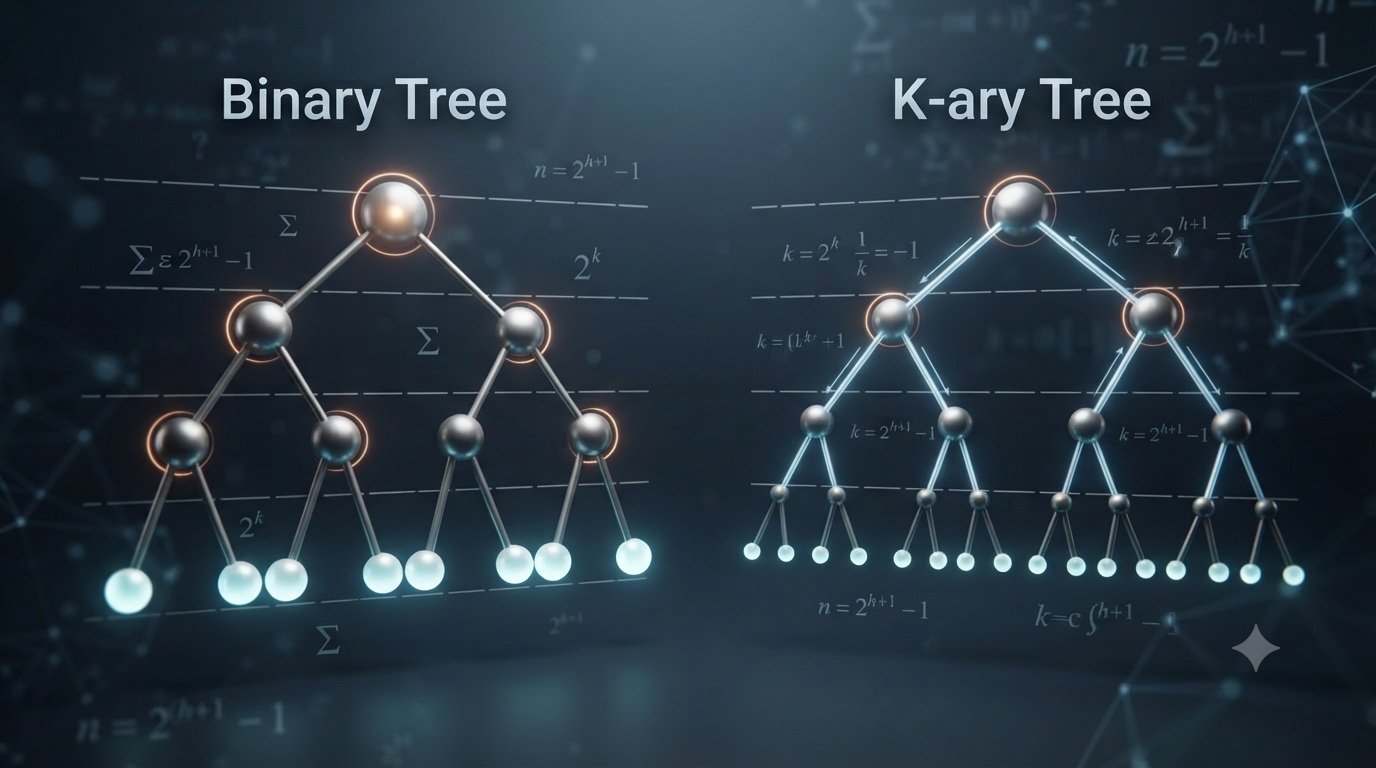
A binary tree is a tree in which each node has at most two children. A full binary tree is more specific: every internal node has exactly two children.
For a full binary tree:
Every internal node has 2 children.
Every node is either an internal node or a leaf.
Let I represent the number of internal nodes and L represent the number of leaves.
The general k-ary formula becomes:
Text block — Formula
L = I + 1
Therefore, a full binary tree with 10 internal nodes has:
L = 10 + 1
The total number of nodes is:
n = I + L
So:
n = I + (I + 1)
Thus:
Text block — Formula
Total nodes = 2I + 1
Similarly, if the number of leaves is known:
Text block — Formula
I = L − 1
and:
n = 2L − 1
These formulas are particularly useful when analyzing expression trees and other binary structures.
Counting Nodes in a Complete Binary Tree
A complete binary tree is a binary tree in which every level is completely filled except possibly the last level, which is filled from left to right.
If the tree has height h and the root is considered to be at height 0, the maximum number of nodes is:
Text block — Formula
Maximum number of nodes = 2^(h + 1) − 1
For example, a complete binary tree of height 3 can contain at most:
2^(3 + 1) − 1
Therefore, the maximum number of nodes is 15.
The maximum number of nodes at exactly level h is:
Text block — Formula
Maximum nodes at level h = 2^h
For example, level 4 can contain at most:
2^4 = 16 nodes
This relationship is important in binary heaps, binary search trees, and many recursive algorithms.
Minimum Height of a Binary Tree
For a binary tree containing n nodes, the minimum possible height occurs when the tree is as balanced as possible.
The maximum number of nodes in a binary tree of height h is:
2^(h + 1) − 1
Therefore, the minimum height needed to contain n nodes can be expressed as:
Text block — Formula
Minimum height = ⌈log₂(n + 1)⌉ − 1
For example, for 15 nodes:
⌈log₂(15 + 1)⌉ − 1
So a binary tree containing 15 nodes can have a minimum height of 3.
Maximum Height of a Binary Tree
The maximum height occurs when every node has only one child, producing a structure that looks like a chain.
For n nodes, the maximum height is:
Text block — Formula
Maximum height = n − 1
For example, a binary tree with 8 nodes can have a maximum height of:
8 − 1 = 7
This difference between minimum and maximum height explains why balanced trees can be much more efficient than highly unbalanced trees.
Counting Nodes at Each Level
In a binary tree, the number of nodes can increase by a factor of two at each level.
If the root is at level 0:
Text block — Formula
Maximum nodes at level l = 2^l
The first few levels can therefore contain:
Level 0 → 1 node
The total number of nodes from level 0 through level h is the sum:
1 + 2 + 4 + ... + 2^h
This geometric series gives:
Text block — Formula
Total nodes = 2^(h + 1) − 1
This formula appears frequently in the analysis of recursive algorithms and binary tree structures.
Number of Edges in a Full Binary Tree
Since every tree with n vertices has n − 1 edges, a full binary tree with n nodes has:
Text block — Formula
Number of edges = n − 1
If the full binary tree has I internal nodes, then:
n = 2I + 1
Therefore:
Text block — Formula
Number of edges = 2I
This also makes sense because every internal node contributes exactly two child edges.
Counting Possible Binary Trees
Tree counting can also mean counting how many different tree structures can be formed.
The number of structurally different binary trees that can be formed using n distinct nodes is given by the Catalan number.
The nth Catalan number is:
Text block — Formula
Cₙ = (1 / (n + 1)) × binomial(2n, n)
An equivalent form is:
Cₙ = (2n)! / ((n + 1)! n!)
The first few Catalan numbers are:
C₀ = 1
For example, there are 5 structurally different binary tree shapes that can be formed using 3 nodes.
Catalan numbers appear in many areas of computer science, including binary trees, expression structures, parenthesization problems, and combinatorial algorithms.
Counting Binary Search Trees
The number of different binary search tree structures that can be created using n distinct keys is also related to Catalan numbers.
The number of possible binary search trees with n distinct keys is:
Text block — Formula
Number of BSTs = Cₙ
Therefore:
Number of BSTs with 3 keys = C₃ = 5
For 4 distinct keys:
Number of BSTs with 4 keys = C₄ = 14
Although the keys may have the same values in different arrangements, their structural organization can produce different binary search trees.
This counting principle is important for understanding the number of possible tree configurations in data structures.
Counting Rooted Trees
A rooted tree has one designated root. Rooting a tree gives every non-root vertex a parent and creates a natural hierarchy.
For a rooted tree with n vertices:
Text block — Formula
Number of parent-child edges = n − 1
Every vertex except the root has exactly one parent. Therefore, there is one parent-child edge for each non-root vertex.
For example, a rooted tree with 9 vertices contains:
9 − 1 = 8 parent-child edges
This relationship is useful when representing trees using parent arrays or adjacency lists in computer programs.
Why Tree Counting Formulas Matter in Computer Science
Tree counting formulas are not only mathematical exercises. They help computer scientists understand the size and efficiency of data structures and algorithms.
Binary trees are used in:
Binary search trees
Binary heaps
Expression trees
Decision trees
File-system structures
Syntax trees
Game trees
Database indexes
Compiler design
Artificial intelligence
For example, understanding the maximum number of nodes at a particular level helps estimate the size of a binary tree. Understanding tree height helps analyze search operations. Catalan numbers help determine how many different tree structures are possible.
Tree Counting and Algorithm Complexity
Tree structure has a direct effect on algorithm performance.
A balanced binary search tree can have a height close to:
log₂ n
This means searching can often be performed efficiently.
A highly unbalanced binary search tree can have a height close to:
n − 1
In that case, the tree behaves more like a linked list.
Therefore, tree counting formulas provide more than structural information. They help explain why some tree-based algorithms are efficient while others can become slow.
Common Tree Counting Formulas at a Glance
Text block — Formula Summary
For a tree with n vertices:
Conclusion
Tree counting formulas provide a mathematical foundation for understanding tree-based data structures in computer science. The simplest and most important relationship is that a tree with n vertices always has n − 1 edges. From this foundation, additional formulas can be used to analyze leaves, internal nodes, tree height, levels, and the maximum number of nodes.
Special tree structures have their own useful relationships. Full k-ary trees connect the number of internal nodes with the number of leaves, while full binary trees provide particularly simple formulas such as L = I + 1 and n = 2I + 1. For binary trees, powers of two describe the maximum number of nodes at each level, and Catalan numbers help count different possible binary tree structures.
Learning these formulas makes it easier to analyze data structures, estimate algorithm performance, and solve combinatorial problems involving trees. They form an important part of the mathematical foundation behind computer science and algorithms.
FAQs
1. What is the basic formula for counting edges in a tree?
For a tree containing n vertices, the number of edges is always n − 1. This is one of the most fundamental properties of trees in computer science and graph theory. For example, if a tree has 10 vertices, it must have 9 edges. The formula works because a tree is connected and contains no cycles. Every time a new vertex is added to an existing tree, exactly one new edge is needed to connect it without creating a cycle. Therefore, regardless of the tree’s shape, the relationship between vertices and edges remains constant.
2. How do you calculate the number of vertices in a tree?
If the number of edges in a tree is known, the number of vertices can be calculated by adding one to the number of edges. The formula is vertices = edges + 1. For example, if a tree contains 15 edges, it must contain 16 vertices. This relationship applies to every finite tree because a tree with n vertices always has n − 1 edges. The formula is useful when working with graph representations, network structures, and algorithm problems where the number of edges is given instead of the number of vertices.
3. What is a full binary tree?
A full binary tree is a binary tree in which every node has either zero children or exactly two children. Nodes with two children are called internal nodes, while nodes with zero children are called leaves. A full binary tree has an important relationship between its internal nodes and leaves. If there are I internal nodes, the number of leaves is I + 1. Therefore, the total number of nodes is 2I + 1. These formulas are useful for analyzing expression trees, decision trees, recursive structures, and other binary tree-based data structures.
4. How do you calculate the number of leaves in a full binary tree?
In a full binary tree, the number of leaves can be calculated from the number of internal nodes. If I represents the number of internal nodes, then the number of leaves is I + 1. For example, if a full binary tree has 8 internal nodes, it has 9 leaves. This relationship occurs because every internal node has exactly two children. The formula is especially useful when the complete structure of the tree is not provided but the number of internal nodes is known. It can also be used to determine the total number of nodes.
5. What is the formula for the maximum number of nodes in a binary tree?
For a binary tree with height h, where the root is considered to be at height 0, the maximum number of nodes is 2^(h + 1) − 1. Each level can contain twice as many nodes as the previous level. For example, a binary tree with height 3 can contain a maximum of 15 nodes. The levels contain 1, 2, 4, and 8 nodes respectively. Adding these values gives 15. This formula is useful when analyzing complete binary trees, binary heaps, recursive algorithms, and the storage requirements of hierarchical data structures.
6. How many nodes can a binary tree have at a particular level?
If the root is at level 0, the maximum number of nodes at level h in a binary tree is 2^h. Therefore, level 0 can contain a maximum of 1 node, level 1 can contain 2 nodes, level 2 can contain 4 nodes, and level 3 can contain 8 nodes. The number doubles as the level increases because each node can have at most two children. This formula helps computer scientists estimate the size of binary trees and understand why the total number of nodes can grow rapidly as tree height increases.
7. What is the maximum height of a binary tree with n nodes?
The maximum height of a binary tree containing n nodes is n − 1, when the root is considered to have height 0. This happens when every node has only one child, creating a completely unbalanced tree. For example, a binary tree containing 7 nodes can have a maximum height of 6. Such a tree resembles a linked list rather than a well-balanced tree. This concept is important when analyzing the performance of binary search trees because an unbalanced tree can cause operations such as searching and insertion to require much more time.
8. What is a full k-ary tree?
A full k-ary tree is a rooted tree in which every internal node has exactly k children. If the tree contains I internal nodes, the number of leaves is calculated using the formula L = (k − 1)I + 1. For example, in a full ternary tree, each internal node has three children. If there are 5 internal nodes, the number of leaves is (3 − 1) × 5 + 1 = 11. Full k-ary trees are useful for understanding hierarchical structures, multiway search trees, decision systems, and other structures where nodes can have more than two children.
9. What are Catalan numbers used for in tree counting?
Catalan numbers are important in combinatorics and computer science because they can be used to count different structural arrangements of several objects. In tree counting, the nth Catalan number gives the number of structurally different binary trees that can be formed using n nodes under common counting assumptions. The formula is Cₙ = (1 / (n + 1)) × binomial(2n, n). The first few values are 1, 1, 2, 5, 14, and 42. Catalan numbers also appear in problems involving binary search trees, expression parenthesization, balanced structures, and other recursive arrangements.
10. Why are tree counting formulas important in computer science?
Tree counting formulas help computer scientists understand the size, structure, and efficiency of tree-based data structures. They can be used to calculate the number of edges, leaves, internal nodes, levels, and possible tree configurations without drawing the complete structure. These relationships are useful for binary search trees, heaps, expression trees, syntax trees, decision trees, and file systems. Tree height formulas are also important for analyzing algorithm performance. For example, a balanced binary tree can have a height close to log₂ n, while an unbalanced tree can have a height close to n − 1.