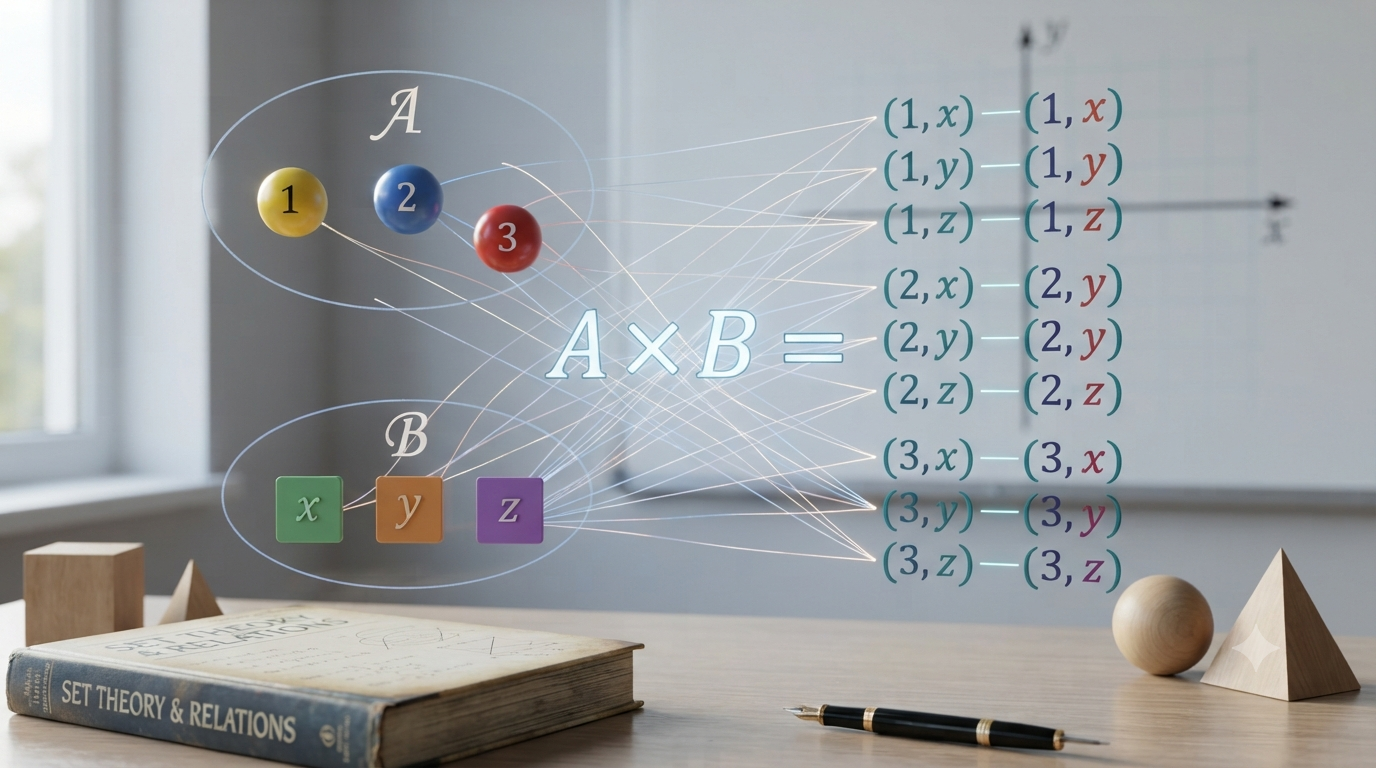
The Cartesian product is an important concept in set theory that helps us combine elements from two or more sets in an ordered way. It is widely used in mathematics, coordinate geometry, relations, functions, probability, and computer science. The main idea is simple: when two sets are given, the Cartesian product forms all possible ordered pairs by taking one element from the first set and one element from the second set.
For example, if one set contains the numbers 1 and 2 and another set contains the letters A and B, their Cartesian product contains four ordered pairs: (1, A), (1, B), (2, A), and (2, B).
Understanding the Cartesian product becomes much easier once we understand sets, ordered pairs, and the difference between an ordered pair and an ordinary combination. This article explains the meaning of the Cartesian product, its basic formula, how to calculate it, its important properties, and its applications.
What Is a Cartesian Product?
The Cartesian product of two sets A and B is the set of all possible ordered pairs in which the first element comes from A and the second element comes from B.
The Cartesian product of A and B is written as:
A × B
It is read as “A cross B.”
The basic definition is:
A × B = {(a, b) | a ∈ A and b ∈ B}
This means that every element of A is paired with every element of B.
The position of the elements matters. In general:
(a, b) ≠ (b, a)
Therefore, the Cartesian product A × B is usually different from B × A.
Example of a Cartesian Product
Suppose:
A = {1, 2}
and
B = {x, y}
To find A × B, pair each element of A with every element of B.
Therefore:
A × B = {(1, x), (1, y), (2, x), (2, y)}
There are four ordered pairs in the Cartesian product.
Understanding Ordered Pairs
An ordered pair is a pair of elements written inside parentheses, such as:
(a, b)
The first position contains a specific element, and the second position contains another element.
For two ordered pairs to be equal, their corresponding elements must be equal.
For example:
(2, 5) = (2, 5)
but:
(2, 5) ≠ (5, 2)
This is important when working with Cartesian products because the order of the sets determines the positions of the elements.
In A × B, the element from A always comes first, while the element from B comes second.
Basic Formula of the Cartesian Product
The most important formula for the Cartesian product is based on the number of elements in the sets.
If set A has m elements and set B has n elements, then:
n(A × B) = n(A) × n(B)
or simply:
|A × B| = |A| × |B|
Here:
|A| represents the number of elements in A.
|B| represents the number of elements in B.
|A × B| represents the number of ordered pairs in A × B.
This formula tells us how many ordered pairs will be present without requiring us to list every pair.
Example
Suppose:
A = {1, 2, 3}
and:
B = {a, b}
Set A contains 3 elements, while set B contains 2 elements.
Therefore:
|A × B| = 3 × 2 = 6
So, A × B contains 6 ordered pairs.
Listing them gives:
A × B = {(1, a), (1, b), (2, a), (2, b), (3, a), (3, b)}
The formula and the actual list give the same result.
How to Find the Cartesian Product
Finding a Cartesian product involves a simple systematic process.
Step 1: Write the first set
Start with all the elements of the first set.
For example:
A = {1, 2, 3}
Step 2: Write the second set
Suppose:
B = {p, q}
Step 3: Pair the first element of A with every element of B
The first element is 1.
So we form:
(1, p)
and:
(1, q)
Step 4: Repeat for the remaining elements of A
For 2:
(2, p)
and:
(2, q)
For 3:
(3, p)
and:
(3, q)
Step 5: Collect all ordered pairs
Therefore:
A × B = {(1, p), (1, q), (2, p), (2, q), (3, p), (3, q)}
This method ensures that no possible ordered pair is missed.
Cartesian Product Example With Numbers
Consider:
A = {2, 4}
and:
B = {1, 3, 5}
The Cartesian product A × B is:
A × B = {(2, 1), (2, 3), (2, 5), (4, 1), (4, 3), (4, 5)}
Set A has 2 elements and set B has 3 elements.
Therefore:
|A × B| = 2 × 3 = 6
There are six ordered pairs.
Notice that every element of A is paired with every element of B.
Cartesian Product in the Reverse Order
Now consider B × A instead of A × B.
Using the previous example:
B = {1, 3, 5}
and:
A = {2, 4}
Therefore:
B × A = {(1, 2), (1, 4), (3, 2), (3, 4), (5, 2), (5, 4)}
Although both products contain six ordered pairs, they are not the same sets.
This happens because the order of the elements changes.
In general:
A × B ≠ B × A
unless there are special circumstances, such as both sets being empty.
This is one of the most important properties to remember.
Cartesian Product of a Set With Itself
A set can also be multiplied by itself.
If:
A = {1, 2, 3}
then:
A × A
contains all ordered pairs in which both elements come from A.
Therefore:
A × A = {(1, 1), (1, 2), (1, 3), (2, 1), (2, 2), (2, 3), (3, 1), (3, 2), (3, 3)}
Since A has 3 elements:
|A × A| = 3 × 3 = 9
The set A × A is also called the Cartesian square of A in many mathematical contexts.
Cartesian Product of Three Sets
The idea can be extended to three sets.
Suppose:
A = {1, 2}
B = {a, b}
C = {x, y}
The Cartesian product is written as:
A × B × C
Each element is an ordered triple:
(a, b, c)
where:
the first element comes from A,
the second element comes from B,
the third element comes from C.
The number of ordered triples is:
|A × B × C| = |A| × |B| × |C|
In this example:
|A × B × C| = 2 × 2 × 2 = 8
So there are eight possible ordered triples.
General Formula for Multiple Sets
The same idea works for more than three sets.
If there are sets:
A₁, A₂, A₃, …, Aₖ
then the Cartesian product is:
A₁ × A₂ × A₃ × … × Aₖ
The number of elements is:
|A₁ × A₂ × A₃ × … × Aₖ| = |A₁| × |A₂| × |A₃| × … × |Aₖ|
This is essentially the multiplication principle. Every choice from one set can be combined with every choice from the other sets.
Cartesian Product and Coordinate Geometry
The Cartesian product has a direct connection with coordinate geometry.
Consider the real numbers:
R × R
This represents all ordered pairs:
(x, y)
where both x and y are real numbers.
These ordered pairs can be represented as points on a two-dimensional Cartesian coordinate plane.
For example:
(2, 3)
represents the point whose x-coordinate is 2 and y-coordinate is 3.
Similarly:
R × R × R
represents ordered triples:
(x, y, z)
which can be used to describe points in three-dimensional space.
Therefore, Cartesian products provide an important mathematical foundation for coordinate systems.
Cartesian Product and Relations
Cartesian products are also closely connected to relations.
A relation from set A to set B is often defined as a subset of:
A × B
For example, let:
A = {1, 2, 3}
and:
B = {2, 4, 6}
The Cartesian product contains every possible ordered pair between A and B.
A relation may select only some of those pairs, such as:
R = {(1, 2), (2, 4), (3, 6)}
Here, R is a subset of A × B.
This idea is important for understanding mathematical relations and functions.
Cartesian Product and Functions
Functions can also be understood using Cartesian products.
A function from A to B assigns each element of A to exactly one element of B.
The ordered pairs representing the function are selected from:
A × B
For example:
A = {1, 2, 3}
and:
B = {2, 4, 6}
A function may be:
f = {(1, 2), (2, 4), (3, 6)}
Every ordered pair belongs to A × B.
Therefore, the Cartesian product provides the larger set of possible input-output pairs from which a function can be formed.
Important Properties of Cartesian Products
The Cartesian product has several useful properties.
1. The Order Matters
In general:
A × B ≠ B × A
The first set determines the first element of each ordered pair, and the second set determines the second element.
2. Number of Elements
If A and B are finite sets:
|A × B| = |A| × |B|
This is the basic counting formula.
3. Empty Set Property
If either set is empty, the Cartesian product is empty.
For example:
A × ∅ = ∅
and:
∅ × A = ∅
There are no elements available to form ordered pairs.
4. Cartesian Product With Itself
For a finite set A:
|A × A| = |A|²
If A contains 5 elements, then A × A contains:
5² = 25
ordered pairs.
5. Product of Multiple Sets
For three finite sets:
|A × B × C| = |A| × |B| × |C|
The same multiplication rule continues for more sets.
Common Mistakes When Finding Cartesian Products
Students often make a few common mistakes while working with Cartesian products.
Forgetting the Order
A common mistake is to assume:
(a, b) = (b, a)
This is generally false.
Ordered pairs depend on position.
Missing Some Pairs
If A contains 3 elements and B contains 4 elements, the Cartesian product must contain:
3 × 4 = 12
ordered pairs.
If fewer than 12 pairs are listed, some pairs have been missed.
Adding Instead of Multiplying
Another common error is to calculate:
|A| + |B|
instead of:
|A| × |B|
The Cartesian product uses multiplication because every element of one set is paired with every element of the other set.
Confusing Cartesian Product With Union
The union A ∪ B collects the elements that belong to A, B, or both.
The Cartesian product A × B creates ordered pairs.
For example, if:
A = {1, 2}
and:
B = {3, 4}
then:
A ∪ B = {1, 2, 3, 4}
while:
A × B = {(1, 3), (1, 4), (2, 3), (2, 4)}
These are completely different operations.
Real-World Applications of Cartesian Products
The Cartesian product may seem abstract at first, but the idea appears in many practical situations.
Suppose a shop offers:
3 shirt colors
2 sizes
4 styles
The number of possible combinations can be calculated using multiplication:
3 × 2 × 4 = 24
This is conceptually similar to a Cartesian product of three sets.
In computer science, Cartesian products can be used when combining records from different datasets. In databases, a Cartesian product can combine every row from one table with every row from another table.
In probability, Cartesian products can represent all possible outcomes of multiple experiments.
For example, when a coin is tossed and a die is rolled, the possible outcomes can be represented using ordered pairs. The first element can represent the coin result and the second element can represent the die result.
A Quick Example for Practice
Let:
A = {1, 2, 3}
and:
B = {a, b, c, d}
Find A × B and determine its number of elements.
Since:
|A| = 3
and:
|B| = 4
the basic formula gives:
|A × B| = 3 × 4 = 12
The Cartesian product is:
A × B = {(1, a), (1, b), (1, c), (1, d), (2, a), (2, b), (2, c), (2, d), (3, a), (3, b), (3, c), (3, d)}
There are exactly 12 ordered pairs.
Conclusion
The Cartesian product is a fundamental concept in set theory that creates all possible ordered pairs from two sets. For sets A and B, the Cartesian product is written as A × B, where the first element of each ordered pair comes from A and the second comes from B.
The most important formula to remember is:
|A × B| = |A| × |B|
This formula makes it easy to determine the number of ordered pairs without listing them individually. Cartesian products also form the foundation for understanding relations, functions, coordinate geometry, probability, databases, and many areas of computer science.
The key idea is simple: take every element of the first set and pair it with every element of the second set, while keeping the order of the elements important. Once this idea is clear, more advanced concepts involving relations, functions, and multidimensional coordinate systems become much easier to understand.
FAQs
1. What is a Cartesian product?
The Cartesian product of two sets is the set of all possible ordered pairs formed by taking one element from the first set and one element from the second set. It is written as A × B. For example, if A = {1, 2} and B = {a, b}, then A × B = {(1, a), (1, b), (2, a), (2, b)}. The first element of every ordered pair comes from A, while the second comes from B. The order is important, so (1, a) and (a, 1) are generally different ordered pairs.
2. What is the basic formula for a Cartesian product?
The basic formula for the Cartesian product of two finite sets is |A × B| = |A| × |B|. Here, |A| represents the number of elements in set A, |B| represents the number of elements in set B, and |A × B| represents the number of ordered pairs in their Cartesian product. For example, if A contains 4 elements and B contains 3 elements, then A × B contains 4 × 3 = 12 ordered pairs. This formula allows you to determine the size of a Cartesian product without listing every ordered pair individually.
3. Why is the Cartesian product called an ordered product?
The Cartesian product is called an ordered product because the position of each element in an ordered pair matters. In A × B, the first element must come from A and the second must come from B. Therefore, the ordered pair (a, b) is generally different from (b, a). For example, (2, 5) and (5, 2) are different ordered pairs. This ordering is important in mathematics because it allows ordered pairs to represent coordinates, relationships, and input-output connections. The word “ordered” emphasizes that changing the positions can change the meaning of the pair.
4. Is A × B equal to B × A?
Generally, A × B is not equal to B × A because the order of the sets determines the order of elements in every pair. For example, if A = {1, 2} and B = {a, b}, then A × B contains (1, a), (1, b), (2, a), and (2, b). However, B × A contains (a, 1), (a, 2), (b, 1), and (b, 2). Although both products contain the same number of ordered pairs, their ordered pairs are different. Therefore, Cartesian products are generally not commutative.
5. How do you find the Cartesian product of two sets?
To find the Cartesian product of two sets, take each element of the first set and pair it with every element of the second set. For example, let A = {1, 2} and B = {x, y, z}. Start with 1 and form (1, x), (1, y), and (1, z). Then use 2 to form (2, x), (2, y), and (2, z). Therefore, A × B = {(1, x), (1, y), (1, z), (2, x), (2, y), (2, z)}. The product contains 2 × 3 = 6 ordered pairs.
6. What happens if one of the sets is empty?
If either set in a Cartesian product is empty, the entire Cartesian product is empty. For example, if A = {1, 2, 3} and B = ∅, then A × B = ∅. This happens because forming an ordered pair requires one element from each set. Since the empty set has no elements, there is nothing available to pair with the elements of A. Similarly, ∅ × A = ∅. In terms of the counting formula, this is also clear because |A| × |∅| = |A| × 0 = 0.
7. What is A × A in set theory?
A × A is the Cartesian product of a set with itself. It contains every possible ordered pair in which both elements come from the same set A. For example, if A = {1, 2}, then A × A = {(1, 1), (1, 2), (2, 1), (2, 2)}. If A has n elements, then the number of ordered pairs in A × A is n². This is because each of the n elements in the first position can be paired with each of the n elements in the second position.
8. How is the Cartesian product related to functions?
The Cartesian product provides the set of all possible ordered pairs that can be considered when defining a relation or function between two sets. If a function maps elements of A to elements of B, its ordered pairs are selected from A × B. For example, if A = {1, 2, 3} and B = {2, 4, 6}, a function may contain {(1, 2), (2, 4), (3, 6)}. Each pair belongs to A × B. A function has the additional requirement that every element of A is associated with exactly one element of B.
9. How is the Cartesian product used in coordinate geometry?
Cartesian products provide the mathematical foundation for coordinate systems. The Cartesian product R × R, where R represents the set of real numbers, consists of all ordered pairs (x, y) of real numbers. Each ordered pair can represent a point on a two-dimensional coordinate plane. For example, (3, 4) represents the point with x-coordinate 3 and y-coordinate 4. Similarly, R × R × R consists of ordered triples (x, y, z), which can represent points in three-dimensional space. Thus, Cartesian products connect set theory with coordinate geometry.
10. What are the main applications of Cartesian products?
Cartesian products are used in many areas of mathematics and computer science. In set theory, they help define relations and functions. In coordinate geometry, ordered pairs and triples represent points in two- and three-dimensional spaces. In probability, Cartesian products can describe possible outcomes of multiple experiments. In computer science and databases, Cartesian products can combine every possible record from one collection with every record from another. They are also useful for counting possible combinations. The central idea remains the same: every element from one set is systematically paired with every element from another set.