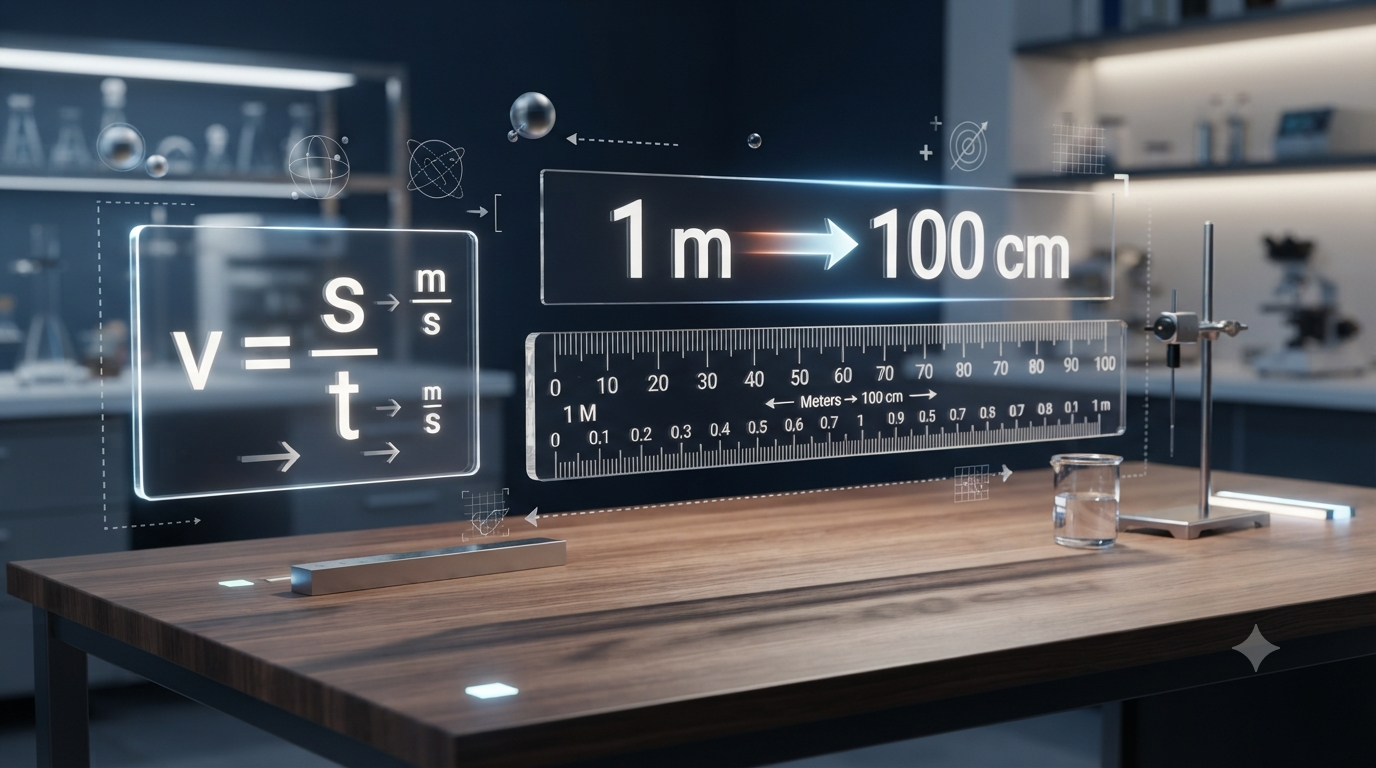
When we change the unit used to measure a physical quantity, the quantity itself does not necessarily change. However, its numerical value can change. This often creates confusion when using physics formulas. For example, a length of 1 metre can also be written as 100 centimetres. The physical length remains exactly the same, but the numerical value changes from 1 to 100 because the unit has changed.
This idea becomes especially important when substituting values into formulas. A formula may give a different numerical result if the quantities are expressed in different units without properly converting them. In some situations, changing a unit appears to change a numerical value in the formula, while in other situations the final physical result remains unchanged.
Understanding the difference between a physical quantity, its numerical value, and its unit helps explain why this happens. It also shows why unit conversion and dimensional consistency are essential when solving physics problems.
A Physical Quantity Has a Numerical Value and a Unit
A physical quantity can be thought of as the combination of a numerical value and a unit.
For example:
Length = 5 m
Here, 5 is the numerical value and metre (m) is the unit.
The same length can be expressed as:
Length = 500 cm
The numerical value has changed from 5 to 500, but the actual physical length has not changed.
This happens because centimetre is a smaller unit than metre. More centimetre units are therefore needed to describe the same physical length.
In general, a physical quantity can be represented as:
Physical quantity = Numerical value × Unit
For example:
5 m = 5 × metre
Since 1 metre is equal to 100 centimetres:
1 m = 100 cm
we can see that:
5 m = 500 cm
The number changes because the size of the measuring unit changes.
Why Does the Numerical Value Change?
Suppose you have a length of 2 metres. If you measure it using metres, the numerical value is 2.
Length = 2 m
Now change the unit to centimetres.
Since:
1 m = 100 cm
we get:
2 m = 200 cm
The numerical value has changed from 2 to 200.
But nothing physically happened to the object. Its length did not become 100 times greater. Only the unit used to describe the length became 100 times smaller.
This is the key idea:
Changing the unit can change the numerical value without changing the physical quantity.
If the new unit is smaller, the numerical value becomes larger. If the new unit is larger, the numerical value becomes smaller.
For example:
1 km = 1000 m
Therefore:
3 km = 3000 m
The numerical value increases when kilometres are changed to metres.
Similarly:
2000 m = 2 km
The numerical value decreases when metres are changed to kilometres.
What Happens When a Quantity Appears in a Formula?
The situation becomes more interesting when a physical quantity is used inside a formula.
Consider the simple formula for speed:
v = s / t
where:
v = speed
Suppose an object travels 100 metres in 20 seconds.
v = 100 m / 20 s
Now express the same distance in centimetres:
100 m = 10,000 cm
The calculation becomes:
v = 10,000 cm / 20 s
The numerical value changed from 5 to 500, but the speed did not physically change.
Both results describe the same speed:
5 m/s = 500 cm/s
Therefore, changing the unit can change the numerical value of the result while leaving the physical quantity unchanged.
The Formula Does Not Change, but Its Numerical Representation Can
A physical formula expresses a relationship between quantities. For example:
v = s / t
This relationship does not depend on whether distance is measured in metres, kilometres, or centimetres.
However, the numerical values substituted into the formula do depend on the units.
Suppose:
s = 5 m
Then:
v = 5 / 2
If the distance is converted to centimetres:
5 m = 500 cm
the same formula gives:
v = 500 / 2
The numerical value changed from 2.5 to 250 because the unit of distance changed.
But:
2.5 m/s = 250 cm/s
So the physical answer is consistent.
Why Does This Become Important in Formulas With Powers?
Unit changes become even more noticeable when a quantity is squared, cubed, or raised to another power.
Consider the formula for the area of a square:
A = l²
Suppose the side length is 2 metres.
A = (2 m)²
Now convert the side length to centimetres:
2 m = 200 cm
Using centimetres:
A = (200 cm)²
The numerical value changed from 4 to 40,000.
At first, this may look like a huge change. But the area itself has not changed.
The important point is that the unit is also squared.
Since:
1 m = 100 cm
then:
1 m² = 10,000 cm²
Therefore:
4 m² = 40,000 cm²
The result is exactly the same physical area.
Cubed Quantities Change Even More
Consider volume:
V = l³
Suppose the side of a cube is 1 metre.
V = (1 m)³
Convert the side length to centimetres:
1 m = 100 cm
Then:
V = (100 cm)³
The numerical value changes from 1 to 1,000,000.
This happens because:
1 m³ = 1,000,000 cm³
A change in the unit of a quantity can therefore produce a much larger change in the numerical value when that quantity is raised to a power.
Why Must Units Be Consistent in a Formula?
A formula usually requires quantities to be expressed in compatible units.
Consider the equation for kinetic energy:
K = ½mv²
Suppose:
m = 2 kg
Then:
K = ½ × 2 × (10)²
Now imagine that velocity is given as 36 km/h instead of 10 m/s.
These two speeds are actually equivalent:
36 km/h = 10 m/s
If we use 36 directly in the formula while treating it as metres per second, we would get an incorrect result.
Incorrect approach:
K = ½ × 2 × (36)²
The correct approach is to first convert the velocity:
36 km/h = 10 m/s
Then:
K = ½ × 2 × (10)²
The formula itself did not fail. The problem was that the numerical value 36 was associated with kilometres per hour, not metres per second.
Changing Units Does Not Change a Physical Law
A physics formula represents a relationship between physical quantities. Changing units does not change that physical relationship.
For example, Newton’s second law is:
F = ma
Whether mass is measured in kilograms or grams and acceleration is measured in metres per second squared, the physical relationship remains the same.
However, the numerical value of force depends on the units selected.
Using SI units:
m = 2 kg
we get:
F = 2 × 3
If mass is expressed as 2000 grams, then the acceleration and resulting force must be handled using compatible units.
The important principle is that the numerical values and units work together.
A number by itself does not completely represent a physical quantity.
The Role of SI Units
The International System of Units, commonly called the SI system, provides a consistent set of units for physics.
Common SI units include:
Length → metre (m)
Using SI units makes calculations easier because many physics formulas are conventionally expressed using these units.
For example, when calculating kinetic energy:
K = ½mv²
using kilograms for mass and metres per second for velocity gives the result directly in joules.
This does not mean other units cannot be used. They can, provided the units are handled consistently.
Why the Final Physical Quantity Can Stay the Same
It is useful to distinguish between a numerical value and a physical quantity.
For example:
5 m
and:
500 cm
have different numerical values but represent the same physical quantity.
Similarly:
5 m/s
and:
500 cm/s
have different numerical values but represent the same speed.
The numerical value depends on the chosen unit.
The physical quantity does not.
This distinction is one of the foundations of measurement in physics.
A Simple Rule to Remember
Whenever you change the unit of a quantity, remember:
A smaller unit usually produces a larger numerical value, while a larger unit produces a smaller numerical value.
For example:
1 m = 100 cm
Therefore:
2 m = 200 cm
The physical quantities remain unchanged.
When these quantities are inserted into formulas, the corresponding units must also be considered.
Unit Conversion and Dimensional Consistency
Another important idea is dimensional consistency.
For example, consider the equation:
s = ut + ½at²
The quantity on the left is displacement.
The terms on the right must also have the dimensions of displacement.
For the first term:
ut = (m/s)(s) = m
For the second term:
at² = (m/s²)(s²) = m
Therefore, every term has the same dimension.
If we change the units, the numerical values may change, but the dimensions and physical meaning must remain consistent.
This is why dimensional analysis is such a useful tool for checking physics equations.
Why You Should Not Change Only the Number
One of the most common mistakes in physics is changing the numerical value without changing its unit.
For example:
1 m = 100 cm
It is incorrect to write:
1 m = 100 m
The number and unit must always be treated together.
Similarly, if:
10 m/s = 36 km/h
we cannot simply replace 10 with 36 without also changing the unit.
The correct statement is:
10 m/s = 36 km/h
not:
10 m/s = 36 m/s
The numerical value is meaningful only when its unit is known.
Conclusion
Changing the unit of a physical quantity can change its numerical value because different units represent different-sized portions of the same quantity. A length of 1 metre becomes 100 centimetres, but the physical length remains unchanged.
When a quantity appears in a formula, changing its unit also changes the numerical value used in the calculation. If the units are converted correctly and consistently, the final physical result remains equivalent. This becomes especially important when quantities are squared or cubed, because the unit conversion is also raised to the corresponding power.
The key lesson is simple: the numerical value depends on the unit, but the physical quantity does not. Always consider the number and its unit together, and make sure the units used in a formula are compatible. This approach prevents calculation errors and makes physics formulas much easier to understand and apply.
FAQs
1. Why does changing the unit change the numerical value?
Changing the unit changes the numerical value because different units represent different sizes of the same quantity. For example, 1 metre is equal to 100 centimetres. Therefore, the numerical value changes from 1 to 100 when metres are changed to centimetres. However, the physical length remains exactly the same. The number and unit work together to represent a physical quantity. A smaller unit requires a larger numerical value, while a larger unit requires a smaller numerical value. Therefore, changing the unit does not change the actual quantity; it only changes how that quantity is expressed.
2. Does changing the unit change the physical quantity?
No, changing the unit does not change the physical quantity itself. It only changes the way the quantity is represented. For example, 5 metres and 500 centimetres describe exactly the same length. The numerical values are different, but the physical length is identical. Similarly, 10 metres per second and 36 kilometres per hour represent the same speed. The unit determines the numerical value needed to describe a quantity. Therefore, when converting units correctly, the physical quantity remains unchanged. This distinction between the numerical value and the physical quantity is fundamental to understanding measurements and physics formulas.
3. Why does a smaller unit give a larger numerical value?
A smaller unit gives a larger numerical value because more smaller units are required to represent the same physical quantity. For example, one metre contains 100 centimetres. Therefore, a length of 3 metres contains 300 centimetres. The numerical value changes from 3 to 300 because the centimetre is smaller than the metre. Similarly, one kilometre contains 1000 metres, so 2 kilometres equals 2000 metres. The physical distance does not increase when expressed in metres. Only the number of units needed to describe it increases. Thus, smaller units generally produce larger numerical values for the same quantity.
4. Can changing units change the answer obtained from a formula?
Changing units can change the numerical value of an answer, but it should not change the physical result if the conversion is done correctly. For example, a speed calculated as 5 m/s can also be expressed as 18 km/h. The numerical values are different, but both represent the same speed. Problems occur when a value is converted incorrectly or when its unit is ignored during substitution. Every quantity in a formula must be expressed using compatible units. Therefore, changing units may change the numerical representation of an answer, but the actual physical quantity represented by that answer remains the same.
5. Why are units important when using physics formulas?
Units are important because they tell us what a numerical value actually represents. A number without its unit may not provide enough information about a physical quantity. For example, 20 could represent 20 metres, 20 seconds, or 20 kilograms. Physics formulas combine quantities with specific relationships between their units and dimensions. If incompatible units are used without conversion, the numerical result can be incorrect. Converting quantities into compatible units before substitution helps prevent errors. Units also allow us to check whether an equation is dimensionally consistent. Therefore, keeping track of units is an essential part of solving physics problems correctly.
6. Why does squaring a quantity make unit conversion more noticeable?
When a quantity is squared, its conversion factor is also squared. This can make the numerical change much larger. For example, 1 metre equals 100 centimetres. However, 1 square metre equals 10,000 square centimetres because the conversion factor is squared. If the side of a square is 2 metres, its area is 4 square metres. In centimetres, the side is 200 centimetres, giving an area of 40,000 square centimetres. Both results describe the same area. Therefore, when quantities are squared, cubed, or raised to another power, the unit conversion must also be raised to that same power.
7. What happens when a quantity is cubed and its unit is changed?
When a quantity is cubed, the unit conversion factor is also cubed. This can produce a very large change in the numerical value. For example, 1 metre equals 100 centimetres, but 1 cubic metre equals 1,000,000 cubic centimetres. This happens because the conversion factor 100 is raised to the third power. Therefore, a volume of 2 cubic metres becomes 2,000,000 cubic centimetres. Although the numerical value changes dramatically, the physical volume remains exactly the same. The important rule is that when a quantity is raised to a power, its unit must also be raised to that same power.
8. What is the difference between a numerical value and a physical quantity?
A numerical value is the number used to express a measurement in a particular unit, while a physical quantity includes both the numerical value and its unit. For example, in 5 metres, 5 is the numerical value and metre is the unit. The same physical quantity can be written as 500 centimetres. Here, the numerical value changes from 5 to 500, but the physical quantity remains unchanged. This distinction is important because numerical values depend on the selected unit. Therefore, when comparing measurements or substituting values into formulas, both the numerical value and its unit must always be considered together.
9. Why must units be converted before substituting values into formulas?
Units should be converted before substitution when a formula requires compatible units. For example, if a speed formula uses metres per second but the given speed is in kilometres per hour, directly using the numerical value without conversion can produce an incorrect result. Consider 36 km/h, which is equal to 10 m/s. If 36 is incorrectly used as though it were 36 m/s, the calculation will be wrong. Converting units first ensures that every numerical value corresponds to the unit expected by the formula. This makes calculations reliable and helps maintain dimensional consistency throughout the solution.
10. How can unit conversion help prevent mistakes in physics?
Unit conversion is one of the simplest ways to prevent mistakes in physics calculations. Before using a formula, identify the units required for each quantity and convert the given values accordingly. For example, if a formula requires metres and seconds, convert kilometres to metres and hours to seconds when necessary. After calculating the result, check whether the final unit is appropriate for the quantity being calculated. Dimensional analysis can also help identify errors. If the units on the two sides of an equation do not match, something may be wrong. Careful attention to units makes calculations clearer and more dependable.