When using a mathematical or scientific formula, getting the correct answer is not only about putting the right numbers into the formula. You also need to perform the mathematical operations in the correct order. This is why the order of operations matters when using a formula.
A formula may contain several operations such as addition, subtraction, multiplication, division, powers, and brackets. If these operations are performed in the wrong order, the final answer can be completely different from the correct result.
For example, consider the formula:
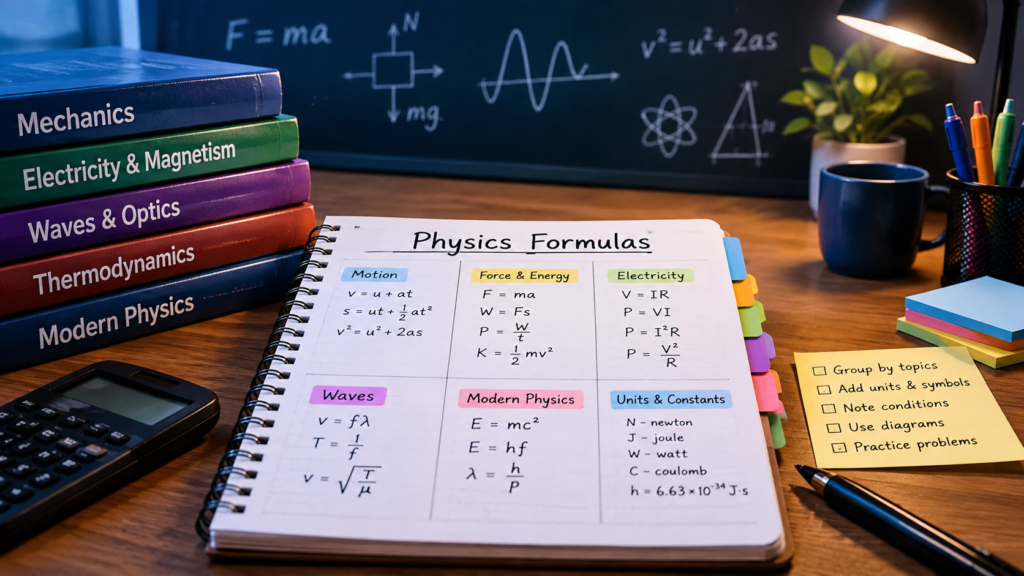
v = u + at
where v is final velocity, u is initial velocity, a is acceleration, and t is time.
Suppose:
u = 10 m/s, a = 2 m/s², and t = 5 s
The correct calculation is:
v = 10 + (2 × 5)
First multiply:
2 × 5 = 10
Then add:
10 + 10 = 20 m/s
Therefore:
v = 20 m/s
If someone adds 10 and 2 first and then multiplies by 5, they would get a different result. The formula itself has not changed; the mistake comes from performing the operations in the wrong order.
Understanding the order of operations helps you use formulas accurately in mathematics, physics, chemistry, engineering, and many other areas of science.
What Is the Order of Operations?
The order of operations is a set of rules that tells us which mathematical operations should be performed first when an expression contains more than one operation.
The commonly used order is:
Brackets or parentheses
Orders, powers, or exponents
Multiplication and division
Addition and subtraction
This is often remembered using terms such as BODMAS, BIDMAS, or PEMDAS, depending on the convention being used.
The important point is that multiplication does not always come before division, and addition does not always come before subtraction. Operations at the same level are normally performed from left to right.
For example:
20 ÷ 5 × 2
First:
20 ÷ 5 = 4
Then:
4 × 2 = 8
So the answer is 8, not 2.
The same principle applies when calculating values from formulas.
Why Is the Order of Operations Important in a Formula?
A formula is a mathematical relationship between quantities. When you substitute values into a formula, you create a mathematical expression that must be evaluated correctly.
The order of operations ensures that the expression has one consistent meaning.
Consider:
A = l × w
If the length is 8 cm and the width is 5 cm:
A = 8 × 5
A = 40 cm²
This is simple because there is only one operation.
However, formulas often contain several operations.
For example:
s = ut + ½at²
This formula for displacement contains multiplication, a power, and addition.
Suppose:
u = 4 m/s
t = 3 s
a = 2 m/s²
Substituting the values gives:
s = (4 × 3) + ½ × 2 × 3²
The exponent must be calculated first:
3² = 9
Then the multiplication:
4 × 3 = 12
and:
½ × 2 × 9 = 9
Finally:
12 + 9 = 21 m
Therefore:
s = 21 m
If the operations are performed in another order, the result may be incorrect.
Brackets Have an Important Role in Formulas
Brackets are particularly important because they tell us which parts of an expression should be treated together.
Consider the formula:
a = (v – u) / t
Suppose:
v = 20 m/s
u = 5 m/s
t = 3 s
First calculate the expression inside the brackets:
v – u = 20 – 5 = 15
Then divide:
a = 15 / 3
a = 5 m/s²
The brackets make it clear that the subtraction must happen before the division.
Without the brackets, an expression such as:
v – u / t
would normally be interpreted differently because division is performed before subtraction.
Therefore, brackets are not simply decorative symbols. They can change the meaning of a formula.
Powers and Exponents Must Be Evaluated Correctly
Many scientific formulas contain squares, cubes, or other powers.
For example:
A = πr²
This formula gives the area of a circle.
Suppose:
r = 5 cm
Substitute the value:
A = π × 5²
The exponent must be evaluated first:
5² = 25
Therefore:
A = π × 25
Using π ≈ 3.14:
A ≈ 78.5 cm²
A common mistake is to multiply the radius by π first and then square the result. That does not follow the formula correctly.
The exponent belongs to the radius, not to the entire expression.
This is why understanding the placement of powers and brackets is essential.
Multiplication and Division Are Performed Before Addition and Subtraction
Consider the expression:
10 + 4 × 3
The multiplication must be performed first:
4 × 3 = 12
Then:
10 + 12 = 22
The answer is therefore 22.
If you simply calculate from left to right without following the order of operations, you might calculate:
10 + 4 = 14
and then:
14 × 3 = 42
That answer is incorrect.
The same idea applies to formulas.
Consider:
P = VI
where P is power, V is voltage, and I is current.
Here, the calculation is simply multiplication.
But if a more complicated formula is used, each operation must be handled according to its mathematical priority.
Order of Operations in Scientific Formulas
Scientific formulas frequently contain several mathematical operations at once.
For example:
KE = ½mv²
This formula gives the kinetic energy of an object.
Suppose:
m = 4 kg
and:
v = 6 m/s
Substitute the values:
KE = ½ × 4 × 6²
First calculate the square:
6² = 36
Then multiply:
½ × 4 × 36 = 72
Therefore:
KE = 72 J
A common error would be to calculate:
½ × 4 × 6
and then square the final result. That would not represent the original formula.
The position of the exponent tells us exactly what should be squared.
What Happens When the Order Is Ignored?
Ignoring the order of operations can produce a numerically incorrect answer even when every number has been substituted correctly.
For example, consider:
y = 3 + 4 × 2
Correct calculation:
4 × 2 = 8
Then:
3 + 8 = 11
Incorrect calculation from left to right:
3 + 4 = 7
Then:
7 × 2 = 14
The two answers are different:
Correct answer = 11
Incorrect answer = 14
This shows why simply knowing the formula is not enough. You must also know how to evaluate the mathematical expression created by the formula.
Order of Operations Prevents Ambiguity
Mathematical formulas are used by people around the world. A standard order of operations ensures that an expression is interpreted consistently.
Imagine that two students use the same formula but perform the operations in different orders. They could obtain different answers even though they started with exactly the same information.
The order of operations removes this ambiguity.
For example:
x = 6 + 2 × 5
Everyone following the standard rules should calculate:
2 × 5 = 10
then:
6 + 10 = 16
The result is therefore 16.
A consistent calculation method is especially important in science because formulas are used to describe measurements, physical laws, chemical relationships, engineering systems, and mathematical models.
How to Apply the Order of Operations When Using a Formula
A simple step-by-step method can help prevent mistakes.
Step 1: Write the Formula Clearly
Start by writing the original formula.
For example:
s = ut + ½at²
Do not immediately substitute numbers without understanding the structure of the formula.
Step 2: Identify Each Quantity
Determine what each symbol represents and make sure the values are expressed in appropriate units.
For example:
u = 5 m/s
a = 2 m/s²
t = 4 s
Step 3: Substitute the Values Carefully
Replace the symbols with their numerical values.
s = (5 × 4) + ½ × 2 × 4²
Writing brackets around substituted values can make the structure easier to see.
Step 4: Calculate Powers First
Evaluate the exponent:
4² = 16
The expression becomes:
s = (5 × 4) + ½ × 2 × 16
Step 5: Perform Multiplication and Division
Calculate the multiplication:
5 × 4 = 20
and:
½ × 2 × 16 = 16
So:
s = 20 + 16
Step 6: Perform Addition or Subtraction
Finally:
s = 36 m
Following these steps makes the calculation easier to check and reduces the chance of an error.
Common Mistakes When Using Formulas
Several mistakes occur repeatedly when people calculate formulas.
Ignoring Brackets
If a formula contains a group of terms in brackets, those terms should usually be calculated together.
For example:
(v – u) / t
should not be treated as:
v – (u / t)
These are different expressions.
Calculating From Left to Right Without Rules
Although some simple expressions can be calculated from left to right, expressions containing different operations must follow the established order of operations.
Forgetting Exponents
In formulas containing r², v², or similar terms, the exponent must be applied to the correct quantity.
Substituting Values Incorrectly
Sometimes the mathematical operation is understood correctly, but a value is placed in the wrong position.
Writing the substitution step clearly can prevent this.
Rounding Too Early
Rounding intermediate values too soon can slightly change the final answer. When appropriate, keep additional digits during the calculation and round the final answer at the end.
Why This Matters in Real Science
The order of operations is not just a school mathematics rule. It is used whenever numerical formulas are applied to real situations.
Scientists calculate quantities such as speed, acceleration, energy, pressure, density, electrical power, temperature changes, and many others.
Engineers use formulas to design structures, machines, circuits, and systems. Chemists use mathematical relationships to calculate concentrations, quantities of substances, and reaction-related values. Astronomers use formulas to study distances, orbital motion, energy, and other properties of objects in space.
In all these cases, performing the operations in the wrong order can produce an incorrect result.
A small mathematical mistake can therefore lead to a significant misunderstanding of a scientific quantity.
A Simple Way to Remember the Process
When using a formula, remember this basic sequence:
Brackets → Powers → Multiplication and Division → Addition and Subtraction
You can think of it as a checklist.
First, look for anything inside brackets.
Next, calculate powers and roots where applicable.
Then perform multiplication and division from left to right.
Finally, perform addition and subtraction from left to right.
After obtaining the answer, check the units and ask whether the result makes physical or mathematical sense.
Final Thoughts
The order of operations matters when using a formula because a formula can contain several mathematical operations that must be performed in a specific sequence. Following the correct order ensures that the formula is interpreted and evaluated correctly.
Brackets, powers, multiplication, division, addition, and subtraction each have a role in determining how a calculation should be performed. Ignoring these rules can produce a completely different answer even when the correct formula and correct numerical values are used.
The safest approach is to write the formula first, substitute the values carefully, calculate brackets and powers before other operations, perform multiplication and division from left to right, and finish with addition or subtraction.
Once this process becomes a habit, using mathematical and scientific formulas becomes much easier. More importantly, it helps ensure that the final answer represents what the formula actually means.
FAQs
1. Why does the order of operations matter when using a formula?
The order of operations matters because a formula may contain several mathematical operations, and performing them in the wrong sequence can produce an incorrect answer. Standard rules tell us to calculate brackets first, followed by powers or exponents, multiplication and division, and finally addition and subtraction. These rules ensure that everyone interprets and evaluates a mathematical expression in the same way. For example, in the expression 5 + 3 × 2, multiplication is performed first, giving 6, and then 5 is added to get 11. Following the correct order helps produce reliable results in mathematics and science.
2. What is the correct order of operations in a formula?
The standard order of operations is brackets or parentheses, powers or exponents, multiplication and division, and then addition and subtraction. Brackets are calculated first because they group operations that should be treated together. Powers are then evaluated before multiplication or division. Multiplication and division have the same priority and are generally performed from left to right. Addition and subtraction also have the same priority and are performed from left to right. This order is commonly remembered using terms such as BODMAS or PEMDAS. Following these rules ensures that a formula is calculated consistently and gives the intended mathematical result.
3. Should multiplication always be done before division?
No. Multiplication and division have the same priority in the order of operations. When they appear together without brackets, they are normally performed from left to right. For example, consider 24 ÷ 4 × 3. First calculate 24 ÷ 4, which gives 6. Then multiply 6 by 3, giving 18. It would be incorrect to automatically perform multiplication before division simply because multiplication is listed before division in some memory aids. The same principle applies to formulas containing both multiplication and division. Understanding their equal priority helps prevent mistakes when substituting values into mathematical and scientific formulas.
4. Why are brackets important when calculating a formula?
Brackets are important because they tell you which operations should be performed together before the remaining parts of an expression. For example, consider the formula a = (v − u) / t. The subtraction between final velocity and initial velocity must be completed before the result is divided by time. If the brackets were ignored, the expression could be interpreted differently. Brackets are especially useful when formulas contain several terms, fractions, or combinations of operations. When substituting numerical values into a formula, keeping brackets around grouped quantities can make the calculation clearer and reduce the chance of applying an operation to the wrong quantity.
5. How do exponents affect the order of operations in formulas?
Exponents are calculated before multiplication, division, addition, or subtraction. This is important because many scientific formulas contain squared or cubed quantities. For example, the kinetic energy formula is KE = ½mv². If the velocity is 5 m/s, you must first calculate 5², which equals 25, before completing the multiplication. The exponent applies specifically to the quantity immediately associated with it. Similarly, in the formula A = πr², the radius is squared before it is multiplied by π. Understanding how exponents work prevents incorrect calculations and ensures that the mathematical structure of the original formula is preserved.
6. What happens if the order of operations is ignored?
Ignoring the order of operations can produce an incorrect answer even when the formula and numerical values are correct. For example, consider 8 + 4 × 2. Multiplication must be performed first, so 4 × 2 = 8, followed by 8 + 8 = 16. If someone adds first, they would calculate 8 + 4 = 12 and then multiply by 2, obtaining 24. The difference is significant. In science, an incorrect calculation can affect the interpretation of measurements and physical quantities. Following the correct order ensures that each formula is evaluated according to its intended mathematical meaning.
7. How should I substitute numbers into a formula correctly?
Start by writing the original formula clearly and identify what each symbol represents. Then replace each symbol with its corresponding numerical value, preferably using brackets when necessary. For example, if v = u + at, with u = 10, a = 2, and t = 5, write v = 10 + (2 × 5). Next, apply the order of operations: multiplication first and addition afterward. Finally, include the appropriate unit with your answer. Writing the substitution step before calculating helps you see the structure of the formula and makes it easier to identify mistakes in both the values and operations.
8. Is the order of operations used in scientific formulas?
Yes, the order of operations is used throughout science. Scientific formulas often contain multiple operations, including multiplication, division, powers, addition, subtraction, and brackets. For example, the formula for kinetic energy, KE = ½mv², requires the velocity to be squared before the other multiplication steps are completed. Similar rules apply in physics, chemistry, engineering, astronomy, and other scientific fields. Scientists and students use the same mathematical principles when evaluating formulas. Correctly following the order of operations ensures that numerical calculations are consistent and that the resulting value correctly represents the relationship described by the scientific formula.
9. How can I avoid mistakes when using a formula?
A reliable way to avoid mistakes is to follow a consistent calculation process. First, write the formula clearly. Second, identify all known values and their units. Third, substitute the values carefully, using brackets where needed. Fourth, calculate brackets and powers before multiplication or division. Finally, complete addition or subtraction and check the units of the final answer. Avoid doing several steps mentally when the formula is complicated. Writing each stage separately makes errors easier to find. It is also useful to estimate the expected size of the answer and check whether the final result is reasonable.
10. Does the order of operations change the meaning of a formula?
The order of operations does not change the formula itself, but it determines how the mathematical expression represented by the formula is evaluated. If the operations are performed incorrectly, the calculated result may no longer represent the relationship described by the formula. For example, in an expression such as 2 + 3 × 4, multiplication must be completed before addition, producing 14 rather than 20. Brackets can intentionally change the order when a different grouping is required. Therefore, understanding the order of operations is essential for correctly interpreting formulas and obtaining results that accurately represent the mathematical or scientific relationship.