Mathematical formulas provide a simple way to represent relationships between different quantities. Instead of solving the same type of problem from the beginning every time, a formula allows us to use known values to calculate an unknown quantity. However, before a formula can be used correctly, the given values must be substituted carefully into the appropriate variables. This process is known as substitution into a mathematical formula.
Substitution is one of the most basic and useful skills in mathematics. It is used in arithmetic, algebra, geometry, trigonometry, statistics, physics, chemistry, engineering, economics, and many other fields. Learning how to substitute values correctly helps reduce calculation errors and makes more complicated mathematical problems easier to solve.
In this article, we will learn what substitution means, how to substitute values into formulas step by step, how to handle negative numbers and fractions, and how to check whether the final answer is reasonable.
What Does Substitution Mean in Mathematics?
In mathematics, substitution means replacing a variable in a mathematical expression or formula with a known value.
A variable is a letter or symbol used to represent a quantity whose value may be known or unknown. For example, consider the formula:
A = l × w
Here, A represents area, l represents length, and w represents width.
Suppose the length is 8 cm and the width is 5 cm. We can substitute these values for the variables:
A = 8 × 5
Then calculate:
A = 40 cm²
Therefore, the area is 40 cm².
The important idea is that substitution does not change the relationship described by the formula. It simply replaces the variables with their known numerical values.
Why Is Substitution Important?
Substitution is important because many mathematical formulas contain variables rather than specific numbers. The formula becomes useful for a particular problem only when the known values are inserted into it.
For example, the formula for speed is:
v = d/t
where v is speed, d is distance, and t is time.
If a vehicle travels 120 km in 3 hours, we substitute the known values:
v = 120/3
Therefore:
v = 40 km/h
Without substitution, the formula only describes the general relationship between distance, time, and speed.
Substitution also develops important algebraic skills. It teaches us how variables work, how mathematical operations are performed, and how to follow the correct order of operations.
The Basic Steps for Substituting Values into a Formula
Substituting values into a formula can usually be done using a few simple steps.
Step 1: Write the Formula
First, identify the formula that is needed to solve the problem.
For example, suppose you need to calculate the perimeter of a rectangle. The formula is:
P = 2(l + w)
where P is perimeter, l is length, and w is width.
Step 2: Identify the Known Values
Read the problem carefully and identify the values given for each variable.
Suppose:
l = 10 cm
w = 6 cm
These are the known values that need to be substituted into the formula.
Step 3: Replace Each Variable with Its Value
Replace l with 10 and w with 6:
P = 2(10 + 6)
At this stage, it is useful to keep the structure of the original formula unchanged.
Step 4: Simplify the Expression
Now perform the mathematical operations in the correct order:
P = 2(16)
P = 32 cm
Therefore, the perimeter of the rectangle is 32 cm.
Step 5: Include the Correct Unit
If the quantities have units, the final answer should normally include the appropriate unit.
For perimeter, the unit is a unit of length, such as centimeters, meters, or kilometers.
Example of Simple Substitution
Consider the formula:
y = 3x + 2
Suppose:
x = 5
Substitute 5 for x:
y = 3(5) + 2
Multiply first:
y = 15 + 2
Therefore:
y = 17
So, when x = 5, the value of y is 17.
This type of substitution is common when evaluating algebraic expressions and functions.
Substituting More Than One Value
Some formulas contain several variables. In such cases, every variable for which a value is provided must be replaced.
Consider the formula:
A = ½bh
where A is the area of a triangle, b is the base, and h is the height.
Suppose:
b = 12 cm
h = 7 cm
Substitute both values:
A = ½(12)(7)
Calculate:
A = 6 × 7
A = 42 cm²
Therefore, the area of the triangle is 42 cm².
When several values are involved, writing each substitution clearly helps prevent variables from being missed.
Substituting Values into Formulas with Exponents
Some formulas contain powers or exponents. When substituting a value, the entire value must be raised to the required power.
For example, the area of a circle is:
A = πr²
Suppose:
r = 4 cm
Substitute the value:
A = π(4)²
Calculate the exponent first:
A = π(16)
Using π ≈ 3.14:
A ≈ 3.14 × 16
A ≈ 50.24 cm²
Therefore, the area is approximately 50.24 cm².
A common mistake is to forget the exponent and calculate π × 4 instead of π × 4².
Substituting Negative Values
Negative values require extra care, particularly when the variable is squared or multiplied by another negative value.
Consider:
y = x² + 3x
Suppose:
x = −2
The safest approach is to place the negative value inside parentheses:
y = (−2)² + 3(−2)
Now calculate:
y = 4 − 6
Therefore:
y = −2
Writing (−2)² makes it clear that the negative number is being squared.
If the parentheses are omitted, the meaning can easily become confusing because the exponent applies differently depending on how the expression is written.
Substituting Fractions
Values do not always have to be whole numbers. Fractions can also be substituted into formulas.
Consider:
A = bh
Suppose:
b = 3/4 m
and
h = 2/3 m
Substitute the values:
A = (3/4)(2/3)
Multiply the numerators and denominators:
A = 6/12
Simplify:
A = 1/2 m²
Therefore, the area is 1/2 square meter.
Keeping fractions in their exact form can sometimes make calculations easier and more accurate than converting them to decimals at the beginning.
Substituting Decimal Values
Decimal numbers can also be substituted directly into formulas.
For example:
C = 2πr
Suppose:
r = 2.5 cm
Substitute the value:
C = 2π(2.5)
Using π ≈ 3.14:
C ≈ 2 × 3.14 × 2.5
C ≈ 15.7 cm
Therefore, the circumference is approximately 15.7 cm.
When decimal values are used, avoid rounding too early because early rounding can affect the final result.
Substitution and the Order of Operations
After substituting values into a formula, mathematical operations must be performed in the correct order.
A commonly used order is:
Parentheses or brackets
Exponents
Multiplication and division
Addition and subtraction
For example, consider:
y = 2x² + 3x − 4
If:
x = 3
Substitute:
y = 2(3)² + 3(3) − 4
First calculate the exponent:
y = 2(9) + 9 − 4
Then multiplication:
y = 18 + 9 − 4
Finally:
y = 23
Therefore, y = 23.
Performing operations from left to right without following the proper order can produce an incorrect answer.
Substitution in a Formula with a Fraction
Some formulas contain a fraction involving variables.
For example:
v = d/t
Suppose:
d = 150 m
and:
t = 10 s
Substitute:
v = 150/10
Therefore:
v = 15 m/s
Now consider a formula such as:
x = (a + b)/c
If:
a = 8
b = 4
and:
c = 3
then:
x = (8 + 4)/3
x = 12/3
x = 4
The parentheses are important because both a and b belong in the numerator.
Substitution When a Variable Appears More Than Once
A variable may appear more than once in a formula. Every occurrence of that variable must use the same value.
For example:
P = 2l + 2w
Suppose:
l = 7 cm
and:
w = 4 cm
Substitute:
P = 2(7) + 2(4)
Calculate:
P = 14 + 8
P = 22 cm
The value of l must be substituted wherever l appears, and the value of w must be substituted wherever w appears.
Substitution in Physics and Science Formulas
Substitution is especially important in science because scientific formulas are used to calculate measurable quantities.
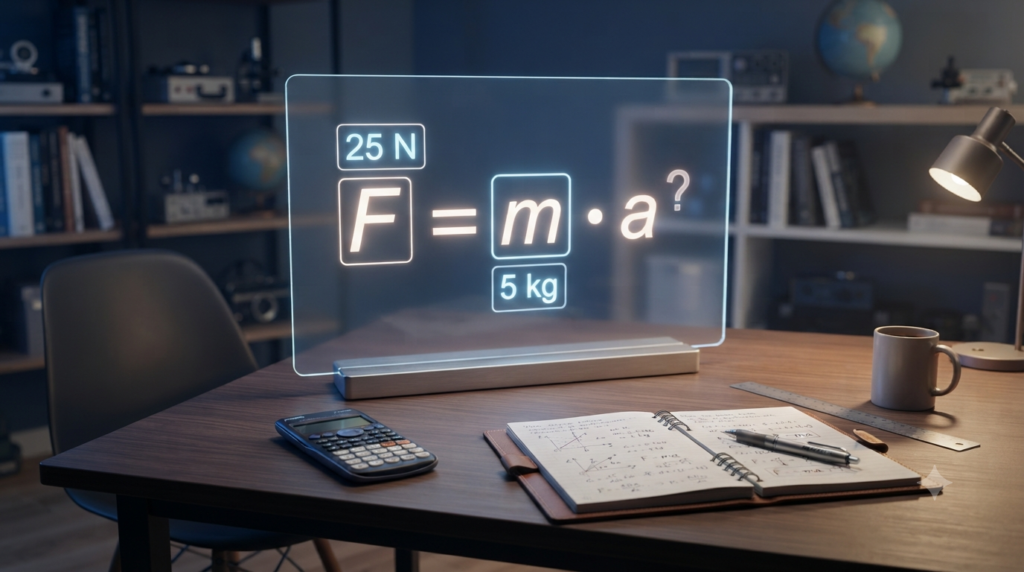
For example, Newton’s second law can be written as:
F = ma
where F is force, m is mass, and a is acceleration.
Suppose:
m = 5 kg
and:
a = 3 m/s²
Substitute:
F = 5(3)
Therefore:
F = 15 N
The answer is expressed in newtons because force is measured in newtons.
This example shows why units should be tracked while substituting values. Units can also help identify mistakes in a calculation.
Substitution in Geometry
Geometry contains many formulas that require substitution.
For the area of a rectangle:
A = lw
For the area of a circle:
A = πr²
For the volume of a cuboid:
V = lwh
For example, suppose a cuboid has:
l = 8 cm
w = 5 cm
h = 3 cm
Using:
V = lwh
we substitute:
V = (8)(5)(3)
Therefore:
V = 120 cm³
So, the volume of the cuboid is 120 cubic centimeters.
Common Mistakes When Substituting Values
Although substitution is straightforward, several common mistakes can lead to incorrect answers.
Using the Wrong Value for a Variable
A problem may provide several numbers. Always identify which number belongs to which variable before substituting.
Forgetting a Variable
If a formula contains three variables and values are given for all three, make sure all three are substituted.
Ignoring Parentheses
Negative numbers and expressions in fractions should often be enclosed in parentheses.
For example:
x², when x = −3, should be written as:
(−3)²
Using the Wrong Order of Operations
Do not simply calculate from left to right. Follow the order of operations.
Forgetting Units
A numerical answer without a unit may be incomplete when the problem involves a physical quantity.
Rounding Too Early
Keep exact values or additional decimal places during intermediate calculations when possible, and round the final answer at the end.
How to Check a Substituted Formula
After calculating an answer, it is useful to check the work.
First, compare the substituted formula with the original formula. Make sure every variable has been replaced correctly.
Next, check the arithmetic.
Then, check the units. For example, an area should have square units such as cm², while a volume should have cubic units such as cm³.
Finally, consider whether the result makes sense. If the dimensions of a rectangle are 5 cm and 4 cm, an area of 20 cm² is reasonable, while an area of 2,000 cm² would require another look at the calculation.
A General Example
Suppose the formula is:
Q = 4a + 2b²
Given:
a = 3
b = 5
Substitute both values:
Q = 4(3) + 2(5)²
Calculate the exponent:
Q = 4(3) + 2(25)
Multiply:
Q = 12 + 50
Therefore:
Q = 62
This example demonstrates the complete process: identify the formula, substitute the values, apply the order of operations, and calculate the final result.
A Simple Method to Remember
A useful way to remember the substitution process is:
Formula → Identify → Substitute → Simplify → Check
Formula
Write the correct formula.
Identify
Identify the value corresponding to each variable.
Substitute
Replace each variable with its known value.
Simplify
Follow the order of operations and calculate.
Check
Check the arithmetic, units, signs, and reasonableness of the answer.
This method works for simple algebraic expressions as well as formulas used in geometry, physics, chemistry, statistics, and other areas of mathematics.
Conclusion
Substituting values into mathematical formulas is a fundamental skill that forms the foundation for solving many types of mathematical and scientific problems. The process involves writing the correct formula, identifying the known values, replacing the variables with those values, simplifying the resulting expression, and checking the final answer.
Careful substitution is particularly important when formulas contain exponents, fractions, negative numbers, multiple variables, or parentheses. Following the order of operations and keeping track of units can significantly reduce errors.
Once substitution becomes familiar, formulas become much easier to use. Whether calculating the area of a shape, solving an algebraic expression, finding a physical quantity, or working with a scientific equation, the same basic process can be applied: write the formula, substitute the values, calculate carefully, and check the result.
FAQs
1. What does it mean to substitute values into a mathematical formula?
Substituting values into a mathematical formula means replacing variables with their known numerical values. A formula usually contains letters that represent quantities. When the values of those quantities are given, we replace the corresponding variables with those values and then calculate the result. For example, in the formula A = lw, if the length is 8 cm and the width is 5 cm, we substitute them as A = (8)(5). The result is 40 cm². Substitution is an important mathematical skill because it allows general formulas to be used to solve specific problems.
2. What are the steps for substituting values into a formula?
The basic steps are simple. First, write the correct formula. Second, identify the value given for each variable. Third, replace every variable with its corresponding value. Use parentheses when necessary, especially with negative numbers or expressions. Fourth, simplify the resulting expression by following the order of operations. Finally, check the calculation and include the correct unit if required. For example, using v = d/t, if distance is 100 m and time is 5 s, substitute to get v = 100/5, giving v = 20 m/s. Following these steps helps prevent common substitution errors.
3. Why should parentheses be used when substituting negative numbers?
Parentheses make negative values clear and prevent mistakes, especially when exponents are involved. For example, if x = −3 and the formula contains x², the correct substitution is (−3)², which equals 9. Without parentheses, writing −3² can be interpreted as −(3²) = −9. Parentheses also make longer calculations easier to read and check. Therefore, whenever a negative number is substituted for a variable, placing the value inside parentheses is a good mathematical practice. It clearly shows that the entire negative value is being used in the formula.
4. How do you substitute multiple values into a formula?
When a formula contains several variables, each known variable must be replaced with its corresponding value. Start by identifying every variable and matching it with the value provided in the problem. For example, the area of a triangle is given by A = ½bh. If b = 10 cm and h = 6 cm, substitute both values: A = ½(10)(6). Then calculate the expression to obtain A = 30 cm². It is helpful to write the complete substitution step before calculating because this makes it easier to notice if a variable has been forgotten or assigned the wrong value.
5. What is the order of operations when evaluating a substituted formula?
After values have been substituted into a formula, the order of operations should be followed. A common sequence is parentheses first, followed by exponents, multiplication and division, and finally addition and subtraction. For example, consider y = 2x² + 3x − 4, where x = 3. Substitute first: y = 2(3)² + 3(3) − 4. Calculate the exponent: y = 2(9) + 9 − 4. Then multiply and add or subtract: y = 18 + 9 − 4 = 23. Following the correct order prevents incorrect results.
6. Can fractions and decimals be substituted into mathematical formulas?
Yes, both fractions and decimals can be substituted directly into mathematical formulas. For example, if A = bh, b = ½ m, and h = 4 m, substitute the values as A = (½)(4), giving A = 2 m². Similarly, decimal values can be substituted without changing the formula. If v = d/t, d = 12.5 m, and t = 2.5 s, then v = 12.5/2.5 = 5 m/s. When possible, keeping fractions in exact form can reduce rounding errors. Decimal answers can be rounded at the end.
7. What happens if the same variable appears more than once in a formula?
If the same variable appears more than once, the same value must be substituted everywhere that variable occurs. For example, consider P = 2l + 2w. If l = 8 cm and w = 5 cm, substitute them as P = 2(8) + 2(5). This gives P = 16 + 10 = 26 cm. A common mistake is to replace one occurrence of a variable but overlook another occurrence. Checking the original formula after substitution can help ensure that every occurrence of each variable has been replaced correctly.
8. Why is it important to include units when substituting values?
Units provide important information about what a numerical value represents and help check whether a calculation makes sense. When substituting values into formulas involving physical quantities, keep the units with the numbers whenever practical. For example, using d = vt, if v = 20 m/s and t = 5 s, then d = (20 m/s)(5 s) = 100 m. The seconds cancel, leaving meters. Units can reveal certain mistakes in calculations. For quantities such as area and volume, the units also change appropriately, such as cm² for area and cm³ for volume.
9. What are the most common mistakes when substituting values into formulas?
Common mistakes include using the wrong value for a variable, forgetting to substitute one of the variables, ignoring negative signs, omitting parentheses around negative values, and applying the wrong order of operations. Another frequent error is rounding numbers too early, which can slightly change the final result. Forgetting units is also a problem when working with physical quantities. To avoid these mistakes, first write the formula clearly, match every variable with its given value, substitute carefully, and then calculate step by step. Finally, check the arithmetic, signs, units, and whether the answer is reasonable.
10. How can I check whether my substituted formula answer is correct?
You can check your answer in several ways. First, compare your substituted expression with the original formula to make sure every variable has been replaced correctly. Second, recalculate the arithmetic independently or work through the calculation again. Third, check the order of operations, signs, and parentheses. If units are involved, verify that the final unit is appropriate for the quantity being calculated. Finally, consider whether the result is reasonable. For example, the area of a small rectangle should not normally be thousands of square meters if its dimensions are only a few centimeters. These checks can catch many simple errors.