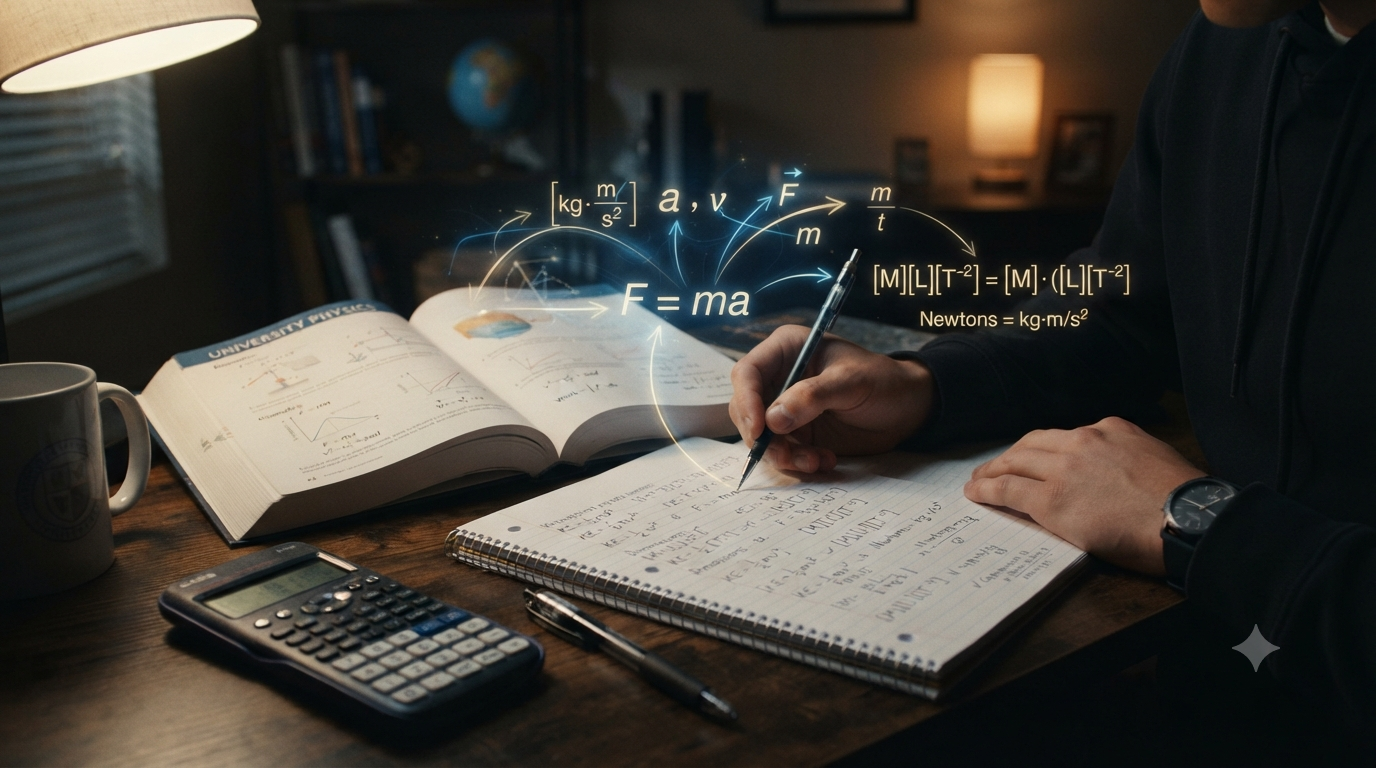
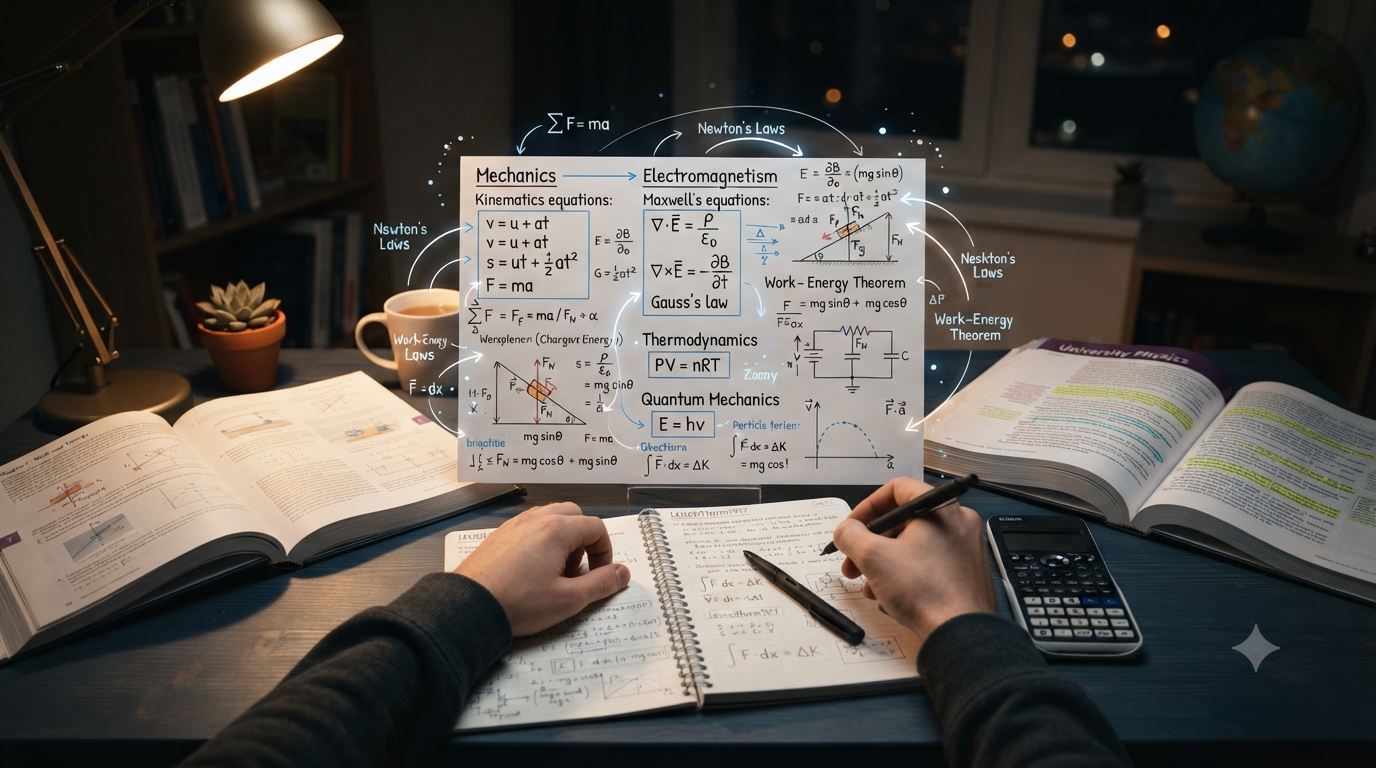
In physics, getting a numerical answer is only part of solving a problem. The next question is whether that answer actually makes sense. One simple way to check a physics answer is by looking at its units. Units provide important information about what a quantity represents and can help reveal mistakes in formulas, calculations, and conversions.
For example, velocity should have units such as metres per second (m/s), while acceleration should have units of metres per second squared (m/s²). If a calculation gives a result with units that do not match the quantity being asked for, something has gone wrong. This method of checking an answer is known as dimensional analysis, and it is one of the most useful tools for verifying physics calculations.
Why Units Matter in Physics
Every physical quantity has a numerical value and a unit. The number tells us how much of the quantity is present, while the unit tells us what kind of measurement it represents.
Consider the statement:
Speed = 20 m/s
Here, 20 is the numerical value and m/s is the unit. The unit tells us that the quantity describes distance travelled per unit time.
Units also help us distinguish between different physical quantities. For example:
Distance → metre (m)
Time → second (s)
Speed → metre per second (m/s)
Acceleration → metre per second squared (m/s²)
Force → newton (N)
Energy → joule (J)
Because physical equations must be dimensionally consistent, units can be used as a quick check after solving a problem.
What Does It Mean to Verify an Answer Using Units?
Verifying an answer using units means checking whether the units produced by your calculation match the expected unit of the physical quantity.
Suppose you are calculating speed. The standard relationship is:
v = s/t
where:
v = speed
s = distance
t = time
If distance is measured in metres and time in seconds, then:
v = m/s
Therefore, the final answer should have units of metres per second.
If your calculation produces something like m × s instead of m/s, the calculation or formula has probably been used incorrectly.
This check does not necessarily prove that the numerical value is correct, but it can quickly identify many mistakes.
Checking Units in a Formula
One of the easiest ways to verify an answer is to write the units along with the numbers during the calculation.
For example, suppose a car travels 150 metres in 10 seconds. Its speed is:
v = s/t
Substituting the values:
v = 150 m / 10 s
Therefore:
v = 15 m/s
The unit m/s confirms that the answer represents speed.
If you accidentally multiplied distance by time:
150 m × 10 s = 1500 m·s
the resulting unit does not represent speed. This immediately tells you that the operation is not appropriate for calculating speed.
Using Units to Check Equations
Units can also help determine whether an equation itself is reasonable.
Consider the equation:
s = ut + ½at²
Here:
s = displacement
u = initial velocity
a = acceleration
t = time
The unit of initial velocity is m/s. Therefore:
ut = (m/s)(s) = m
The unit of acceleration is m/s², so:
at² = (m/s²)(s²) = m
Both terms on the right side have units of metres. Therefore, they can be added together, and the result has the same unit as displacement:
s = m
This is a good example of dimensional consistency.
Why Different Terms Must Have Compatible Units
A very important rule in physics is that quantities being added or subtracted must have the same dimensions and compatible units.
For example:
5 m + 3 m = 8 m
This is meaningful because both quantities represent length.
But an expression such as:
5 m + 3 s
does not make physical sense. Metres and seconds represent different physical dimensions.
This rule is useful when checking complicated equations. If two terms that are being added or subtracted have different dimensions, the equation contains an error.
Checking Derived Units
Some physical quantities have units that are derived from other units.
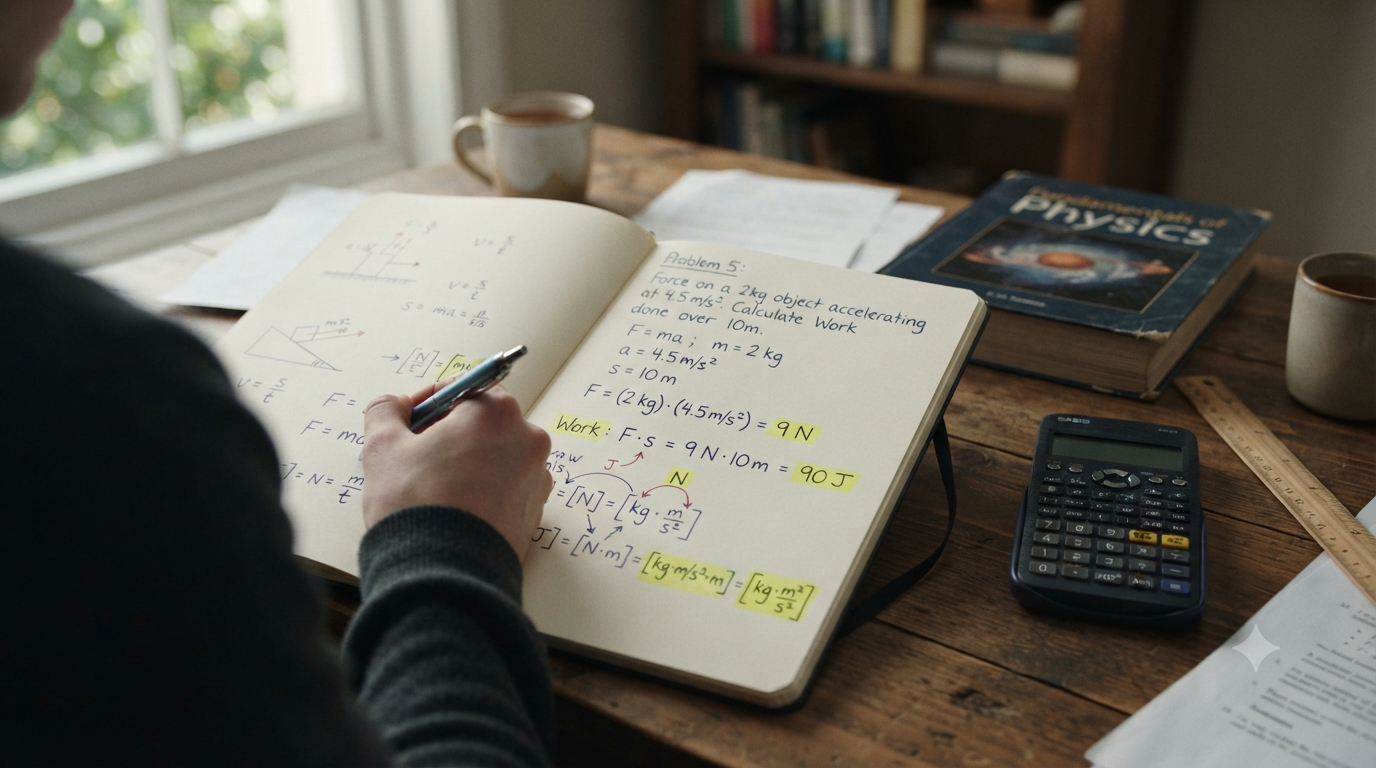
For example, force is defined by:
F = ma
Mass has units of kilograms (kg), and acceleration has units of m/s².
Therefore:
F = kg × m/s²
The SI unit of force is the newton (N), so:
1 N = 1 kg·m/s²
This relationship allows you to check whether a calculated force has the correct units.
Similarly, work is given by:
W = Fd
Force has units of N and distance has units of m.
Therefore:
W = N·m
The SI unit of work is the joule (J):
1 J = 1 N·m
Knowing these relationships makes it easier to recognize whether an answer has the correct physical meaning.
Using Unit Conversion as an Error Check
Unit conversion is another useful way to verify calculations.
Suppose a distance is given as 2 kilometres and needs to be converted into metres.
Since:
1 km = 1000 m
we get:
2 km = 2000 m
If you accidentally write 2 km = 200 m, the unit conversion is incorrect even though the unit is still metres.
This shows that checking units alone is not enough to verify every numerical error. Units can reveal dimensional mistakes, but numerical values and conversion factors must also be checked.
A Simple Step by Step Method
You can use the following method whenever you want to verify a physics answer using units.
Step 1 Identify the Quantity
First, determine what the problem is asking you to calculate.
Is it distance, velocity, acceleration, force, energy, pressure, or another quantity?
Step 2 Write the Expected Unit
Before checking the calculation, identify the standard or required unit.
For example:
Velocity → m/s
Acceleration → m/s²
Force → N
Energy → J
Pressure → Pa
Step 3 Write the Formula
Use the appropriate physical relationship and include units with the known quantities.
Step 4 Simplify the Units
Cancel common units and combine the remaining units.
For example:
(m/s) × s = m
Step 5 Compare the Result
Compare the units you obtained with the expected unit.
If they match, the answer is dimensionally consistent. If they do not match, review the formula, calculation, and unit conversions.
An Example of Finding a Mistake
Suppose a student calculates acceleration using:
a = v × t
The velocity is 20 m/s and the time is 5 s.
The student obtains:
a = (20 m/s)(5 s) = 100 m
But acceleration should have units of m/s², not metres.
The unit check immediately reveals a problem. The correct relationship is:
a = v/t
Therefore:
a = (20 m/s)/(5 s) = 4 m/s²
The units now match the expected unit for acceleration.
What Units Can and Cannot Tell You
Units are powerful, but they do not detect every possible mistake.
A correct unit does not guarantee that the numerical answer is correct. For example, an arithmetic mistake could still produce an answer in m/s. Similarly, using the wrong formula might sometimes produce a result with units that appear correct.
Therefore, a reliable answer should be checked in several ways:
Check the formula.
Check the units.
Check the arithmetic.
Check unit conversions.
Check whether the magnitude is reasonable.
Check whether the result makes physical sense.
Units are one part of a broader verification process.
Dimensional Analysis as a Problem Solving Tool
Dimensional analysis is not only useful after solving a problem. It can also help while solving one.
If you are unsure which formula to use, comparing the dimensions of possible expressions can help eliminate incorrect relationships. It is also useful for converting between units and checking whether a proposed equation could be physically meaningful.
For example, if a quantity must have dimensions of length, any valid expression used to calculate it must ultimately reduce to a length dimension.
This makes dimensional analysis particularly valuable in physics, engineering, chemistry, and other scientific fields.
Conclusion
Units provide a simple but powerful way to verify physics answers. By tracking units through a calculation, you can identify incorrect formulas, incompatible quantities, calculation mistakes, and conversion errors. The basic idea is straightforward: determine the expected unit, carry the units through the calculation, simplify them, and compare the final result with the required unit.
However, a matching unit does not automatically prove that an answer is completely correct. Numerical calculations, formulas, conversions, and physical reasonableness should also be checked. When used together, these checks make problem solving more reliable and help turn units from simple labels into useful tools for understanding and verifying physics.
FAQs
1. How can units help verify a physics answer?
Units can help determine whether a physics answer is dimensionally consistent with the quantity being calculated. Every physical quantity has an appropriate unit. For example, velocity should have units such as metres per second (m/s), while acceleration should have units of metres per second squared (m/s²). To verify an answer, carry the units through each step of the calculation and simplify them. Then compare the resulting unit with the expected unit. If they match, the answer is dimensionally consistent. If they do not, there may be an error in the formula, calculation, or unit conversion. However, matching units do not guarantee numerical correctness.
2. What is dimensional analysis in physics?
Dimensional analysis is a method used to examine the dimensions of physical quantities in an equation. It helps determine whether an equation is dimensionally consistent and can also help verify calculations. For example, velocity has dimensions of length divided by time, written as [LT⁻¹]. Acceleration has dimensions [LT⁻²]. When dimensions are compared on both sides of a physical equation, they should be compatible. Dimensional analysis is useful for checking formulas, converting units, and identifying certain calculation mistakes. It cannot prove that an equation is completely correct because two different equations can have the same dimensions.
3. Can units tell if a physics formula is wrong?
Units can reveal whether a formula is dimensionally inconsistent, but they cannot identify every possible error. For example, if an equation for velocity produces units of metres instead of metres per second, the formula or calculation is clearly incorrect for velocity. However, two different formulas may produce the same units while only one correctly describes the physical situation. Therefore, dimensional consistency is a necessary check rather than complete proof. When verifying a formula, you should also consider the physical relationship, definitions of the quantities, experimental evidence, and whether the equation applies to the particular situation being studied.
4. Why must units be the same when quantities are added?
Quantities being added or subtracted must have compatible dimensions because addition requires quantities to represent the same type of physical measurement. For example, 5 metres can be added to 3 metres to give 8 metres. However, adding 5 metres to 3 seconds has no physical meaning because length and time are different dimensions. This rule also applies inside physics equations. In the equation s = ut + ½at², both ut and ½at² have units of metres, so they can be added to obtain displacement. Checking units of individual terms can therefore reveal errors in equations and calculations.
5. How do you check units in a physics calculation?
Start by identifying the physical quantity you are calculating and determine its expected unit. Then write the formula and include the units of every known quantity. Carry the units through each mathematical operation just as you would carry the numerical values. Cancel common units and simplify the remaining units. Finally, compare the resulting unit with the expected unit. For example, using v = s/t with distance in metres and time in seconds gives v = m/s. Since m/s is the expected unit for velocity, the result is dimensionally consistent. If the units do not match, review the calculation carefully.
6. Can unit checking find arithmetic mistakes?
Unit checking can identify some mistakes, but it cannot detect every arithmetic error. Suppose you calculate velocity and make a multiplication error while working with metres and seconds. The final result may still have units of m/s even though the numerical value is incorrect. Units mainly check whether the mathematical relationship has the correct dimensions. Therefore, arithmetic should be checked separately. Recalculate important numerical steps, check decimal places, verify conversion factors, and compare the final value with a reasonable estimate. Using both unit checking and numerical checking provides a much stronger method for verifying a physics answer.
7. How are units used to check derived quantities?
Derived quantities are formed from combinations of fundamental physical quantities, so their units can be checked using the defining equation. For example, force is given by F = ma. Mass has units of kilograms (kg), while acceleration has units of metres per second squared (m/s²). Therefore, force has units of kg·m/s², which is called the newton (N). Similarly, energy can be checked using W = Fd. Since force is measured in newtons and distance in metres, work has units of N·m, which is the joule (J). This provides a useful way to verify derived quantities.
8. Why is unit conversion important when verifying an answer?
Unit conversion is important because a calculation may involve quantities expressed in different units. Before using them together, the units often need to be converted into compatible forms. For example, kilometres and metres both measure length, but their numerical values differ by a factor of 1000. If a conversion factor is applied incorrectly, the final answer can be wrong even if the dimensional unit appears correct. Always check the conversion relationship and direction of conversion. After calculating, examine whether the final unit and numerical magnitude are reasonable. Correct unit conversion is therefore an essential part of checking physics calculations.
9. Does a correct unit mean the physics answer is correct?
No. A correct unit means that the answer is dimensionally consistent, but it does not guarantee that the numerical value or physical reasoning is correct. A student can use the wrong formula and still obtain a result with the expected unit. Similarly, an arithmetic mistake may leave the final unit unchanged. A complete verification should include checking the formula, substitution, arithmetic, unit conversion, significant figures, and physical reasonableness of the result. Unit checking is therefore an important first layer of verification, but it should be combined with other methods to establish confidence in a physics answer.
10. When should you use dimensional analysis in physics?
Dimensional analysis can be used at several stages of solving a physics problem. Before solving, it can help examine whether a proposed equation has the correct dimensions. During a calculation, it can help track units and prevent incompatible quantities from being combined. After solving, it can help verify whether the final answer has the expected unit. Dimensional analysis is also useful for unit conversions, deriving relationships, and identifying possible mistakes in formulas. It is especially valuable when working with unfamiliar equations or multi-step problems. Developing the habit of checking dimensions can make physics calculations more organized and reliable.
Related Posts
What Do Coefficients Mean in Chemistry Formulas?
When you look at a chemical equation, you may notice numbers written before chemical formulas. These numbers are called coefficients. […]
Read MoreHow to Read Subscripts in Chemical Formulas
Chemical formulas are a simple way to represent substances using symbols and numbers. When you look at a formula such […]
Read MoreHow to Identify Elements in a Chemical Formula
Chemical formulas provide a simple way to describe the substances that make up the world around us. A formula may […]
Read MoreHow Elements Are Represented in Chemical Formulas
Chemistry deals with many different substances, from the oxygen we breathe to the water we drink and the minerals found […]
Read MoreChemical Symbols and Their Role in Chemistry Formulas
Chemistry is often described as the science of matter, but understanding chemistry also means learning how scientists communicate information about […]
Read MoreHow Chemical Formulas Represent Substances
Chemical formulas are one of the simplest ways scientists communicate information about matter. A substance may contain millions or billions […]
Read MoreWhat Is a Chemical Formula in Chemistry?
Chemistry is the study of substances, their properties, and the changes they undergo. To describe these substances clearly, chemists need […]
Read MoreBasic Types of Chemistry Formulas Explained
Chemistry formulas are one of the simplest ways scientists describe substances, reactions, and relationships between different particles. A formula can […]
Read MoreHow to Read and Understand Chemistry Formulas
Chemistry formulas may look like a collection of letters, numbers, and symbols, but they are actually a simple language used […]
Read MoreWhat Are Chemistry Formulas and Why Are They Important?
Chemistry is the science of substances, their properties, and the changes they undergo. To describe these substances clearly, chemists use […]
Read MoreHow to Verify an Answer Using Units
In physics, getting a numerical answer is only part of solving a problem. The next question is whether that answer […]
Read MoreHow to Check Whether a Physics Formula Is Correct
A physics formula is more than a collection of symbols and numbers. It represents a relationship between physical quantities and […]
Read MoreHow to Avoid Unit Conversion Mistakes in Physics
Unit conversion is one of the most common sources of mistakes in physics. A formula may be correct, the calculation […]
Read MoreHow to Avoid Sign Errors in Physics Calculations
Physics calculations are not only about choosing the correct formula and putting numbers into it. The signs of physical quantities […]
Read MoreCommon Mistakes When Using Physics Formulas
Physics formulas help us describe motion, forces, energy, electricity, heat, waves, and many other phenomena using mathematical relationships. A formula […]
Read MoreHow to Study Physics Formulas Step by Step
Physics formulas are an important part of learning physics, but simply memorizing them is not enough. A formula represents a […]
Read MoreHow to Organize Physics Formulas for Easy Revision
Physics becomes much easier when formulas are organized in a clear and meaningful way. Many learners struggle not because they […]
Read MoreHow to Build a Physics Formula Sheet
Physics involves many formulas, and remembering all of them can become difficult as you move from basic concepts to more […]
Read More