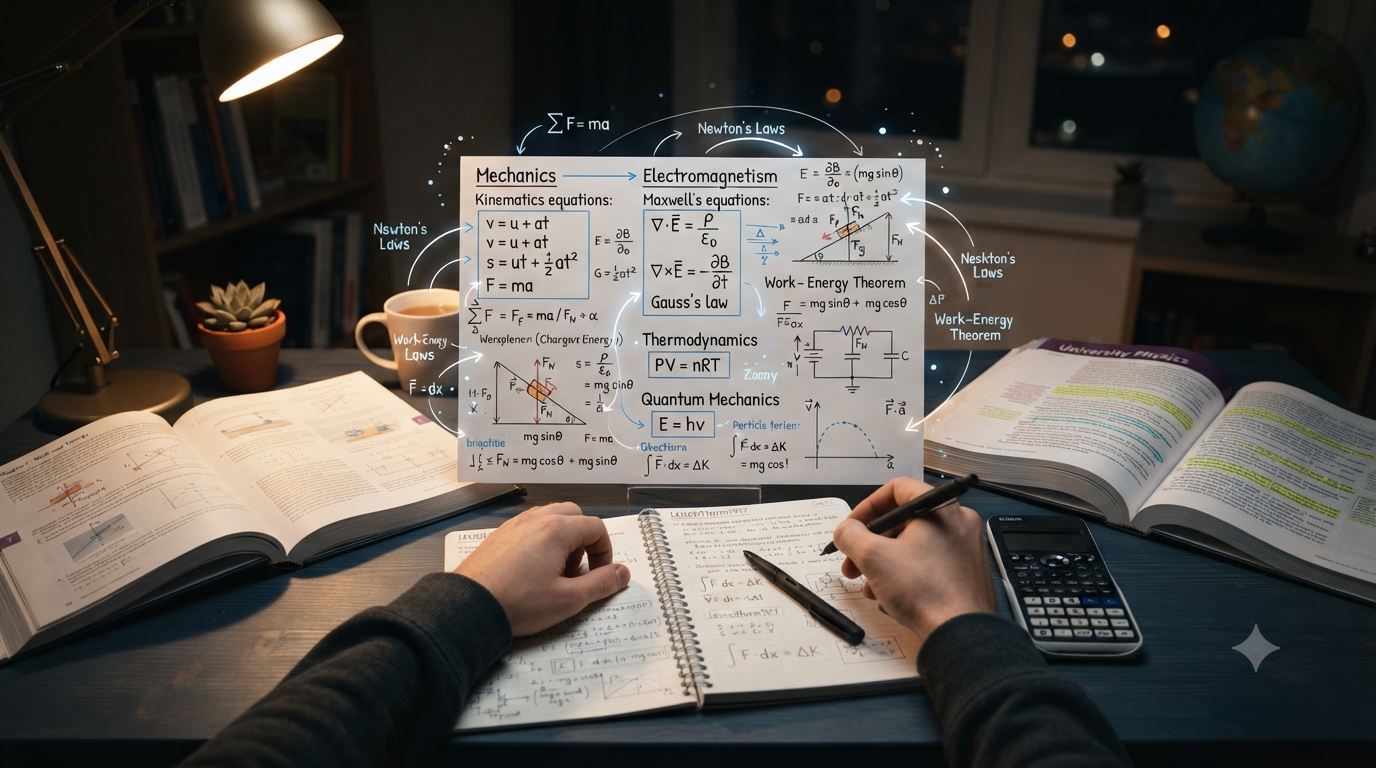
Physics calculations are not only about choosing the correct formula and putting numbers into it. The signs of physical quantities can be equally important. A positive or negative sign can tell us about direction, motion, change, or the relationship between two quantities. If a sign is ignored or used incorrectly, an otherwise correct calculation can produce the wrong answer.
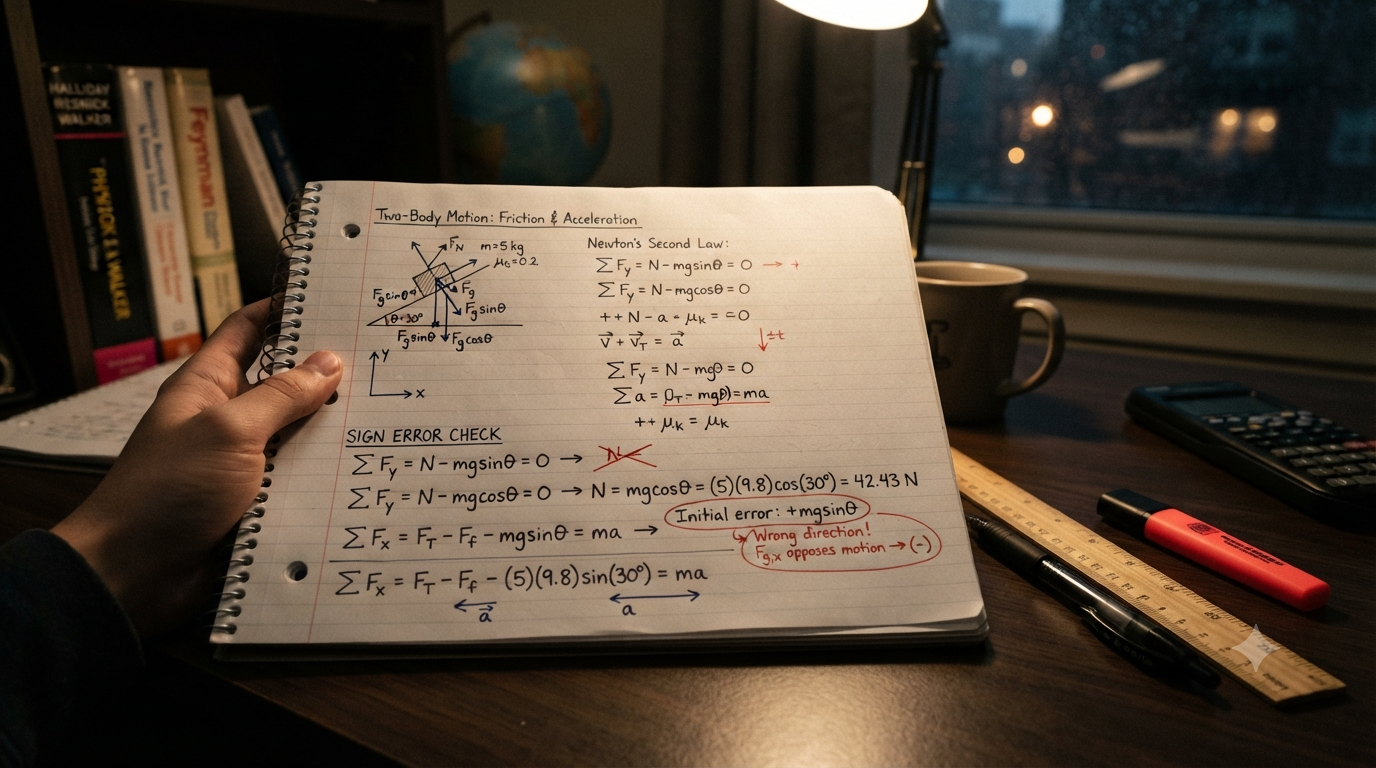
Sign errors are especially common in problems involving displacement, velocity, acceleration, force, work, electric charge, potential, and vectors. The good news is that most sign mistakes can be avoided by following a consistent method. Understanding what each sign represents is more useful than simply trying to remember whether a particular quantity should be positive or negative.
What Does a Sign Mean in Physics?
In physics, a sign often carries physical meaning. A positive or negative value may indicate direction relative to a chosen reference direction.
For example, suppose upward is chosen as positive. An object moving upward can have a positive velocity, while an object moving downward can have a negative velocity. The negative sign does not mean that the object has “less” velocity. It tells us that its velocity is directed opposite to the chosen positive direction.
Similarly, if right is positive, motion toward the left can be represented by a negative displacement or velocity.
Therefore, a sign is often part of the information contained in a physical quantity.
Choose a Positive Direction First
One of the simplest ways to prevent sign errors is to establish a positive direction before starting the calculation.
For one-dimensional motion, you might choose:
Right as positive and left as negative.
Upward as positive and downward as negative.
East as positive and west as negative.
The choice itself is usually not the main issue. What matters is consistency.
For example, if upward is positive, then:
Upward velocity → positive
Downward velocity → negative
Upward acceleration → positive
Downward acceleration → negative
Changing the positive direction during the calculation can easily create a sign error.
Do Not Assign Signs From the Formula
A common mistake is to look at a formula and decide that a quantity should be positive or negative simply because of the plus or minus symbol in the formula.
Consider the equation:
s = ut + ½at²
The plus sign between the two terms does not mean that acceleration must always be positive. The value of acceleration can itself be negative depending on the chosen direction.
For example, if upward is positive and an object accelerates downward, then a is negative. The equation remains:
s = ut + ½at²
The negative value is included when substituting the physical quantity.
This distinction is important: the signs of physical quantities come from the physical situation and chosen coordinate system, not from the appearance of the formula alone.
Understand the Difference Between Distance and Displacement
Sign errors often occur because distance and displacement are treated as if they were the same quantity.
Distance is a scalar quantity and represents the total path length traveled. It does not normally carry a direction-based positive or negative sign.
Displacement is a vector quantity and depends on the initial and final positions. In one-dimensional motion, it can be positive, negative, or zero.
Suppose a person moves 10 m to the right and then 4 m to the left. The total distance is:
10 m + 4 m = 14 m
If right is positive, the displacement is:
10 m − 4 m = 6 m
Confusing these two quantities can lead to incorrect signs as well as incorrect magnitudes.
Keep Track of Initial and Final Values
Many physics equations involve changes between an initial and final state. A reliable way to avoid sign mistakes is to label quantities clearly.
For example:
Then displacement can be written as:
Δx = x₂ − x₁
The order matters. Reversing the order changes the sign.
If an object moves from x₁ = 2 m to x₂ = 8 m:
Δx = 8 − 2 = 6 m
If it moves from x₁ = 8 m to x₂ = 2 m:
Δx = 2 − 8 = −6 m
The negative sign tells us that the displacement is in the negative direction of the coordinate system.
Be Careful With Acceleration Due to Gravity
Gravity is one of the most common sources of sign errors.
Near Earth’s surface, gravitational acceleration acts downward. But whether we write it as +g or −g depends on the direction chosen as positive.
If upward is positive:
a = −g
If downward is positive:
a = +g
Both choices can work. Problems arise when a coordinate convention is chosen but the sign of g is changed later without a reason.
Instead of automatically writing g = 9.8 m/s² as positive in every equation, first ask: Which direction is positive?
Watch the Signs in Newton’s Laws
Newton’s laws also require careful attention to direction.
For example:
F = ma
This equation is not simply about magnitudes. Force and acceleration have directions. If the positive direction is to the right, a force acting to the left may be represented as negative.
Suppose a net force of 5 N acts to the left and right is positive. Then:
F = −5 N
If the mass is 2 kg:
a = F/m
a = −5/2
a = −2.5 m/s²
The negative acceleration means acceleration is toward the left.
Writing 2.5 m/s² without the negative sign would remove important information from the answer.
Check Work and Energy Signs Carefully
Signs are also important in work calculations.
The work done by a force can be written as:
W = Fs cosθ
The angle between force and displacement determines the sign of work.
If the force and displacement are in the same direction, cosθ is positive and the work is positive.
If they act in opposite directions, cosθ is negative and the work is negative.
For example, friction usually acts opposite to the direction of motion. Therefore, the work done by friction is often negative.
A negative work value does not mean that the calculation is wrong. It describes the direction of energy transfer associated with that force.
Avoid Changing Signs Just to Get a Positive Answer
Sometimes learners see a negative answer and assume something must have gone wrong. This can lead them to change a sign without checking the physics.
A negative answer can be completely correct.
For example:
v = −12 m/s
does not mean the speed is negative. It means the velocity is 12 m/s in the negative direction.
Likewise, negative displacement, negative acceleration, negative work, or negative potential change can all be physically meaningful.
Before changing a negative result, ask what the sign represents.
Use a Sign Convention Table
For complicated problems, a small sign table can make the calculation much easier.
| Quantity | Positive Direction | Negative Direction |
|---|---|---|
| Displacement | Chosen positive direction | Opposite direction |
| Velocity | Motion in positive direction | Motion in negative direction |
| Acceleration | Acceleration in positive direction | Acceleration in negative direction |
| Force | Force in positive direction | Force in negative direction |
Writing this before solving a problem takes only a few seconds but can prevent several mistakes.
Check the Final Answer Physically
After completing a calculation, do not immediately move on. Take a moment to interpret the answer.
Ask:
Is the sign reasonable?
Does the direction match the situation?
Are the units correct?
Did I use the same positive direction throughout?
Did I confuse a scalar with a vector?
Did I accidentally change the sign while substituting values?
For example, if an object is moving downward and your calculation gives a positive velocity while downward was defined as negative, check the calculation again.
A quick physical check can catch an algebraic mistake that may otherwise go unnoticed.
A Simple Method to Prevent Sign Errors
A reliable approach is to follow these steps for every problem involving direction:
Read the problem carefully.
Identify the relevant physical quantities.
Choose a positive direction.
Assign signs according to that direction.
Write the formula before substituting values.
Substitute signed values carefully.
Complete the calculation without changing signs unnecessarily.
Interpret the final sign physically.
Check the units and overall reasonableness of the answer.
This method becomes easier with practice.
Conclusion
Sign errors in physics calculations usually happen when direction and algebra are treated separately. A negative sign is not automatically a mistake, and a positive sign is not automatically correct. The sign of a physical quantity often tells us how that quantity is directed relative to a chosen reference.
The most effective habit is to choose a positive direction at the beginning and remain consistent throughout the problem. Label initial and final quantities clearly, substitute signed values carefully, and interpret the final answer instead of changing a negative result automatically. With these habits, sign conventions become a useful part of physics rather than a common source of confusion.
FAQs
1. Why are sign conventions important in physics calculations?
Sign conventions are important because they help represent direction consistently in physics calculations. Many physical quantities, such as displacement, velocity, acceleration, force, and momentum, can have positive or negative values depending on the chosen reference direction. For example, if upward is selected as positive, downward acceleration due to gravity is represented as negative. Without a clear sign convention, it is easy to mix directions and obtain incorrect results. The key is not which direction is chosen as positive, but maintaining the same convention throughout the entire calculation. A consistent sign convention makes equations easier to solve and final answers easier to interpret.
2. How do I choose a positive direction in physics?
Choose a positive direction before beginning a calculation involving direction. The choice depends on the physical situation. For horizontal motion, you might choose right as positive and left as negative. For vertical motion, upward can be positive and downward negative. You can also choose the opposite convention if it makes the problem easier. There is usually no single universally correct choice. The important point is to use the same convention throughout the calculation. Once the positive direction is selected, assign positive and negative signs to other quantities according to their directions. Clearly writing the chosen direction at the beginning can help prevent sign errors.
3. Does a negative answer mean that a physics calculation is wrong?
No, a negative answer does not necessarily mean that the calculation is wrong. In many physics problems, a negative value provides useful information about direction. For example, if right is chosen as positive and the calculated velocity is −5 m/s, the object is moving at 5 m/s toward the left. Similarly, negative acceleration can indicate acceleration in the negative direction, while negative displacement can indicate movement opposite to the chosen positive direction. Instead of automatically changing a negative answer into a positive one, first interpret what the sign represents. A negative result can be physically meaningful and completely correct.
4. Why does acceleration due to gravity sometimes have a negative sign?
Acceleration due to gravity sometimes has a negative sign because gravity acts downward, while the coordinate system may define upward as positive. In that case, gravitational acceleration is written as a = −g. If downward is chosen as positive, gravitational acceleration can instead be written as a = +g. The sign depends on the chosen coordinate system, not on gravity changing its direction. For example, when solving a vertical motion problem with upward as positive, using a = −9.8 m/s² consistently is appropriate near Earth’s surface. The most important rule is to choose a direction and maintain that convention throughout the calculation.
5. How can I avoid sign errors when using physics formulas?
To avoid sign errors, first identify the directions involved in the problem. Then choose a positive direction and assign signs to all relevant quantities before substituting them into a formula. Write the formula separately before inserting numerical values. This helps prevent confusion between the signs already present in the equation and the signs of physical quantities. Keep the same sign convention throughout the calculation and avoid changing a negative value simply because the result looks unusual. After calculating, check whether the sign and magnitude make physical sense. Finally, verify the units. These simple steps can prevent many common calculation mistakes.
6. What is the difference between positive velocity and negative velocity?
Positive and negative velocity describe direction relative to a chosen coordinate system. If right is defined as positive, an object moving toward the right has positive velocity, while an object moving toward the left has negative velocity. For example, +10 m/s means motion at 10 m/s in the positive direction, while −10 m/s means motion at 10 m/s in the opposite direction. The negative sign does not mean that the object has negative speed. Speed is a scalar quantity and does not normally include direction. Velocity is a vector quantity, so its sign can provide important information about the direction of motion.
7. Can changing the positive direction change the final answer?
Changing the positive direction can change the sign of a vector quantity while leaving its physical meaning unchanged. For example, suppose an object moves 5 m to the right. If right is positive, its displacement is +5 m. If left is chosen as positive, the same physical displacement becomes −5 m. The object has not changed its motion; only the coordinate convention has changed. A correct calculation should remain physically consistent regardless of which direction is selected as positive. Problems occur when the positive direction is changed in the middle of a calculation without changing the signs of the related quantities consistently.
8. Why do students often make sign errors in physics?
Students often make sign errors because they focus on mathematical operations without first considering the physical direction of quantities. Another common problem is memorizing signs instead of understanding what they represent. For example, some learners always use g = +9.8 m/s² without checking which direction has been defined as positive. Sign mistakes can also occur when initial and final values are confused, when vector quantities are treated like scalars, or when a negative answer is changed automatically. Developing the habit of drawing a simple diagram, choosing a positive direction, and labeling quantities before calculating can greatly reduce these errors.
9. How can diagrams help prevent sign errors?
Diagrams provide a visual way to track directions before performing calculations. A simple sketch can show the object’s motion, forces, coordinate axes, and positive direction. For example, in a vertical motion problem, drawing an upward arrow labeled positive and a downward arrow labeled negative makes it easier to assign the correct sign to velocity, acceleration, and displacement. In force problems, arrows can show which forces act in opposite directions. Diagrams are especially useful when several quantities have different directions. Spending a few seconds creating a clear diagram can prevent confusion and make the mathematical steps much easier to follow.
10. What should I check after completing a physics calculation?
After completing a physics calculation, check both the mathematics and the physical meaning of the result. First, verify that the units are correct. Then check whether the sign agrees with the direction chosen at the beginning. Confirm that initial and final values were used in the correct order and that no sign was accidentally changed during substitution. Also consider whether the magnitude of the answer is reasonable for the situation. If the result is negative, do not immediately assume it is wrong. Determine what the negative sign represents physically. This final review can catch many sign errors before they affect the final answer.
Related Posts
What Do Coefficients Mean in Chemistry Formulas?
When you look at a chemical equation, you may notice numbers written before chemical formulas. These numbers are called coefficients. […]
Read MoreHow to Read Subscripts in Chemical Formulas
Chemical formulas are a simple way to represent substances using symbols and numbers. When you look at a formula such […]
Read MoreHow to Identify Elements in a Chemical Formula
Chemical formulas provide a simple way to describe the substances that make up the world around us. A formula may […]
Read MoreHow Elements Are Represented in Chemical Formulas
Chemistry deals with many different substances, from the oxygen we breathe to the water we drink and the minerals found […]
Read MoreChemical Symbols and Their Role in Chemistry Formulas
Chemistry is often described as the science of matter, but understanding chemistry also means learning how scientists communicate information about […]
Read MoreHow Chemical Formulas Represent Substances
Chemical formulas are one of the simplest ways scientists communicate information about matter. A substance may contain millions or billions […]
Read MoreWhat Is a Chemical Formula in Chemistry?
Chemistry is the study of substances, their properties, and the changes they undergo. To describe these substances clearly, chemists need […]
Read MoreBasic Types of Chemistry Formulas Explained
Chemistry formulas are one of the simplest ways scientists describe substances, reactions, and relationships between different particles. A formula can […]
Read MoreHow to Read and Understand Chemistry Formulas
Chemistry formulas may look like a collection of letters, numbers, and symbols, but they are actually a simple language used […]
Read MoreWhat Are Chemistry Formulas and Why Are They Important?
Chemistry is the science of substances, their properties, and the changes they undergo. To describe these substances clearly, chemists use […]
Read MoreHow to Verify an Answer Using Units
In physics, getting a numerical answer is only part of solving a problem. The next question is whether that answer […]
Read MoreHow to Check Whether a Physics Formula Is Correct
A physics formula is more than a collection of symbols and numbers. It represents a relationship between physical quantities and […]
Read MoreHow to Avoid Unit Conversion Mistakes in Physics
Unit conversion is one of the most common sources of mistakes in physics. A formula may be correct, the calculation […]
Read MoreHow to Avoid Sign Errors in Physics Calculations
Physics calculations are not only about choosing the correct formula and putting numbers into it. The signs of physical quantities […]
Read MoreCommon Mistakes When Using Physics Formulas
Physics formulas help us describe motion, forces, energy, electricity, heat, waves, and many other phenomena using mathematical relationships. A formula […]
Read MoreHow to Study Physics Formulas Step by Step
Physics formulas are an important part of learning physics, but simply memorizing them is not enough. A formula represents a […]
Read MoreHow to Organize Physics Formulas for Easy Revision
Physics becomes much easier when formulas are organized in a clear and meaningful way. Many learners struggle not because they […]
Read MoreHow to Build a Physics Formula Sheet
Physics involves many formulas, and remembering all of them can become difficult as you move from basic concepts to more […]
Read More