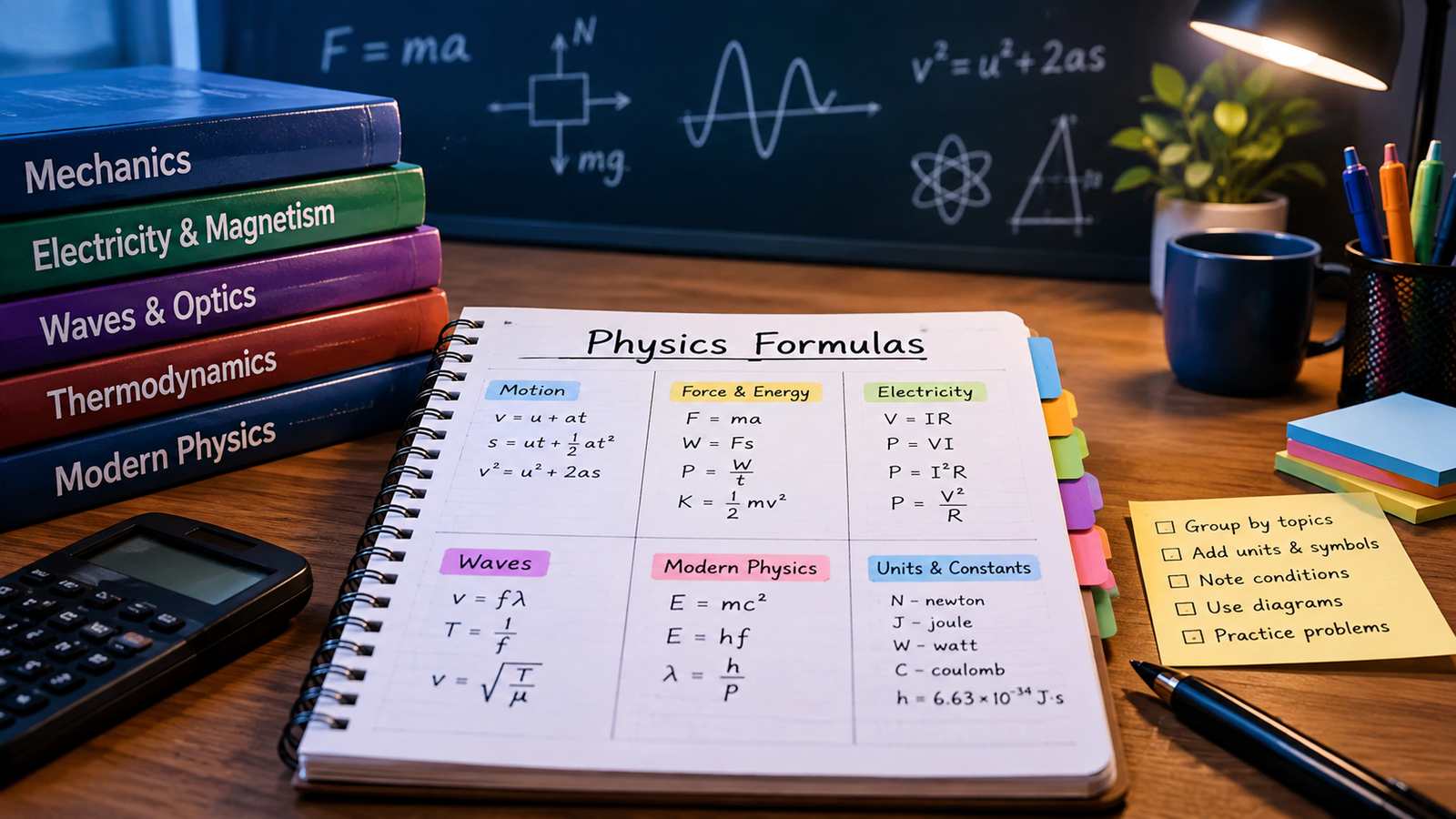
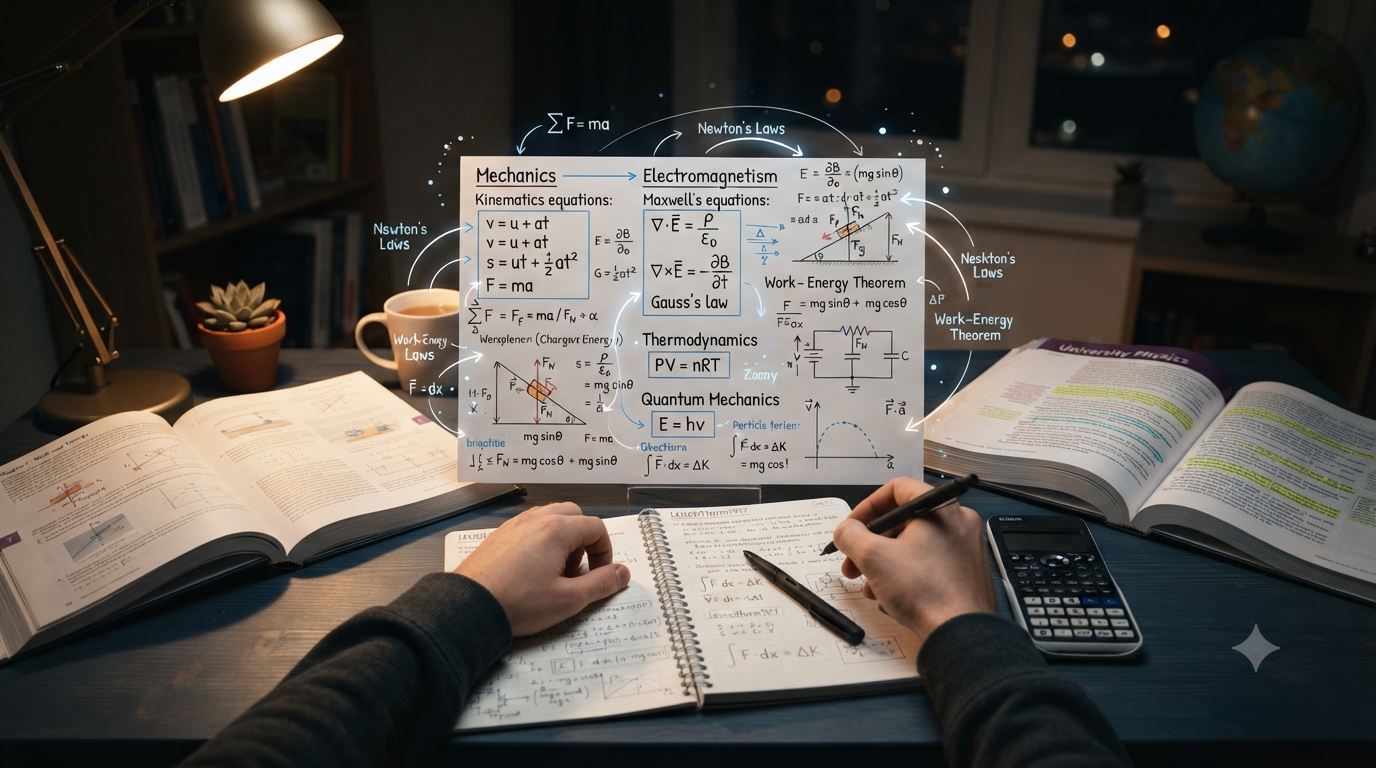
Physics formulas help us describe motion, forces, energy, electricity, heat, waves, and many other phenomena using mathematical relationships. A formula can make a physics problem much easier to solve, but only when it is used correctly. Many mistakes in physics do not happen because the formula itself is difficult. They happen because of incorrect units, misunderstood quantities, poor substitution, or using a formula in the wrong situation.
Understanding these common mistakes is an important part of learning physics. Instead of simply memorizing formulas, it is better to understand what each quantity means, when the formula applies, and how the answer should be interpreted. Here are some of the most common mistakes learners make when using physics formulas and how to avoid them.
1. Choosing the Wrong Formula
One of the most common mistakes is selecting a formula without understanding the physical situation. A problem may contain several quantities that appear in different formulas, so choosing a familiar formula is not always enough.
For example, the equations
v = u + at
and
s = ut + ½at²
are both equations of motion, but they are useful for finding different quantities. If a problem asks for final velocity, the first equation may be appropriate. If it asks for displacement and provides suitable information, the second equation may be useful.
Before selecting a formula, identify what the question gives and what it asks you to find. Then choose a relationship that connects those quantities.
2. Substituting Values Without Understanding Them
Another common mistake is immediately putting numbers into a formula without identifying what each number represents.
Consider the formula:
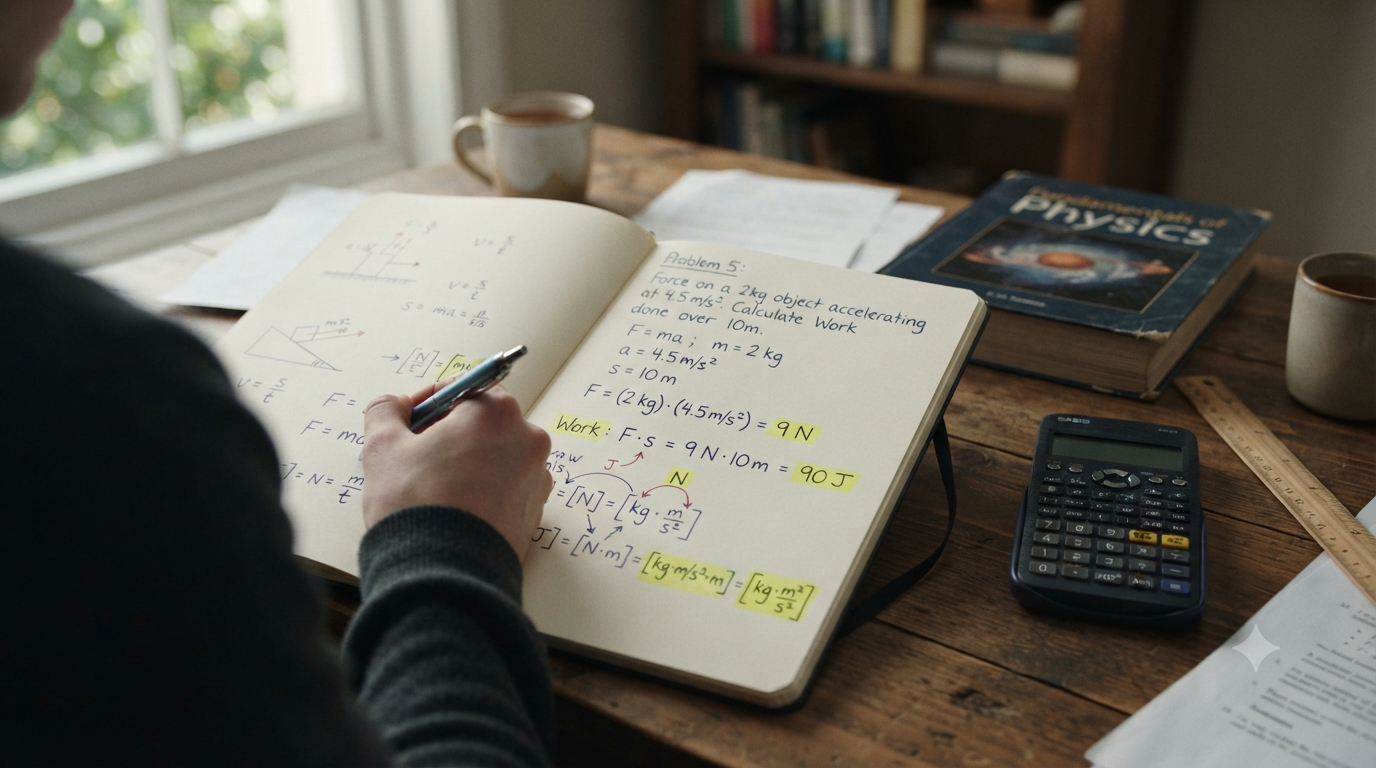
F = ma
If a problem gives a mass of 5 kg and an acceleration of 2 m/s², then:
F = 5 × 2 = 10 N
The calculation is simple, but the important step is recognizing that 5 kg represents mass and 2 m/s² represents acceleration.
Always write the known quantities first. This reduces the chance of putting a value into the wrong part of a formula.
3. Ignoring Units
Units are not just labels attached to numbers. They are an important part of a physical quantity. Ignoring them can lead to completely incorrect answers.
For example, if distance is given in kilometres while velocity is given in metres per second, using the values directly may produce an incorrect result.
Before applying a formula, check whether the quantities are expressed in compatible units. Common conversions include:
1 km = 1000 m
1 h = 3600 s
1 g = 0.001 kg
Using SI units such as metres, kilograms, seconds, amperes, and kelvin often makes calculations easier and more consistent.
4. Forgetting to Convert Units
Sometimes learners know that units matter but forget to convert them before substitution.
Suppose a car travels at 72 km/h. If the calculation requires metres per second, the speed must be converted:
72 km/h = 20 m/s
Using 72 directly in a formula that expects metres per second can produce a wrong answer.
A useful habit is to write the conversion as a separate step before starting the main calculation. This makes the solution easier to check.
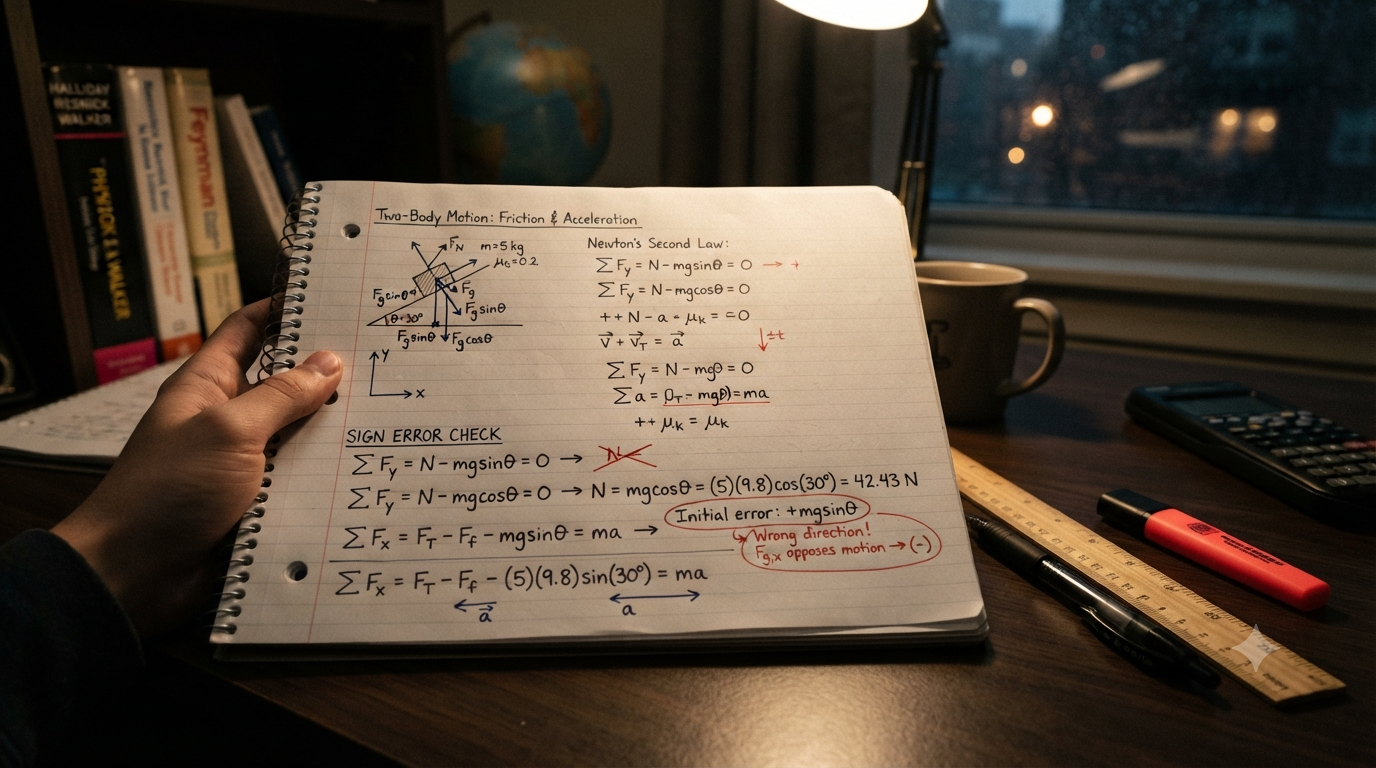
5. Using the Wrong Sign
Physics quantities can have positive and negative values, especially when direction is involved. Ignoring signs can change the meaning of an answer.
For example, if upward is chosen as positive, downward acceleration due to gravity can be written as:
a = -9.8 m/s²
The negative sign does not mean that gravity is negative in every situation. It indicates that the acceleration is directed opposite to the chosen positive direction.
Always establish the direction convention before substituting values into formulas involving vectors or motion.
6. Confusing Similar Quantities
Some physics quantities sound similar but have different meanings. Confusing them can lead to the wrong formula.
For example, distance and displacement are not the same. Speed and velocity are also different physical quantities. Similarly, mass and weight describe different concepts.
Mass is measured in kilograms, while weight is a force measured in newtons.
Weight can be calculated using:
W = mg
Using mass where weight is required, or weight where mass is required, can produce an incorrect result.
Understanding the meaning and unit of each quantity helps prevent these mistakes.
7. Using a Formula Outside Its Conditions
Physics formulas are often developed under specific conditions. Applying a formula without checking those conditions can lead to an incorrect result.
For example, some equations of motion are commonly used when acceleration is constant. If acceleration changes significantly with time, those equations may not directly describe the situation.
Similarly, simplified formulas may assume ideal conditions, such as negligible air resistance or constant temperature.
Before using a formula, ask: Under what conditions does this relationship apply?
8. Making Calculation Errors
Even when the correct formula is selected, simple mathematical errors can affect the final answer.
Mistakes can occur during multiplication, division, powers, fractions, or rearranging equations.
For example:
E = ½mv²
If v = 10 m/s, then v² is:
10² = 100
It is easy to accidentally use 10 instead of 100.
Writing each important calculation step clearly makes such mistakes easier to identify.
9. Rearranging Formulas Incorrectly
Sometimes the required quantity is not directly isolated in the given formula. The formula must first be rearranged.
For example:
v = u + at
To find acceleration:
a = (v – u) / t
A common mistake is changing one part of the equation without applying the same mathematical operation correctly to the entire relationship.
Instead of rearranging mentally, write each step. This is especially useful with formulas involving fractions, squares, or multiple terms.
10. Forgetting Powers and Square Roots
Some formulas contain squared or cubed quantities, which can easily be overlooked.
For example:
K = ½mv²
The velocity must be squared before multiplying by mass and one-half.
Similarly, if:
v² = u² + 2as
and the question asks for velocity, you may need to take the square root after calculating v².
Always check whether a quantity is squared, cubed, or inside a square root.
11. Rounding Too Early
Rounding values too early can slightly change the final answer, especially when several calculations are involved.
For example, if a calculation produces 9.80665, replacing it immediately with 9.8 may introduce a small difference in later calculations.
It is usually better to keep a few extra digits during intermediate steps and round the final answer appropriately.
The number of significant figures should also reflect the precision of the given measurements.
12. Not Checking Whether the Answer Makes Sense
Getting a numerical answer does not automatically mean the solution is correct.
After solving a problem, ask whether the answer is physically reasonable.
For example, if a calculation gives the speed of an ordinary moving vehicle as 50,000 m/s, that result should immediately raise a question. There may be a unit conversion or calculation error.
Also check the unit. If you calculate force, the final unit should be newtons. If you calculate energy, it should be joules.
13. Memorizing Formulas Without Understanding Them
Memorization can help, but relying only on memory can make physics problems confusing. A learner may remember a formula but forget what its variables represent or when it should be used.
Understanding the physical relationship behind a formula makes it easier to remember and apply.
For example, Newton’s second law:
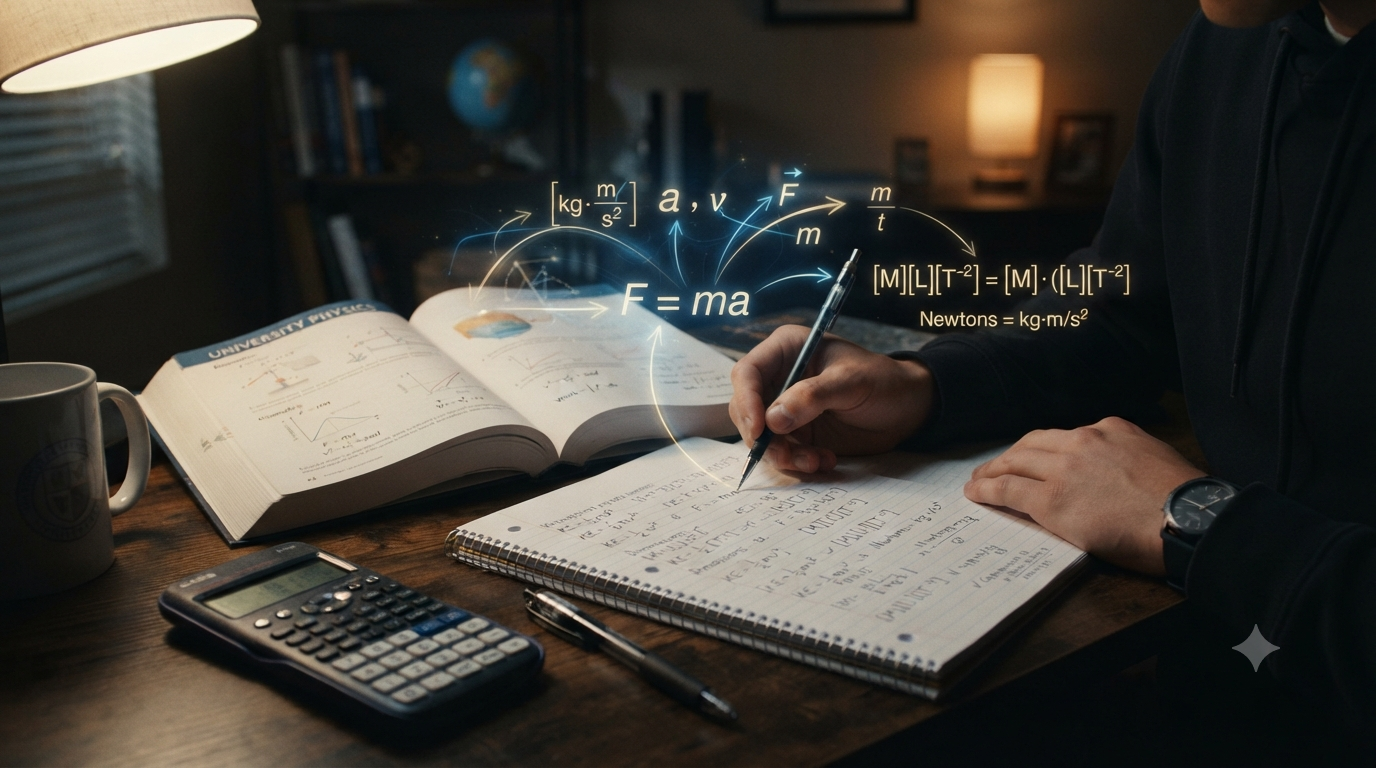
F = ma
shows that force is related to both mass and acceleration. Understanding this relationship is more useful than simply remembering three letters.
How to Avoid Common Formula Mistakes
A simple checking process can make physics calculations much more reliable.
Read the problem carefully.
Identify what is given.
Identify what must be found.
Write the relevant formula.
Check whether the formula applies to the situation.
Convert quantities into compatible units.
Substitute values carefully.
Rearrange the formula if necessary.
Perform the calculation step by step.
Check the final unit and direction.
Consider whether the answer is physically reasonable.
This process may take slightly longer than immediately inserting numbers into a calculator, but it greatly reduces avoidable errors.
Conclusion
Using physics formulas correctly involves much more than remembering equations. A good solution requires understanding the physical quantities, selecting the appropriate relationship, checking units, handling signs and directions, and performing calculations carefully. Mistakes such as choosing the wrong formula, forgetting unit conversions, confusing similar quantities, or rounding too early are common, but they can be avoided with a systematic approach.
The goal of solving a physics problem is not simply to obtain a number. The calculation should represent a meaningful physical situation. When you understand what a formula means and check each step of the solution, formulas become powerful tools for connecting mathematics with the real world.

FAQs
1. What is the most common mistake when using physics formulas?
The most common mistake is choosing or applying a formula without understanding what the physical quantities represent. Learners sometimes see familiar numbers in a problem and immediately substitute them into a remembered equation. This can lead to incorrect results even when the mathematical calculation is correct. Other common mistakes include using incompatible units, confusing similar quantities such as speed and velocity, forgetting signs, and making calculation errors. A good approach is to first identify what is given, what needs to be found, and which formula connects those quantities. Understanding the formula is more useful than simply memorizing it.
2. Why are units important when using physics formulas?
Units are important because they describe what a physical quantity represents and help ensure that calculations are consistent. For example, if distance is given in kilometres while velocity is expressed in metres per second, using the values directly may produce an incorrect result. Converting quantities into compatible units before substitution reduces this risk. SI units are commonly used in physics because they provide a consistent system for measurements. Units also help check the final answer. For example, force should have the unit newton, while energy should have the unit joule. Therefore, checking units is an important part of solving physics problems.
3. Why do students sometimes choose the wrong physics formula?
Students may choose the wrong formula because several equations can involve similar physical quantities. Memorizing formulas without understanding their meanings can make this problem more common. For example, different equations of motion are used depending on which quantities are known and which quantity must be calculated. To choose correctly, first identify the information given in the problem. Then identify the quantity that needs to be found and select a formula connecting those quantities. It is also important to check whether the physical conditions required for the formula are satisfied. Understanding the relationship between variables makes formula selection easier and more reliable.
4. What happens if units are not converted before using a formula?
If units are not converted when necessary, the numerical answer can be incorrect even if the formula and arithmetic are correct. For example, a speed given in kilometres per hour should normally be converted to metres per second when working with quantities expressed in SI units. Similarly, centimetres may need to be converted to metres. The problem occurs because physics formulas describe relationships between quantities expressed in compatible units. Before substitution, check the units of every given value. Converting them at the beginning is usually easier than trying to correct the answer later. Always include units throughout the calculation whenever possible.
5. Why is understanding the formula better than memorizing it?
Understanding a formula helps you recognize when and how it should be used. Memorization alone may allow you to recall an equation, but it does not necessarily explain what each variable represents or what conditions are required. For example, F = ma shows a relationship between force, mass, and acceleration. Understanding this relationship makes it easier to use the equation in different situations. It also helps when a formula needs to be rearranged. When learners understand the physical meaning behind equations, they are less likely to select an inappropriate formula or substitute quantities incorrectly. This makes problem solving more logical and effective.
6. Why are signs important in physics calculations?
Signs can represent direction, especially when working with vectors and motion. A positive or negative value does not necessarily mean that a quantity is good or bad. Instead, it often indicates direction relative to a chosen reference direction. For example, if upward is defined as positive, acceleration due to gravity can be written as -9.8 m/s² because it acts downward. Ignoring the sign can produce an incorrect result or an incorrect interpretation of the motion. Before calculating, establish the positive direction and use the signs consistently. This is particularly important in problems involving displacement, velocity, acceleration, force, and vectors.
7. How can I avoid calculation mistakes in physics?
You can reduce calculation mistakes by solving the problem step by step instead of entering everything into a calculator immediately. First write the known quantities and the required quantity. Then write the appropriate formula and rearrange it if necessary. Substitute the values carefully and perform important mathematical operations separately. Pay particular attention to powers, square roots, fractions, and negative signs. Keep units with the calculation where possible. Finally, check the result using estimation or another method. A calculator can reduce arithmetic errors, but it cannot determine whether you selected the correct formula or entered the correct values.
8. Why should I check the final answer in a physics problem?
Checking the final answer helps identify mistakes that may not be obvious during the calculation. First, check whether the unit matches the quantity being calculated. For example, force should be expressed in newtons, while speed should be expressed in metres per second when using SI units. Next, consider whether the numerical value is physically reasonable. An extremely large or extremely small answer may indicate a conversion or calculation error. You should also check the sign and direction when relevant. Taking a few moments to review the result can catch errors before the answer is considered final.
9. Can rounding numbers too early cause errors in physics?
Yes, rounding numbers too early can sometimes affect the final result, particularly when several calculations are performed in sequence. For example, replacing a value with a rounded approximation at the beginning may introduce a small difference that becomes more noticeable later. A better approach is to keep a few extra digits during intermediate calculations and round the final answer at the end. The appropriate number of significant figures should also depend on the precision of the measurements provided in the problem. This approach helps maintain accuracy without making the final answer unnecessarily complicated. Careful rounding is an important part of quantitative physics.
10. What is the best way to use physics formulas correctly?
A systematic approach is one of the best ways to use physics formulas correctly. Begin by reading the problem carefully and identifying the known and unknown quantities. Choose a formula that connects them and check whether its conditions apply. Convert units into compatible forms before substitution. Then substitute the values carefully, paying attention to signs, powers, and mathematical operations. Rearrange the equation when necessary rather than guessing. After calculating, check the unit, direction, significant figures, and physical reasonableness of the answer. This process helps turn formulas from memorized equations into useful tools for understanding and solving physics problems.
Related Posts
What Do Coefficients Mean in Chemistry Formulas?
When you look at a chemical equation, you may notice numbers written before chemical formulas. These numbers are called coefficients. […]
Read MoreHow to Read Subscripts in Chemical Formulas
Chemical formulas are a simple way to represent substances using symbols and numbers. When you look at a formula such […]
Read MoreHow to Identify Elements in a Chemical Formula
Chemical formulas provide a simple way to describe the substances that make up the world around us. A formula may […]
Read MoreHow Elements Are Represented in Chemical Formulas
Chemistry deals with many different substances, from the oxygen we breathe to the water we drink and the minerals found […]
Read MoreChemical Symbols and Their Role in Chemistry Formulas
Chemistry is often described as the science of matter, but understanding chemistry also means learning how scientists communicate information about […]
Read MoreHow Chemical Formulas Represent Substances
Chemical formulas are one of the simplest ways scientists communicate information about matter. A substance may contain millions or billions […]
Read MoreWhat Is a Chemical Formula in Chemistry?
Chemistry is the study of substances, their properties, and the changes they undergo. To describe these substances clearly, chemists need […]
Read MoreBasic Types of Chemistry Formulas Explained
Chemistry formulas are one of the simplest ways scientists describe substances, reactions, and relationships between different particles. A formula can […]
Read MoreHow to Read and Understand Chemistry Formulas
Chemistry formulas may look like a collection of letters, numbers, and symbols, but they are actually a simple language used […]
Read MoreWhat Are Chemistry Formulas and Why Are They Important?
Chemistry is the science of substances, their properties, and the changes they undergo. To describe these substances clearly, chemists use […]
Read MoreHow to Verify an Answer Using Units
In physics, getting a numerical answer is only part of solving a problem. The next question is whether that answer […]
Read MoreHow to Check Whether a Physics Formula Is Correct
A physics formula is more than a collection of symbols and numbers. It represents a relationship between physical quantities and […]
Read MoreHow to Avoid Unit Conversion Mistakes in Physics
Unit conversion is one of the most common sources of mistakes in physics. A formula may be correct, the calculation […]
Read MoreHow to Avoid Sign Errors in Physics Calculations
Physics calculations are not only about choosing the correct formula and putting numbers into it. The signs of physical quantities […]
Read MoreCommon Mistakes When Using Physics Formulas
Physics formulas help us describe motion, forces, energy, electricity, heat, waves, and many other phenomena using mathematical relationships. A formula […]
Read MoreHow to Study Physics Formulas Step by Step
Physics formulas are an important part of learning physics, but simply memorizing them is not enough. A formula represents a […]
Read MoreHow to Organize Physics Formulas for Easy Revision
Physics becomes much easier when formulas are organized in a clear and meaningful way. Many learners struggle not because they […]
Read MoreHow to Build a Physics Formula Sheet
Physics involves many formulas, and remembering all of them can become difficult as you move from basic concepts to more […]
Read More