Physics formulas connect different physical quantities through mathematical relationships. But a formula can give a wrong answer if the quantities are expressed in incompatible units. This is why SI units are so important in physics. The International System of Units provides a common measurement system that allows physicists, engineers, researchers, and learners to work with physical quantities consistently.
Using SI units in a physics formula usually means converting the given measurements into the appropriate SI units before substituting them into the equation. This simple habit can prevent many calculation errors and make the final answer easier to understand and compare. Learning how to use SI units correctly is therefore an important part of solving physics problems.
What Are SI Units in Physics?
SI stands for the International System of Units. It is the internationally accepted system used to measure physical quantities.
The SI system is based on seven base units. Some of the most commonly used ones in basic physics are:
Length — metre (m)
Mass — kilogram (kg)
Time — second (s)
Electric current — ampere (A)
Temperature — kelvin (K)
Amount of substance — mole (mol)
Luminous intensity — candela (cd)
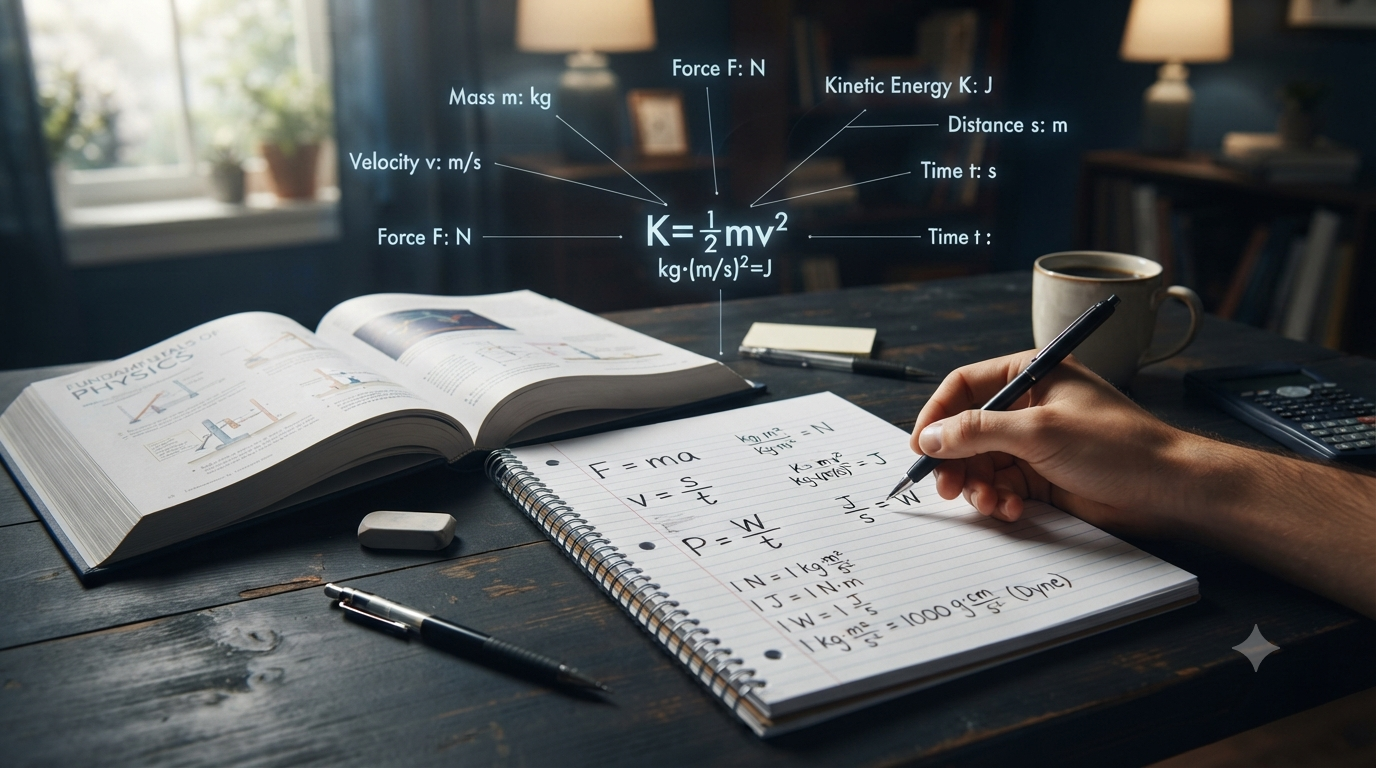
Many other units used in physics are derived from these base units. For example, velocity is measured in metres per second (m/s), acceleration in metres per second squared (m/s²), and force in newtons (N).
Why Should You Use SI Units in Physics Formulas?
Physics formulas are generally written using a consistent system of units. When the quantities are expressed in SI units, the mathematical relationship between them works correctly without requiring additional conversion factors.
For example, the formula for speed is:
v = s/t
If distance is given in metres and time in seconds, the resulting speed is automatically in metres per second.
Suppose an object travels 100 metres in 20 seconds:
v = 100/20 = 5 m/s
The calculation is straightforward because both quantities are already in SI units.
However, if the distance were given as 100 centimetres and the time as 20 seconds, directly substituting 100 into the formula would give 5 m/s, which would be incorrect because 100 centimetres is only 1 metre.
Therefore, checking units before using a formula is just as important as checking the numbers.
Identify the SI Unit Required for Each Quantity
Before solving a physics problem, first identify the quantities in the formula and determine their standard SI units.
For example, consider the formula:
F = ma
Here:
F is force, measured in newtons (N)
m is mass, measured in kilograms (kg)
a is acceleration, measured in metres per second squared (m/s²)
If a problem gives a mass of 2 kg and an acceleration of 3 m/s², the values are already in SI units.
F = 2 × 3 = 6 N
But if the mass is given as 2000 g, it should be converted into kilograms before substitution.
2000 g = 2 kg
Then:
F = 2 × 3 = 6 N
The conversion ensures that the formula produces the correct SI result.
Convert Common Measurements Into SI Units
Many physics problems provide values using units such as centimetres, grams, kilometres, minutes, or hours. These measurements often need to be converted before they are used in formulas.
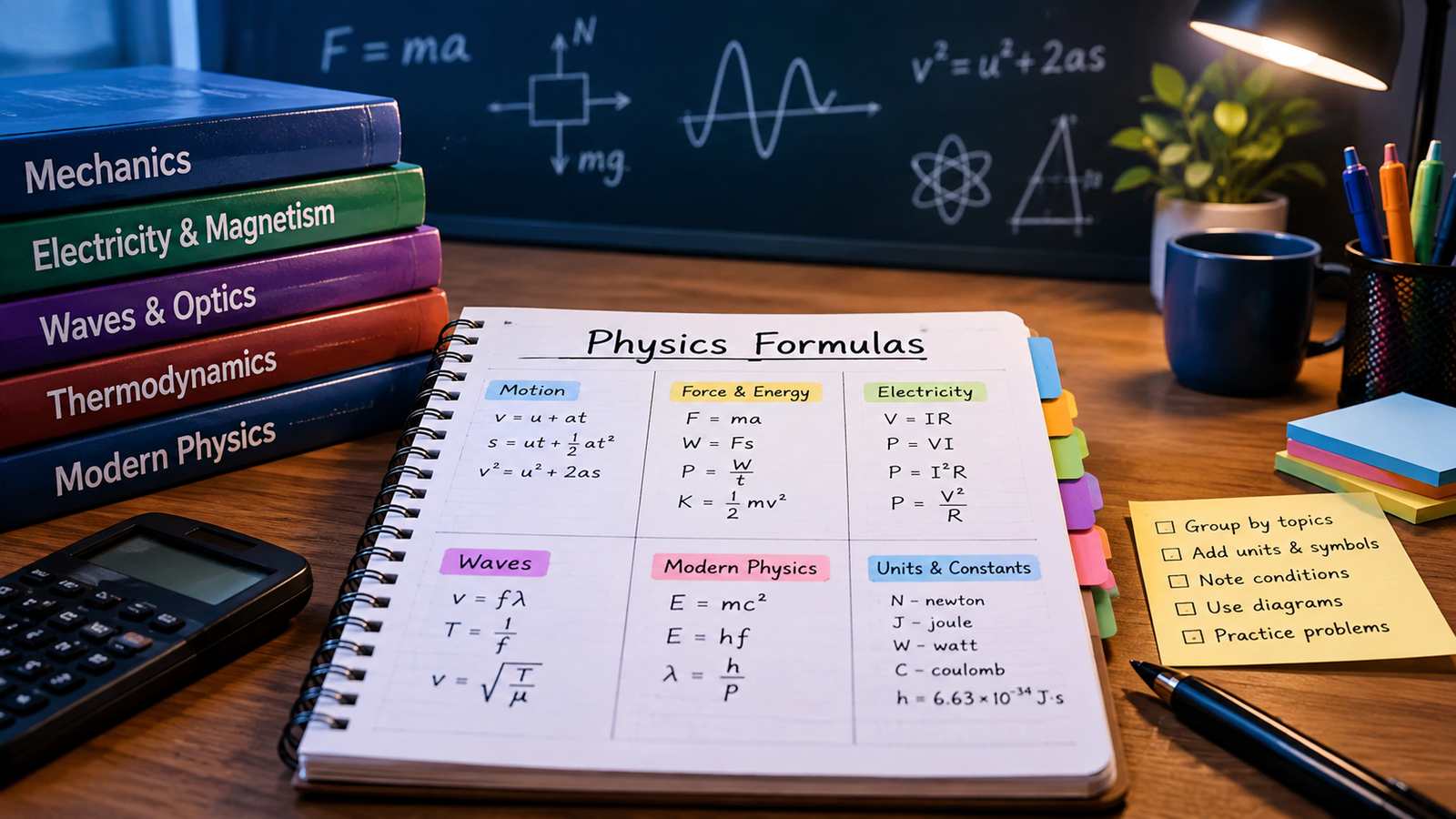
Some useful conversions are:
1 km = 1000 m
1 cm = 0.01 m
1 mm = 0.001 m
1 g = 0.001 kg
1 min = 60 s
1 h = 3600 s
For example, if a car travels 2 km in 10 seconds, convert the distance first:
2 km = 2000 m
Now use the speed formula:
v = s/t
v = 2000/10 = 200 m/s
The important step is not the formula itself but making sure that the distance and time are expressed in compatible units.
Understand Derived SI Units
Not every physical quantity has a separate base unit. Many important quantities have derived SI units.
For example:
These derived units can also be expressed using SI base units.
For example:
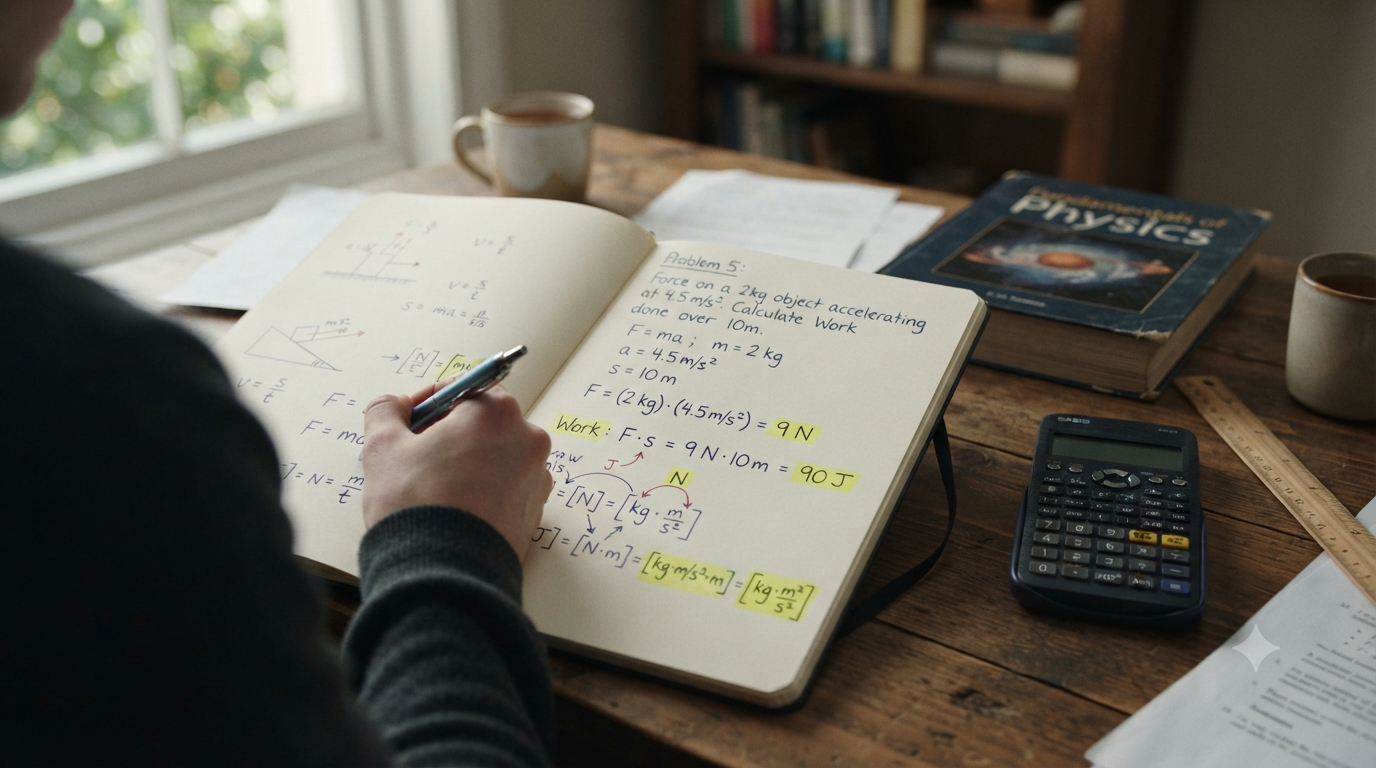
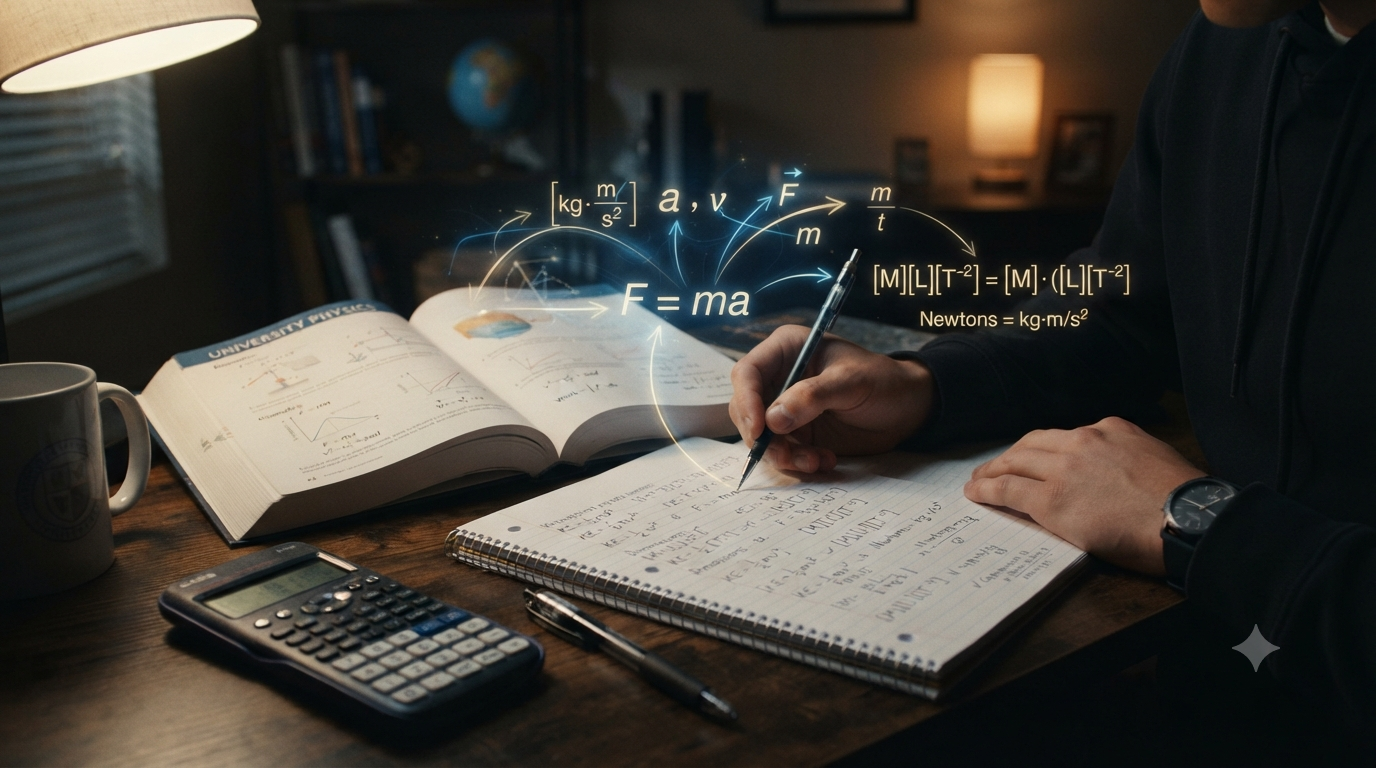
1 N = 1 kg·m/s²
This comes directly from the formula:
F = ma
If mass is measured in kilograms and acceleration in metres per second squared, the force naturally has the unit kg·m/s², which is called a newton.
Understanding this relationship helps you see why SI units fit naturally into physics formulas.
Example of Using SI Units in a Formula
Consider the equation for kinetic energy:
K = ½mv²
Suppose an object has a mass of 500 g and moves at 20 m/s.
The velocity is already in SI units, but the mass is not.
Convert the mass:
500 g = 0.5 kg
Now substitute:
K = ½ × 0.5 × 20²
K = 0.25 × 400
K = 100 J
The answer is 100 joules because kilograms and metres per second are SI units, and the resulting derived unit is the joule.
If the mass had been entered as 500 instead of 0.5, the answer would have been 100,000 J, which is incorrect.
Pay Attention to Squared and Cubed Units
Unit conversions become especially important when a quantity is squared or cubed.
For example:
1 cm = 0.01 m
But:
1 cm² = (0.01 m)² = 0.0001 m²
Similarly:
1 cm³ = (0.01 m)³ = 0.000001 m³
This matters in formulas involving area and volume.
For example, the volume of a cube is:
V = l³
If the side length is 10 cm, convert it first:
10 cm = 0.1 m
Then:
V = (0.1)³ = 0.001 m³
Simply changing cm to m without applying the power would produce an incorrect result.
Check Units Before Substituting Values
A useful habit is to write the unit beside every given quantity before beginning the calculation.
For example:
m = 2 kg
a = 5 m/s²
Then:
F = ma
F = 2 kg × 5 m/s²
F = 10 kg·m/s²
Since kg·m/s² is equivalent to newtons:
F = 10 N
This approach makes it easier to notice unit mismatches and can also help you understand what the final answer represents.
Use Unit Conversion as a Checking Tool
SI units are not only useful before calculations. They can also help you check whether your final answer makes sense.
Consider:
P = W/t
Power is measured in watts. A watt is equivalent to joules per second:
1 W = 1 J/s
If work is measured in joules and time in seconds, the result should therefore be in watts.
If your final unit does not match the physical quantity expected by the formula, something may have gone wrong during the calculation.
This type of checking is closely related to dimensional analysis and can be a powerful way to find mistakes.
Common Mistakes When Using SI Units
Several mistakes occur frequently when solving physics problems.
One common mistake is using grams instead of kilograms in formulas involving mass. Another is using kilometres instead of metres when the formula expects metres. Time is also frequently left in minutes or hours when seconds are required.
Another mistake is forgetting that squared and cubed quantities require the conversion factor to be squared or cubed as well.
It is also possible to convert some quantities but forget others. For example, using distance in kilometres and time in seconds may produce an answer with an unexpected unit.
The safest approach is to convert all relevant quantities into SI units before substitution.
A Simple Method to Follow
You can use the following method for most numerical physics problems:
Write the given quantities.
Identify the SI unit required for each quantity.
Convert non-SI values into SI units.
Write the physics formula.
Substitute the converted values.
Calculate the result.
Write the correct SI unit with the final answer.
Check whether the result and unit are reasonable.
This method may seem slower at first, but with practice it becomes almost automatic.
Conclusion
Using SI units in physics formulas is a simple but essential skill. SI units create consistency between measurements and allow formulas to work correctly across different problems. Before substituting values, always check whether quantities such as length, mass, time, velocity, and temperature are expressed in the appropriate SI units. Pay special attention to squared and cubed quantities because their conversion factors also change accordingly.
Once SI unit conversion becomes a regular part of your problem-solving process, many physics calculations become easier to organize and check. More importantly, you begin to understand that units are not just labels attached to numbers. They are an important part of the physical meaning of every equation.