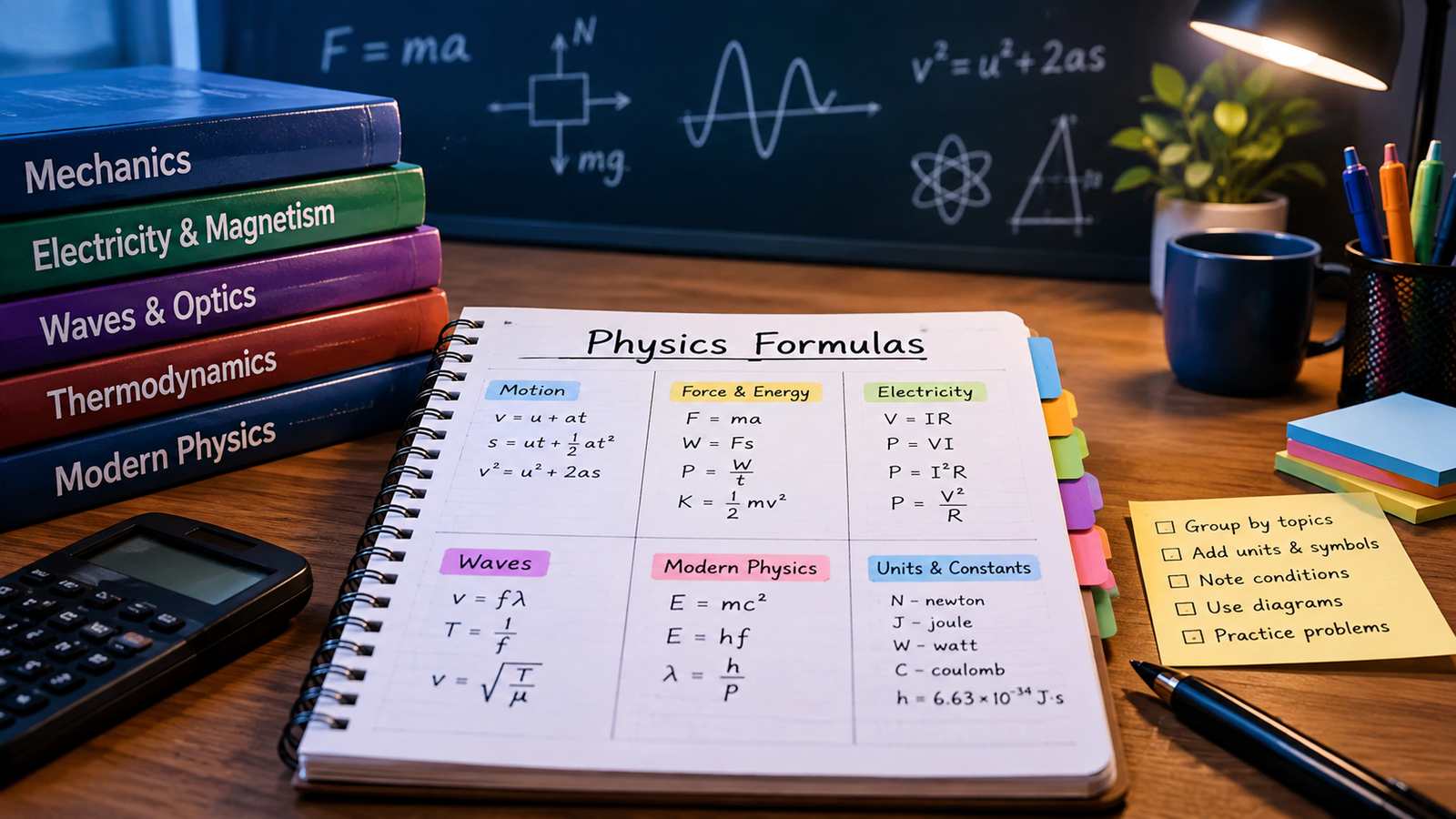
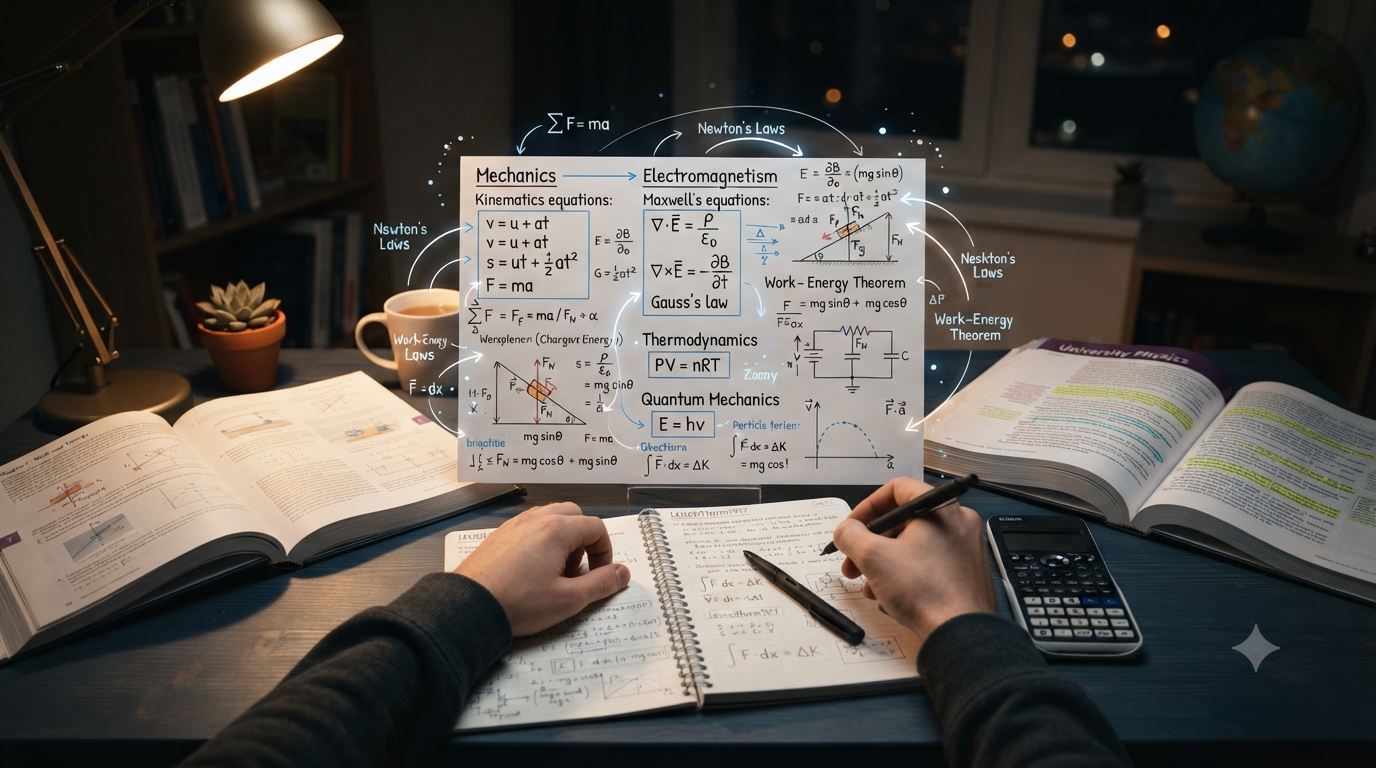
Physics is the study of matter, energy, motion, forces, space, time, and the interactions that shape the natural world. To describe these ideas clearly, physicists use mathematics. One of the most useful tools that connects physics with mathematics is the physics formula.
A physics formula is a mathematical relationship that shows how different physical quantities are connected. Instead of describing a relationship using many words, a formula can express the same idea in a short and precise form. For example, the formula for speed is v = s/t, which shows that speed depends on the distance travelled and the time taken.
Physics formulas are important because they help us understand physical relationships, solve problems, make predictions, and connect observations with measurable quantities.
What Is a Physics Formula?
A physics formula is a mathematical expression used to represent a relationship between two or more physical quantities. Each symbol in a formula represents a measurable quantity, while the equation describes how those quantities are related.
For example:
F = ma
This is Newton’s second law of motion. Here, F represents force, m represents mass, and a represents acceleration. The formula tells us that the force acting on an object is related to its mass and acceleration.
A formula therefore does more than provide a calculation. It expresses a physical relationship in a precise mathematical form.
Why Do Physicists Use Formulas?
Physics deals with quantities that can be measured. Distance, time, mass, temperature, velocity, energy, and force can all be represented using numbers and units. Mathematical formulas allow physicists to connect these measurements.
Suppose an object travels 100 metres in 20 seconds. Instead of simply saying that the object travelled quickly, we can calculate its speed:
v = s/t
v = 100/20 = 5 m/s
The formula converts measured information into a meaningful physical quantity.
This makes physics more precise than a purely verbal description. A formula can also be applied to many different situations, provided the physical conditions and assumptions are appropriate.
Formulas Show Relationships Between Physical Quantities
One of the most important purposes of a physics formula is to show how physical quantities depend on one another.
Consider:
V = IR
This relationship connects voltage, current, and resistance in an electrical circuit. If resistance remains constant, increasing the current increases the voltage. Similarly, changing one quantity can affect the others.
Formulas therefore help us understand not only what happens, but also how different quantities influence one another.
This is especially useful when studying complicated physical systems. Instead of memorizing separate observations, we can use mathematical relationships to understand the underlying pattern.
Physics Formulas Help Solve Problems
Physics problems often provide some known quantities and ask us to determine an unknown quantity. A suitable formula provides a structured way to solve the problem.
For example, suppose an object has an acceleration of 2 m/s² and starts from rest. If we want to find its velocity after 5 seconds, we can use:
v = u + at
Since the initial velocity is zero:
v = 0 + (2 × 5)
v = 10 m/s
The formula connects the information given in the problem with the quantity we want to find.
This approach is useful because it turns a physical situation into a mathematical problem that can be solved step by step.
Formulas Help Make Predictions
Physics is not only about explaining what has already happened. It is also about predicting what will happen under particular conditions.
For example, the formula:
s = ut + ½at²
can be used to determine the displacement of an object when its initial velocity, acceleration, and time are known.
A physicist can use such a relationship to predict the position of an object after a certain period.
Formulas are therefore powerful because they allow us to move from observation to prediction.
Formulas Make Physics More Precise
Words can sometimes have different interpretations. Mathematics provides a common language that reduces ambiguity.
For example, saying that an object is moving “fast” does not give an exact value. Saying that it is moving at 20 m/s provides a precise measurement.
Similarly, the formula:
p = mv
defines the relationship between momentum, mass, and velocity.
Mathematical notation allows physicists around the world to communicate physical relationships without depending on long verbal explanations.
Formulas Connect Theory With Measurement
Physics formulas are closely connected with experiments and measurements. A formula may describe a theoretical relationship, while experimental measurements can be used to test whether the relationship works in the real world.
For example, if a formula predicts how the period of a pendulum changes with its length, experiments can be performed to measure the period at different lengths.
If the experimental results agree with the predicted relationship within the expected uncertainty, the formula gains support.
This connection between mathematics and measurement is one of the foundations of physics.
Common Examples of Physics Formulas
Physics contains many formulas because different physical phenomena require different mathematical relationships.
Some basic examples include:
Speed: v = s/t
Acceleration: a = (v − u)/t
Force: F = ma
Momentum: p = mv
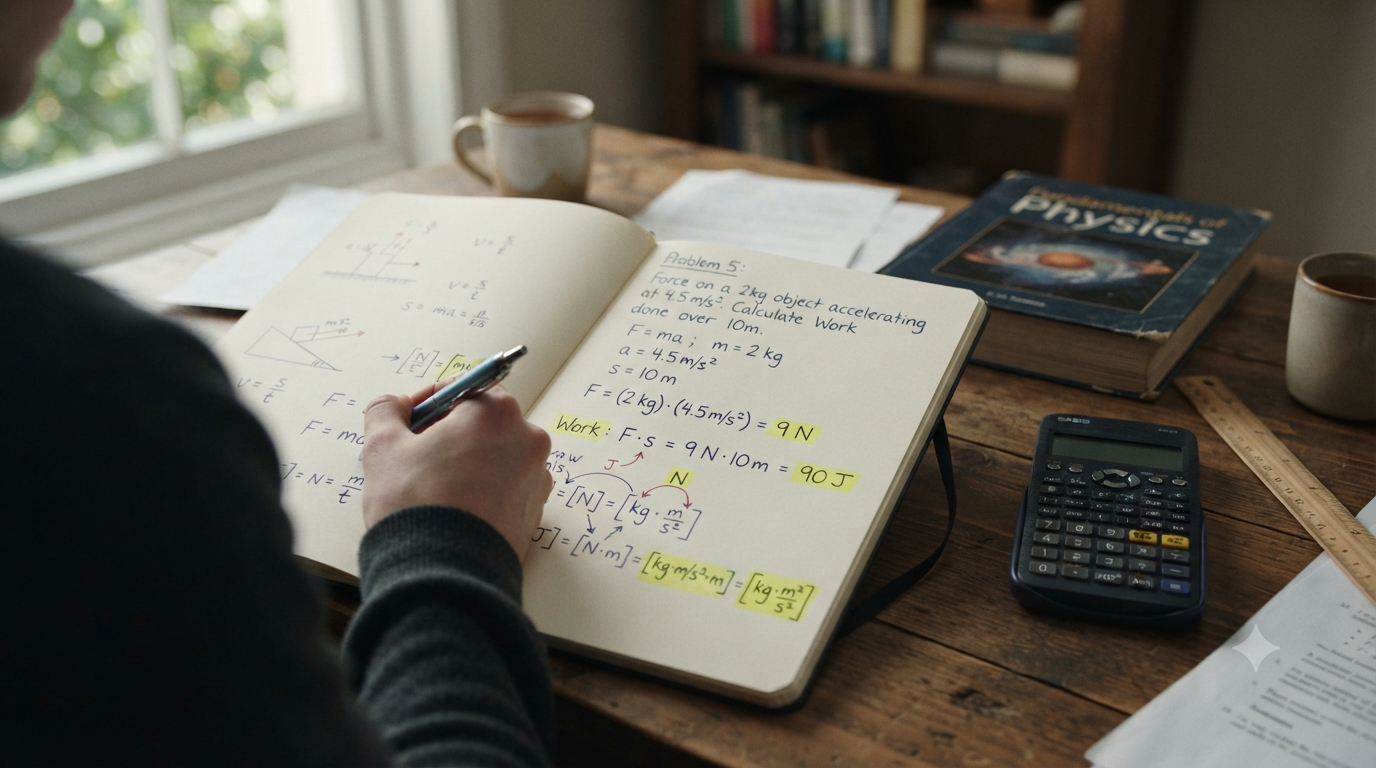
Work: W = Fs
Power: P = W/t
Density: ρ = m/V
Pressure: P = F/A
Kinetic energy: KE = ½mv²
Potential energy: PE = mgh
Each formula describes a particular relationship. Learning what the symbols mean and when the formula applies is more important than simply memorizing the equations.
Understanding a Formula Is More Important Than Memorizing It
A common mistake in learning physics is trying to memorize a large collection of formulas without understanding them.
For example, knowing F = ma is useful, but understanding what force, mass, and acceleration mean makes the formula much more meaningful.
When learning a formula, it is helpful to understand:
What each symbol represents
What units are used
What physical relationship the formula describes
When the formula can be applied
What assumptions are involved
How changing one quantity affects another
Understanding these points makes it easier to remember and correctly use formulas.
Formulas Also Help Check Answers
Physics formulas can help determine whether an answer is reasonable.
For example, suppose a calculation gives a speed of several million metres per second for an ordinary moving bicycle. The numerical result may indicate that something went wrong in the calculation or that the units were misunderstood.
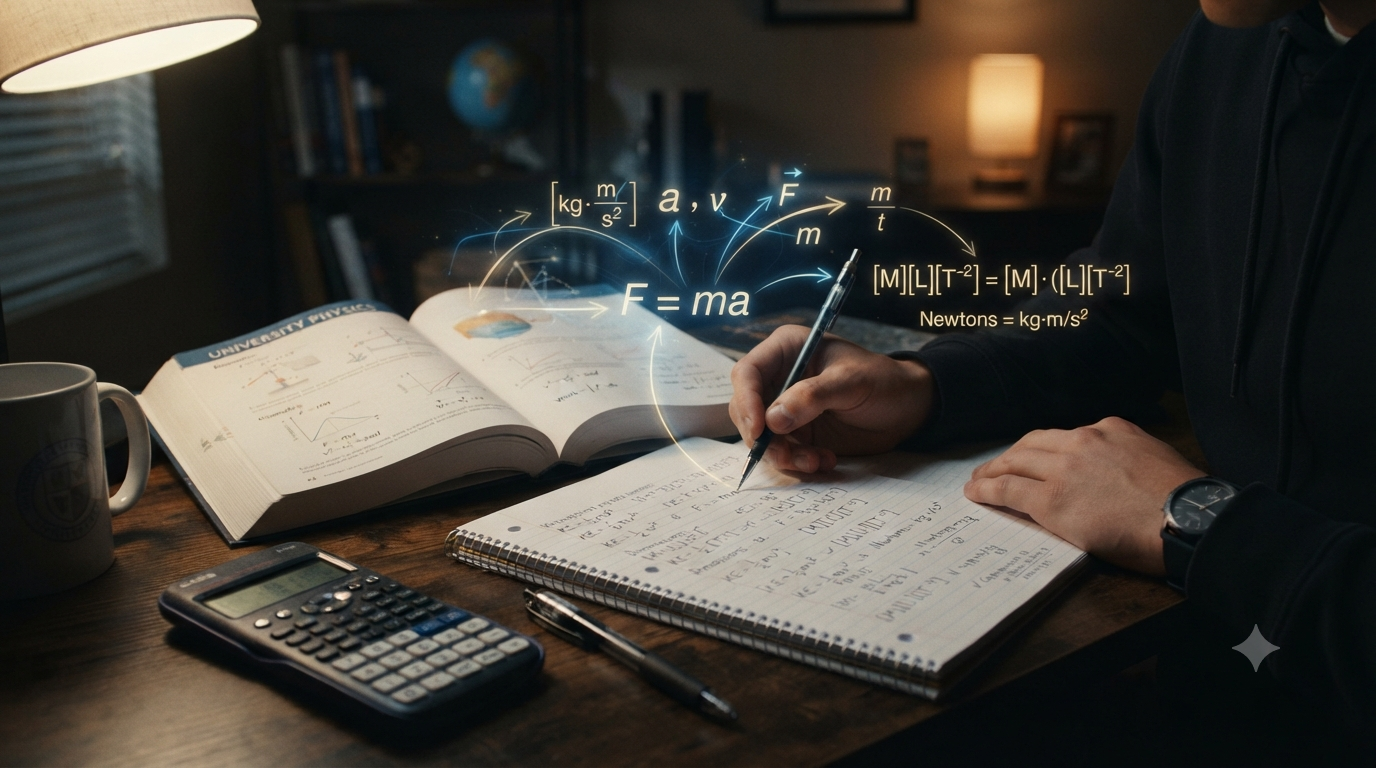
Units are particularly useful for checking formulas. In physics, both sides of a valid equation must have compatible dimensions.
For example:
F = ma
The dimensions of mass multiplied by acceleration give the dimensions of force. This type of checking is called dimensional analysis.
Physics Formulas Connect Different Areas of Physics
Many formulas are connected to other concepts. Learning one relationship can therefore help build understanding of another.
For example, work is related to force and displacement:
W = Fs
Power is related to work and time:
P = W/t
Energy is also connected with work. These relationships show that physics is not a collection of completely separate topics. Different concepts often form a connected system.
As learners progress, they begin to see how formulas from mechanics, electricity, thermodynamics, waves, and other areas are linked.
Formulas Are Tools for Thinking
A physics formula should not be viewed simply as something to memorize before an examination. It is a tool for thinking about the physical world.
When a physicist sees a formula, they can ask questions such as: What happens if one quantity increases? What happens if another becomes zero? Which quantities are directly related? Which quantities are inversely related? What units should the result have?
These questions turn formulas into tools for reasoning.
For example, from F = ma, we can understand that greater acceleration requires greater force when mass is fixed. We can also see that a larger mass requires more force to produce the same acceleration.
Why Physics Formulas Are Important
Physics formulas are important because they allow us to express physical relationships accurately, solve quantitative problems, interpret measurements, and make predictions.
They also provide a bridge between physical observations and mathematical reasoning. A falling object, a moving vehicle, an electrical circuit, a wave, or a planetary orbit can all be described using mathematical relationships.
Without formulas, many ideas in physics would be difficult to express with the same precision and usefulness.
Conclusion
Physics formulas are mathematical tools that describe relationships between physical quantities. They help us calculate unknown quantities, understand how different variables are connected, test physical ideas, interpret measurements, and make predictions about natural phenomena.
The real value of a formula is not simply in remembering its symbols. It lies in understanding what the formula means, why the relationship exists, what each quantity represents, and when the formula should be used. Once formulas are understood in this way, physics becomes more than a collection of equations. It becomes a powerful way to describe, explain, and predict how the physical world works.

FAQs
A physics formula is a mathematical expression that shows the relationship between two or more physical quantities. It uses symbols to represent measurable quantities such as mass, time, distance, force, velocity, and energy. For example, F = ma shows the relationship between force, mass, and acceleration. Physics formulas allow complex physical ideas to be expressed in a short and precise form. Instead of explaining a relationship using many words, a formula provides a mathematical representation that can be used for calculations, comparisons, and predictions. Understanding the meaning of each symbol is important for using a formula correctly.
Physics formulas are important because they help us describe, understand, and calculate physical phenomena. They allow us to connect measurements with physical relationships and determine unknown quantities. For example, the formula v = s/t can be used to calculate speed when distance and time are known. Formulas also help physicists make predictions about how objects and systems will behave. They provide a common mathematical language that scientists can use to communicate ideas accurately. Rather than memorizing formulas without meaning, learners should understand what each formula represents and the conditions under which it can be applied.
Yes, physics formulas are essential for solving numerical problems. A typical physics problem provides some known quantities and asks you to find an unknown quantity. The appropriate formula connects these quantities mathematically. For example, if distance and time are given, the formula v = s/t can be used to calculate speed. A good approach is to identify the known values, determine the unknown quantity, select the correct formula, substitute the values with their units, and calculate the result. This systematic method makes problem-solving easier and reduces mistakes caused by using an inappropriate formula.
No, memorizing formulas alone is not enough to understand physics. A learner should also understand what each symbol means, what relationship the formula describes, which units are involved, and when the formula can be used. For example, knowing F = ma is useful, but understanding that force depends on mass and acceleration provides deeper knowledge. Understanding formulas also makes it easier to remember them because they become connected to physical concepts. When learners understand the meaning behind equations, they can apply formulas to unfamiliar problems instead of simply recalling equations from memory.
Physics formulas allow us to predict what may happen when certain physical conditions are known. For example, the equation v = u + at can be used to calculate an object’s final velocity when its initial velocity, acceleration, and time are known. Similarly, formulas for energy, force, motion, and electricity allow scientists and engineers to predict how systems may behave. These predictions can then be compared with experimental observations. This makes formulas powerful scientific tools because they connect mathematical relationships with real-world events and allow researchers to test whether theoretical descriptions agree with measurements.
Physics uses mathematics to express relationships between measurable physical quantities. A formula provides a mathematical description of a physical idea. For example, p = mv connects momentum with mass and velocity, while W = Fs connects work with force and displacement. Mathematics allows these relationships to be calculated, compared, and analyzed precisely. This connection also helps physicists identify patterns that may not be obvious from observations alone. Mathematics therefore acts as a language for physics, allowing physical concepts to be represented using equations, graphs, symbols, numbers, and relationships.
Yes, formulas and units can help check whether a physics answer is reasonable. One useful method is dimensional analysis, which checks whether the units on both sides of an equation are compatible. For example, in F = ma, mass multiplied by acceleration produces the unit of force. The magnitude of an answer can also be considered. If a calculation gives an extremely unusual value for an everyday situation, it may indicate an error in calculation, unit conversion, or formula selection. Checking units and considering whether the result makes physical sense are important parts of solving physics problems.
Units are important because physical quantities must be measured consistently. A formula can give an incorrect result if incompatible or incorrectly converted units are used. For example, distance may need to be expressed in metres and time in seconds when calculating speed in metres per second. Units also help identify what a calculated quantity represents. They provide useful information about the physical meaning of a result. Before substituting values into a formula, it is therefore important to check the units and convert them when necessary. Correct units are an essential part of accurate physics calculations.
No, every physics formula has conditions or assumptions under which it applies. A formula may describe a particular physical situation, approximation, or idealized model. For example, equations of motion with constant acceleration cannot automatically be used when acceleration changes unpredictably. Similarly, some formulas are valid only under specific conditions. Understanding these limitations is important because using a correct formula in the wrong situation can produce an incorrect result. Learners should therefore ask not only “Which formula should I use?” but also “Does this formula apply to the physical situation described in the problem?”
The best way to learn physics formulas is to understand them rather than memorize them mechanically. Start by learning what each symbol represents and the physical relationship described by the equation. Then study the units and try simple numerical examples. Practice rearranging formulas to find different unknown quantities and connect related formulas together. It is also helpful to understand where a formula comes from when possible. Regular problem-solving builds familiarity and confidence. When formulas are connected to real-world situations, diagrams, experiments, and physical concepts, they become easier to remember and much more useful.
Related Posts
What Do Coefficients Mean in Chemistry Formulas?
When you look at a chemical equation, you may notice numbers written before chemical formulas. These numbers are called coefficients. […]
Read MoreHow to Read Subscripts in Chemical Formulas
Chemical formulas are a simple way to represent substances using symbols and numbers. When you look at a formula such […]
Read MoreHow to Identify Elements in a Chemical Formula
Chemical formulas provide a simple way to describe the substances that make up the world around us. A formula may […]
Read MoreHow Elements Are Represented in Chemical Formulas
Chemistry deals with many different substances, from the oxygen we breathe to the water we drink and the minerals found […]
Read MoreChemical Symbols and Their Role in Chemistry Formulas
Chemistry is often described as the science of matter, but understanding chemistry also means learning how scientists communicate information about […]
Read MoreHow Chemical Formulas Represent Substances
Chemical formulas are one of the simplest ways scientists communicate information about matter. A substance may contain millions or billions […]
Read MoreWhat Is a Chemical Formula in Chemistry?
Chemistry is the study of substances, their properties, and the changes they undergo. To describe these substances clearly, chemists need […]
Read MoreBasic Types of Chemistry Formulas Explained
Chemistry formulas are one of the simplest ways scientists describe substances, reactions, and relationships between different particles. A formula can […]
Read MoreHow to Read and Understand Chemistry Formulas
Chemistry formulas may look like a collection of letters, numbers, and symbols, but they are actually a simple language used […]
Read MoreWhat Are Chemistry Formulas and Why Are They Important?
Chemistry is the science of substances, their properties, and the changes they undergo. To describe these substances clearly, chemists use […]
Read MoreHow to Verify an Answer Using Units
In physics, getting a numerical answer is only part of solving a problem. The next question is whether that answer […]
Read MoreHow to Check Whether a Physics Formula Is Correct
A physics formula is more than a collection of symbols and numbers. It represents a relationship between physical quantities and […]
Read MoreHow to Avoid Unit Conversion Mistakes in Physics
Unit conversion is one of the most common sources of mistakes in physics. A formula may be correct, the calculation […]
Read MoreHow to Avoid Sign Errors in Physics Calculations
Physics calculations are not only about choosing the correct formula and putting numbers into it. The signs of physical quantities […]
Read MoreCommon Mistakes When Using Physics Formulas
Physics formulas help us describe motion, forces, energy, electricity, heat, waves, and many other phenomena using mathematical relationships. A formula […]
Read MoreHow to Study Physics Formulas Step by Step
Physics formulas are an important part of learning physics, but simply memorizing them is not enough. A formula represents a […]
Read MoreHow to Organize Physics Formulas for Easy Revision
Physics becomes much easier when formulas are organized in a clear and meaningful way. Many learners struggle not because they […]
Read MoreHow to Build a Physics Formula Sheet
Physics involves many formulas, and remembering all of them can become difficult as you move from basic concepts to more […]
Read More