Length is one of the most basic quantities measured in science. Whether we measure the distance between two cities, the size of a cell, the wavelength of light, or the dimensions of a machine, we need a reliable unit of length. The metre (m) is the SI unit of length and is used throughout modern science, engineering, technology, and everyday measurement.
The metre may appear to be a simple unit, but its definition has changed significantly over time. Early definitions were based on physical objects and geographical measurements. Today, the metre is defined using one of the most fundamental constants of nature: the speed of light in vacuum. This modern definition makes the unit highly precise, reproducible, and independent of any particular physical object.
What Is the SI Unit of Length?
The metre, symbol m, is the SI base unit of length. The International System of Units, commonly called the SI system, provides a common framework for measurements used around the world.
Length describes the distance between two points. It can be measured on many different scales. For example, the length of a room may be several metres, the size of a bacterium may be measured in micrometres, and astronomical distances may be expressed using much larger units.
The metre provides the fundamental reference from which many other commonly used units of length are derived.
Some examples include:
1 kilometre = 1,000 metres
1 centimetre = 0.01 metre
1 millimetre = 0.001 metre
1 micrometre = 0.000001 metre
1 nanometre = 0.000000001 metre
Because the metre is an SI base unit, these relationships can be expressed systematically using SI prefixes.
How Was the Metre Defined in the Past?
The definition of the metre has evolved as measurement technology became more accurate.
In the late eighteenth century, scientists attempted to create a universal unit of length that was not based on local measurements. The metre was originally associated with a fraction of the Earth’s meridian, with the intention of making it a globally meaningful standard.
Later, a physical prototype made from platinum-iridium was used as the international reference for the metre. This approach provided a physical standard that laboratories could compare their measurements against.
However, relying on a physical object has limitations. A material object can be damaged, contaminated, or undergo tiny physical changes. Even extremely small changes matter when measurements become highly precise.
Scientists therefore searched for a definition based on a natural phenomenon that could be reproduced anywhere with suitable equipment.
The Metre and the Speed of Light
A major change occurred in 1983, when the metre was redefined in terms of the speed of light.
The modern definition states that:
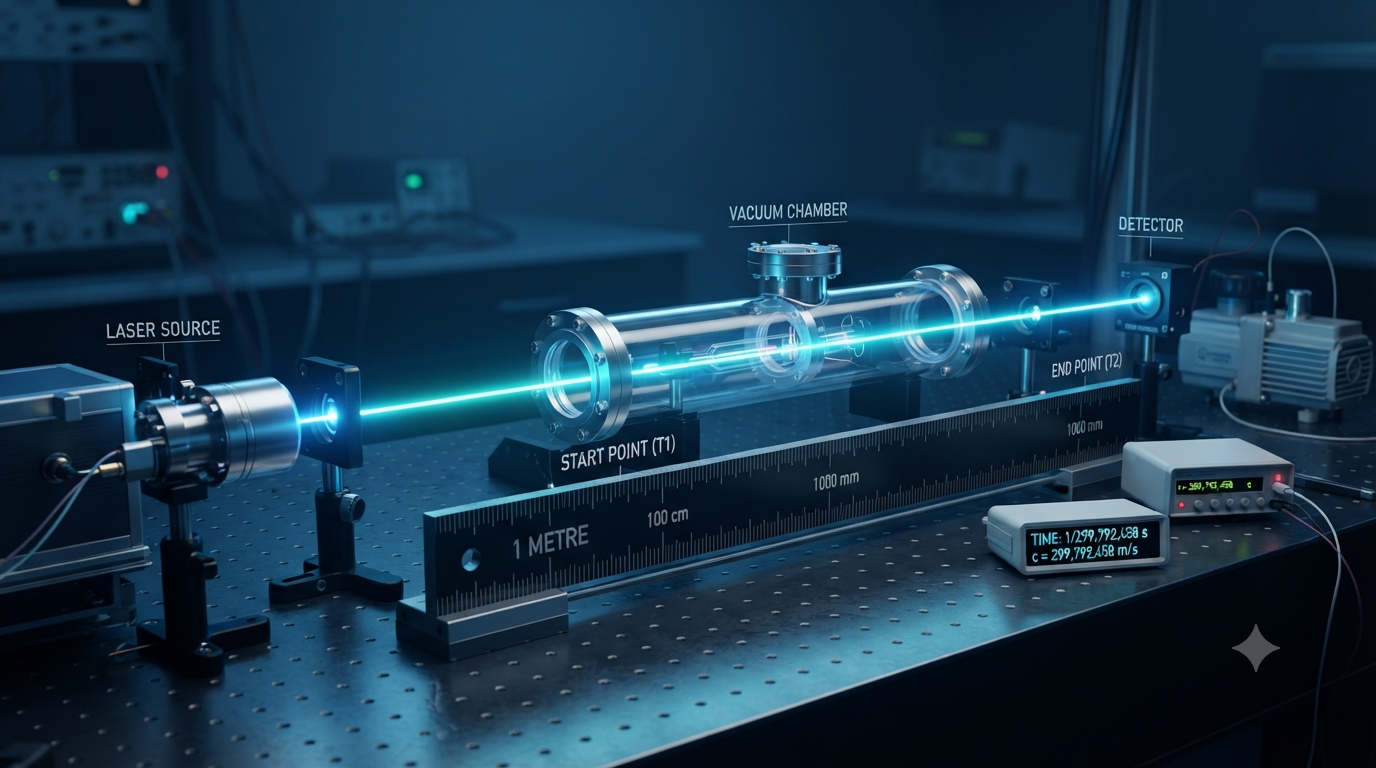
The metre is the length of the path travelled by light in vacuum during a time interval of 1/299,792,458 of a second.
This definition connects the metre with the speed of light in vacuum.
The speed of light in vacuum is assigned the exact value:
c = 299,792,458 m/s
The value is exact rather than an experimentally measured approximation within the SI system.
This means that if the speed of light and the duration of one second are known, the metre can be realized through the distance light travels during a precisely defined fraction of a second.
Why Is the Speed of Light Used?
The speed of light is an important constant in modern physics. According to Einstein’s theory of special relativity, light in vacuum travels at the same speed for all inertial observers, regardless of the motion of the source or observer.
Using this constant to define the metre provides several advantages.
First, the definition does not depend on a particular physical object. A laboratory does not need to possess an original metre bar to determine the unit.
Second, the definition can be reproduced using precise technologies such as lasers, optical frequency measurements, and advanced timing systems.
Third, the definition connects length measurement with time measurement. Since the speed of light has an exact value, extremely precise measurements of time can be used to establish extremely precise measurements of length.
What Does the Modern Definition Actually Mean?
The modern definition can seem complicated at first, but its basic idea is straightforward.
Suppose light travels through a vacuum at a speed of exactly 299,792,458 metres per second. If we allow the light to travel for exactly 1/299,792,458 of a second, the distance it travels is defined as exactly one metre.
In simple form:
Distance = Speed × Time
Therefore:
1 m = 299,792,458 m/s × 1/299,792,458 s
So:
1 m = 1 m
The definition effectively fixes the speed of light and uses the precisely defined second to establish the metre.
How Is the Second Related to the Metre?
The modern definition of the metre depends on the second because the metre is defined through the distance travelled by light during a specific time interval.
The second itself is defined using the frequency of radiation associated with a particular transition in the caesium-133 atom.
The SI definition uses the exact value:
ΔνCs = 9,192,631,770 Hz
This means that modern measurements of length ultimately depend on extremely precise measurements of time and frequency.
This relationship is one reason modern metrology can achieve extraordinary precision. Atomic clocks provide highly accurate measurements of time, while advanced optical technologies allow scientists to use those measurements to determine lengths.
Why Is the Modern Metre Definition Important?
The modern definition of the metre is important because it makes the unit universal and reproducible.
Imagine if the definition depended on a particular metal bar stored in one location. Scientists around the world would need to compare their instruments with that object or with copies of it. Any physical change could create uncertainty.
The modern definition avoids this problem. The metre is not tied to a single object. Instead, it is linked to fundamental constants and precise measurement procedures.
This is especially important in fields where tiny differences matter.
Modern length measurements are essential in:
Precision engineering
Semiconductor manufacturing
Laser technology
Astronomy
Physics experiments
Medical imaging
Nanotechnology
Space science
Telecommunications
In advanced industries, differences much smaller than a millimetre can be scientifically and technologically significant.
Common SI Prefixes Used With the Metre
The metre can be combined with SI prefixes to describe very large or very small lengths.
For example:
Kilometre (km) = 1,000 m
Centimetre (cm) = 0.01 m
Millimetre (mm) = 0.001 m
Micrometre (μm) = 0.000001 m
Nanometre (nm) = 0.000000001 m
These prefixes allow scientists and engineers to express measurements conveniently without writing extremely large or small decimal numbers.
For example, the diameter of many microscopic structures may be expressed in micrometres, while wavelengths of visible light are commonly expressed in nanometres.
The Metre in Modern Science
The metre is more than a unit used to measure everyday distances. It is part of the foundation of modern physical measurement.
In physics, length appears in many important quantities and equations. Velocity involves length per unit time, acceleration involves length per unit time squared, and quantities such as wavelength, displacement, radius, and distance all depend on length.
Accurate length measurement also supports the practical realization of many technologies. From manufacturing tiny electronic components to measuring astronomical objects, scientists need reliable standards that can be reproduced across laboratories and countries.
The modern metre provides this common foundation.
Why the Metre Is Considered a Universal Unit
One of the greatest strengths of the modern metre is that its definition does not depend on where you are located or which physical reference object you possess.
A suitably equipped laboratory anywhere in the world can realize the metre using the same fundamental definition. This creates consistency between scientific measurements performed in different countries and at different times.
The definition also demonstrates an important principle of modern science: measurement standards can become increasingly connected to fundamental properties of nature as technology improves.
Conclusion
The metre (m) is the SI base unit of length, but its modern definition represents much more than a simple measurement convention. Earlier definitions depended on geographical measurements and physical reference objects, while today’s definition is based on the exact value of the speed of light in vacuum.
Since 1983, the metre has been defined through the distance travelled by light in vacuum during a precisely specified fraction of a second. This approach makes the unit universal, highly precise, and reproducible.
The modern metre also shows how fundamental physics, accurate time measurement, and advanced technology work together. From ordinary measurements to cutting-edge scientific experiments, the metre provides a reliable foundation for understanding and measuring the physical world.
FAQs
The SI unit of length is the metre, represented by the symbol m. It is one of the seven SI base units and provides the standard reference for measuring length and distance. The metre is used in science, engineering, technology, industry, and everyday measurements. Other length units can be related to the metre using SI prefixes. For example, one kilometre equals 1,000 metres, while one centimetre equals 0.01 metre. The metre is especially important because modern measurement systems around the world use it as a common and reproducible standard for length.
The metre is defined as the length of the path travelled by light in vacuum during a time interval of 1/299,792,458 of a second. This definition uses the exact value of the speed of light in vacuum, which is 299,792,458 metres per second. Instead of depending on a physical object, the modern definition connects the metre with fundamental constants and precise time measurement. This makes the unit universal and reproducible. Laboratories can realize the metre using advanced technologies without needing to compare their measurements with a particular physical metre bar.
The speed of light in vacuum is a fundamental constant of nature with an exact value in the SI system. Using it to define the metre provides a highly stable and reproducible standard. A physical object can potentially change because of damage, temperature, contamination, or other effects. The speed of light, however, provides a universal reference. By combining the exact speed of light with the precise definition of the second, scientists can establish the metre with extremely high accuracy. This approach is particularly valuable for advanced physics, engineering, manufacturing, astronomy, and precision measurement.
The metre received its modern definition in 1983. Before this change, the metre had been defined using physical and geographical references. The 1983 definition established the metre through the distance travelled by light in vacuum during a specified fraction of a second. This represented an important development in metrology because the unit no longer depended on a physical prototype. The definition made the metre more reproducible and connected length measurement with fundamental physical constants. Later developments in the SI system have continued to improve the precision with which the metre can be realized.
The metre was originally associated with the Earth’s dimensions. In the late eighteenth century, scientists developed a definition related to a fraction of the distance along the Earth’s meridian between the equator and the North Pole. Later, a physical prototype made from platinum-iridium became the international reference for the metre. Although the physical standard provided a practical reference, it had limitations because a physical object could experience tiny changes. As measurement technology improved, scientists developed more universal definitions. The modern metre is now based on the speed of light rather than a physical prototype.
The metre is an SI base unit because it is one of the fundamental units from which many other SI units are constructed. It represents the basic quantity of length in the International System of Units. Several derived units contain metres as part of their definitions. For example, velocity is expressed in metres per second, acceleration in metres per second squared, and area in square metres. Having a standardized base unit allows measurements to be communicated consistently across different scientific fields. The metre therefore forms an important foundation of the international measurement system.
The official SI symbol for the metre is m. SI unit symbols are written in standardized forms so that measurements can be understood consistently around the world. The symbol is normally written without a period and does not change between singular and plural forms. For example, measurements can be written as 1 m, 5 m, or 25 m. SI prefixes can also be combined with the metre symbol. Examples include km for kilometre, cm for centimetre, mm for millimetre, and nm for nanometre.
The modern definition of the metre directly connects length with time. Light travels through vacuum at exactly 299,792,458 metres per second. The metre is defined as the distance light travels during 1/299,792,458 of a second. Therefore, extremely accurate time measurement is essential for realizing the metre. The second itself is defined using a specific frequency associated with caesium-133 atoms. This connection allows advanced laboratories to use highly accurate clocks and frequency technologies to establish length. It demonstrates how modern SI units are interconnected through fundamental physical constants and precise measurements.
Many commonly used units of length are related to the metre through SI prefixes. A kilometre (km) equals 1,000 metres, while a centimetre (cm) equals 0.01 metre. A millimetre (mm) equals 0.001 metre. For very small measurements, a micrometre (μm) equals one-millionth of a metre, and a nanometre (nm) equals one-billionth of a metre. These units make it easier to describe objects across different scales. Kilometres are useful for large distances, while micrometres and nanometres are commonly used for microscopic and nanoscale measurements.
The modern definition makes the metre a universal and highly reproducible unit of length. It does not depend on a particular physical object stored in one location. Instead, it is based on the exact value of the speed of light and the precisely defined second. This allows laboratories around the world to realize the same unit using appropriate measurement technologies. Accurate length measurement is essential in physics, engineering, manufacturing, astronomy, nanotechnology, and many other fields. The modern metre therefore provides a reliable foundation for comparing measurements and advancing scientific and technological research.
Related Post
What Do Coefficients Mean in Chemistry Formulas?
When you look at a chemical equation, you may notice numbers written before chemical formulas. These numbers are called coefficients. […]
Read MoreHow to Read Subscripts in Chemical Formulas
Chemical formulas are a simple way to represent substances using symbols and numbers. When you look at a formula such […]
Read MoreHow to Identify Elements in a Chemical Formula
Chemical formulas provide a simple way to describe the substances that make up the world around us. A formula may […]
Read MoreHow Elements Are Represented in Chemical Formulas
Chemistry deals with many different substances, from the oxygen we breathe to the water we drink and the minerals found […]
Read MoreChemical Symbols and Their Role in Chemistry Formulas
Chemistry is often described as the science of matter, but understanding chemistry also means learning how scientists communicate information about […]
Read MoreHow Chemical Formulas Represent Substances
Chemical formulas are one of the simplest ways scientists communicate information about matter. A substance may contain millions or billions […]
Read MoreWhat Is a Chemical Formula in Chemistry?
Chemistry is the study of substances, their properties, and the changes they undergo. To describe these substances clearly, chemists need […]
Read MoreBasic Types of Chemistry Formulas Explained
Chemistry formulas are one of the simplest ways scientists describe substances, reactions, and relationships between different particles. A formula can […]
Read MoreHow to Read and Understand Chemistry Formulas
Chemistry formulas may look like a collection of letters, numbers, and symbols, but they are actually a simple language used […]
Read MoreWhat Are Chemistry Formulas and Why Are They Important?
Chemistry is the science of substances, their properties, and the changes they undergo. To describe these substances clearly, chemists use […]
Read MoreHow to Verify an Answer Using Units
In physics, getting a numerical answer is only part of solving a problem. The next question is whether that answer […]
Read MoreHow to Check Whether a Physics Formula Is Correct
A physics formula is more than a collection of symbols and numbers. It represents a relationship between physical quantities and […]
Read MoreHow to Avoid Unit Conversion Mistakes in Physics
Unit conversion is one of the most common sources of mistakes in physics. A formula may be correct, the calculation […]
Read MoreHow to Avoid Sign Errors in Physics Calculations
Physics calculations are not only about choosing the correct formula and putting numbers into it. The signs of physical quantities […]
Read MoreCommon Mistakes When Using Physics Formulas
Physics formulas help us describe motion, forces, energy, electricity, heat, waves, and many other phenomena using mathematical relationships. A formula […]
Read MoreHow to Study Physics Formulas Step by Step
Physics formulas are an important part of learning physics, but simply memorizing them is not enough. A formula represents a […]
Read MoreHow to Organize Physics Formulas for Easy Revision
Physics becomes much easier when formulas are organized in a clear and meaningful way. Many learners struggle not because they […]
Read MoreHow to Build a Physics Formula Sheet
Physics involves many formulas, and remembering all of them can become difficult as you move from basic concepts to more […]
Read More