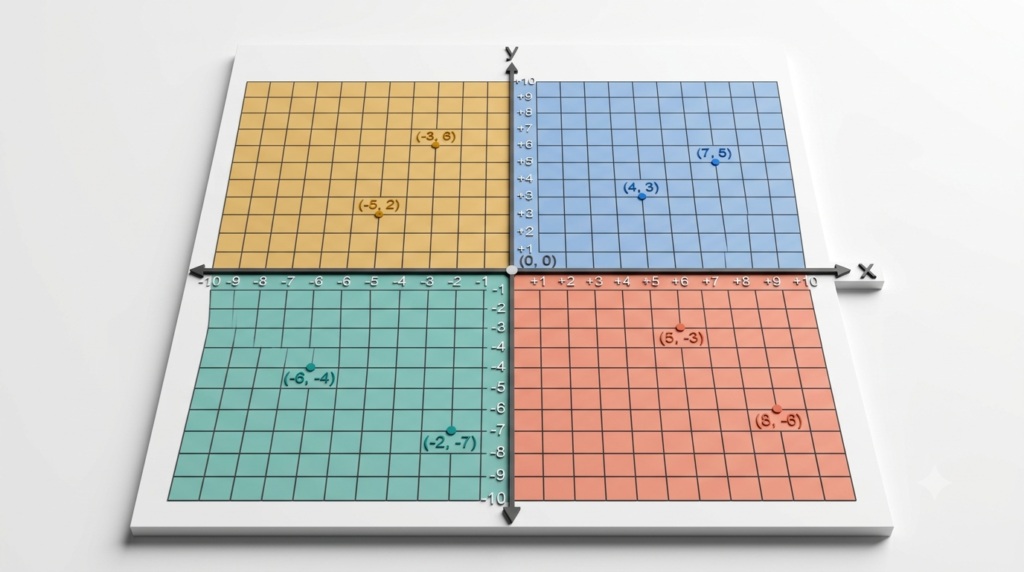
Coordinates and ordered pairs are fundamental concepts in coordinate geometry. They help us identify the exact position of a point on a flat surface using numbers. Instead of describing a location vaguely as being to the left, right, above, or below another point, we can use coordinates to specify its position accurately. These concepts are widely used in mathematics, science, engineering, computer graphics, digital maps, and many everyday applications.
An ordered pair consists of two numbers written in a specific order. The first number represents the horizontal position, while the second represents the vertical position of a point on a coordinate plane. By understanding coordinates and ordered pairs, learners can plot points, read graphs, describe geometric shapes, and solve mathematical problems more confidently. This article explains the meaning of coordinates, the structure of ordered pairs, the coordinate plane, the four quadrants, plotting methods, examples, and practical applications in simple language.
What Are Coordinates?
Coordinates are numerical values used to describe the position of a point relative to a reference system. In coordinate geometry, two coordinates are commonly used to locate a point on a two-dimensional surface.
Imagine looking at a map that shows streets, buildings, and parks. To identify a particular location accurately, we need a method for describing its position. Coordinates provide that method by assigning numerical values to locations.
In a standard coordinate plane, two perpendicular number lines are used:
The horizontal number line is called the x-axis.
The vertical number line is called the y-axis.
These axes intersect at a point called the origin. The origin is the starting reference point for measuring horizontal and vertical positions.
For example, the point (3, 2) represents a location three units to the right of the origin and two units upward. Similarly, the point (-3, 2) is three units to the left and two units upward.
Coordinates make mathematical descriptions precise. They allow us to identify points, compare locations, draw shapes, and represent relationships between quantities.
What Is an Ordered Pair?
An ordered pair is a pair of values written in a particular sequence. In coordinate geometry, it is used to identify the position of a point on a coordinate plane.
The standard format of an ordered pair is:
(x, y)
Here, x represents the horizontal coordinate, and y represents the vertical coordinate.
The first value is called the x-coordinate, while the second value is called the y-coordinate.
For example, consider the ordered pair (4, 3).
The x-coordinate is 4.
The y-coordinate is 3.
Starting from the origin, move four units to the right and three units upward. The resulting position represents the point (4, 3).
The order of the numbers is important. The ordered pairs (4, 3) and (3, 4) represent different points because their horizontal and vertical positions are different.
An ordered pair is therefore more than two numbers written together. It is a mathematical way of communicating the precise position of a point.
Understanding the Coordinate Plane
The coordinate plane, also known as the Cartesian plane, is a flat surface formed by two perpendicular number lines. It provides a systematic way to represent points and study geometric relationships.
The horizontal and vertical axes divide the plane into four regions called quadrants.
The x-axis
The x-axis runs horizontally across the coordinate plane. It represents horizontal positions.
Positive x-values extend to the right of the origin, while negative x-values extend to the left.
Examples include:
(5, 0) represents a point five units to the right of the origin.
(-4, 0) represents a point four units to the left of the origin.
(0, 0) represents the origin.
Every point on the x-axis has a y-coordinate of zero.
The y-axis
The y-axis runs vertically through the origin. It represents vertical positions.
Positive y-values extend upward, while negative y-values extend downward.
Examples include:
(0, 3) represents a point three units above the origin.
(0, -5) represents a point five units below the origin.
(0, 0) represents the origin.
Every point on the y-axis has an x-coordinate of zero.
The origin
The origin is the point where the x-axis and y-axis intersect. It is the reference point from which horizontal and vertical positions are measured.
Coordinates of the origin: (0, 0)
At the origin, neither horizontal nor vertical movement has occurred. Both coordinates are zero.
The origin is important because it provides a common starting point for plotting points and understanding the coordinate system.
The Four Quadrants of the Coordinate Plane
The x-axis and y-axis divide the coordinate plane into four quadrants. Each quadrant contains points with a particular combination of positive and negative coordinates.
The quadrants are numbered counterclockwise, beginning with the upper-right region.
First Quadrant
The first quadrant is located in the upper-right region of the coordinate plane. Both coordinates are positive.
Example: (3, 4)
The point is three units to the right and four units upward from the origin.
Second Quadrant
The second quadrant is located in the upper-left region. The x-coordinate is negative, while the y-coordinate is positive.
Example: (-3, 4)
The point is three units to the left and four units upward from the origin.
Third Quadrant
The third quadrant is located in the lower-left region. Both coordinates are negative.
Example: (-3, -4)
The point is three units to the left and four units downward from the origin.
Fourth Quadrant
The fourth quadrant is located in the lower-right region. The x-coordinate is positive, while the y-coordinate is negative.
Example: (3, -4)
The point is three units to the right and four units downward from the origin.
The following table summarizes the signs of coordinates in each quadrant.
| Quadrant | x-coordinate | y-coordinate | Example |
|---|---|---|---|
| First | Positive | Positive | (3, 4) |
| Second | Negative | Positive | (-3, 4) |
| Third | Negative | Negative | (-3, -4) |
| Fourth | Positive | Negative | (3, -4) |
Points located directly on the x-axis or y-axis do not belong to any quadrant. For example, (4, 0) lies on the x-axis, while (0, -2) lies on the y-axis.
How to Read an Ordered Pair
Reading an ordered pair correctly is an essential skill in coordinate geometry. The main rule is to read the first number as the horizontal position and the second number as the vertical position.
Consider the ordered pair (5, 2).
To locate this point:
Start at the origin (0, 0).
Move five units to the right because the x-coordinate is positive.
Move two units upward because the y-coordinate is positive.
Mark the resulting position and label it (5, 2).
Now consider the ordered pair (-4, 3).
Start at the origin.
Move four units to the left because the x-coordinate is negative.
Move three units upward because the y-coordinate is positive.
Mark the point and label it (-4, 3).
For the point (2, -5), move two units to the right and five units downward.
Always follow the same order: horizontal movement first, followed by vertical movement. This approach makes it easier to interpret coordinates correctly and avoid common mistakes.
How to Plot Ordered Pairs on a Coordinate Plane
Plotting an ordered pair means marking its position on a coordinate plane according to its coordinate values.
Step 1: Draw the axes
Draw one horizontal line and one vertical line so that they intersect at right angles. Label the horizontal line x and the vertical line y.
Step 2: Mark the origin
Label the intersection of the two axes as (0, 0). This is the starting point for locating other points.
Step 3: Choose a suitable scale
Mark equally spaced intervals along both axes. Each interval commonly represents one unit. If the coordinates contain larger numbers, you may choose a suitable scale that allows all points to fit on the graph.
Step 4: Identify the coordinates
Read the ordered pair and identify the horizontal and vertical values.
For example, in (4, 2), the x-coordinate is 4 and the y-coordinate is 2.
Step 5: Move horizontally
Starting from the origin, move four units to the right.
Step 6: Move vertically
From that horizontal position, move two units upward.
Step 7: Mark the point
Place a dot at the final position and label it (4, 2).
The same process works for negative coordinates. A negative x-coordinate requires movement to the left, while a negative y-coordinate requires movement downward.
With regular practice, plotting ordered pairs becomes a simple and reliable process.
Examples of Coordinates and Ordered Pairs
The following examples explain how different ordered pairs represent different positions on the coordinate plane.
Example 1: Plotting (2, 3)
The x-coordinate is 2, and the y-coordinate is 3.
Move two units to the right and three units upward from the origin. The point lies in the first quadrant because both coordinates are positive.
Example 2: Plotting (-4, 2)
The x-coordinate is -4, and the y-coordinate is 2.
Move four units to the left and two units upward. The point lies in the second quadrant because the x-coordinate is negative and the y-coordinate is positive.
Example 3: Plotting (-3, -5)
Both coordinates are negative.
Move three units to the left and five units downward. The point lies in the third quadrant.
Example 4: Plotting (5, -2)
The x-coordinate is positive, while the y-coordinate is negative.
Move five units to the right and two units downward. The point lies in the fourth quadrant.
Example 5: Plotting (0, 4)
The x-coordinate is zero, so there is no horizontal movement away from the y-axis.
Move four units upward. The point lies on the positive y-axis and does not belong to any quadrant.
Example 6: Plotting (-3, 0)
The y-coordinate is zero, so there is no vertical movement away from the x-axis.
Move three units to the left. The point lies on the negative x-axis and does not belong to any quadrant.
These examples show that the values and signs of the coordinates determine the exact position of a point.
Why Is the Order of Coordinates Important?
The order of coordinates matters because each number represents a different direction.
Consider the ordered pairs (2, 5) and (5, 2).
For (2, 5), the point is two units to the right and five units upward.
For (5, 2), the point is five units to the right and two units upward.
Although both pairs contain the same numbers, they identify different locations.
This distinction is important when reading graphs, identifying points, and working with equations. Reversing the coordinates can change the meaning of a mathematical statement or produce an incorrect graph.
Always remember that the x-coordinate comes first and the y-coordinate comes second.
Coordinates of Points on the Axes
Points can lie on the coordinate axes as well as within the four quadrants. Their coordinates follow specific rules.
Points on the x-axis
Every point on the x-axis has a y-coordinate equal to zero.
General form: (x, 0)
Examples include (2, 0), (-5, 0), and (7, 0).
The x-coordinate may be positive, negative, or zero.
Points on the y-axis
Every point on the y-axis has an x-coordinate equal to zero.
General form: (0, y)
Examples include (0, 3), (0, -6), and (0, 8).
The y-coordinate may be positive, negative, or zero.
The origin
The origin is the only point where both coordinates are zero.
Coordinates: (0, 0)
Understanding these rules helps learners determine whether a point belongs to a quadrant or lies directly on one of the axes.
Difference Between Coordinates and Ordered Pairs
Coordinates and ordered pairs are closely related, but they describe different aspects of a point’s position.
Coordinates are the individual numerical values that specify a point’s location. An ordered pair is the complete representation formed by placing two coordinate values in the correct sequence.
For example, consider (6, -2).
The number 6 is the x-coordinate, and the number -2 is the y-coordinate. Together, they form the ordered pair (6, -2), which identifies a particular point on the coordinate plane.
In two-dimensional coordinate geometry, two coordinate values are generally sufficient to identify a point. In three-dimensional coordinate systems, three values are used to represent positions along three different axes.
Understanding the difference helps learners recognize how individual coordinate values work together to describe a complete location.
Applications of Coordinates and Ordered Pairs
Coordinates are not limited to mathematical exercises. They are widely used in technology, science, navigation, and everyday problem-solving.
Maps and Navigation
Digital maps use coordinate systems to identify locations. Geographic coordinates, such as latitude and longitude, help locate cities, roads, landmarks, and other places on Earth.
Although geographic coordinates work differently from the standard Cartesian coordinate plane, both systems use numerical values to describe positions accurately.
Computer Graphics
Computers use coordinates to position objects on screens. Images, shapes, icons, animations, and other visual elements can be represented using positions measured relative to a coordinate system.
For example, a computer program may use coordinates to determine where a button appears or how an object moves across a screen in a video game.
Science and Engineering
Scientists and engineers use coordinates to describe the positions of objects, represent measurements, and interpret graphs. Coordinates can help display relationships between quantities, such as time and temperature or distance and speed.
Architecture and Design
Architects and designers use coordinate systems to organize points, dimensions, and shapes. Accurate positioning helps them create floor plans, technical drawings, and digital models.
Mathematics and Data Analysis
Coordinate geometry uses ordered pairs to represent points and graph mathematical relationships. Data analysts also use coordinate-based graphs to compare variables, identify patterns, and communicate information clearly.
These applications demonstrate why understanding coordinates is a valuable skill for learners across many fields.
Common Mistakes to Avoid
Beginners often make a few predictable mistakes when working with coordinates and ordered pairs.
Reversing the coordinates
A common mistake is reading (3, 5) as five units horizontally and three units vertically.
How to avoid it: Always remember that x comes first and y comes second.
Ignoring negative signs
Negative coordinates indicate movement in a different direction. Ignoring a negative sign can place a point in the wrong quadrant.
How to avoid it: Check the sign of each coordinate before plotting the point.
Starting from the wrong position
Some learners begin their movement from another point instead of the origin.
How to avoid it: When plotting a point from its coordinates, begin at (0, 0) and follow the coordinate values.
Using an incorrect scale
If the intervals on an axis do not represent the intended scale, points may be plotted inaccurately.
How to avoid it: Label the axes clearly and use consistent intervals.
Assigning axis points to quadrants
Points on the x-axis or y-axis do not belong to any of the four quadrants.
How to avoid it: Check whether either coordinate equals zero before identifying the quadrant.
Recognizing these mistakes early helps learners develop accuracy and confidence in coordinate geometry.
Conclusion
Coordinates and ordered pairs provide a simple and precise way to identify the positions of points on a coordinate plane. An ordered pair is written in the form (x, y), where the first value represents the horizontal position and the second represents the vertical position. The signs of these values determine the direction of movement and help identify the quadrant in which a point lies.
By learning about the axes, origin, quadrants, and plotting methods, beginners can develop a strong foundation in coordinate geometry. These concepts also support more advanced topics, including graphing equations, calculating distances, studying geometric shapes, and analyzing mathematical relationships. With regular practice, reading and plotting ordered pairs becomes easier and more intuitive.
FAQs
1. What are coordinates in mathematics?
Coordinates are numerical values used to identify the exact position of a point on a coordinate plane. In two-dimensional coordinate geometry, a point is usually represented by two coordinates: an x-coordinate and a y-coordinate. The x-coordinate describes the horizontal position, while the y-coordinate describes the vertical position. For example, the point (3, 5) is located three units to the right and five units above the origin. Coordinates are useful for plotting points, drawing graphs, studying geometric shapes, and representing mathematical relationships. They are also applied in computer graphics, engineering, mapping, and scientific data analysis.
2. What is an ordered pair?
An ordered pair is a pair of numbers written in a specific sequence to represent the position of a point on a coordinate plane. It is generally written as (x, y), where x is the horizontal coordinate and y is the vertical coordinate. For example, (4, 2) represents a point four units to the right and two units upward from the origin. The order of the numbers is important because changing their positions usually changes the location of the point. Ordered pairs are essential for plotting points, interpreting graphs, and understanding coordinate geometry.
3. Why is the order of coordinates important?
The order of coordinates is important because the first and second numbers represent different directions. In an ordered pair, the first number identifies the horizontal position, while the second identifies the vertical position. For example, (2, 5) represents a point two units to the right and five units upward. However, (5, 2) represents a point five units to the right and two units upward. These points have different locations even though they contain the same numbers. Remembering that x comes first and y comes second helps prevent mistakes when plotting points and interpreting coordinate graphs.
4. What is the origin of a coordinate plane?
The origin is the point where the horizontal x-axis and the vertical y-axis intersect. It serves as the reference point for locating other points on the coordinate plane. Both the x-coordinate and the y-coordinate of the origin are zero, so its ordered pair is (0, 0). When plotting a point, learners commonly begin at the origin and move horizontally according to the x-coordinate before moving vertically according to the y-coordinate. The origin is important because it provides a consistent starting position for measuring distances and identifying points in all four quadrants of the coordinate plane.
5. What are the four quadrants of the coordinate plane?
The four quadrants are the regions created when the x-axis and y-axis divide the coordinate plane. The first quadrant contains points with positive x- and y-coordinates. The second quadrant contains negative x-coordinates and positive y-coordinates. The third quadrant contains two negative coordinates, while the fourth quadrant contains positive x-coordinates and negative y-coordinates. For example, (2, 3) lies in the first quadrant, whereas (-2, -3) lies in the third quadrant. Quadrants help learners identify the approximate location of a point by examining the signs of its coordinates. Points on the axes do not belong to any quadrant.
6. How do you plot an ordered pair on a coordinate plane?
To plot an ordered pair, first draw the x-axis and y-axis and mark their intersection as the origin. Read the ordered pair and identify its horizontal and vertical coordinates. Move horizontally from the origin according to the x-coordinate, moving right for positive values and left for negative values. Next, move vertically, moving upward for positive values and downward for negative values. Mark the final position with a dot and label it using the original ordered pair. For example, to plot (3, -2), move three units right and two units down. This method works for points in all four quadrants.
7. Can an ordered pair contain zero?
Yes, an ordered pair can contain zero in either coordinate or in both coordinates. When the y-coordinate is zero, the point lies on the x-axis. For example, (4, 0) lies four units to the right of the origin. When the x-coordinate is zero, the point lies on the y-axis. For example, (0, -3) lies three units below the origin. If both coordinates are zero, the point is the origin, represented by (0, 0). These points do not belong to any quadrant because they lie directly on an axis or at the intersection of the axes.
8. What is the difference between the x-coordinate and the y-coordinate?
The x-coordinate and y-coordinate describe different aspects of a point’s position on the coordinate plane. The x-coordinate is the first number in an ordered pair and indicates horizontal movement. Positive values represent movement to the right, while negative values represent movement to the left. The y-coordinate is the second number and indicates vertical movement. Positive values represent movement upward, while negative values represent movement downward. For example, in the ordered pair (-4, 3), the x-coordinate is -4 and the y-coordinate is 3. Together, these values identify a point four units left and three units above the origin.
9. Where are coordinates and ordered pairs used in everyday life?
Coordinates and ordered pairs are used in many practical situations. Digital maps use coordinate systems to identify locations, while computer graphics use coordinates to position images, buttons, and animated objects on screens. Engineers and architects use coordinate systems to create accurate designs and technical drawings. Scientists represent experimental measurements on graphs to identify patterns and relationships between quantities. Coordinates are also useful in mathematics for plotting points, drawing geometric shapes, and studying equations. Although different applications may use different coordinate systems, the basic principle remains similar: numerical values provide a structured way to describe positions and represent information accurately.
10. What are the common mistakes when working with ordered pairs?
Common mistakes include reversing the coordinates, ignoring negative signs, plotting points from the wrong starting position, and using an incorrect scale on the axes. For example, confusing (2, 5) with (5, 2) places the point in a different location because the horizontal and vertical values have been exchanged. Forgetting a negative sign can also move a point into the wrong quadrant. To avoid these errors, always read the x-coordinate first and the y-coordinate second. Start from the origin, follow the correct directions, and check the scale before plotting. Regular practice helps improve accuracy and confidence in coordinate geometry.