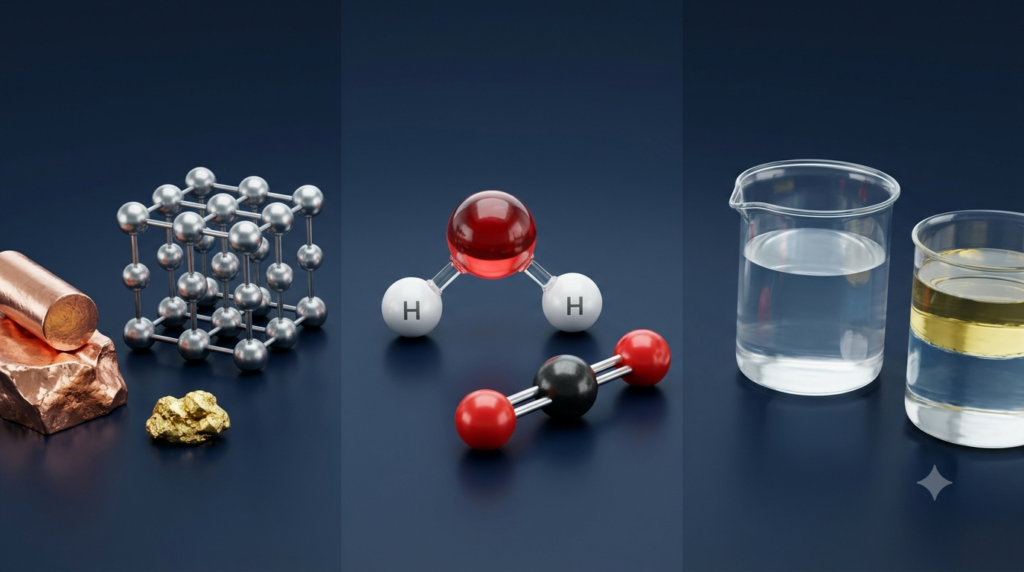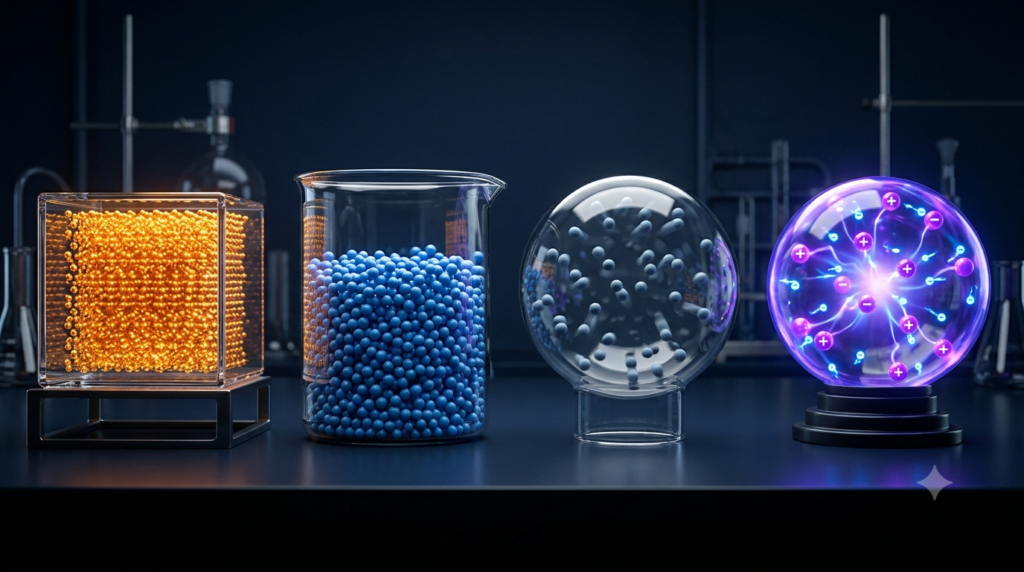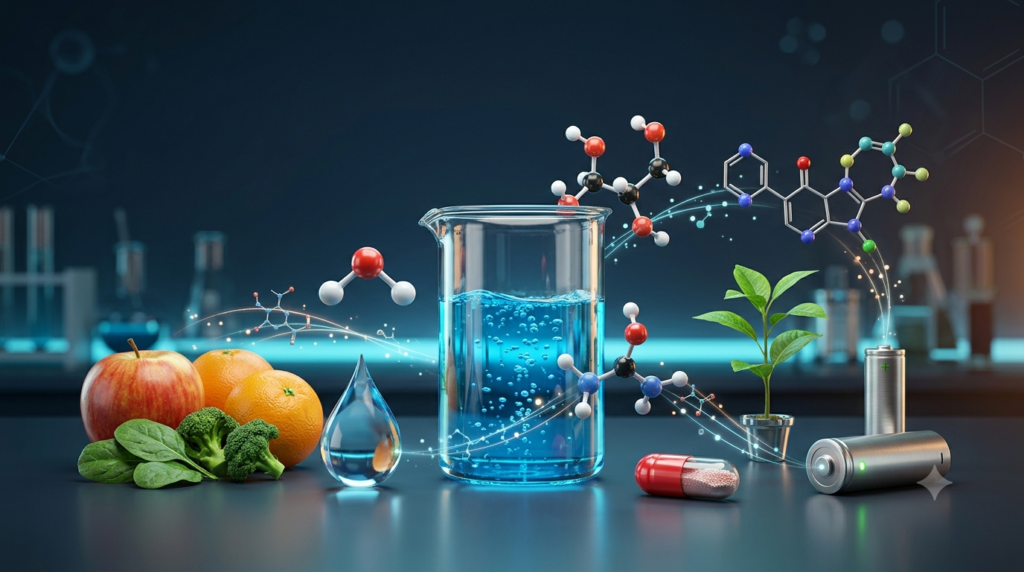
Matter is everything that has mass and occupies space. The water we drink, the air we breathe, the food we eat, and the objects we use every day are all made of matter. Matter constantly undergoes changes, some of which are easy to notice, while others happen so slowly that we may not observe them immediately. Ice melts into water, paper burns into ash, iron develops rust, and food cooks when heated. Although these examples all involve changes in matter, they do not occur in the same way.
Changes in matter are generally classified into two main types: physical changes and chemical changes. A physical change affects the form, size, shape, or state of a substance without producing a new substance. In contrast, a chemical change produces one or more new substances with different chemical properties. Understanding these changes helps us explain natural processes, everyday activities, industrial operations, and many scientific phenomena.
What Are Changes in Matter?
A change in matter occurs when a substance experiences an alteration in its physical condition, appearance, composition, or properties. Such changes can happen because of heating, cooling, mixing, cutting, pressure, exposure to air, or chemical reactions.
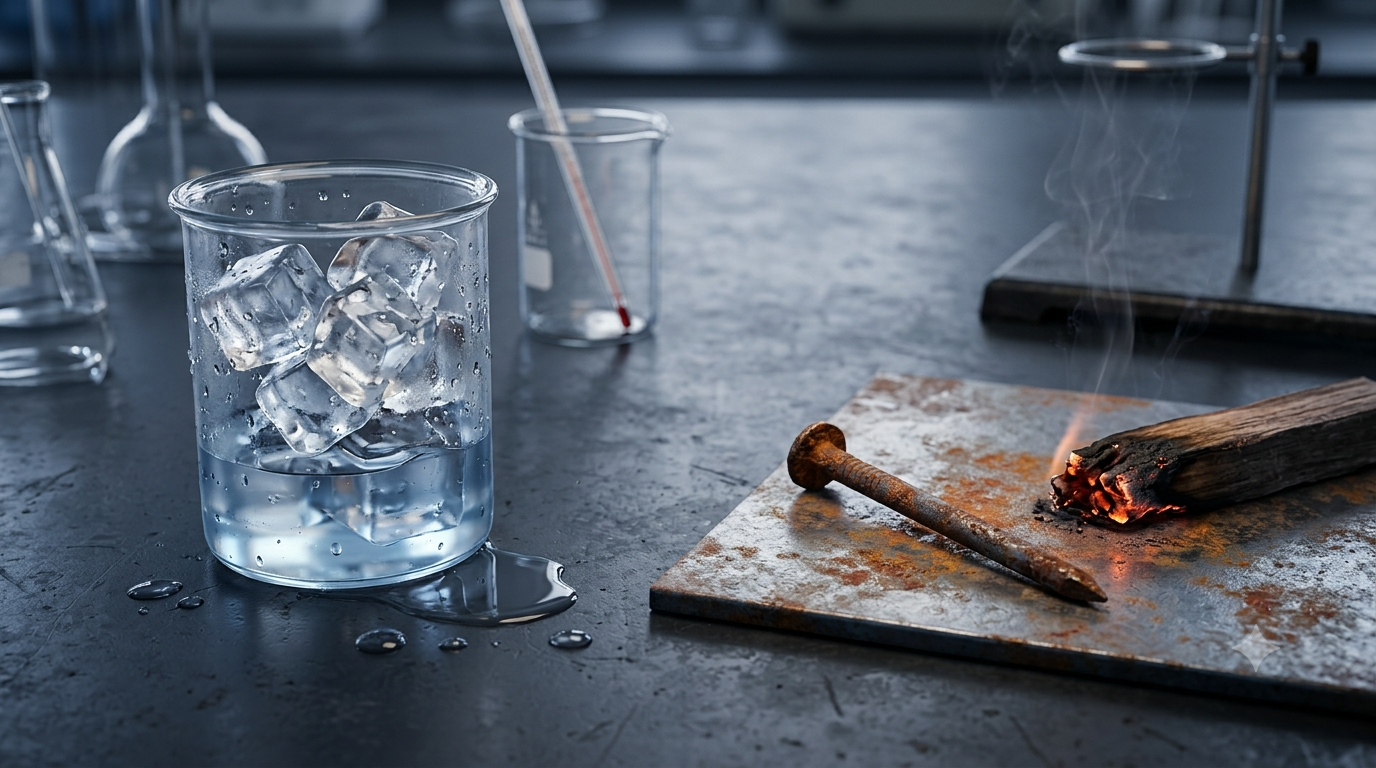
For example, when ice melts, solid water changes into liquid water. The substance remains water, even though its physical state changes. However, when wood burns, it produces substances such as ash and gases that have different chemical compositions from the original wood.
Scientists use the distinction between physical and chemical changes to understand whether a process changes only the physical characteristics of matter or transforms the substance into something chemically different.
Physical Changes in Matter
A physical change is a change in which the physical properties of a substance are altered without changing its chemical composition. These properties include shape, size, volume, texture, and state of matter.
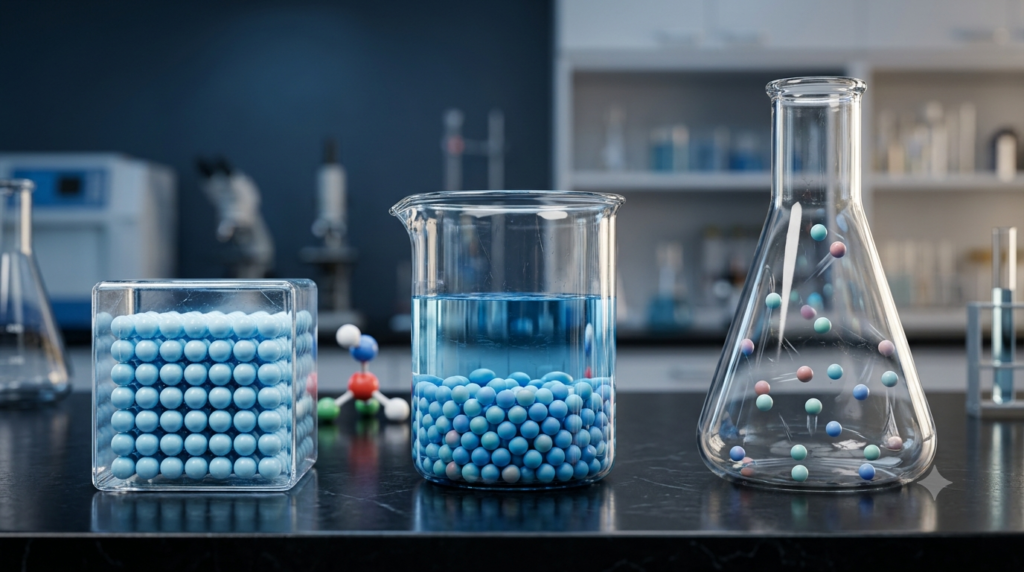
During a physical change, the particles of a substance may move differently or become arranged in a different way, but the substance’s chemical identity remains the same.
For example, when a piece of paper is cut into smaller pieces, its size and shape change, but the paper remains paper. Similarly, when water freezes, liquid water becomes solid ice without turning into a different chemical substance.
Characteristics of Physical Changes
Physical changes have several important characteristics.
No new substance is formed: The chemical composition of the material remains unchanged. For example, melting ice produces liquid water, not a new chemical substance.
Physical properties may change: The substance may change in size, shape, state, or volume. Bending a metal wire changes its shape without necessarily changing its chemical composition.
Many physical changes are reversible: Some physical changes can be reversed easily. Water can freeze into ice and melt back into liquid water. However, not every physical change is reversible. Breaking glass, for example, is a physical change that is difficult to reverse.
Chemical identity remains the same: The substance retains its chemical identity even when its appearance changes.
Energy may be absorbed or released: Physical changes can involve energy transfer. Ice absorbs heat while melting, whereas water releases heat while freezing.
Examples of Physical Changes
1. Melting of Ice
When ice receives heat from its surroundings, it melts and becomes liquid water. The arrangement and movement of its particles change, but the chemical composition remains the same.
Text block:
Initial state: Solid water (ice)
Change: Melting
Final state: Liquid water
Chemical formula before and after: H₂O
This is a physical change because no new substance is formed.
2. Freezing of Water
When water is cooled sufficiently under ordinary atmospheric pressure, it freezes and forms ice. Its particles become arranged in a more ordered structure.
Text block:
Liquid water → Solid ice
Chemical formula: H₂O → H₂O
Freezing is a physical change because the substance remains water.
3. Evaporation of Water
Evaporation occurs when liquid water changes into water vapour from its surface. It can happen even below the boiling point.
Text block:
Liquid water → Water vapour
Chemical formula: H₂O → H₂O
The physical state changes, but the chemical identity remains unchanged.
4. Cutting Paper
Cutting a sheet of paper into smaller pieces changes its size and shape. The pieces remain paper, and no new substance is produced simply by cutting.
5. Dissolving Sugar in Water
When sugar dissolves in water, its particles spread throughout the liquid. Under ordinary conditions, sugar does not chemically react with water during this process. The sugar can be recovered by evaporating the water.
Text block:
Sugar + Water → Sugar solution
The process is generally classified as a physical change because the sugar’s chemical identity remains unchanged.
6. Breaking Glass
Breaking a glass object changes its size and shape. Although the broken pieces look different from the original object, the glass does not become a new substance merely because it breaks.
7. Stretching a Rubber Band
Stretching a rubber band changes its length and shape. When the force is removed, it may return to its original form, provided it has not been stretched beyond its elastic limit.
8. Crushing a Can
Crushing an aluminium can changes its shape and volume. The aluminium remains aluminium, so the process is a physical change.
Types of Physical Changes
Physical changes can occur in several ways.
Changes of state: These include melting, freezing, evaporation, condensation, sublimation, and deposition.
Changes in size and shape: Cutting, grinding, crushing, folding, and bending are common examples.
Dissolving and mixing: Dissolving salt in water and mixing sand with iron filings are generally physical processes when no chemical reaction occurs.
Changes caused by temperature or pressure: A gas may be compressed into a smaller volume, or a substance may expand when heated. These changes can alter physical properties without changing chemical identity.
Chemical Changes in Matter
A chemical change is a process in which one or more substances are transformed into new substances with different chemical compositions and properties. Chemical changes commonly occur through chemical reactions.
During a chemical reaction, atoms are rearranged as existing chemical bonds break and new bonds form. The atoms themselves are conserved in ordinary chemical reactions, but they combine in different ways to produce new substances.
For example, when iron reacts with oxygen and moisture, rust forms. Rust has properties that differ from those of iron. Similarly, burning wood produces ash, gases, and other products that cannot simply be changed back into the original wood through ordinary physical methods.
Characteristics of Chemical Changes
New substances are formed: This is the defining characteristic of a chemical change. The products have chemical compositions different from those of the starting substances.
Chemical composition changes: Atoms are rearranged during the reaction, creating different chemical substances.
Energy is transferred: Chemical reactions may release energy, absorb energy, or require an initial input of energy to begin. Burning fuels releases energy, while some other reactions absorb heat from their surroundings.
Chemical properties change: The products may have different properties, such as colour, reactivity, acidity, or flammability.
Many chemical changes are difficult to reverse: Rusting and burning cannot generally be reversed by simple physical methods. However, some chemical reactions are reversible under suitable conditions, so irreversibility is not a universal rule.
Examples of Chemical Changes
1. Rusting of Iron
Rusting occurs when iron reacts with oxygen in the presence of moisture. The process produces hydrated iron oxides, commonly called rust.
Text block:
Iron + Oxygen + Water → Rust
Rusting changes the chemical composition of iron and produces new substances. Therefore, it is a chemical change.
Rusting is common in iron gates, tools, vehicles, bridges, and other objects exposed to moist air. Protective coatings, painting, and galvanisation can help reduce rust formation.
2. Burning of Wood
When wood burns in the presence of sufficient oxygen, it undergoes combustion. The reaction produces substances such as carbon dioxide, water vapour, smoke, and ash, depending on the burning conditions.
Text block:
Wood + Oxygen → Carbon dioxide + Water vapour + Other products
This is a simplified representation of wood combustion rather than a balanced chemical equation, because wood is a complex mixture of substances.
Burning is a chemical change because the original material is transformed into new substances.
3. Cooking Food
Cooking involves several chemical changes. Heat can cause proteins to change structure, sugars to undergo browning reactions, and other ingredients to react with one another.
For example, when an egg is boiled, its proteins undergo structural changes that make the egg white firm. These changes are difficult to reverse under ordinary conditions.
Cooking can also involve physical changes, such as water evaporating from food. Therefore, cooking is a process that may include both physical and chemical changes.
4. Digestion of Food
During digestion, enzymes and digestive substances help break down complex food molecules into simpler substances that the body can absorb and use.
For example, digestive enzymes help break down starch into smaller carbohydrate molecules.
Text block:
Starch + Water → Smaller carbohydrate molecules
This simplified representation describes part of the digestion process. Actual digestion involves multiple reactions and enzymes.
Digestion is a chemical change because the chemical structures of food molecules are transformed.
5. Burning of a Candle
A burning candle demonstrates both physical and chemical changes.
The wax near the flame melts, which is a physical change. The liquid wax moves towards the wick and vaporises. Wax vapour then reacts with oxygen in the flame, producing substances such as carbon dioxide and water vapour when combustion is sufficiently complete.
Text block:
Wax + Oxygen → Carbon dioxide + Water vapour + Energy
This is a simplified representation of complete combustion of candle wax.
The melting of wax is a physical change, whereas the combustion of wax vapour is a chemical change.
6. Souring of Milk
Milk becomes sour when certain microorganisms convert lactose, the sugar present in milk, into lactic acid. The increased acidity changes the taste and other properties of the milk.
Text block:
Lactose → Lactic acid
This simplified expression represents a biological chemical transformation. The actual process involves microorganisms and several biochemical steps.
Souring is a chemical change because new substances are formed.
7. Reaction Between Vinegar and Baking Soda
Vinegar contains acetic acid, while baking soda is sodium hydrogen carbonate. When they are mixed, a chemical reaction produces carbon dioxide gas, water, and sodium acetate.
Text block:
Acetic acid + Sodium hydrogen carbonate → Sodium acetate + Water + Carbon dioxide
The formation of carbon dioxide bubbles is a visible sign of the reaction.
8. Photosynthesis
Plants use light energy to convert carbon dioxide and water into glucose and oxygen. This process supports plant growth and provides the foundation for many food chains.
Text block:
6CO₂ + 6H₂O → C₆H₁₂O₆ + 6O₂
Light energy is required for this reaction, which takes place through a series of processes in plant cells.
Photosynthesis is a chemical change because the starting substances are converted into different substances.
Differences Between Physical and Chemical Changes
Physical and chemical changes differ mainly in whether a new substance is formed.
| Basis of comparison | Physical change | Chemical change |
|---|---|---|
| Meaning | Changes the physical properties of a substance | Produces one or more new substances |
| Chemical composition | Usually remains unchanged | Changes as atoms are rearranged |
| New substance | Not formed | Formed |
| Particle arrangement | May change | Chemical bonding and composition change |
| Energy transfer | May absorb or release energy | May absorb or release energy |
| Reversibility | May be reversible or irreversible | May be reversible or irreversible |
| Common examples | Melting ice, cutting paper | Rusting iron, burning wood |
| Chemical identity | Remains the same | Starting substances are transformed |
An important point is that reversibility alone cannot determine whether a change is physical or chemical. Some physical changes, such as breaking glass, are difficult to reverse. Some chemical reactions, on the other hand, can be reversed under suitable conditions.
The most reliable distinction is whether the chemical composition changes and new substances are produced.
How Can We Identify a Chemical Change?
Several observations can provide evidence that a chemical reaction has occurred. However, no single observation proves a chemical change in every situation. The evidence should be considered in context.
1. Change in Colour
A colour change may indicate the formation of a new substance. For example, iron develops a reddish-brown coating as it rusts. However, colour changes can also occur during physical processes, so colour alone is not conclusive evidence.
2. Production of Gas
Bubbles may appear when two substances react and produce a gas. The reaction between vinegar and baking soda releases carbon dioxide. However, boiling water also produces bubbles, even though boiling is a physical change.
3. Formation of a Precipitate
A precipitate is an insoluble solid that forms when certain solutions react. Its formation can indicate a chemical reaction.
4. Temperature Change
Some chemical reactions release heat, while others absorb it. A noticeable temperature change may therefore provide evidence of a chemical reaction. However, heating and cooling can also cause physical changes.
5. Production of Light or Sound
Combustion reactions may produce light and heat. Some rapid chemical reactions also produce sound. These observations can help identify chemical changes when considered alongside other evidence.
6. Formation of a New Smell
Certain reactions produce substances with distinctive odours. For example, food spoilage may generate new compounds that change its smell. However, smell alone is not a reliable test, and unknown substances should never be smelled directly.
Factors That Cause Changes in Matter
Matter can undergo physical or chemical changes under different conditions.
Temperature: Heating can melt ice, evaporate water, or initiate chemical reactions. Cooling can freeze water and slow many chemical reactions.
Pressure: Changes in pressure can compress gases and influence the boiling point of liquids. Pressure can also affect the conditions under which some chemical reactions occur.
Exposure to oxygen: Oxygen supports many oxidation reactions, including the rusting of iron and the combustion of fuels.
Moisture: Water is necessary for rusting under ordinary conditions and supports many chemical and biological processes.
Light: Light can initiate certain chemical reactions. Photosynthesis is a familiar example of a light-driven chemical process.
Mixing substances: Mixing can produce a physical mixture or cause a chemical reaction, depending on the substances and conditions involved.
Electricity: Electrical energy can drive chemical reactions, such as the decomposition of water during electrolysis.
Importance of Physical and Chemical Changes in Everyday Life
Physical and chemical changes are essential to daily life and the natural world.
In the kitchen, melting butter, freezing water, and dissolving sugar are examples of physical changes. Cooking eggs, baking bread, and fermenting food involve chemical changes.
In nature, water moves through evaporation, condensation, and precipitation. These are physical processes that form part of the water cycle. Photosynthesis and respiration involve chemical reactions that support living organisms.
In industries, physical changes are used in processes such as crushing minerals, separating mixtures, and distilling liquids. Chemical changes are important in manufacturing medicines, fertilisers, plastics, cement, and many other materials.
Understanding these changes also helps people protect the environment. Burning fuels produces new substances and releases energy, while rust prevention extends the life of metal structures. Recycling often involves physical separation, although some recycling methods also use chemical processes.
Can a Process Involve Both Physical and Chemical Changes?
Yes. Many everyday processes involve physical and chemical changes at the same time or in sequence.
A burning candle is one example. Wax melts and changes into liquid wax, which is a physical change. The wax vapour reacts with oxygen, producing new substances, which is a chemical change.
Cooking food provides another example. Water in the food may evaporate physically while proteins and sugars undergo chemical reactions.
When a piece of wood burns, its temperature increases, moisture may evaporate, and chemical reactions transform its components into gases, ash, and other products.
These examples show why it is important to examine each part of a process rather than classifying the entire process using only one visible feature.
Common Misconceptions About Changes in Matter
Misconception 1: Every reversible change is physical.
Reversibility is not a reliable way to classify a change. Some chemical reactions are reversible, while some physical changes are difficult to reverse.
Misconception 2: Every colour change is chemical.
Colour can change because of physical effects, such as changes in light absorption or the mixing of pigments. A colour change alone does not establish that a new substance has formed.
Misconception 3: Every change involving heat is chemical.
Melting, freezing, boiling, and condensation all involve energy transfer but are physical changes.
Misconception 4: Dissolving always produces a chemical change.
Many substances dissolve without forming new substances. However, some substances react chemically with the solvent during dissolution, so the classification depends on the actual process.
Misconception 5: Physical changes do not involve particles.
Physical changes can involve major changes in particle movement, spacing, and arrangement. What distinguishes them is that the chemical identity of the substance remains unchanged.
Conclusion
Physical and chemical changes are two fundamental ways in which matter can change. Physical changes affect properties such as size, shape, and state without changing the chemical identity of a substance. Melting ice, freezing water, cutting paper, and dissolving sugar are common examples. Chemical changes produce new substances with different chemical compositions and properties. Rusting iron, burning wood, cooking food, and photosynthesis are familiar examples.
The most reliable way to distinguish between these changes is to determine whether new substances have formed. Features such as colour changes, gas production, temperature changes, and the formation of solids can provide useful evidence, but they must be interpreted carefully. By understanding physical and chemical changes, we can explain everyday observations, understand natural processes, and appreciate the scientific principles behind cooking, manufacturing, environmental processes, and life itself.
FAQs
1. What is the difference between a physical change and a chemical change?
A physical change affects the size, shape, appearance, or state of a substance without changing its chemical composition. For example, melting ice changes solid water into liquid water, but the substance remains H₂O. A chemical change produces one or more new substances with different chemical compositions and properties. Burning wood, rusting iron, and cooking an egg are examples of chemical changes. The most reliable way to distinguish these changes is to determine whether new substances have formed. Reversibility alone is not a reliable test because both physical and chemical changes can be reversible or irreversible.
2. What are some common examples of physical changes in everyday life?
Physical changes occur frequently in everyday activities. Melting ice, freezing water, boiling water, cutting paper, breaking glass, crushing a can, and stretching a rubber band are common examples. Dissolving sugar or salt in water is also generally considered a physical change when no chemical reaction occurs. In these processes, the substance’s chemical identity remains unchanged, although its shape, size, state, or distribution may change. Physical changes are important in cooking, manufacturing, construction, and many natural processes. Some physical changes are reversible, such as freezing water, while others, such as breaking glass, are difficult to reverse.
3. What are some examples of chemical changes in everyday life?
Chemical changes occur when substances react and form new substances. Common examples include rusting iron, burning wood, cooking food, digesting food, souring milk, and baking bread. Photosynthesis in plants is another important example because carbon dioxide and water are converted into glucose and oxygen through a series of chemical reactions. During these processes, atoms are rearranged, and new chemical substances are produced. Signs such as gas formation, colour changes, temperature changes, or the production of light may indicate a chemical reaction. However, these signs must be interpreted carefully because some physical changes can produce similar observations.
4. Why is melting ice considered a physical change?
Melting ice is a physical change because only the state of water changes. When ice absorbs sufficient heat, its particles gain energy and move more freely, allowing the solid structure to become liquid water. However, the chemical composition remains unchanged throughout the process. Both ice and liquid water have the chemical formula H₂O. When the liquid water is cooled sufficiently, it can freeze and become ice again. No new substance is produced during ordinary melting or freezing. This example demonstrates that changes in the state, particle arrangement, and movement of matter do not necessarily involve chemical reactions.
5. Why is rusting of iron considered a chemical change?
Rusting is a chemical change because iron reacts with oxygen in the presence of moisture to produce rust, which consists mainly of hydrated iron oxides. The resulting material has different chemical properties from the original iron. Rusting can weaken metal objects and damage gates, vehicles, tools, bridges, and other structures. Unlike a simple physical change, rust formation involves chemical reactions that transform the original material. Rusting can be reduced by painting, applying protective coatings, galvanising iron, or limiting exposure to moisture. Understanding rusting is important in construction, engineering, manufacturing, and the maintenance of metal equipment.
6. Can a single process involve both physical and chemical changes?
Yes, many processes involve both physical and chemical changes. Burning a candle is a familiar example. When the candle is lit, the wax near the flame melts, which is a physical change because the wax retains its chemical identity. The liquid wax travels through the wick and vaporises. The wax vapour then reacts with oxygen, producing new substances such as carbon dioxide and water vapour during sufficiently complete combustion. This is a chemical change. Cooking food may also involve water evaporation, which is physical, alongside chemical reactions that change proteins, sugars, and other components.
7. Is dissolving sugar in water a physical or chemical change?
Dissolving sugar in water is generally a physical change because the sugar molecules disperse throughout the water without normally forming new chemical substances. The sugar retains its chemical identity, even though it is no longer visible as separate crystals. If the water is evaporated under suitable conditions, sugar can be recovered from the solution. However, dissolving does not always involve only a physical change. Some substances react chemically with their solvents. Therefore, the classification depends on whether a chemical reaction occurs. In ordinary sugar-water solutions, dissolution is considered a physical process because the sugar molecules remain chemically unchanged.
8. What are the main signs of a chemical change?
Common signs of a chemical change include a colour change, gas production, formation of an insoluble solid, temperature change, emission of light, and the development of a new smell. For example, bubbles appear when vinegar reacts with baking soda because carbon dioxide gas is produced. Rust develops a reddish-brown colour when iron reacts with oxygen and moisture. However, no single sign proves that a chemical change has occurred. Boiling water produces bubbles without forming a new substance, and temperature changes can also accompany physical processes. Scientists consider the available evidence and determine whether new substances have actually formed.
9. Are physical changes always reversible and chemical changes always irreversible?
No, reversibility does not reliably distinguish physical changes from chemical changes. Some physical changes are easily reversible. For example, ice melts into water, and the water can freeze again. Other physical changes, such as breaking glass or cutting paper, are difficult to reverse. Similarly, many chemical changes, including burning wood and rusting iron, are difficult to reverse through ordinary methods. However, some chemical reactions are reversible under suitable conditions. In these reactions, products can react to form the original substances. Therefore, the most important difference between physical and chemical changes is whether the chemical composition changes and new substances form.
10. Why is it important to understand physical and chemical changes in matter?
Understanding physical and chemical changes helps us explain everyday activities, natural processes, and industrial applications. Physical changes are important in freezing food, distilling liquids, separating mixtures, and manufacturing objects. Chemical changes are essential for digestion, respiration, photosynthesis, cooking, fuel combustion, and the production of medicines and fertilisers. This knowledge also helps engineers prevent rusting, improve material durability, and develop useful chemical products. In environmental science, understanding chemical reactions helps explain air pollution, combustion emissions, and processes involved in water treatment. Recognising these changes allows people to interpret scientific observations, make informed decisions, and understand how matter behaves under different conditions.