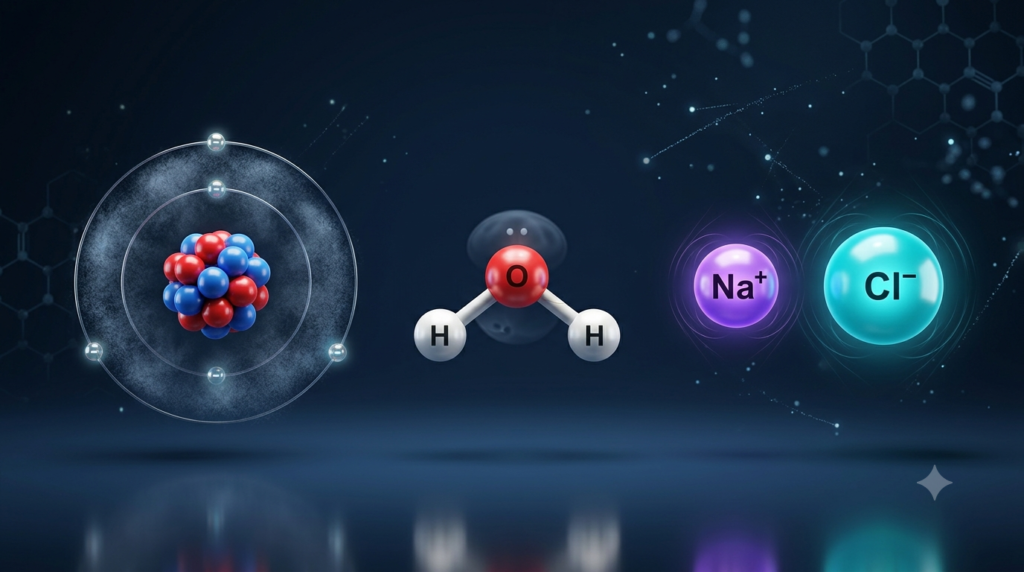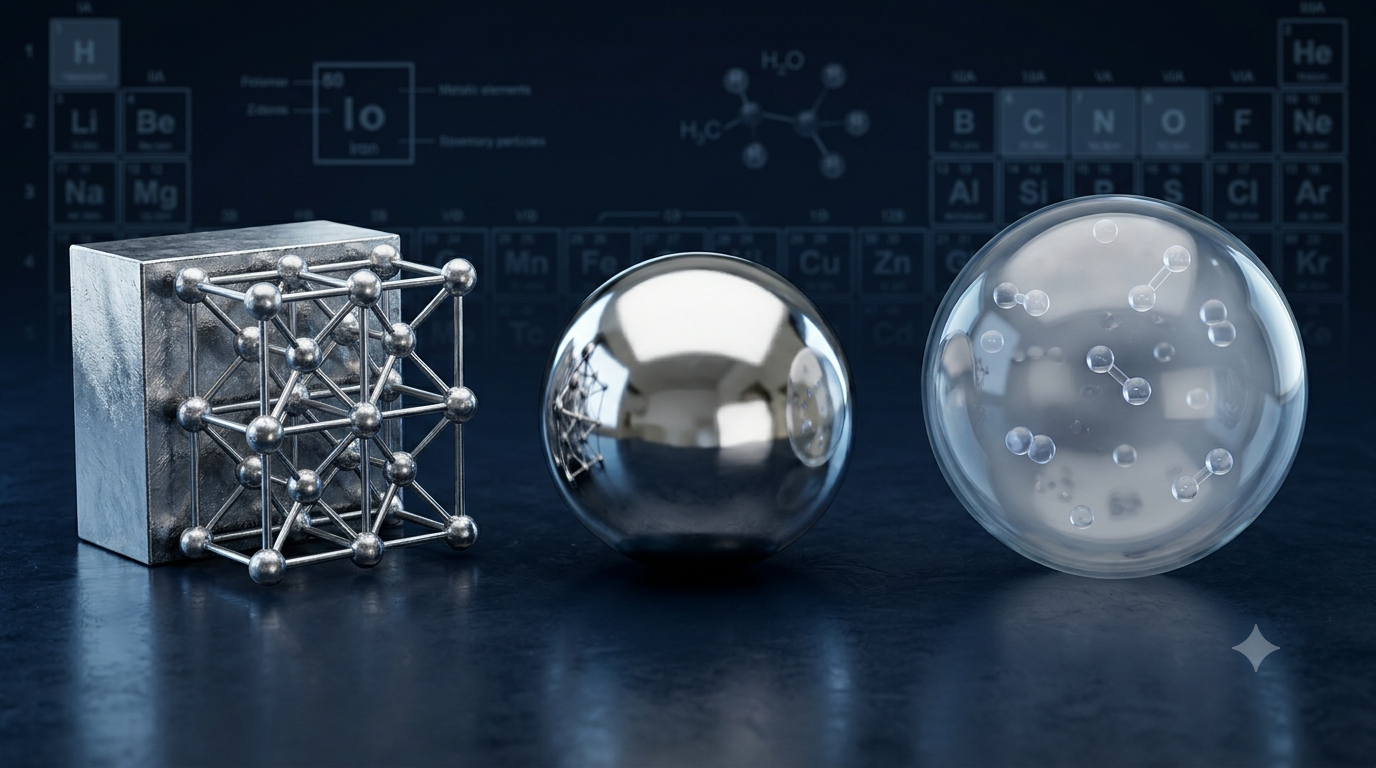
The periodic table contains 118 known chemical elements, and each element has its own physical and chemical properties. One important physical property is its physical state, which describes whether an element exists as a solid, liquid, or gas under particular conditions of temperature and pressure.
At room temperature and normal atmospheric pressure, most elements in the periodic table exist as solids. Only a small number exist as gases, while just two elements are liquids. These differences occur because elements have different atomic structures, bonding forces, and intermolecular attractions.
Understanding the physical states of elements helps us learn how they behave in nature, how they interact with other substances, and why certain elements are used in particular applications. In this article, we will explore the three physical states of elements, identify which elements belong to each group, and understand how temperature and pressure affect their physical states.
What Are the Physical States of Elements?
The physical state of an element refers to its form of matter under specific conditions of temperature and pressure. Elements can generally exist in three physical states:
Solid
Liquid
Gas
The physical state of an element depends mainly on the strength of attraction between its particles and the amount of thermal energy they possess.
For example, iron is a solid at room temperature because its atoms are held together by strong metallic bonds. Mercury is a liquid because its metallic bonding is relatively weak compared with most other metals. Oxygen is a gas because its molecules have relatively weak attractions between them.
The physical states of elements are not always fixed. Changes in temperature and pressure can cause an element to change from one state to another.
1. Solid Elements in the Periodic Table
<text>Solid elements are those that maintain a definite shape and volume under ordinary conditions. Their particles are closely packed together and have strong attractive forces that keep them in relatively fixed positions.</text>
Most elements in the periodic table exist as solids at room temperature (approximately 25°C or 298 K) and normal atmospheric pressure.
Characteristics of Solid Elements
Solid elements generally have the following characteristics:
They have a definite shape and volume.
Their particles are closely packed together.
They usually have strong attractive forces between their particles.
They cannot be compressed easily.
Their particles vibrate around fixed positions rather than moving freely.
Most solid elements have higher densities than gases.
However, not all solid elements have the same physical properties. Some are hard and strong, while others are soft, brittle, or easily broken.
For example, iron and tungsten are strong metals, whereas sodium and potassium are soft metals. Carbon can exist as hard diamond or soft graphite, depending on how its atoms are arranged.
Examples of Solid Elements
Some common solid elements include:
| Element | Symbol | Atomic Number |
|---|---|---|
| Lithium | Li | 3 |
| Beryllium | Be | 4 |
| Boron | B | 5 |
| Carbon | C | 6 |
| Sodium | Na | 11 |
| Magnesium | Mg | 12 |
| Aluminium | Al | 13 |
| Silicon | Si | 14 |
| Phosphorus | P | 15 |
| Sulfur | S | 16 |
| Iron | Fe | 26 |
| Copper | Cu | 29 |
| Silver | Ag | 47 |
| Gold | Au | 79 |
| Lead | Pb | 82 |
These are only a few examples. Most elements in the periodic table belong to the solid category at room temperature.
Why Are Most Elements Solids?
Most elements are solids because their particles experience sufficiently strong attractive forces to remain closely packed.
In metals, metallic bonding holds atoms together in a stable structure. In many nonmetals, covalent bonds form strong networks or molecules that can produce solid structures.
For example, iron atoms are held together through metallic bonding, while carbon atoms in diamond form a strong three-dimensional covalent network.
These strong interactions help solid elements maintain their shape and volume.
2. Liquid Elements in the Periodic Table
Liquid elements are substances that have a definite volume but do not have a fixed shape. They take the shape of the container in which they are placed.
At room temperature and normal atmospheric pressure, only two elements exist naturally as liquids:
Mercury (Hg)
Bromine (Br)
These two elements are important exceptions in the periodic table because almost all other elements are solids or gases under the same conditions.
Characteristics of Liquid Elements
Liquid elements generally have the following characteristics:
They have a definite volume but no fixed shape.
Their particles are close together but can move past one another.
They flow easily.
They take the shape of their containers.
They are generally less compressible than gases.
Their particles have greater freedom of movement than particles in solids.
Mercury (Hg)
Mercury is a metallic element with the chemical symbol Hg and atomic number 80.
It is the only metal that is liquid at ordinary room temperature and normal atmospheric pressure. Mercury has a shiny, silvery appearance and is relatively dense.
Unlike most metals, mercury has a low melting point of approximately −38.83°C. This is why it remains liquid at room temperature.
Uses of mercury:
It was traditionally used in thermometers.
It has been used in certain electrical switches.
It has applications in some scientific instruments.
It has been used in certain industrial processes.
Mercury is toxic and can cause serious health problems. Its use has therefore been restricted or replaced in many applications.
Bromine (Br)
Bromine is a nonmetal with the chemical symbol Br and atomic number 35.
It is the only nonmetal that is liquid at ordinary room temperature and normal atmospheric pressure. Bromine has a reddish-brown colour and produces reddish-brown vapours.
Its melting point is approximately −7.2°C, while its boiling point is approximately 58.8°C.
Uses of bromine:
It is used in the production of certain flame retardants.
It is used in some chemical manufacturing processes.
It is used in certain water-treatment applications.
It is used in the production of specialised chemical compounds.
Bromine is corrosive and harmful to human health, so it must be handled carefully.
Why Are Mercury and Bromine Liquid at Room Temperature?
Mercury and bromine have relatively low melting points compared with most elements.
Mercury has weaker metallic bonding than many other metals, allowing it to remain liquid at ordinary room temperature.
Bromine exists as Br₂ molecules. The attractive forces between these molecules are strong enough to keep bromine liquid at room temperature but not strong enough to make it solid under those conditions.
3. Gaseous Elements in the Periodic Table
Gaseous elements are substances that have neither a definite shape nor a definite volume. They spread throughout the available space and take the shape and volume of their containers.
At room temperature and normal atmospheric pressure, 11 elements exist as gases.
These elements include hydrogen, nitrogen, oxygen, fluorine, chlorine, and the noble gases.
List of Gaseous Elements
| Element | Symbol | Atomic Number |
|---|---|---|
| Hydrogen | H | 1 |
| Helium | He | 2 |
| Nitrogen | N | 7 |
| Oxygen | O | 8 |
| Fluorine | F | 9 |
| Neon | Ne | 10 |
| Chlorine | Cl | 17 |
| Argon | Ar | 18 |
| Krypton | Kr | 36 |
| Xenon | Xe | 54 |
| Radon | Rn | 86 |
Most gaseous elements exist as individual atoms or diatomic molecules under ordinary conditions.
For example, hydrogen exists as H₂, oxygen as O₂, nitrogen as N₂, and chlorine as Cl₂. Noble gases such as helium, neon, and argon generally exist as individual atoms.
Characteristics of Gaseous Elements
Gaseous elements generally have the following characteristics:
They have no definite shape or volume.
Their particles are widely separated.
They can expand to fill their containers.
They are highly compressible.
Their particles move freely and rapidly.
They generally have low densities compared with solids and liquids.
They exert pressure on the walls of their containers.
Important Examples of Gaseous Elements
Hydrogen (H):
Hydrogen is the lightest chemical element, with atomic number 1. It exists as a colourless and highly flammable diatomic gas. It is used in fuel cells, ammonia production, and various industrial processes.
Oxygen (O):
Oxygen has atomic number 8 and is essential for aerobic respiration in most living organisms. It exists as a colourless diatomic gas and supports combustion.
Nitrogen (N):
Nitrogen has atomic number 7 and makes up approximately 78% of Earth’s atmosphere. It exists as a diatomic gas and is important in the production of fertilisers and other chemicals.
Helium (He):
Helium is a noble gas with atomic number 2. It is colourless, odourless, and very unreactive. It is used in balloons, cryogenic applications, and scientific equipment.
Chlorine (Cl):
Chlorine is a greenish-yellow gas with atomic number 17. It is widely used in water disinfection and chemical manufacturing.
Physical States of Elements by Periodic Table Groups
The physical states of elements also show interesting patterns when we examine the different groups of the periodic table.
1. Alkali Metals
Alkali metals belong to Group 1 of the periodic table, excluding hydrogen in the usual classification of alkali metals.
Examples include lithium, sodium, potassium, rubidium, caesium, and francium.
All these elements are classified as solids at room temperature under ordinary pressure. However, they have relatively low melting points compared with many other metals.
2. Alkaline Earth Metals
Alkaline earth metals belong to Group 2.
Examples include beryllium, magnesium, calcium, strontium, barium, and radium.
All these elements are solids at room temperature. They generally have stronger metallic bonding than alkali metals.
3. Transition Metals
Transition metals occupy the central region of the periodic table.
Examples include iron, copper, nickel, zinc, silver, gold, and platinum.
Almost all transition metals are solids at room temperature. Mercury is the important exception because it exists as a liquid under ordinary room conditions.
4. Halogens
Halogens belong to Group 17 of the periodic table.
Their physical states change as we move down the group:
Fluorine (F) – Gas
Chlorine (Cl) – Gas
Bromine (Br) – Liquid
Iodine (I) – Solid
Astatine (At) – Solid (commonly predicted)
Tennessine (Ts) – Predicted to be solid; its properties are not well established.
This trend occurs because the strength of intermolecular attractions generally increases with increasing molecular size and electron count.
5. Noble Gases
Noble gases belong to Group 18.
Examples include helium, neon, argon, krypton, xenon, and radon.
All six naturally occurring or well-known members in this list are gases at room temperature. Oganesson, the heaviest Group 18 element, is predicted to be solid under ordinary conditions, although its physical properties remain uncertain because only a very small number of atoms have been produced.
Physical State of Elements at Room Temperature
The following table summarises the general distribution of physical states among the 118 elements at approximately 25°C and normal atmospheric pressure.
| Physical State | Number of Elements |
|---|---|
| Solid | 105 |
| Liquid | 2 |
| Gas | 11 |
| Total | 118 |
These numbers use the commonly accepted classification of the elements under ordinary room conditions. The physical properties of some extremely heavy synthetic elements have not been directly established, so their classifications are based on theoretical predictions.
The two liquids are mercury and bromine.
The 11 gases are hydrogen, helium, nitrogen, oxygen, fluorine, neon, chlorine, argon, krypton, xenon, and radon.
All remaining elements are classified as solids under these conditions.
How Do Temperature and Pressure Affect the Physical States of Elements?
The physical state of an element is not permanent. It can change when temperature or pressure changes.
Temperature affects the movement and kinetic energy of particles. Pressure affects how closely particles are held together, particularly in gases.
Effect of Temperature
When an element is heated, its particles gain kinetic energy and generally move more rapidly.
As the temperature increases, a solid can melt into a liquid. With further heating, the liquid can boil and become a gas.
For example:
Solid mercury melts at approximately −38.83°C.
Liquid mercury changes into gas at approximately 356.7°C under standard atmospheric pressure.
Similarly, oxygen is a gas at room temperature but becomes a liquid when cooled below its boiling point of approximately −183°C at standard atmospheric pressure.
Effect of Pressure
Pressure can also change the physical state of an element.
Increasing pressure can cause a gas to become a liquid if suitable temperature conditions are maintained. Under certain conditions, pressure can also cause changes in solid structures.
For example, hydrogen and nitrogen can be liquefied by applying suitable combinations of low temperature and high pressure.
However, pressure does not always produce the same result. The outcome depends on the temperature and the physical properties of the element.
Difference Between Solid, Liquid, and Gaseous Elements
The three physical states have different characteristics.
| Property | Solid | Liquid | Gas |
|---|---|---|---|
| Shape | Definite | Not definite | Not definite |
| Volume | Definite | Definite | Not definite |
| Particle arrangement | Closely packed | Close together | Widely separated |
| Particle movement | Vibrate around fixed positions | Slide past one another | Move freely |
| Compressibility | Very low | Very low | High |
| Flow | Generally does not flow | Flows | Flows |
| Example | Iron | Mercury | Oxygen |
This comparison helps us understand why different elements behave differently under the same environmental conditions.
Why Is Knowing the Physical State of Elements Important?
Understanding the physical states of elements is useful in chemistry, physics, industry, and everyday life.
Some important reasons include:
Understanding material properties: The physical state helps explain how an element behaves under ordinary conditions.
Industrial applications: Industries select elements based on their physical properties. For example, copper is used in electrical wiring because of its excellent electrical conductivity.
Scientific experiments: Knowing whether an element is solid, liquid, or gas helps scientists select suitable experimental conditions.
Chemical storage and transportation: The physical state influences how elements are stored, transported, and handled safely.
Understanding natural processes: Physical states help explain processes such as evaporation, condensation, melting, and freezing.
Learning periodic trends: Comparing the physical states of elements across groups and periods helps students understand patterns in the periodic table.
Conclusion
The physical states of elements are an important part of understanding the periodic table. At approximately 25°C and normal atmospheric pressure, most of the 118 known elements exist as solids, only two elements—mercury and bromine—exist as liquids, and 11 elements exist as gases.
These physical states depend on factors such as atomic structure, bonding forces, temperature, and pressure. The physical state of an element can also change when environmental conditions change.
Learning the differences between solid, liquid, and gaseous elements makes it easier to understand the properties, behaviour, and practical applications of chemical elements. It also provides a useful foundation for exploring other important topics in chemistry and the periodic table.
FAQs
1. What are the physical states of elements in the periodic table?
The physical states of elements refer to the forms in which elements exist under specific conditions of temperature and pressure. There are three main physical states: solid, liquid, and gas. Most elements in the periodic table are solids at room temperature. Only two elements, mercury and bromine, are liquids under ordinary room conditions. Eleven elements exist as gases, including hydrogen, oxygen, nitrogen, and the noble gases. These physical states depend on factors such as atomic structure, bonding forces, temperature, and pressure.
2. How many elements are solid in the periodic table?
Approximately 105 of the 118 known elements are classified as solids at room temperature and normal atmospheric pressure. These include most metals, metalloids, and several nonmetals. Examples include iron, copper, gold, silver, carbon, silicon, and aluminium. Solid elements generally have closely packed particles that remain in relatively fixed positions. However, their physical properties can vary significantly. Some solids are hard and strong, while others are soft or brittle. Their melting points and other physical characteristics also differ depending on their atomic structures and bonding.
3. Which two elements are liquid at room temperature?
Mercury (Hg) and bromine (Br) are the only two elements that exist as liquids at ordinary room temperature and normal atmospheric pressure. Mercury is a silvery metal with a melting point of approximately −38.83°C. Bromine is a reddish-brown nonmetal with a melting point of approximately −7.2°C. Both elements remain liquid at approximately 25°C. Mercury is used in certain industrial and scientific applications, while bromine is used in chemical manufacturing and other specialised applications. Both elements require careful handling because they can be harmful to human health.
4. How many elements are gases in the periodic table?
There are 11 elements that exist as gases at approximately 25°C and normal atmospheric pressure. These include hydrogen, helium, nitrogen, oxygen, fluorine, neon, chlorine, argon, krypton, xenon, and radon. Some gaseous elements exist as diatomic molecules, such as hydrogen (H₂), oxygen (O₂), and nitrogen (N₂). Noble gases, including helium and neon, generally exist as individual atoms. Gaseous elements have no fixed shape or volume, and their particles move freely. They expand to fill their containers and can be compressed more easily than solids and liquids.
5. Why are most elements in the periodic table solids?
Most elements are solids because their atoms or molecules experience attractive forces that keep their particles closely packed together. In metals, metallic bonding holds atoms in stable arrangements. In other elements, covalent bonds and other attractive forces help form solid structures. These interactions allow solid elements to maintain a definite shape and volume. However, the strength of these forces varies between elements. This explains why some solids are extremely hard, while others are soft. Temperature and pressure also influence whether an element remains solid or changes into another physical state.
6. Why is mercury liquid at room temperature?
Mercury is liquid at room temperature because it has a relatively low melting point of approximately −38.83°C. Its metallic bonding is comparatively weak, partly because of the unusual electronic structure of mercury atoms and relativistic effects. As a result, mercury does not require extremely high temperatures to melt, unlike most metals. At approximately 25°C, mercury remains in its liquid state. It has a shiny, silvery appearance and high density. Mercury was traditionally used in thermometers and other instruments, although its toxicity has led to restrictions on many applications.
7. Why is bromine the only liquid nonmetal at room temperature?
Bromine is the only nonmetal that exists as a liquid at ordinary room temperature and normal atmospheric pressure. It consists of diatomic Br₂ molecules, and the attractive forces between these molecules are strong enough to keep bromine liquid at approximately 25°C. However, these forces are not strong enough to make it solid under ordinary conditions. Bromine has a melting point of approximately −7.2°C and a boiling point of approximately 58.8°C. It appears as a reddish-brown liquid and produces coloured vapours. It is corrosive and must be handled carefully.
8. Can the physical state of an element change?
Yes, the physical state of an element can change when its temperature or pressure changes. Heating a solid can cause it to melt into a liquid, while further heating can change the liquid into a gas. Cooling reverses these processes through condensation and freezing. For example, oxygen is a gas at room temperature but becomes liquid when cooled below approximately −183°C at standard atmospheric pressure. Similarly, mercury freezes at approximately −38.83°C. These changes are called changes of physical state, and they generally do not change the chemical identity of the element.
9. What is the difference between solid, liquid, and gaseous elements?
Solid, liquid, and gaseous elements differ mainly in their shape, volume, particle arrangement, and movement. Solids have a definite shape and volume because their particles are closely packed and vibrate around fixed positions. Liquids have a definite volume but take the shape of their containers because their particles can move past one another. Gases have neither a definite shape nor a definite volume because their particles are widely separated and move freely. These differences also affect compressibility, density, and flow. Iron, mercury, and oxygen are examples of solid, liquid, and gaseous elements, respectively.
10. Do all elements maintain the same physical state under different temperatures?
No, elements do not maintain the same physical state at all temperatures. Their physical states depend on temperature and pressure. For example, iron is solid at room temperature but becomes liquid when heated above its melting point of approximately 1,538°C. Oxygen is gaseous at room temperature but becomes liquid at sufficiently low temperatures. Similarly, mercury is liquid at room temperature but freezes below approximately −38.83°C. Each element has its own melting point and boiling point at a given pressure. These characteristic temperatures help scientists understand and study the physical properties of elements.