Calculus is an important branch of mathematics that helps us understand how quantities change and how different mathematical relationships behave. One of its most fundamental concepts is the limit. Limits provide a way to study what happens to a function when its input approaches a particular value, even when the function is not defined at that exact point. This idea may seem difficult at first, but it becomes easier to understand through simple examples, graphs, and real-life situations.
Limits form the foundation of two major concepts in calculus: derivatives and integrals. Derivatives help us understand rates of change, while integrals help us calculate quantities such as areas and accumulated distances. Without limits, many of the central ideas of modern calculus would be difficult to define precisely. In this article, you will learn what a limit is, how it works, why it matters, and how it is used in mathematics and everyday applications.
What Is a Limit in Calculus?
A limit in calculus describes the value that a function approaches as its input approaches a particular number. The important point is that a limit focuses on the behavior of a function near a specific input, rather than only on the value of the function at that exact input.
For example, imagine a function whose output gets closer and closer to 10 whenever its input approaches 2. If the output continues approaching 10 from nearby values, we can say that the limit of the function is 10 as the input approaches 2.
The function does not necessarily need to equal 10 when the input is exactly 2. It may even be undefined at that point. A limit describes what happens nearby, which makes it different from simply evaluating a function.
Consider the following function:
f(x) = x + 3
When the input approaches 2, the output approaches 5. For example, if the input is 1.9, the output is 4.9. If the input is 1.99, the output is 4.99. As the input gets closer to 2, the output gets closer to 5.
We can express this using limit notation:
limₓ→₂ (x + 3) = 5
This notation means that the limit of x + 3, as x approaches 2, is 5.
Understanding this basic idea is the first step toward learning more advanced concepts in calculus.
How Does a Limit Work?
A limit works by examining the values of a function when its input gets closer and closer to a chosen number. Instead of looking only at one input, we study several nearby inputs and observe the pattern in their outputs.
Suppose we have the function:
f(x) = x²
We want to understand what happens when x approaches 3.
When x is 2.9, the output is 8.41. When x is 2.99, the output is 8.9401. When x is 2.999, the output is 8.994001.
These values get closer to 9 as x approaches 3.
Therefore:
limₓ→₃ x² = 9
The same conclusion can be reached by approaching 3 from values greater than 3. For example, inputs such as 3.1, 3.01, and 3.001 also produce outputs that approach 9.
This shows that limits help us understand the behavior of functions through nearby values. We do not always need to calculate the function at the exact point to determine what value it approaches.
Approaching a Value from the Left
Approaching a number from the left means using input values smaller than that number.
For example, when x approaches 3 from the left, we might examine values such as 2.9, 2.99, and 2.999. These values get progressively closer to 3 while remaining smaller than 3.
The left-hand limit describes the value that the function approaches from this direction.
It is particularly useful when studying functions that behave differently on different parts of their domains.
Approaching a Value from the Right
Approaching a number from the right means using input values greater than the chosen number.
For example, when x approaches 3 from the right, we might examine 3.1, 3.01, and 3.001. These values approach 3 from above.
The right-hand limit describes the value that the function approaches from this direction.
For an ordinary two-sided limit to exist, the left-hand and right-hand limits must approach the same finite value. If they approach different values, the two-sided limit does not exist.
How Is a Limit Represented Mathematically?
Mathematicians use a special notation to express limits. This notation identifies the function, the input value being approached, and the output value that the function approaches.
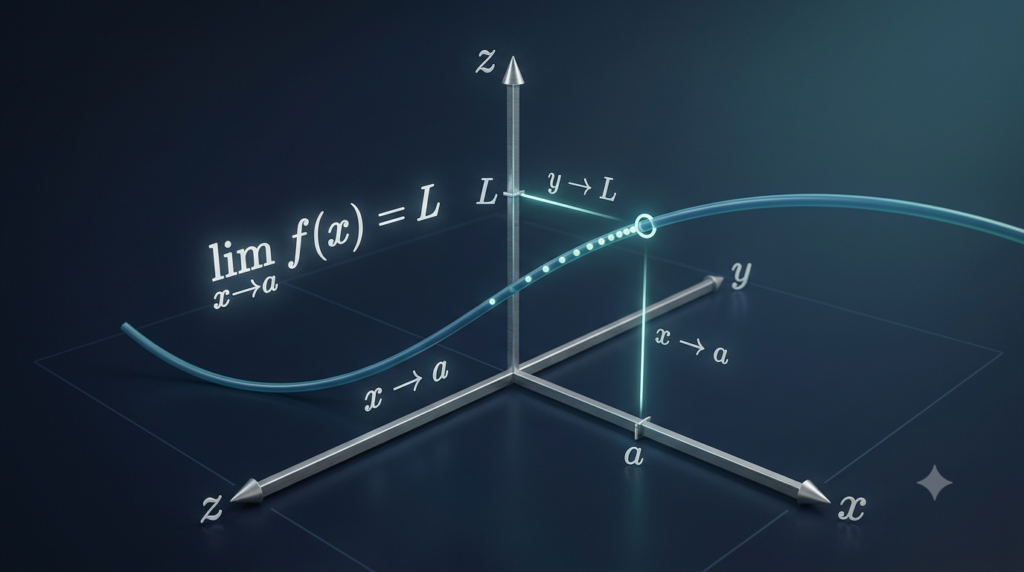
The general form is:
limₓ→ₐ f(x) = L
In this expression:
lim represents the limit.
x is the input variable.
a is the value that x approaches.
f(x) represents the function.
L is the value that the function approaches.
For example:
limₓ→₄ (2x + 1) = 9
This means that the expression 2x + 1 approaches 9 as x approaches 4.
Limit notation is important because it allows mathematicians to describe behavior precisely. It is widely used in textbooks, mathematical proofs, scientific calculations, and advanced applications of calculus.
Why Are Limits Important in Calculus?
Limits are important because they allow mathematicians to study changing quantities and function behavior with precision. They provide the mathematical foundation for several major ideas.
1. Limits Help Define Derivatives
A derivative measures how quickly a quantity changes with respect to another quantity. For example, it can describe the speed of a moving object or the rate at which a population grows.
However, calculating the rate of change at one exact instant presents a challenge. Ordinary average rates of change describe what happens over an interval, not at a single instant.
Limits solve this problem by allowing the interval to become smaller and smaller.
The derivative of a function f(x) is defined as:
f′(x) = limₕ→₀ [f(x + h) − f(x)] / h
Here, h represents a small change in the input. As h approaches zero, the expression approaches the instantaneous rate of change, provided the limit exists.
For example, the derivative of f(x) = x² is:
f′(x) = 2x
This result allows us to calculate the instantaneous rate of change of the function at any point in its domain.
Without limits, the standard definition of a derivative would not be possible.
2. Limits Help Explain Continuity
A function is continuous at a point when its graph has no break, jump, or hole at that point, and its value agrees with the limit there.
For a function f(x) to be continuous at x = a, three conditions must hold:
The function must be defined at x = a.
The limit of the function as x approaches a must exist.
The limit must equal the actual function value at x = a.
In simple terms, the function’s behavior near the point must agree with its value at the point.
For example, consider:
f(x) = x²
This function is continuous at x = 2 because its limit and actual value are both 4.
However, imagine a function that follows the rule x + 1 everywhere except at x = 2, where it is assigned the value 10. Nearby values still approach 3, but the function’s actual value at 2 is 10.
The limit exists, but the function is not continuous at that point.
Limits therefore help us identify and understand discontinuities in mathematical functions.
3. Limits Help Define Integrals
Integrals are used to calculate accumulated quantities, including areas under curves, distances travelled, and total changes over time.
One way to understand a definite integral is to divide an interval into many small sections, calculate the area or contribution of each section, and add them together. Limits allow us to make this process mathematically precise as the sections become increasingly narrow.
For a continuous function, a definite integral can be represented using a limit of sums:
∫ₐᵇ f(x) dx = limₙ→∞ Σᵢ₌₁ⁿ f(xᵢ) Δx*
Here, the interval from a to b is divided into n smaller sections. The width of each section is represented by Δx, and xᵢ* is a chosen point within each section.
As the number of sections increases, their widths approach zero. Under the appropriate conditions, the sum approaches the definite integral.
This relationship shows why limits are essential for understanding areas, accumulated quantities, and many applications of integration.
4. Limits Help Analyze Graphs
Limits help us understand what happens to a graph near particular points. They can reveal whether a graph approaches a specific height, contains a hole, jumps between values, or increases or decreases without bound.
For example, a graph may approach the same height from both sides of a point even if the point itself is missing. A limit allows us to describe this behavior clearly.
Limits are also useful when studying vertical and horizontal asymptotes. An asymptote is a line that a graph approaches under certain conditions.
For example, consider:
f(x) = 1 / x
As x approaches zero from the positive side, the function increases without bound. As x approaches zero from the negative side, the function decreases without bound.
The two-sided limit at zero does not exist as a finite real number because the behavior differs on the two sides.
Graphical analysis using limits is valuable in algebra, calculus, physics, and engineering.
What Are the Different Types of Limits?
Limits can be classified according to the direction from which the input approaches a value and the behavior of the function.
1. Two-Sided Limits
A two-sided limit describes what a function approaches as the input moves toward a particular value from both the left and the right.
For example:
limₓ→₂ (x² + 1) = 5
As x approaches 2 from either direction, the function approaches 5.
A two-sided limit exists when the left-hand and right-hand limits agree on the same finite value.
2. Left-Hand Limits
A left-hand limit describes the behavior of a function as the input approaches a value from smaller numbers.
It is especially useful for piecewise functions, where different rules apply to different intervals.
If the function approaches 4 as x approaches 2 from the left, the left-hand limit is 4, regardless of whether the function is defined at x = 2.
3. Right-Hand Limits
A right-hand limit describes the behavior of a function as the input approaches a value from larger numbers.
For example, a function may approach 7 from the right side of a particular point. This information helps determine whether its two-sided limit exists.
If the left-hand and right-hand limits are different, the two-sided limit does not exist.
4. Limits at Infinity
Limits at infinity describe the behavior of a function as its input becomes increasingly large in the positive or negative direction.
For example:
limₓ→∞ (1 / x) = 0
As x becomes larger and larger, 1 divided by x gets closer to zero.
This does not mean that 1 divided by x becomes exactly zero for any finite positive value of x. Instead, the function approaches zero as x increases without bound.
Limits at infinity are useful for studying long-term trends, horizontal asymptotes, and the behavior of mathematical models.
5. Infinite Limits
An infinite limit describes a function whose values grow without bound in the positive or negative direction as the input approaches a particular point.
For example:
limₓ→₀⁺ (1 / x) = +∞
As x approaches zero through positive values, 1 divided by x becomes increasingly large.
In this situation, infinity describes unbounded growth rather than a finite numerical limit. Such behavior is important when studying vertical asymptotes and singularities.
How Can You Calculate a Simple Limit?
Many basic limits can be calculated by substituting the value that the input approaches directly into the function. This method is called direct substitution.
Consider the expression:
limₓ→₃ (2x + 4)
Replace x with 3:
2 × 3 + 4 = 10
Therefore:
limₓ→₃ (2x + 4) = 10
Direct substitution works for many polynomial functions and other functions that are continuous at the point being considered.
However, not every limit can be calculated this way. Sometimes substitution produces an indeterminate form, such as 0/0. This does not automatically mean the limit does not exist. It means that further analysis is required.
For example:
limₓ→₂ (x² − 4) / (x − 2)
Direct substitution produces 0/0. We can simplify the expression by factoring the numerator:
x² − 4 = (x − 2)(x + 2)
For x values other than 2, the expression simplifies to:
(x − 2)(x + 2) / (x − 2) = x + 2
As x approaches 2, the simplified expression approaches 4. Therefore:
limₓ→₂ (x² − 4) / (x − 2) = 4
The original expression is undefined at x = 2, but its limit still exists. This example illustrates one of the most important features of limits: the behavior near a point can be understood even when the original function is undefined at that point.
What Is the Difference Between a Limit and a Function Value?
A limit and a function value are related, but they describe different things.
A function value tells us the output produced by a function at a specific input. A limit tells us what output the function approaches as the input gets closer to a particular value.
For example, suppose a function behaves like x + 1 near x = 2, but its value at x = 2 is defined to be 8.
The limit is:
limₓ→₂ f(x) = 3
However, the actual function value is:
f(2) = 8
These values are different because the limit depends on nearby behavior, while the function value depends on the function’s definition at the exact point.
If a function is continuous at a point, its limit and function value are equal there. If it is discontinuous, they may differ, or the limit may not exist.
Understanding this distinction is essential when studying continuity, derivatives, and advanced mathematical functions.
Real-Life Applications of Limits
Limits are not just abstract mathematical ideas. They support many practical calculations and scientific models.
1. Physics and Motion
In physics, limits help define instantaneous velocity and acceleration. Average velocity measures the distance travelled over a time interval, while instantaneous velocity describes the rate of motion at a particular moment.
By allowing the time interval to approach zero, limits provide the mathematical basis for calculating instantaneous velocity.
This concept is essential for understanding moving vehicles, falling objects, planetary motion, and mechanical systems.
2. Engineering
Engineers use calculus to study changing forces, electrical signals, fluid movement, and the behavior of structures.
Limits help establish mathematical models for rates of change and allow engineers to analyze how systems behave near critical values.
For example, the study of changing electrical current or the response of a mechanical component may involve derivatives defined through limits.
3. Economics and Business
Limits are useful in economic models that examine how quantities change as conditions vary.
The concept of marginal cost, for example, relates to the additional cost associated with producing another unit. In calculus-based models, marginal cost is commonly represented using the derivative of a cost function, which is defined through a limit.
Limits also support the study of marginal revenue, growth rates, and optimization.
4. Computer Science
Limits help explain the behavior of mathematical functions used in algorithms and computational models.
Computer scientists often analyze how an algorithm’s resource requirements change as the size of its input increases. Although algorithm analysis also uses other mathematical tools, limiting behavior can help explain the growth of functions and the long-term performance of certain processes.
5. Biology and Population Studies
Limits can be used in mathematical models of population growth, resource availability, and biological processes.
For instance, a population model may predict that a population approaches a maximum sustainable level as resources become limited. In such a model, the limiting value helps describe the long-term behavior of the population.
The usefulness of this approach depends on the assumptions and accuracy of the model.
Common Mistakes When Learning Limits
Beginners sometimes confuse limits with function values or assume that every limit can be found by direct substitution. Understanding a few common mistakes can make the topic much easier.
Mistake 1: Assuming the limit must equal the function value.
A limit describes nearby behavior. The actual function value may be different or may not exist.
Mistake 2: Thinking that 0/0 equals zero.
The expression 0/0 is undefined and is called an indeterminate form in limit calculations. It indicates that further analysis may be needed.
Mistake 3: Ignoring the left-hand and right-hand limits.
A two-sided limit exists only when both one-sided limits approach the same finite value.
Mistake 4: Assuming a function must be defined at the point.
A function can be undefined at a particular input while its limit at that input still exists.
Mistake 5: Confusing infinity with an ordinary number.
Infinity describes unbounded behavior in this context. It is not a finite real number that a function necessarily reaches.
Avoiding these mistakes builds a stronger foundation for derivatives, continuity, and integration.
Conclusion
A limit in calculus describes the value that a function approaches as its input gets closer to a particular number. It helps mathematicians study function behavior even when a function is undefined at the point being examined. By examining values from the left and right, limits also help identify continuity, discontinuities, and unbounded behavior.
The importance of limits extends far beyond basic mathematics. They provide the foundation for derivatives, which describe rates of change, and integrals, which measure accumulated quantities. Limits also support applications in physics, engineering, economics, computer science, and biology.
For beginners, the best way to understand limits is to start with simple functions, examine nearby input values, and observe how their outputs behave. Once this central idea becomes clear, many other concepts in calculus become easier to understand and apply.
FAQs
1. What Is a Limit in Calculus?
A limit in calculus describes the value that a function approaches as its input gets closer to a particular number. It helps us understand the behavior of a function near a point, even if the function is not defined at that exact point. For example, when x approaches 2, the function f(x) = x + 3 approaches 5. Therefore, the limit is 5. Limits are fundamental to calculus because they help define derivatives and integrals. They are also useful for studying continuity, graph behavior, and mathematical models in physics, engineering, economics, and other scientific fields.
2. Why Are Limits Important in Calculus?
Limits are important because they form the foundation of several major concepts in calculus. They help define derivatives, which measure instantaneous rates of change, and integrals, which calculate accumulated quantities such as areas and distances. Limits also help determine whether a function is continuous at a particular point. In science and engineering, these concepts are used to study motion, changing forces, electrical signals, and growth patterns. Without limits, it would be difficult to describe many mathematical processes precisely. Learning limits first makes it easier to understand advanced calculus topics and apply them to practical problems.
3. What Is the Basic Formula for a Limit?
The general notation for a limit is limₓ→ₐ f(x) = L. In this expression, x represents the input variable, a is the value that x approaches, f(x) is the function, and L is the value the function approaches. For example, limₓ→₂ (x + 3) = 5 means that the function x + 3 approaches 5 as x approaches 2. This notation allows mathematicians to describe the behavior of functions precisely. Understanding the meaning of each part makes it easier to read limit expressions, solve basic problems, and develop a strong foundation for studying derivatives and integrals.
4. What Is the Difference Between a Limit and a Function Value?
A limit describes the value that a function approaches near a particular input, while a function value represents the actual output at that input. These values may be equal, but they are not always the same. For example, a function may approach 3 as x approaches 2, while its assigned value at x = 2 is 8. In this case, the limit is 3, but the function value is 8. If a function is continuous at a point, its limit and function value are equal. Understanding this difference is essential for studying continuity and functions with holes or other discontinuities.
5. What Are Left-Hand and Right-Hand Limits?
A left-hand limit describes the value a function approaches when its input approaches a particular number from smaller values. A right-hand limit describes the value approached from larger values. Both are important when studying functions that behave differently on either side of a point. For a two-sided limit to exist as a finite real number, the left-hand and right-hand limits must be equal. If they approach different values, the two-sided limit does not exist. These concepts are especially useful for analyzing piecewise functions, identifying discontinuities, and understanding the behavior of graphs near specific points.
6. Can a Limit Exist When a Function Is Undefined at a Point?
Yes, a limit can exist even when a function is undefined at the point being considered. This happens when the function’s values approach the same number from both sides of that point. For example, consider f(x) = (x² − 4) / (x − 2). The function is undefined at x = 2 because the denominator becomes zero. However, simplifying the expression for x values other than 2 gives x + 2. As x approaches 2, the simplified expression approaches 4. Therefore, the limit exists and equals 4, even though the original function is undefined at that point.
7. How Do You Calculate a Limit?
A limit can often be calculated using direct substitution when the function is continuous at the value being approached. For example, to calculate limₓ→₃ (2x + 4), substitute 3 for x. The result is 2 × 3 + 4 = 10, so the limit is 10. However, direct substitution does not always work. Sometimes it produces an indeterminate form such as 0/0. In these cases, methods such as factoring, simplifying algebraic expressions, or using other limit rules may be necessary. Choosing the correct method depends on the structure of the function and the behavior near the point.
8. What Is the Relationship Between Limits and Derivatives?
Limits are essential for defining derivatives in calculus. A derivative measures the instantaneous rate of change of a function, such as the speed of a moving object at a particular moment. Average rates of change can be calculated over an interval, but an instantaneous rate requires examining what happens as that interval becomes smaller. Limits make this possible by allowing the interval to approach zero. The derivative definition uses the limit of a difference quotient. This process produces a precise mathematical description of how a function changes at a point and is widely used in physics, engineering, economics, and optimization.
9. What Is the Difference Between Finite and Infinite Limits?
A finite limit exists when a function approaches a specific real number as its input approaches a particular value. For example, limₓ→₂ (x + 3) = 5 is a finite limit. An infinite limit describes a function whose values increase or decrease without bound near a point. For example, 1/x grows without bound as x approaches zero from the positive side. In this case, the function does not approach a finite real number. Infinite limits are useful for understanding vertical asymptotes and unbounded behavior. Recognizing the difference helps students interpret limit notation and analyze mathematical graphs correctly.
10. Where Are Limits Used in Real Life?
Limits are used in many scientific and practical applications. In physics, they help define instantaneous velocity and acceleration. In engineering, limits support the mathematical analysis of changing forces, electrical signals, and mechanical systems. In economics, derivatives based on limits help describe marginal cost and marginal revenue. In computer science, mathematical limiting behavior can help explain how functions grow as input sizes increase. Limits also appear in biological models that describe population growth and resource limitations. Although these applications may use advanced mathematics, they rely on the same basic idea: examining how a quantity behaves as another quantity approaches a particular value.