Sine Calculator
Calculate the sine of any angle in degrees or radians quickly and accurately.
Quick Angles
sin(θ) = Opposite Side ÷ Hypotenuse
Degrees to Radians:
Radians = Degrees × π ÷ 180
Range: −1 ≤ sin(θ) ≤ 1
A Sine Calculator is an online mathematical tool that helps you calculate the sine of an angle quickly and accurately. It is useful for students, teachers, engineers, scientists, and anyone who works with trigonometry. Instead of calculating sine values manually or searching through trigonometric tables, you can enter an angle, select the appropriate unit, and obtain the result within seconds.
The sine function is one of the fundamental concepts in trigonometry. It describes the relationship between an angle and the sides of a right-angled triangle. It is also widely used to understand waves, oscillations, circular motion, sound, light, and many other scientific phenomena.
A Sine Calculator makes these calculations easier by supporting angles measured in degrees or radians. Whether you need to calculate sin 30°, sin 45°, sin 60°, or the sine of a more complicated angle, this tool provides a convenient way to find the answer.
In this article, you will learn what a Sine Calculator is, how it works, how to calculate sine values, which formulas are involved, and where the sine function is used in mathematics, physics, engineering, and everyday applications.
What Is a Sine Calculator?
A Sine Calculator is an online calculator that determines the sine value of a given angle. The sine function is commonly written as sin(θ), where θ represents the angle.
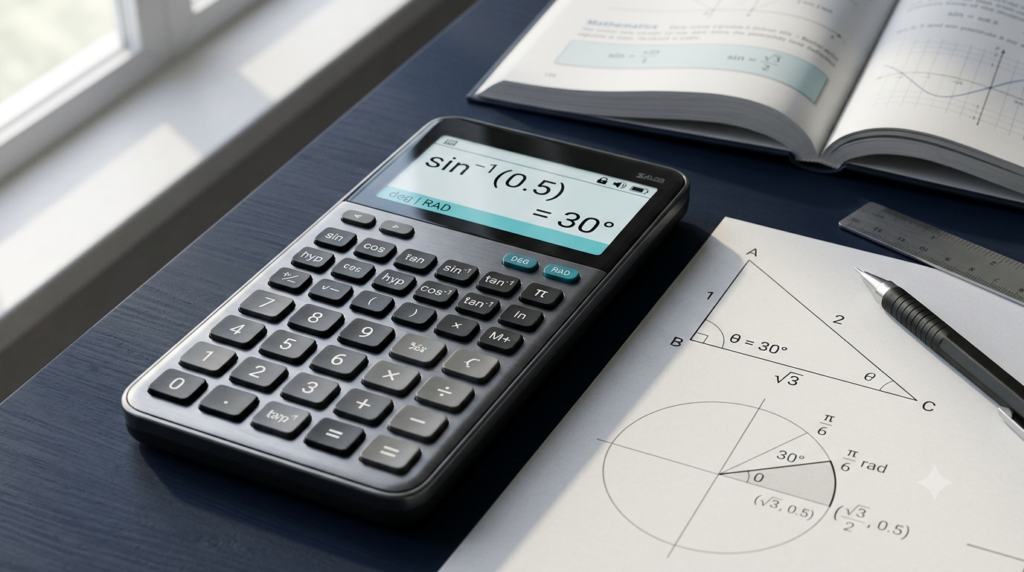
For a right-angled triangle, the sine of an angle is calculated by dividing the length of the side opposite that angle by the length of the hypotenuse.
The formula is:
sin(θ) = Opposite Side ÷ Hypotenuse
For example, if the opposite side of a right-angled triangle is 3 units long and the hypotenuse is 6 units long, the sine of the angle is:
sin(θ) = 3 ÷ 6 = 0.5
Therefore, the sine value is 0.5, which corresponds to an angle of 30° in a right-angled triangle.
An online Sine Calculator performs this type of trigonometric calculation using mathematical functions built into the calculator. You only need to enter the angle and choose whether it is measured in degrees or radians.
Unlike a basic arithmetic calculator, a Sine Calculator is designed specifically for trigonometric calculations. It is particularly useful when solving mathematical problems involving angles, triangles, periodic motion, and waves.
How Does a Sine Calculator Work?
A Sine Calculator uses the mathematical sine function to determine the value associated with an angle. The calculation depends on the unit used to express the angle.
When you enter an angle in degrees, the calculator converts it into radians before evaluating the sine function. When you enter an angle in radians, the calculator can calculate the sine directly.
For example, suppose you enter 30 and select degrees.
The calculator interprets the input as 30°, converts the angle into radians, and evaluates its sine.
sin(30°) = 0.5
If you enter π ÷ 6 radians, the result is also 0.5 because π ÷ 6 radians is equivalent to 30°.
The calculator generally follows these steps:
You enter the angle you want to calculate.
You select degrees or radians as the angle unit.
The calculator interprets the input using the selected unit.
It evaluates the sine function.
It displays the calculated result.
Modern online calculators perform these operations almost instantly. They can also calculate sine values for negative angles, large angles, and decimal angles.
How to Use the Sine Calculator
Using an online Sine Calculator is straightforward. You do not need advanced mathematical knowledge to calculate the sine of an angle.
Follow these steps to obtain your result.
Step 1: Enter the Angle
Enter the angle for which you want to calculate the sine value.
For example, you can enter 30, 45, 60, or 90.
Make sure that the number represents the angle you want to evaluate.
Step 2: Select the Angle Unit
Choose the appropriate unit for your input.
The two most common options are degrees and radians.
Select degrees if your angle is expressed in degrees, such as 30° or 60°. Select radians if the angle is expressed in radians, such as π ÷ 4 or 1.2 radians.
Choosing the correct unit is important because the same numerical input produces different results when interpreted as degrees rather than radians.
Step 3: Calculate the Result
Click the Calculate button to evaluate the sine function.
The calculator processes the input and displays the sine value.
For example, entering 45 and selecting degrees produces the result:
sin(45°) ≈ 0.7071067812
Step 4: Understand the Result
The displayed result is a numerical value representing the sine of the selected angle.
For angles measured in degrees or radians, the sine value always lies between −1 and 1, inclusive.
A positive result indicates a positive sine value, while a negative result indicates a negative sine value. The sign depends on the angle’s position on the unit circle.
Step 5: Try Another Angle
You can change the angle and calculate another result whenever needed.
This makes the calculator useful for checking homework, solving trigonometry exercises, and comparing different sine values.
Formula Used by a Sine Calculator
The sine function can be understood using two important mathematical relationships.
1. Sine Formula for a Right-Angled Triangle
For an acute angle in a right-angled triangle, the sine formula is:
sin(θ) = Opposite Side ÷ Hypotenuse
Here:
θ represents the angle being considered.
Opposite side is the side directly across from the angle.
Hypotenuse is the longest side of the right-angled triangle, opposite the right angle.
Suppose a triangle has an opposite side of 5 cm and a hypotenuse of 10 cm.
sin(θ) = 5 ÷ 10
sin(θ) = 0.5
The corresponding acute angle is 30°.
This formula is particularly useful when the sides of a right-angled triangle are known.
2. Sine Formula Using Radians
When angles are expressed in radians, the sine function is evaluated directly using the radian measure.
For example:
sin(π ÷ 6) = 0.5
Similarly:
sin(π ÷ 4) ≈ 0.7071067812
The radian system is especially important in calculus, physics, engineering, and the mathematical study of periodic functions.
Converting Degrees to Radians
If an angle is given in degrees but the calculation requires radians, use this formula:
Radians = Degrees × π ÷ 180
For example, convert 60° into radians.
Radians = 60 × π ÷ 180
Radians = π ÷ 3
Therefore, 60° is equivalent to π ÷ 3 radians.
Converting Radians to Degrees
To convert radians into degrees, use:
Degrees = Radians × 180 ÷ π
For example, converting π ÷ 4 radians gives:
Degrees = (π ÷ 4) × 180 ÷ π
Degrees = 45°
These conversion formulas help you use a Sine Calculator correctly when working with different angle units.
Common Sine Values
Some angles have standard sine values that are frequently used in mathematics. Learning these values can make trigonometric calculations easier.
| Angle in Degrees | Angle in Radians | Sine Value |
|---|---|---|
| 0° | 0 | 0 |
| 30° | π ÷ 6 | 0.5 |
| 45° | π ÷ 4 | 0.7071 |
| 60° | π ÷ 3 | 0.8660 |
| 90° | π ÷ 2 | 1 |
| 180° | π | 0 |
| 270° | 3π ÷ 2 | −1 |
| 360° | 2π | 0 |
These values are useful for solving trigonometric equations, checking calculator results, and understanding the relationship between angles and sine values.
For example, if you calculate sin(90°), the result is 1. If you calculate sin(270°), the result is −1.
Both results are correct because the sine function changes according to the angle’s position on the unit circle.
Sine Calculator Examples
The following examples demonstrate how a Sine Calculator can be used to evaluate different angles.
Example 1: Calculate sin(30°)
Suppose you need to find the sine of 30 degrees.
Using the standard trigonometric value:
sin(30°) = 0.5
The result is 0.5.
This value is frequently used in elementary trigonometry and right-angled triangle problems.
Example 2: Calculate sin(45°)
Enter 45 and select degrees.
The calculator evaluates the sine function and displays:
sin(45°) ≈ 0.7071067812
The exact value is √2 ÷ 2.
This value commonly appears in geometry problems involving 45° angles and isosceles right-angled triangles.
Example 3: Calculate sin(60°)
Enter 60 degrees into the calculator.
The result is:
sin(60°) ≈ 0.8660254038
The exact value is √3 ÷ 2.
This value is useful in triangle calculations, geometry, and physics problems involving angles.
Example 4: Calculate sin(90°)
Enter 90 and select degrees.
The result is:
sin(90°) = 1
This is the maximum possible value of the sine function.
On the unit circle, the angle of 90° corresponds to the point (0, 1). The sine value is represented by the vertical coordinate of that point.
Example 5: Calculate sin(180°)
Enter 180 degrees.
The calculator returns:
sin(180°) = 0
This happens because the point corresponding to 180° on the unit circle is (−1, 0). Its vertical coordinate is zero.
Example 6: Calculate sin(−30°)
A Sine Calculator can also evaluate negative angles.
For example:
sin(−30°) = −0.5
The sine function is an odd function, meaning that the sine of a negative angle is the negative of the sine of the corresponding positive angle.
Mathematically:
sin(−θ) = −sin(θ)
This relationship is useful when working with circular motion, coordinate systems, and trigonometric equations.
Understanding Degrees and Radians
Degrees and radians are two different units used to measure angles.
Degrees divide a complete rotation into 360 equal parts. A right angle measures 90°, while a straight angle measures 180°.
Radians measure angles using the relationship between the radius of a circle and the length of an arc. One complete rotation is equal to 2π radians.
The relationship between degrees and radians is:
180° = π radians
Both units describe the same angles, but they are used in different mathematical contexts.
Degrees are commonly used in school-level geometry, navigation, construction, and everyday angle measurements.
Radians are especially important in calculus, advanced mathematics, physics, and engineering. Many mathematical formulas involving derivatives, integrals, and periodic motion are expressed naturally in radians.
A Sine Calculator that supports both units gives you the flexibility to solve a wider range of problems.
Always check the selected unit before calculating a sine value. For example, sin(30°) = 0.5, but sin(30 radians) is approximately −0.9880. These results differ because the calculator interprets the input using different angle units.
Properties of the Sine Function
Understanding the basic properties of sine helps you interpret calculator results correctly.
1. Range of the Sine Function
The sine function has a range from −1 to 1.
This means that its value can never be greater than 1 or less than −1 for a real angle.
The maximum value is 1, and the minimum value is −1.
2. Periodicity
The sine function repeats its values after every complete rotation of 360°, or 2π radians.
The mathematical relationship is:
sin(θ + 360°) = sin(θ)
In radians, the same relationship is:
sin(θ + 2π) = sin(θ)
For example:
sin(30°) = sin(390°) = 0.5
This property is useful when working with repeating waves, rotating objects, and periodic motion.
3. Odd Function
The sine function is an odd function.
Its defining relationship is:
sin(−θ) = −sin(θ)
For example, sin(45°) is approximately 0.7071, while sin(−45°) is approximately −0.7071.
4. Important Zero Values
The sine function equals zero at integer multiples of 180°.
Examples include:
sin(0°) = 0
sin(180°) = 0
sin(360°) = 0
In radians, the corresponding angles are integer multiples of π.
These values are important when solving trigonometric equations and analyzing periodic functions.
Applications of the Sine Calculator
The sine function is used in many areas of mathematics, science, technology, and engineering. A Sine Calculator helps users evaluate sine values needed in these applications.
1. Mathematics and Trigonometry
Sine is a fundamental trigonometric function used to solve triangle problems, evaluate angles, and study relationships between geometric measurements.
Students use sine values to calculate unknown sides of triangles, solve trigonometric equations, and understand the unit circle.
For example, when the hypotenuse and one acute angle of a right-angled triangle are known, the opposite side can be calculated using:
Opposite Side = Hypotenuse × sin(θ)
A Sine Calculator makes it easier to evaluate the trigonometric part of this equation.
2. Physics
The sine function appears in many physics calculations involving waves, vibrations, oscillations, and circular motion.
For example, the vertical component of a force can be calculated using the sine of an angle when the angle is measured from the horizontal direction.
The relationship is:
Vertical Component = Force × sin(θ)
The formula applies when θ is measured from the horizontal and the force is resolved into horizontal and vertical components.
Physicists also use sine functions to describe wave motion, alternating electrical signals, and simple harmonic motion.
3. Engineering
Engineers use trigonometric functions to calculate dimensions, angles, forces, and components in structures and machines.
Civil engineers may use sine values when analyzing inclined structures, while mechanical engineers use them in problems involving rotating components and periodic movement.
Electrical engineers also work with sinusoidal signals when studying alternating current and electrical waveforms.
A Sine Calculator helps evaluate the numerical sine values required in these calculations.
4. Astronomy
Sine functions are useful in astronomy when studying angular measurements, coordinate systems, and the positions of celestial objects.
Astronomers use trigonometry in methods that involve distances, directions, and geometric relationships between objects.
Although advanced astronomical calculations often require more complex mathematical models, the sine function remains an important mathematical building block.
5. Computer Graphics
Computer graphics and game development frequently use trigonometric functions to represent rotation, direction, and periodic movement.
The sine function can help determine the vertical position of an object moving along a circular path or following a wave-like trajectory.
For example, a developer can use sine values to animate an object moving smoothly up and down.
A Sine Calculator is useful for checking individual values while learning the mathematics behind these graphics calculations.
6. Sound and Wave Analysis
Sound waves, electromagnetic waves, and many other periodic phenomena can be represented mathematically using sinusoidal functions.
A typical sine wave can be described by an equation such as:
y = A × sin(ωt + φ)
Here, A represents the amplitude, ω represents the angular frequency, t represents time, and φ represents the phase angle.
The sine function determines how the wave’s value changes throughout its cycle.
Sine calculations are therefore important in acoustics, signal processing, communications, and electrical engineering.
Advantages of Using an Online Sine Calculator
An online Sine Calculator offers several practical advantages for students and professionals.
Fast calculations: You can calculate sine values within seconds without manually evaluating trigonometric expressions.
Convenient access: A browser-based calculator can be used on compatible computers, tablets, and smartphones without installing separate software.
Degree and radian support: Working with both angle units makes the calculator suitable for a wide range of mathematical problems.
Reduced calculation errors: Automated calculations help avoid common arithmetic mistakes associated with manual calculations and trigonometric tables.
Useful for learning: Students can compare calculated values with standard sine values and develop a better understanding of trigonometry.
Support for negative angles: The sine function can be evaluated for negative angles as well as positive ones.
Helpful for practical calculations: The results can be used in further equations involving geometry, physics, engineering, and other technical subjects.
Although an online calculator improves convenience, understanding the formula and the meaning of the result remains important. You should also check the angle unit and the number of decimal places required for your problem.
Common Mistakes to Avoid
Even when using a Sine Calculator, a few common mistakes can lead to incorrect answers or misunderstandings.
Selecting the Wrong Angle Unit
One of the most common errors is entering an angle in degrees while the calculator is set to radians, or the reverse.
Always verify the selected unit before calculating.
Confusing Sine with Other Trigonometric Functions
Sine, cosine, and tangent are different functions.
For a right-angled triangle:
sin(θ) = Opposite Side ÷ Hypotenuse
cos(θ) = Adjacent Side ÷ Hypotenuse
tan(θ) = Opposite Side ÷ Adjacent Side
Using the wrong function can produce an incorrect result for a triangle problem.
Expecting Every Sine Value to Be Positive
Sine values can be positive, negative, or zero.
For example, sin(30°) = 0.5, whereas sin(210°) = −0.5.
The sign depends on the angle’s position on the unit circle.
Rounding Too Early
Rounding intermediate values can introduce small errors into longer calculations.
Whenever possible, retain sufficient decimal precision during intermediate steps and round the final answer according to the requirements of your problem.
Misinterpreting the Result
The sine of an angle is a ratio, not an angle measurement. Its value does not have a degree or radian unit.
For example, sin(30°) = 0.5. The result is a dimensionless number.
Understanding this distinction is important when applying sine values to scientific equations.
Conclusion
A Sine Calculator is a practical online tool for calculating the sine of an angle quickly and accurately. It simplifies trigonometric calculations by allowing users to enter an angle, select degrees or radians, and obtain the corresponding sine value.
The tool is useful for students learning basic trigonometry, teachers explaining mathematical concepts, and professionals working with geometry, physics, engineering, computer graphics, and wave analysis.
By understanding the sine formula, common trigonometric values, angle conversions, and important properties of the sine function, you can use the calculator more effectively and interpret its results correctly.
Whether you need to calculate sin(30°), solve a right-angled triangle problem, or evaluate a sine value for a scientific application, an online Sine Calculator provides a convenient starting point for your calculations.
FAQs
1. What is a Sine Calculator?
A Sine Calculator is an online mathematical tool used to calculate the sine value of an angle. It allows users to enter an angle in degrees or radians and obtain the corresponding result quickly. The sine function is an important part of trigonometry and describes the relationship between an angle and the sides of a right-angled triangle. For example, sin(30°) = 0.5. This calculator is useful for students, teachers, engineers, and anyone solving mathematical or scientific problems involving angles, triangles, waves, and periodic motion.
2. How do you use a Sine Calculator?
To use a Sine Calculator, enter the angle for which you want to calculate the sine value. Next, select the appropriate angle unit, either degrees or radians. Click the Calculate button to obtain the result. For example, entering 45 and selecting degrees gives approximately 0.7071067812. You can change the angle and repeat the calculation whenever necessary. Always ensure that the selected unit matches your input. This simple process helps you calculate sine values without manually using trigonometric tables or performing complicated mathematical calculations.
3. What is the formula for calculating sine?
The basic sine formula for a right-angled triangle is sin(θ) = Opposite Side ÷ Hypotenuse. Here, θ represents the angle being considered, the opposite side is directly across from that angle, and the hypotenuse is the longest side of the triangle. For example, if the opposite side measures 4 cm and the hypotenuse measures 8 cm, the sine value is 4 ÷ 8 = 0.5. Therefore, the angle is 30° when it is an acute angle in a right-angled triangle. This formula is fundamental to trigonometry.
4. What is the sine of 30 degrees?
The sine of 30 degrees is 0.5. This is one of the standard trigonometric values frequently used in mathematics and geometry. It can be expressed as sin(30°) = 1 ÷ 2. In a right-angled triangle containing a 30° angle, the opposite side is half the length of the hypotenuse. You can verify this value using an online Sine Calculator by entering 30 and selecting degrees. Knowing common sine values helps students solve trigonometric equations, calculate unknown triangle sides, and check their answers to mathematical problems.
5. What is the difference between degrees and radians in a Sine Calculator?
Degrees and radians are two units used to measure angles. A complete rotation equals 360 degrees or 2π radians. Degrees are commonly used in basic geometry, while radians are widely used in calculus, physics, and engineering. A Sine Calculator can produce different results if the same numerical input is interpreted using different units. For example, sin(30°) = 0.5, whereas sin(30 radians) is approximately −0.9880. Therefore, you should select the correct angle unit before calculating. You can convert degrees to radians by multiplying the degree value by π ÷ 180.
6. Can a Sine Calculator calculate negative angles?
Yes, a Sine Calculator can calculate the sine of negative angles. Negative angles represent rotation in the opposite direction under the standard mathematical convention. The sine function follows the identity sin(−θ) = −sin(θ). For example, sin(−30°) = −0.5, while sin(30°) = 0.5. Negative angles are useful in coordinate geometry, circular motion, physics, and trigonometric equations. To calculate a negative angle, enter the negative numerical value and select the correct angle unit. The calculator will return the corresponding sine value, which always remains between −1 and 1.
7. What is the maximum and minimum value of the sine function?
The maximum value of the sine function is 1, and its minimum value is −1. Therefore, the sine function’s range is −1 to 1, inclusive. The maximum occurs at 90° and equivalent angles, such as 450°. The minimum occurs at 270° and equivalent angles, such as −90°. These values can be understood using the unit circle, where sine corresponds to the vertical coordinate of a point. A Sine Calculator helps you verify these values and explore how the sine function changes as the angle increases or decreases.
8. Can a Sine Calculator be used for right-angled triangles?
Yes, a Sine Calculator is useful for solving problems involving right-angled triangles. The sine ratio relates the opposite side of an angle to the hypotenuse. The formula is sin(θ) = Opposite Side ÷ Hypotenuse. If you know the angle and hypotenuse, you can calculate the opposite side using Opposite Side = Hypotenuse × sin(θ). For example, if the hypotenuse is 10 cm and the angle is 30°, the opposite side is 10 × 0.5 = 5 cm. This makes the calculator helpful for geometry homework and practical measurements.
9. Where is a Sine Calculator used in real life?
A Sine Calculator is useful in mathematics, physics, engineering, astronomy, computer graphics, and signal processing. Engineers use sine values to resolve forces into components and calculate dimensions involving angles. Physicists use sine functions to describe oscillations, circular motion, and waves. Computer graphics developers use them to create smooth animations and represent periodic movement. Sine functions also help scientists analyze sound waves and alternating electrical signals. Students frequently use Sine Calculators to solve triangle problems and verify trigonometric exercises. These applications demonstrate why understanding sine is important in both scientific studies and technical work.
10. Why should I use an online Sine Calculator instead of calculating manually?
An online Sine Calculator provides a quick and convenient way to determine sine values without manually performing trigonometric calculations. It supports different angle units and can evaluate positive angles, negative angles, and decimal inputs. This saves time when solving homework, checking mathematical answers, or working on scientific problems. Manual calculations remain useful for understanding the underlying formulas, but an online tool reduces routine calculation effort and helps minimize arithmetic errors. For accurate results, enter the correct angle, select degrees or radians appropriately, and retain sufficient decimal precision for your problem.