Fraction to Percentage Converter
Convert any fraction into a percentage quickly and easily.
Step-by-Step Solution
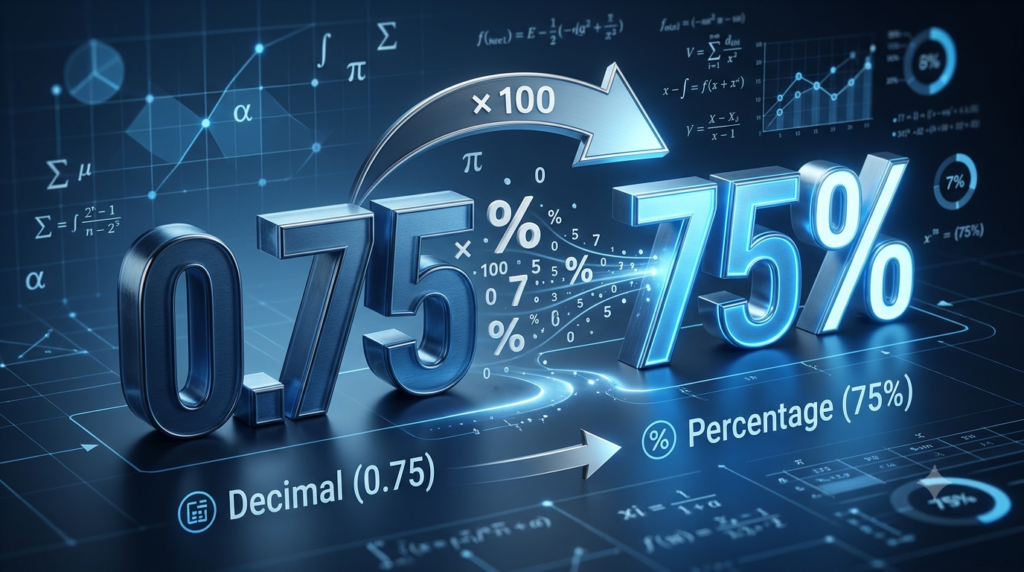
Formula: Percentage = (Numerator ÷ Denominator) × 100
Fractions and percentages are two common ways of representing parts of a whole. They are widely used in mathematics, education, shopping, finance, statistics, and everyday calculations. Although fractions and percentages look different, they express the same mathematical idea: a portion or part of a total value.
Converting a fraction into a percentage is a useful mathematical skill. For example, you may want to find what percentage of a class passed an examination, calculate a discount, understand a test score, or compare two quantities. In each situation, converting a fraction into a percentage makes the value easier to understand and compare.
A Fraction to Percentage Converter makes this calculation quick and simple. Instead of performing the calculation manually, you can enter the numerator and denominator of a fraction and obtain its percentage value. This tool is useful for students, teachers, professionals, and anyone who regularly works with numbers.
In this article, you will learn how to use a fraction to percentage converter, understand the mathematical formula, explore step-by-step examples, and discover how fractions can be converted into percentages manually.
What Is a Fraction to Percentage Converter?
A Fraction to Percentage Converter is an online mathematical tool that changes a fraction into its equivalent percentage value.
A fraction represents a part of a whole and consists of two numbers: a numerator and a denominator. The numerator indicates how many parts are being considered, while the denominator indicates the total number of equal parts.
For example, in the fraction 3/4:
Numerator: 3
Denominator: 4
This fraction means that three out of four equal parts are being considered.
A percentage expresses a value as a part of 100. The word percentage means per hundred. Therefore, converting a fraction into a percentage means finding how many parts would be represented if the whole were divided into 100 equal parts.
For example:
3/4 = 75%
This means that 3/4 of a whole is equivalent to 75 out of 100.
A fraction to percentage converter performs this calculation automatically and displays the result in percentage form.
How to Use the Fraction to Percentage Converter
Using an online fraction to percentage converter is straightforward. You only need to enter the numerator and denominator of the fraction.
Follow these steps to convert your fraction into a percentage.
Step 1: Enter the Numerator
Enter the numerator in the first input field.
The numerator is the top number of a fraction. For example, in 5/8, the numerator is 5.
Step 2: Enter the Denominator
Enter the denominator in the second input field.
The denominator is the bottom number of a fraction. In the fraction 5/8, the denominator is 8.
Remember that the denominator cannot be zero because division by zero is mathematically undefined.
Step 3: Click the Convert Button
After entering both values, click the Convert to Percentage button.
The converter divides the numerator by the denominator and multiplies the result by 100.
Step 4: View the Percentage Result
The calculated percentage appears on the screen.
For example, if you enter 5 as the numerator and 8 as the denominator, the converter displays:
5/8 = 62.5%
Step 5: Check the Step-by-Step Solution
The tool also displays the calculation steps so that you can understand how the result was obtained.
This feature is particularly useful for students who want to learn the conversion method rather than simply obtain the answer.
Step 6: Copy or Clear the Result
You can use the Copy Result button to copy the calculated fraction and percentage.
If you want to perform another calculation, use the Clear button to remove the previous values.
Fraction to Percentage Formula
The mathematical formula for converting a fraction into a percentage is:
Percentage = (Numerator ÷ Denominator) × 100
This formula works because a percentage represents a value out of 100.
To convert a fraction into a percentage, first divide the numerator by the denominator. This gives the decimal equivalent of the fraction. Then multiply the decimal value by 100.
The final answer is the percentage equivalent of the original fraction.
For example, consider the fraction 2/5.
Percentage = (2 ÷ 5) × 100
Percentage = 0.4 × 100
Percentage = 40%
Therefore:
2/5 = 40%
You can use this formula to convert proper fractions, improper fractions, and many other numerical fractions into percentages.
How to Convert a Fraction into a Percentage Manually
You do not always need an online calculator to convert a fraction into a percentage. You can perform the calculation manually by following a simple mathematical process.
The conversion involves two main operations: division and multiplication.
Method 1: Divide the Numerator by the Denominator
First, divide the numerator by the denominator to obtain a decimal number.
For example:
3/5
Divide 3 by 5.
3 ÷ 5 = 0.6
Method 2: Multiply the Decimal by 100
Now multiply the decimal result by 100.
0.6 × 100 = 60
Add the percentage symbol to the answer.
Therefore:
3/5 = 60%
This method works for almost all fractions with a non-zero denominator.
Fraction to Percentage Examples
Understanding different examples makes fraction-to-percentage conversion easier. Here are some common examples with their calculations.
Example 1: Convert 1/2 into a Percentage
Given fraction:
1/2
Step 1: Divide the numerator by the denominator.
1 ÷ 2 = 0.5
Step 2: Multiply the decimal by 100.
0.5 × 100 = 50
Final answer:
1/2 = 50%
This means that one-half of a whole is equal to 50 percent.
Example 2: Convert 1/4 into a Percentage
Given fraction:
1/4
Step 1:
1 ÷ 4 = 0.25
Step 2:
0.25 × 100 = 25
Final answer:
1/4 = 25%
Therefore, one-quarter is equivalent to 25 percent.
Example 3: Convert 3/4 into a Percentage
Given fraction:
3/4
Step 1:
3 ÷ 4 = 0.75
Step 2:
0.75 × 100 = 75
Final answer:
3/4 = 75%
This means that three-quarters of a whole represent 75 percent.
Example 4: Convert 2/5 into a Percentage
Given fraction:
2/5
Step 1:
2 ÷ 5 = 0.4
Step 2:
0.4 × 100 = 40
Final answer:
2/5 = 40%
Example 5: Convert 7/8 into a Percentage
Given fraction:
7/8
Step 1:
7 ÷ 8 = 0.875
Step 2:
0.875 × 100 = 87.5
Final answer:
7/8 = 87.5%
This example shows that a percentage does not always have to be a whole number. It can also contain decimal values.
Example 6: Convert 5/6 into a Percentage
Given fraction:
5/6
Step 1:
5 ÷ 6 = 0.833333…
Step 2:
0.833333… × 100 = 83.3333…%
Final answer:
5/6 ≈ 83.33%
The repeating decimal can be rounded to two decimal places when an approximate answer is sufficient.
Common Fraction to Percentage Conversions
Some fractions appear frequently in mathematical problems, examinations, and everyday calculations. Learning their percentage equivalents can make calculations faster.
| Fraction | Decimal | Percentage |
|---|---|---|
| 1/2 | 0.5 | 50% |
| 1/3 | 0.3333… | 33.33% |
| 1/4 | 0.25 | 25% |
| 1/5 | 0.2 | 20% |
| 1/6 | 0.1667… | 16.67% |
| 1/8 | 0.125 | 12.5% |
| 1/10 | 0.1 | 10% |
| 2/3 | 0.6667… | 66.67% |
| 3/4 | 0.75 | 75% |
| 3/5 | 0.6 | 60% |
| 4/5 | 0.8 | 80% |
| 5/8 | 0.625 | 62.5% |
| 7/8 | 0.875 | 87.5% |
| 9/10 | 0.9 | 90% |
| 1/1 | 1 | 100% |
Note: Repeating decimal percentages in the table are rounded to two decimal places.
Converting Different Types of Fractions into Percentages
Not all fractions are proper fractions. You may also encounter improper fractions, mixed numbers, and negative fractions. The same basic conversion principle can be applied to these values.
1. Converting Proper Fractions into Percentages
A proper fraction is a fraction in which the numerator is smaller than the denominator.
Examples include:
1/2, 2/5, 3/4, and 5/8.
To convert a proper fraction into a percentage, divide the numerator by the denominator and multiply the result by 100.
For example:
4/5 = (4 ÷ 5) × 100
4/5 = 0.8 × 100
4/5 = 80%
Proper fractions generally produce percentages between 0% and 100% when their numerator and denominator are positive.
2. Converting Improper Fractions into Percentages
An improper fraction has a numerator that is greater than or equal to its denominator.
Examples include:
5/4, 7/3, and 9/5.
The same formula applies to improper fractions.
For example:
Convert 5/4 into a percentage.
Percentage = (5 ÷ 4) × 100
Percentage = 1.25 × 100
Percentage = 125%
Therefore:
5/4 = 125%
An improper fraction can produce a percentage greater than 100% because the fraction represents more than one whole.
3. Converting Mixed Numbers into Percentages
A mixed number contains a whole number and a proper fraction.
For example:
2 1/2
First, convert the mixed number into an improper fraction.
2 1/2 = 5/2
Now apply the percentage formula.
Percentage = (5 ÷ 2) × 100
Percentage = 2.5 × 100
Percentage = 250%
Therefore:
2 1/2 = 250%
Converting a mixed number into an improper fraction first makes the calculation easier.
4. Converting Negative Fractions into Percentages
A negative fraction contains a negative sign.
For example:
-3/4
Divide the numerator by the denominator.
-3 ÷ 4 = -0.75
Multiply the result by 100.
-0.75 × 100 = -75%
Therefore:
-3/4 = -75%
The negative sign remains in the percentage result.
Fraction to Percentage Conversion Using Equivalent Fractions
Another useful way to convert a fraction into a percentage is to change it into an equivalent fraction with a denominator of 100.
An equivalent fraction represents the same value as the original fraction, even though its numerator and denominator are different.
For example:
3/4
To change the denominator from 4 to 100, multiply it by 25.
Multiply the numerator by the same number.
3 × 25 = 75
4 × 25 = 100
Therefore:
3/4 = 75/100
Since a percentage represents a value out of 100:
3/4 = 75%
This method is especially useful when the denominator can be easily converted into 100.
However, not every fraction can be converted into an equivalent fraction with an integer denominator of exactly 100. In those situations, the decimal method is more convenient.
Difference Between Fractions and Percentages
Fractions and percentages both represent parts of a whole, but they express values in different formats.
A fraction uses a numerator and denominator to represent a portion of a quantity. A percentage expresses that portion as a value out of 100.
| Basis | Fraction | Percentage |
|---|---|---|
| Meaning | Part of a whole | Part per hundred |
| Format | Numerator/Denominator | Number followed by % |
| Example | 3/4 | 75% |
| Denominator | Can have different values | Based on 100 |
| Common use | Mathematical calculations | Comparisons, scores, discounts |
For example, 1/2 and 50% represent exactly the same mathematical value.
The difference is only in how the value is written.
Fractions are often useful for representing exact parts, while percentages make it easier to compare quantities with different totals.
Applications of Fraction to Percentage Conversion in Daily Life
Fraction-to-percentage conversion is not limited to classroom mathematics. It is also useful in many everyday situations.
1. Examination Results
Students frequently receive marks that can be expressed as fractions or percentages.
Suppose a student scores 45 marks out of 60.
The fraction is:
45/60
Percentage = (45 ÷ 60) × 100
Percentage = 75%
Therefore, the student scored 75%.
2. Shopping Discounts
Percentages are commonly used to represent discounts on products.
Suppose a store offers a discount equivalent to 1/5 of the original price.
1/5 = (1 ÷ 5) × 100
1/5 = 20%
The discount is therefore 20% of the original price.
3. Business and Sales
Businesses use percentages to understand sales performance, targets, and product distribution.
For example, if a business sells 30 products out of a total of 50 products, the fraction sold is 30/50.
Percentage = (30 ÷ 50) × 100
Percentage = 60%
This helps the business understand its sales performance in percentage form.
4. Surveys and Statistics
Survey results are often represented as percentages because they make comparisons easier.
Suppose 18 out of 25 people select a particular option in a survey.
18/25 = (18 ÷ 25) × 100
18/25 = 72%
Therefore, 72% of the participants selected that option.
5. Cooking and Measurements
Fractions are frequently used in cooking to describe ingredient quantities.
For example, 1/4 of a mixture represents 25% of the total mixture.
Understanding this relationship can help when adjusting ingredient quantities or comparing proportions.
Advantages of Using an Online Fraction to Percentage Converter
An online converter provides several benefits when working with mathematical fractions.
Saves Time
Manual calculations require division and multiplication. An online converter performs both operations automatically and provides the answer quickly.
Reduces Calculation Errors
Entering the correct numerator and denominator allows the tool to calculate the percentage without requiring manual arithmetic.
Provides Step-by-Step Results
A good converter does more than display the final answer. It also shows the calculation process, helping users understand how the result was obtained.
Useful for Students
Students can use the converter to check homework, practise mathematical problems, and understand the relationship between fractions and percentages.
Supports Different Fraction Values
The converter can handle proper fractions, improper fractions, and negative fractions, provided the denominator is not zero and the input values are valid.
Easy to Access
An online converter can be used through a web browser on a desktop computer, tablet, or smartphone without installing additional software.
Important Points to Remember When Converting Fractions into Percentages
Keep these mathematical points in mind to avoid common mistakes:
Always divide the numerator by the denominator first.
Multiply the decimal result by 100 to obtain the percentage.
Never use zero as the denominator because division by zero is undefined.
Remember to include the percentage symbol (%) in the final answer.
An improper fraction can produce a percentage greater than 100%.
Negative fractions produce negative percentages.
Repeating decimal results may need to be rounded to a suitable number of decimal places.
Simplifying a fraction does not change its percentage value.
Understanding these points will help you perform conversions accurately, whether you use an online tool or calculate the answer manually.
Conclusion
A Fraction to Percentage Converter is a practical mathematical tool that makes it easier to change fractions into percentage values. It uses a simple formula: divide the numerator by the denominator and multiply the result by 100.
Whether you are working with examination marks, shopping discounts, business calculations, survey results, or everyday mathematical problems, understanding this conversion can be very useful.
You can use the online Fraction to Percentage Converter to calculate results quickly and check the step-by-step solution. By learning the formula and practising a few examples, you can also perform these conversions confidently without depending on a calculator.
Fractions and percentages are simply two different ways of representing the same numerical relationship. Once you understand how they are connected, converting between them becomes much easier.
FAQs
1. What is a Fraction to Percentage Converter?
A Fraction to Percentage Converter is an online mathematical tool that converts a fraction into its equivalent percentage. It works by dividing the numerator by the denominator and multiplying the result by 100. For example, the fraction 3/4 becomes 75%. This tool makes calculations faster and easier without requiring manual division or multiplication. It is useful for students, teachers, professionals, and anyone who needs to work with fractions and percentages in everyday situations.
2. How do you convert a fraction into a percentage?
To convert a fraction into a percentage, divide the numerator by the denominator and multiply the result by 100. The formula is: Percentage = (Numerator ÷ Denominator) × 100. For example, consider the fraction 2/5. Divide 2 by 5 to get 0.4. Then multiply 0.4 by 100 to obtain 40%. Therefore, 2/5 is equal to 40%. You can use this formula to convert different types of fractions into percentages.
3. What is the formula for converting fractions into percentages?
The formula for converting a fraction into a percentage is: Percentage = (Numerator ÷ Denominator) × 100. The numerator is the top number of a fraction, while the denominator is the bottom number. First, divide the numerator by the denominator to obtain a decimal value. Next, multiply that value by 100. Finally, add the percentage symbol (%) to the answer. For example, 3/5 = (3 ÷ 5) × 100 = 60%.
4. What is 1/2 as a percentage?
The fraction 1/2 is equal to 50%. To calculate this manually, divide the numerator 1 by the denominator 2. The result is 0.5. Now multiply 0.5 by 100 to get 50. Therefore, 1/2 = 50%. This means that one-half of a whole represents 50 out of 100 equal parts. It is one of the most commonly used fraction-to-percentage conversions in mathematics, examinations, and everyday calculations.
5. Can an improper fraction be converted into a percentage?
Yes, an improper fraction can easily be converted into a percentage using the same conversion formula. An improper fraction is one in which the numerator is greater than or equal to the denominator. For example, consider 5/4. Divide 5 by 4 to get 1.25. Then multiply 1.25 by 100 to obtain 125%. Therefore, 5/4 is equal to 125%. Improper fractions can produce percentages greater than 100% because they represent more than one whole.
6. Can a fraction produce a decimal percentage?
Yes, a fraction can produce a percentage containing decimal places. This happens when dividing the numerator by the denominator produces a decimal value that does not become a whole number after multiplication by 100. For example, 5/8 equals 0.625. Multiplying 0.625 by 100 gives 62.5%. Therefore, 5/8 = 62.5%. Some fractions also produce repeating decimal percentages, such as 1/3, which is approximately 33.33%. You can round these results to a suitable number of decimal places.
7. What happens if the denominator of a fraction is zero?
A fraction with a denominator of zero is mathematically undefined because division by zero is not possible. For example, 5/0 does not have a valid numerical value. Therefore, it cannot be converted into a meaningful percentage. When using an online fraction to percentage converter, always enter a non-zero denominator. If you accidentally enter zero, the calculator should display an error message instead of providing an incorrect percentage. This validation helps maintain accurate mathematical calculations.
8. What is the difference between a fraction and a percentage?
A fraction and a percentage represent parts of a whole, but they use different formats. A fraction consists of a numerator and denominator, such as 3/4. A percentage expresses a value out of 100 and uses the percentage symbol (%). For example, 3/4 is equivalent to 75%. Both represent the same mathematical value, but percentages are often easier to compare because they use a common base of 100. Fractions are useful for representing exact parts of a quantity.
9. Is an online Fraction to Percentage Converter useful for students?
Yes, an online Fraction to Percentage Converter is useful for students learning basic mathematics, fractions, decimals, and percentages. It helps them check homework answers, solve practice questions, and understand the relationship between different numerical formats. Some converters also provide step-by-step calculations, allowing students to learn how each result is obtained. However, students should also practise the conversion formula manually to strengthen their mathematical understanding. The tool is best used as a learning aid and a way to verify calculations.
10. Can I convert negative fractions into percentages?
Yes, negative fractions can also be converted into percentages using the standard conversion formula. Simply divide the numerator by the denominator and multiply the result by 100. The negative sign remains in the final answer. For example, consider -3/4. Divide -3 by 4 to get -0.75. Then multiply -0.75 by 100 to obtain -75%. Therefore, -3/4 = -75%. This method works for negative fractions as well as positive fractions, provided the denominator is not zero.