Radians to Degrees Converter
Convert radians into degrees quickly and accurately. Enter a radian value, select the decimal places, and calculate the equivalent angle in degrees.
Degrees = Radians × 180 ÷ π
Common Radians to Degrees Conversions
| Radians | Degrees |
|---|---|
| 0 | 0° |
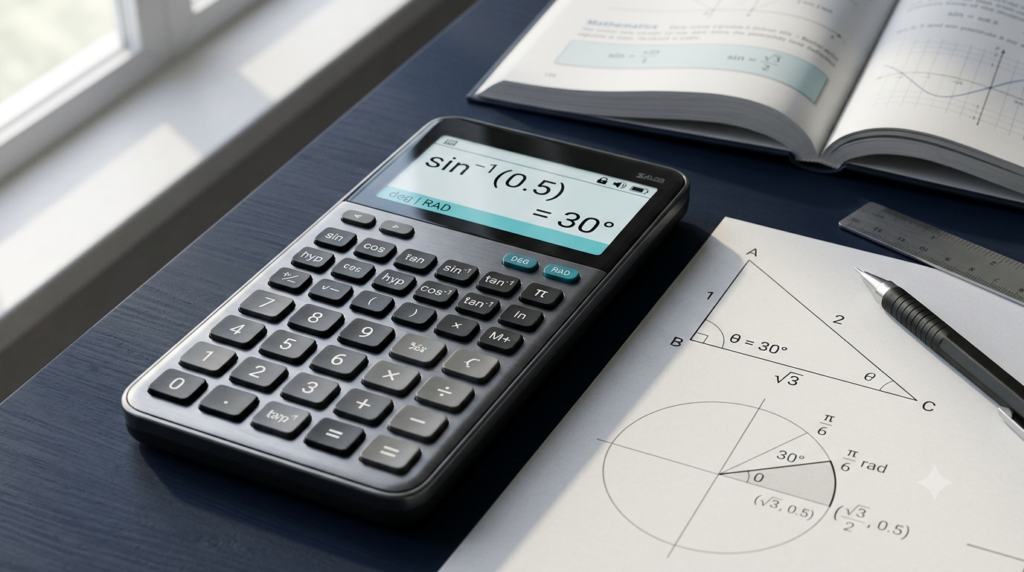
| π/6 | 30° |
| π/4 | 45° |
| π/3 | 60° |
| π/2 | 90° |
| 2π/3 | 120° |
| π | 180° |
| 3π/2 | 270° |
| 2π | 360° |
Note: Enter the numerical value of radians. For example, enter 3.14159265 for π radians. The calculator supports positive and negative values and rounds results to your selected decimal places.
A Radians to Degrees Converter is a simple online tool that converts angles measured in radians into degrees. It helps students, teachers, engineers, and anyone working with mathematics or science convert angular measurements quickly and accurately. Instead of performing the calculation manually, you can enter a radian value and obtain its equivalent in degrees within seconds.
Radians and degrees are two commonly used units for measuring angles. Degrees are often used in basic geometry, everyday measurements, and practical applications, while radians are widely used in trigonometry, calculus, physics, and advanced mathematics. Understanding how to convert between these units is important when solving mathematical problems, working with trigonometric functions, or interpreting scientific calculations.
The Radians to Degrees Converter makes this process straightforward. You simply enter the angle in radians, choose the required decimal precision, and calculate the equivalent angle in degrees. The tool also displays the conversion formula and includes common angle conversions to help you understand the relationship between radians and degrees.
What Is a Radians to Degrees Converter?
A Radians to Degrees Converter is an online calculator that changes an angle expressed in radians into its equivalent measurement in degrees. Both units describe the size of an angle, but they use different scales.
A complete circle contains 360 degrees or 2π radians. This relationship provides the mathematical foundation for converting between the two units.
For example, π radians is equal to 180 degrees, while π/2 radians is equal to 90 degrees. Similarly, 2π radians represents a complete rotation of 360 degrees.
The converter uses this relationship to perform the calculation automatically. It is especially useful when a question provides an angle in radians but requires the answer in degrees.
Instead of calculating the conversion manually every time, you can use the tool to obtain the result quickly and reduce arithmetic errors.
How to Use the Radians to Degrees Converter
Using the Radians to Degrees Converter is easy, even if you have limited experience with angle measurements.
Follow these steps to convert radians into degrees.
Enter the radian value: Type the angle you want to convert into the input field. You can enter positive or negative values, including decimal numbers.
Select decimal places: Choose how many decimal places you want in the result. The available options help you display either a shorter answer or a more precise decimal approximation.
Click Convert to Degrees: The calculator processes the entered value using the standard conversion formula.
Read the result: The equivalent angle appears in degrees, marked with the degree symbol (°).
Check the calculation: The tool displays the calculation used to obtain the result, helping you understand how the conversion works.
Copy the result: Use the Copy Result button to copy the calculated value for your notes, assignments, or other work.
Reset the calculator: If you want to perform another calculation, use the Reset button to clear the previous input and restore the default settings.
The converter also includes a table of common radian values and their equivalent angles in degrees. This is useful when learning standard angles in trigonometry.
Radians to Degrees Conversion Formula
The standard formula for converting radians into degrees is:
Degrees = Radians × 180 ÷ π
In this formula, radians represent the angle you want to convert, and π is the mathematical constant approximately equal to 3.141592653589793.
The formula works because 180 degrees is equivalent to π radians. Multiplying the radian value by 180 and dividing it by π changes the measurement from radians to degrees.
For example, suppose you want to convert 1 radian into degrees.
Degrees = 1 × 180 ÷ π
Degrees ≈ 57.2958°
Therefore, 1 radian is approximately equal to 57.2958 degrees.
This formula can be applied to whole numbers, fractions, decimal values, and negative angles. The online converter performs the same calculation automatically.
Examples of Radians to Degrees Conversion
Understanding a few examples makes the conversion process easier.
Example 1: Convert π/6 Radians to Degrees
To convert π/6 radians into degrees, use the standard formula.
Degrees = (π/6) × 180 ÷ π
The π terms cancel each other.
Degrees = 180 ÷ 6
Answer: 30°
Therefore, π/6 radians is equal to 30 degrees.
Example 2: Convert π/4 Radians to Degrees
Substitute π/4 into the formula.
Degrees = (π/4) × 180 ÷ π
Cancel π and divide 180 by 4.
Degrees = 180 ÷ 4
Answer: 45°
Thus, π/4 radians is equal to 45 degrees.
Example 3: Convert π/2 Radians to Degrees
Use the conversion formula.
Degrees = (π/2) × 180 ÷ π
After cancelling π:
Degrees = 180 ÷ 2
Answer: 90°
This is a right angle, which is one of the most important angles in geometry.
Example 4: Convert π Radians to Degrees
Substitute π into the formula.
Degrees = π × 180 ÷ π
Cancel π from the numerator and denominator.
Answer: 180°
An angle of π radians represents a straight angle.
Example 5: Convert 2 Radians to Degrees
For a decimal radian value, apply the same formula.
Degrees = 2 × 180 ÷ π
Degrees ≈ 114.5916°
Answer: 114.5916°
The result is a decimal approximation because 2 radians does not correspond to a simple whole-number angle in degrees.
Common Radians to Degrees Conversions
The following values are frequently used in geometry and trigonometry.
| Radians | Degrees |
|---|---|
| 0 radians | 0° |
| π/6 radians | 30° |
| π/4 radians | 45° |
| π/3 radians | 60° |
| π/2 radians | 90° |
| 2π/3 radians | 120° |
| 3π/4 radians | 135° |
| 5π/6 radians | 150° |
| π radians | 180° |
| 7π/6 radians | 210° |
| 5π/4 radians | 225° |
| 4π/3 radians | 240° |
| 3π/2 radians | 270° |
| 5π/3 radians | 300° |
| 7π/4 radians | 315° |
| 11π/6 radians | 330° |
| 2π radians | 360° |
These standard conversions are particularly helpful when working with unit circles, trigonometric identities, and graphs of trigonometric functions.
What Is the Difference Between Radians and Degrees?
Radians and degrees are both units used to measure angles, but their definitions differ.
A degree divides a complete circle into 360 equal parts. Each part represents one degree. This system is widely used in school geometry, construction, navigation, and everyday measurements.
A radian is based on the relationship between the radius of a circle and the length of an arc. One radian is the angle formed at the centre of a circle when the arc length is equal to the circle’s radius.
A complete circle contains 2π radians, which is approximately 6.28318 radians. The same circle contains 360 degrees.
The two units can therefore be converted using a fixed mathematical relationship.
Degrees are often convenient for expressing familiar angles, such as 30°, 45°, 90°, and 180°. Radians are especially useful in calculus and many scientific formulas because they simplify mathematical relationships involving angles.
Neither unit is universally better than the other. The appropriate choice depends on the problem, the formula being used, and the conventions of the subject.
Why Is Converting Radians to Degrees Important?
Converting radians into degrees is useful in several areas of mathematics and science.
1. Geometry
Geometry frequently involves measuring angles in degrees. When a problem provides an angle in radians, converting it into degrees can make the measurement easier to interpret.
For example, converting π/2 radians into 90 degrees immediately identifies the angle as a right angle.
2. Trigonometry
Trigonometry uses angles to study the relationships between the sides of triangles and the values of trigonometric functions.
Angles may be expressed in either radians or degrees. Converting between the units helps students interpret questions, compare results, and work with standard angles.
However, it is important to ensure that the calculator or mathematical function is using the correct angle mode.
3. Physics
Radians appear in many physics topics, including rotational motion, angular displacement, oscillations, and wave motion.
Degrees may be easier to interpret when describing the orientation or rotation of an object. Converting radians into degrees helps connect mathematical calculations with familiar angular measurements.
4. Engineering
Engineers work with angles when designing mechanical systems, analysing rotating components, and studying structures.
Depending on the application, calculations may use radians while technical descriptions or diagrams use degrees. A converter helps translate between these representations.
5. Education and Homework
Students often encounter both radians and degrees while studying mathematics.
An online converter can help verify homework answers, practise angle conversions, and understand the relationship between the two units. It is also useful for checking manual calculations before submitting an assignment.
Can You Convert Negative Radians to Degrees?
Yes. Negative radian values can also be converted into degrees using the same formula.
A negative angle generally indicates rotation in the opposite direction to a positive angle under the usual convention used in coordinate geometry.
For example, consider −π/2 radians.
Degrees = (−π/2) × 180 ÷ π
Answer: −90°
Therefore, −π/2 radians is equal to −90 degrees.
Negative angles are commonly used in trigonometry, coordinate systems, and rotational motion. The sign of the result is preserved during conversion because the formula multiplies the original value by a positive constant.
The converter supports negative inputs, allowing you to calculate these values without changing the formula.
How Accurate Is the Radians to Degrees Converter?
The converter calculates the result using the standard mathematical relationship between radians and degrees. It uses the value of π provided by JavaScript’s mathematical library to perform the calculation.
The displayed answer is rounded according to the selected number of decimal places.
For example, 1 radian is approximately 57.2957795 degrees. If you select two decimal places, the result is displayed as 57.30°. If you select six decimal places, the result is displayed as 57.295780°.
The displayed decimal value is an approximation, particularly when the exact result contains infinitely many decimal digits.
Selecting more decimal places provides a more detailed numerical representation, but it does not make the underlying computer calculation mathematically exact. For most educational calculations, six decimal places are more than sufficient.
For advanced scientific or engineering work, always consider the precision required by the problem and the accuracy of the original measurement.
Advantages of Using an Online Radians to Degrees Converter
An online converter offers several practical benefits.
Fast calculations: Convert radians into degrees within seconds without repeating manual arithmetic.
Easy to use: Enter a value, select decimal precision, and calculate the result using a straightforward interface.
Reduced arithmetic errors: Automatic calculations help avoid mistakes when multiplying and dividing values.
Flexible inputs: Convert positive, negative, whole-number, and decimal radian values.
Adjustable precision: Choose the number of decimal places that suits your needs.
Visible formula: Understand the mathematical operation used to calculate the answer.
Copyable results: Copy the converted value for notes, assignments, and calculations.
Useful examples: Refer to common angle conversions while learning geometry and trigonometry.
Mobile-friendly access: Use the converter on a smartphone, tablet, laptop, or desktop computer.
These features make the tool useful for students, educators, professionals, and anyone who needs to convert angular measurements.
Conclusion
The Radians to Degrees Converter provides a convenient way to convert angles from radians into degrees. By using the formula Degrees = Radians × 180 ÷ π, the tool calculates the equivalent angle and displays the result according to your selected decimal precision.
Understanding this conversion is valuable in geometry, trigonometry, physics, engineering, and many other subjects. Whether you are converting a standard angle such as π/2 radians or a decimal value such as 2 radians, the calculator helps simplify the process.
Use the Radians to Degrees Converter whenever you need a quick and reliable numerical conversion, and refer to the formula and examples to strengthen your understanding of angular measurements.
FAQs
1. What is a Radians to Degrees Converter?
A Radians to Degrees Converter is an online tool that converts an angle measured in radians into its equivalent value in degrees. It uses the standard mathematical relationship between the two units to calculate the result. You simply enter a radian value, select the desired decimal precision, and click the conversion button. The calculator displays the corresponding angle in degrees. This tool is useful for students, teachers, engineers, and anyone working with geometry, trigonometry, physics, or other subjects involving angular measurements. It helps save time and reduces errors associated with manual calculations.
2. What is the formula for converting radians to degrees?
The formula for converting radians to degrees is Degrees = Radians × 180 ÷ π. In this formula, radians represent the angle being converted, and π is a mathematical constant approximately equal to 3.141592653589793. The formula is based on the fact that π radians equals 180 degrees. For example, to convert 1 radian into degrees, multiply 1 by 180 and divide the result by π. The answer is approximately 57.2958 degrees. You can use this formula for positive values, negative values, fractions, and decimal radian measurements.
3. How many degrees are in one radian?
One radian is approximately equal to 57.2958 degrees. This value is obtained by multiplying one radian by 180 and dividing by π. Unlike familiar angles such as 90 degrees or 180 degrees, one radian does not produce a simple whole-number result when expressed in degrees. Its decimal value continues beyond the digits shown in a rounded calculation. One radian is defined as the central angle that subtends an arc whose length equals the radius of the circle. An online converter can provide the equivalent degree value to your preferred decimal precision.
4. How do you convert π radians into degrees?
To convert π radians into degrees, use the formula Degrees = Radians × 180 ÷ π. Substitute π for the radian value to obtain π × 180 ÷ π. The π terms cancel, leaving 180 degrees. Therefore, π radians is exactly equal to 180 degrees. This angle represents a straight angle and corresponds to half a complete rotation around a circle. It is one of the most important standard conversions in trigonometry. You can also use the Radians to Degrees Converter to verify this result and understand how the conversion formula works.
5. How many degrees are equal to π/2 radians?
π/2 radians is equal to 90 degrees. To calculate this conversion, substitute π/2 into the formula Degrees = Radians × 180 ÷ π. The expression becomes (π/2) × 180 ÷ π. After cancelling π, divide 180 by 2 to obtain 90 degrees. This angle is known as a right angle and appears frequently in geometry, trigonometry, construction, and physics. For example, the corners of a square measure 90 degrees. Remembering that π/2 radians equals 90 degrees makes it easier to recognise and solve many common mathematical problems.
6. Can I convert negative radians into degrees?
Yes, negative radian values can be converted into degrees using the same standard formula. Multiply the negative radian value by 180 and divide by π. For example, −π/2 radians equals −90 degrees. The negative sign remains because the conversion factor is positive. In standard coordinate geometry, a negative angle generally represents rotation in the direction opposite to positive rotation. Negative angles are commonly used in trigonometry, rotational motion, and coordinate systems. The Radians to Degrees Converter accepts negative values, allowing you to calculate their equivalent degree measurements without changing the formula.
7. Why are radians used instead of degrees in mathematics?
Radians are widely used in advanced mathematics because they simplify many important mathematical formulas. They are particularly useful in calculus, where derivatives and integrals involving trigonometric functions take their standard forms when angles are measured in radians. Radians also appear in equations describing angular velocity, oscillations, circular motion, and waves. Degrees remain convenient for everyday angle measurements and many geometry problems. Neither unit is always preferable; the choice depends on the calculation. When a mathematical expression uses radians but the result needs to be understood in degrees, a Radians to Degrees Converter makes the conversion straightforward.
8. Is the Radians to Degrees Converter accurate?
The converter calculates angles using the standard conversion formula and the numerical value of π provided by the computer’s mathematical library. The displayed result is rounded to the number of decimal places you select. For example, choosing two decimal places produces a shorter answer than choosing six or ten decimal places. Rounding affects the displayed value, not the conversion relationship itself. For most educational purposes, six decimal places provide sufficient precision. In scientific or engineering applications, choose a suitable precision based on the problem’s requirements and the accuracy of the original measurement.
9. What is the difference between radians and degrees?
Radians and degrees are two units used to measure angles. A complete circle contains 360 degrees or 2π radians. A degree represents one of 360 equal divisions of a full circle, while a radian is defined using the relationship between an arc’s length and the circle’s radius. Degrees are commonly used in basic geometry and everyday measurements. Radians are widely used in calculus, trigonometry, physics, and engineering. Both units describe the same angular quantity, but their numerical values differ. A converter allows you to express an angle in degrees when it is originally given in radians.
10. Can I use the Radians to Degrees Converter on a mobile phone?
Yes, the Radians to Degrees Converter is designed to work on smartphones, tablets, laptops, and desktop computers. Its responsive layout adjusts to smaller screens, making the input field, conversion button, result, and other controls easier to use on mobile devices. Enter the radian value, choose your preferred decimal precision, and calculate the equivalent angle in degrees. You can also copy the result or reset the calculator for another conversion. Because the tool runs directly in your web browser, you generally do not need to install an additional application to perform the calculation.