Angle Calculator
Calculate angles, solve triangle angles, convert degrees and radians, and find trigonometric values using this free online calculator.
Enter any two interior angles of a triangle to calculate the third angle.
Results are rounded to 8 decimal places where needed. Trigonometric values use the standard mathematical definitions. Tangent is undefined where cosine is zero.
An Angle Calculator is a useful online tool that helps you calculate angles, convert between different angle units, solve triangle angles, and find trigonometric values quickly and accurately. It is designed for students, teachers, engineers, and anyone who works with geometry, mathematics, physics, or technical measurements. Instead of performing calculations manually, you can enter the required values and obtain results within seconds.
Angles are an important part of mathematics and everyday life. They are used to measure the rotation between two lines, describe the corners of geometric shapes, calculate directions, and understand the movement of objects. From measuring the angle of a triangle to calculating the rotation of a mechanical component, angle measurements are essential in many practical applications.
An online Angle Calculator makes these calculations easier by providing a convenient way to work with degrees, radians, and gradians. Depending on the calculation mode, it can also help you determine the missing angle of a triangle or calculate sine, cosine, and tangent values.
In this article, you will learn what an Angle Calculator is, how it works, which calculations it supports, and how to use it for different mathematical and practical problems.
What Is an Angle Calculator?
An Angle Calculator is an online mathematical tool used to calculate, convert, and analyze angles. It allows users to enter an angle and obtain its equivalent measurement in other units. Some angle calculators also provide additional functions, such as finding missing triangle angles and calculating trigonometric ratios.
For example, an angle of 90 degrees is equivalent to π/2 radians and 100 gradians. An Angle Calculator can convert these values automatically without requiring you to remember the conversion formulas.
The tool is particularly helpful when working with different mathematical systems. Degrees are commonly used in school geometry and everyday measurements, while radians are frequently used in trigonometry, calculus, and scientific calculations.
An Angle Calculator can also help solve triangle problems. Since the three interior angles of a triangle always add up to 180 degrees, you can enter two known angles to calculate the third angle.
Depending on its features, the calculator may support:
Converting degrees to radians and gradians.
Converting radians and gradians into degrees.
Finding coterminal angles.
Calculating the missing angle of a triangle.
Identifying whether a triangle is acute, right, or obtuse.
Calculating sine, cosine, and tangent.
Supporting mathematical and scientific calculations.
These features make the Angle Calculator a practical resource for learning and applying angle-related concepts.
How Does an Angle Calculator Work?
An Angle Calculator works by applying mathematical formulas to the values entered by the user. Each calculation mode uses a specific formula or mathematical relationship to produce the result.
For angle conversion, the calculator converts the entered value into degrees or radians and then calculates the equivalent values in other units.
For triangle calculations, it uses the fact that the sum of the interior angles of a triangle is 180 degrees.
For trigonometric calculations, it uses the sine, cosine, and tangent functions to determine the relationship between an angle and the sides of a right-angled triangle.
The general process is simple:
Select the required calculation mode.
Enter the angle or other required values.
Choose the appropriate angle unit, if necessary.
Click the calculate or convert button.
Read the result displayed by the calculator.
The calculator performs the mathematical operations automatically, reducing the need for manual calculations. However, you should always enter valid values and select the correct units to obtain meaningful results.
How to Use the Angle Calculator
Using an online Angle Calculator is straightforward. The exact steps depend on the type of calculation you want to perform.
1. Converting Angle Units
Choose the angle conversion option and enter the value you want to convert. Select whether the input is in degrees, radians, or gradians.
For example, if you enter 45 degrees, the calculator can display the equivalent angle in radians and gradians.
The result allows you to understand the same angle in different measurement systems.
2. Calculating Triangle Angles
Select the triangle angle calculation option and enter two known interior angles.
The calculator subtracts their sum from 180 degrees to determine the missing angle.
For example, if a triangle has angles of 60 degrees and 70 degrees, the third angle is 50 degrees.
All three angles must be greater than zero and their total must equal 180 degrees.
3. Calculating Trigonometric Values
Choose the trigonometry option and enter the required angle. Select degrees or radians as the input unit.
The calculator then determines the sine, cosine, and tangent values of the angle.
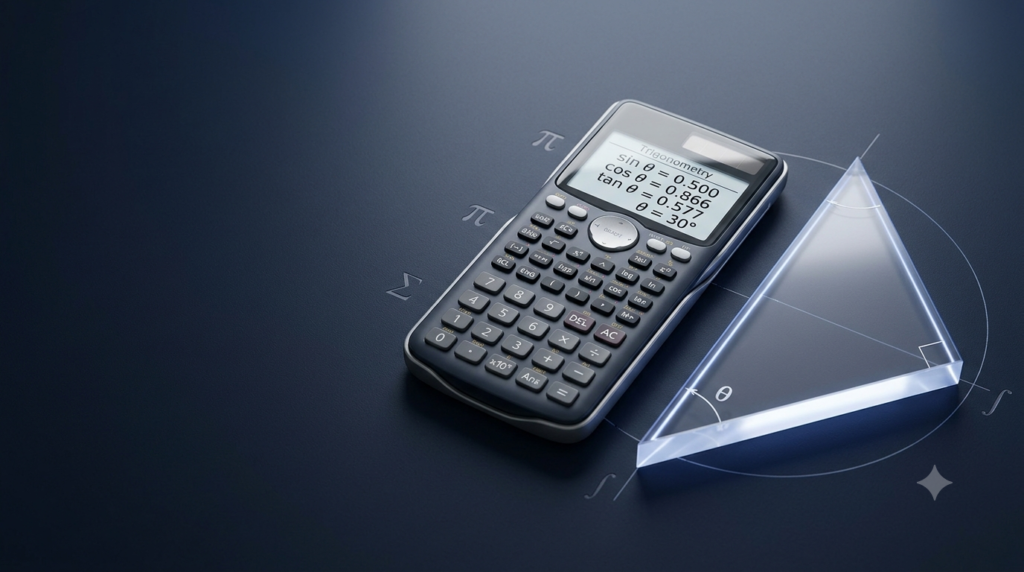
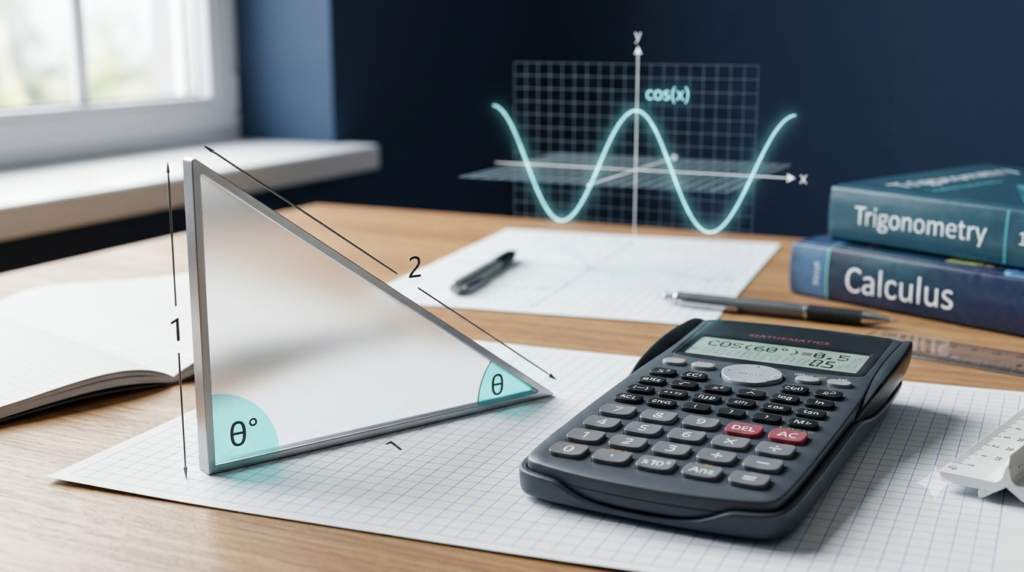
For example, the sine of 30 degrees is 0.5, while the cosine of 60 degrees is also 0.5.
These values are useful for solving geometry, trigonometry, physics, and engineering problems.
Angle Measurement Units
Angles can be expressed using different units. The most commonly used units are degrees, radians, and gradians.
Degrees
Degrees are one of the most familiar units for measuring angles. A complete rotation contains 360 degrees.
A right angle measures 90 degrees, a straight angle measures 180 degrees, and a complete angle measures 360 degrees.
Degrees are widely used in school mathematics, geometry, navigation, construction, and everyday measurements.
Examples include:
Acute angle: less than 90 degrees.
Right angle: exactly 90 degrees.
Obtuse angle: greater than 90 degrees but less than 180 degrees.
Straight angle: exactly 180 degrees.
Complete angle: exactly 360 degrees.
The degree symbol is written as °. For example, 45 degrees is written as 45°.
Radians
Radians are another important unit for measuring angles. They are commonly used in advanced mathematics, trigonometry, calculus, and physics.
One radian is the angle formed at the center of a circle when the arc length is equal to the radius of the circle.
A complete circle measures 2π radians, which is equivalent to 360 degrees.
Important radian equivalents include:
90° = π/2 radians.
180° = π radians.
270° = 3π/2 radians.
360° = 2π radians.
Radians are especially useful when working with circular motion, angular velocity, periodic functions, and calculus.
Gradians
Gradians, sometimes called gon, are an angle measurement unit in which a right angle equals 100 gradians. A complete circle therefore contains 400 gradians.
This system divides a complete circle into four equal sections of 100 gradians each.
Gradians are used in some surveying, engineering, and measurement applications.
The relationship between these units is:
360° = 2π radians = 400 gradians.
Understanding these units makes it easier to work with different mathematical and technical systems.
Important Angle Calculator Formulas
An Angle Calculator uses several mathematical formulas depending on the selected operation. Understanding these formulas helps you check the results and learn how angle calculations work.
Degrees to Radians
To convert degrees into radians, multiply the angle in degrees by π and divide by 180.
Radians = Degrees × π ÷ 180
For example, to convert 90 degrees:
Radians = 90 × π ÷ 180
Radians = π/2
Therefore, 90 degrees is equal to π/2 radians.
Radians to Degrees
To convert radians into degrees, multiply the angle in radians by 180 and divide by π.
Degrees = Radians × 180 ÷ π
For example:
Degrees = π × 180 ÷ π
Degrees = 180°
Therefore, π radians is equal to 180 degrees.
Degrees to Gradians
To convert degrees into gradians, multiply the angle by 10/9.
Gradians = Degrees × 10 ÷ 9
For example, 90 degrees equals 100 gradians.
Gradians to Degrees
To convert gradians into degrees, multiply the angle by 0.9.
Degrees = Gradians × 0.9
For example, 200 gradians equals 180 degrees.
Missing Angle of a Triangle
The sum of the interior angles of a triangle is always 180 degrees.
Third Angle = 180° − First Angle − Second Angle
For example, consider a triangle with two angles of 45 degrees and 65 degrees.
Third Angle = 180° − 45° − 65°
Third Angle = 70°
The missing angle is therefore 70 degrees.
Sine, Cosine, and Tangent
Trigonometric functions describe relationships between angles and sides of right-angled triangles.
Sine = Opposite Side ÷ Hypotenuse
Cosine = Adjacent Side ÷ Hypotenuse
Tangent = Opposite Side ÷ Adjacent Side
These ratios are particularly useful when the angle and one or more side lengths are known.
For example, the sine of 30 degrees is 0.5. This means that, in a right-angled triangle containing a 30-degree angle, the opposite side is half the length of the hypotenuse.
What Is a Coterminal Angle?
Coterminal angles are angles that share the same initial and terminal sides when drawn in standard position. They differ by one or more complete rotations.
For example, 45 degrees and 405 degrees are coterminal because their difference is 360 degrees.
Similarly, −315 degrees and 45 degrees are coterminal.
A common formula for finding coterminal angles is:
Coterminal Angle = Original Angle + 360° × n
Here, n represents any integer, such as −2, −1, 0, 1, or 2.
For example:
45° + 360° = 405°
45° − 360° = −315°
Both results represent angles coterminal with 45 degrees.
A calculator that provides a normalized angle can also express the result between 0 degrees and 360 degrees. This is useful when working with rotations and directions.
Types of Angles
Understanding the different types of angles is important when using an Angle Calculator for geometry problems.
Acute Angle
An acute angle measures more than 0 degrees but less than 90 degrees.
Examples include 25°, 45°, and 75°.
Right Angle
A right angle measures exactly 90 degrees. It is commonly found at the corners of squares and rectangles.
Obtuse Angle
An obtuse angle measures more than 90 degrees but less than 180 degrees.
Examples include 110°, 135°, and 160°.
Straight Angle
A straight angle measures exactly 180 degrees. It forms a straight line.
Reflex Angle
A reflex angle measures more than 180 degrees but less than 360 degrees.
For example, 225 degrees and 300 degrees are reflex angles.
Complete Angle
A complete angle measures exactly 360 degrees. It represents one full rotation around a point.
Recognizing these angle types helps you interpret results and determine whether a calculated angle is reasonable for a particular geometry problem.
Applications of an Angle Calculator
Angle calculations are important in many educational, scientific, and practical fields.
Mathematics and Geometry
Students use angle calculations to solve problems involving triangles, polygons, circles, parallel lines, and geometric constructions.
An Angle Calculator can help verify answers and make it easier to understand relationships between different angles.
Physics
In physics, angles are used to describe the direction of forces, projectile motion, circular motion, waves, and the movement of objects.
Radians are especially important in calculations involving angular displacement, angular velocity, and angular acceleration.
Engineering
Engineers use angle measurements when designing mechanical components, structures, machines, and technical systems.
Accurate angle calculations can help ensure that components fit together correctly and perform as intended.
Construction and Architecture
Angles are essential when designing roofs, staircases, walls, support structures, and building layouts.
Professionals use angle measurements to establish slopes, align structural components, and verify geometric dimensions.
Navigation and Surveying
Angle measurements are used to determine directions, establish positions, and calculate alignments.
Surveyors may use angular measurements to map land and establish boundaries, while navigation systems use angles to describe directions and bearings.
Computer Graphics and Game Development
Angles are used to rotate objects, position cameras, calculate directions, and control movement in two-dimensional and three-dimensional environments.
Developers frequently use radians in programming libraries and mathematical calculations.
Education and Self-Study
An Angle Calculator is a convenient learning resource for students studying geometry, trigonometry, and related subjects.
It can help learners check their work, compare angle units, and understand how mathematical formulas produce specific results.
Advantages of Using an Online Angle Calculator
An online Angle Calculator provides several practical benefits.
Fast calculations: It produces results quickly without requiring repeated manual calculations.
Unit conversion: It simplifies conversions between degrees, radians, and gradians.
Convenient learning: Students can verify calculations and compare their answers with the calculator’s results.
Reduced arithmetic errors: Automatic calculations reduce mistakes that may occur during manual arithmetic, although incorrect inputs or limitations in numerical precision can still affect results.
Multiple functions: A calculator with several modes can handle angle conversion, triangle calculations, and trigonometric operations in one place.
Easy accessibility: A browser-based calculator can be used on computers, tablets, and smartphones without installing additional software.
These advantages make an online calculator useful for both learning and practical calculations.
Common Mistakes to Avoid When Calculating Angles
Although angle calculations are straightforward, certain mistakes can lead to incorrect results.
Mixing Degrees and Radians
One of the most common mistakes is entering a degree value into a calculation that expects radians, or the reverse.
Always check the selected unit before calculating trigonometric values.
Using Invalid Triangle Angles
The interior angles of a triangle must add up to exactly 180 degrees.
If two entered angles add up to 180 degrees or more, there is no valid third interior angle greater than zero.
Forgetting Negative Angles
Negative angles can represent clockwise rotations, while positive angles commonly represent counterclockwise rotations in standard mathematical position.
A negative angle is not necessarily incorrect. Its meaning depends on the context of the calculation.
Misinterpreting Trigonometric Results
Sine, cosine, and tangent values are ratios, not angles themselves. For example, the sine of 30 degrees is 0.5, not 0.5 degrees.
If you need to determine an angle from a known trigonometric ratio, you generally need an inverse trigonometric function, such as arcsine, arccosine, or arctangent.
Ignoring Undefined Values
Tangent is undefined whenever cosine equals zero. For example, tan(90°) is undefined.
A calculator should identify such cases rather than presenting a misleading finite result.
Conclusion
An Angle Calculator is a practical online tool for calculating angles, converting measurement units, solving triangle problems, and finding trigonometric values. It simplifies many mathematical operations by applying standard formulas automatically, making angle-related calculations faster and more convenient.
Whether you are studying geometry, learning trigonometry, solving physics problems, or working with engineering measurements, understanding how angles are measured and calculated is essential. By using an Angle Calculator correctly and learning the formulas behind its results, you can improve your understanding of mathematical concepts and solve angle-related problems more efficiently.
FAQs
1. What is an Angle Calculator?
An Angle Calculator is an online tool that helps you calculate angles, convert angle units, solve triangle problems, and find trigonometric values. It can convert degrees into radians and gradians, calculate a missing triangle angle, and determine sine, cosine, and tangent values. The calculator uses mathematical formulas to produce results quickly and reduce manual calculation errors. It is useful for students, teachers, engineers, and anyone working with geometry, trigonometry, physics, or technical measurements. Most online angle calculators work directly in a web browser, making them accessible on computers, tablets, and smartphones without installing additional software.
2. How do I use an Angle Calculator?
To use an Angle Calculator, first select the calculation you want to perform. For angle conversion, enter the angle value and choose the input unit, such as degrees, radians, or gradians. For triangle calculations, enter two known interior angles to find the third angle. For trigonometric calculations, enter an angle and select the correct unit. Then click the calculate or convert button to display the result. Always check the input values and selected units before calculating. This helps you obtain accurate results and avoid common mistakes when working with different angle measurement systems.
3. How do you convert degrees to radians?
To convert degrees to radians, multiply the angle in degrees by π and divide the result by 180. The formula is Radians = Degrees × π ÷ 180. For example, to convert 90 degrees into radians, calculate 90 × π ÷ 180. The answer is π/2 radians, approximately 1.57079633 radians. Similarly, 180 degrees equals π radians, and 360 degrees equals 2π radians. An Angle Calculator performs these conversions automatically. Radians are commonly used in trigonometry, calculus, physics, and calculations involving circular motion, making this conversion useful in mathematics and scientific applications.
4. How do you calculate a missing angle in a triangle?
To calculate a missing interior angle in a triangle, subtract the sum of the two known angles from 180 degrees. The formula is Third Angle = 180° − First Angle − Second Angle. For example, if two angles measure 50 degrees and 60 degrees, their sum is 110 degrees. Subtracting 110 degrees from 180 degrees gives a missing angle of 70 degrees. An Angle Calculator performs this calculation automatically when you enter the two known angles. Both entered angles must be positive, and their sum must be less than 180 degrees for a valid triangle.
5. What is the difference between degrees and radians?
Degrees and radians are two different units used to measure angles. A complete circle contains 360 degrees or 2π radians. Degrees are commonly used in school geometry, construction, navigation, and everyday measurements. Radians are widely used in advanced mathematics, calculus, physics, and trigonometry. A right angle measures 90 degrees, which is equivalent to π/2 radians. Although the numerical values differ, both units represent the same angular measurement when properly converted. An Angle Calculator makes it easy to switch between degrees and radians, helping users perform calculations accurately in different mathematical and scientific situations.
6. Can an Angle Calculator calculate sine, cosine, and tangent?
Yes, an Angle Calculator with trigonometric functions can calculate sine, cosine, and tangent values for a given angle. These functions describe mathematical relationships between angles and the sides of a right-angled triangle. For example, sin(30°) = 0.5, cos(60°) = 0.5, and tan(45°) = 1. Before calculating, select the correct angle unit because degrees and radians produce different results when the same numerical value is interpreted differently. Tangent is undefined at angles such as 90 degrees and 270 degrees. These calculations are useful in geometry, physics, engineering, and other technical subjects.
7. What are gradians in angle measurement?
Gradians, also called gon, are a unit of angular measurement in which a right angle equals 100 gradians. A complete circle contains 400 gradians, compared with 360 degrees. To convert degrees into gradians, multiply the degree value by 10/9. To convert gradians into degrees, multiply the gradian value by 0.9. For example, 90 degrees equals 100 gradians, while 200 gradians equals 180 degrees. Gradians are used in certain surveying, engineering, and measurement applications. An Angle Calculator that supports gradians can perform these conversions quickly without requiring you to calculate the values manually.
8. What is a coterminal angle?
A coterminal angle is an angle that shares the same initial and terminal sides as another angle when measured in standard position. Coterminal angles differ by a whole number of complete rotations. Since one complete rotation equals 360 degrees, you can find coterminal angles by adding or subtracting multiples of 360 degrees. For example, 45 degrees and 405 degrees are coterminal because their difference is 360 degrees. Similarly, −315 degrees is coterminal with 45 degrees. Coterminal angles are useful in trigonometry, circular motion, and coordinate geometry. Some Angle Calculators can also display an equivalent angle between 0 and 360 degrees.
9. Is an online Angle Calculator accurate?
An online Angle Calculator can provide accurate results when you enter valid values, select the correct angle units, and use a calculator with properly implemented mathematical formulas. It can reduce arithmetic mistakes and perform conversions much faster than manual calculations. However, results may be affected by rounding, floating-point precision, incorrect inputs, or software limitations. Trigonometric functions also have special cases where a value is undefined, such as tangent at 90 degrees. For important engineering or scientific applications, verify the results when necessary and consider the precision required. Understanding the underlying formulas helps you check whether a calculated answer is reasonable.
10. Where are Angle Calculators used in everyday life?
Angle Calculators are useful in education, construction, architecture, engineering, physics, navigation, surveying, and computer graphics. Students use them to solve geometry and trigonometry problems, while construction professionals work with angles when planning roofs, stairs, and structural components. Engineers use angular measurements to design mechanical parts and analyze motion. In physics, angles help describe forces, projectile motion, and circular movement. Computer graphics and game development use angles to rotate objects and control directions. Even everyday activities such as measuring slopes or adjusting the position of an object can involve angles. An online calculator makes these calculations more convenient and efficient.