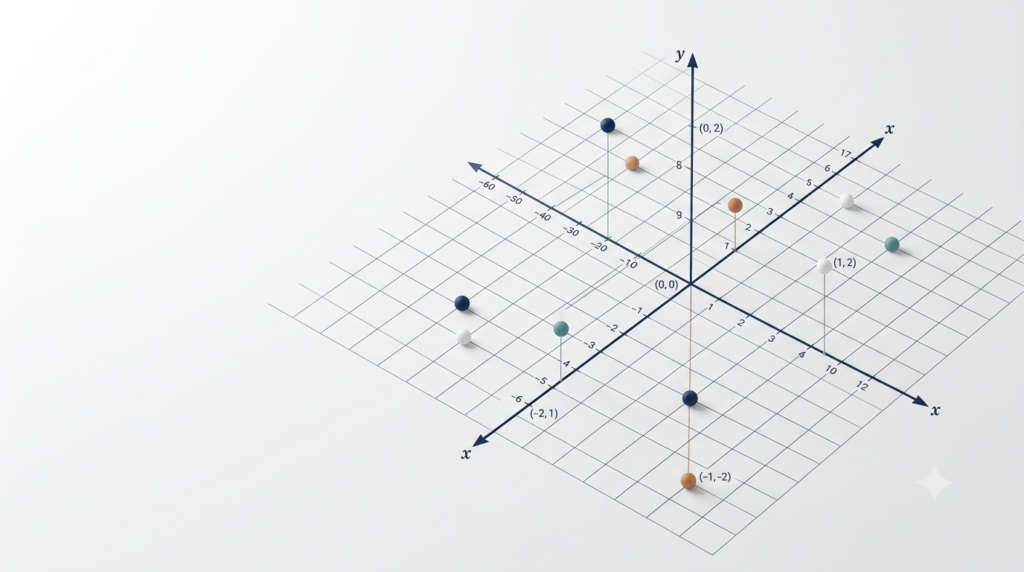
The coordinate plane is an important concept in mathematics that helps us locate points, describe positions, and understand the relationships between numbers and shapes. It is widely used in geometry, algebra, graphing, and many real-world applications. One of its most important features is the origin, which serves as the central reference point for locating other points on the plane.
The origin is the point where the horizontal x-axis and the vertical y-axis intersect. It has the coordinates (0, 0), meaning that both the x-coordinate and the y-coordinate are zero. Every other point on the coordinate plane is located in relation to this fixed point. Understanding the origin makes it easier to read graphs, plot coordinates, calculate distances, and solve mathematical problems. In this article, we will learn what the origin is, why it is important, how to identify it, and how it is used in different areas of mathematics and everyday life.
What Is a Coordinate Plane?
A coordinate plane is a flat, two-dimensional surface used to represent points through numerical coordinates. It is formed by two perpendicular number lines that intersect at a common point.
The horizontal number line is called the x-axis, while the vertical number line is called the y-axis. These axes divide the plane into four regions known as quadrants.
Each point on the coordinate plane is represented by an ordered pair of numbers written as (x, y). The first number indicates the position along the x-axis, and the second number indicates the position along the y-axis.
For example, the point (4, 3) is located four units to the right of the origin and three units upward. Similarly, the point (−2, 5) is located two units to the left and five units upward.
The coordinate plane provides a systematic way to describe the exact position of a point without relying on verbal directions alone.
What Is the Origin in a Coordinate Plane?
The origin is the point where the x-axis and y-axis intersect. It is represented by the ordered pair (0, 0).
At the origin, the horizontal coordinate is zero and the vertical coordinate is also zero. This means that there is no movement to the left or right and no movement upward or downward from the reference point.
The origin is usually marked with the letter O on a coordinate plane. It acts as the starting point for measuring the positions of all other points.
For example, suppose you want to plot the point (3, 2). Starting from the origin, you move three units to the right along the horizontal direction and then two units upward. The final position represents the point (3, 2).
If you want to plot the point (−3, −2), you move three units to the left and two units downward from the origin.
These examples show that the origin provides a common reference point for describing positions in every direction.
Coordinates of the Origin
The coordinates of the origin are always (0, 0) in a standard two-dimensional Cartesian coordinate plane.
The first zero represents the x-coordinate, while the second zero represents the y-coordinate.
Text block for the formula:
Coordinates of the origin = (0, 0)
x = 0
y = 0
These values remain the same regardless of the scale used on the coordinate plane. Whether each grid square represents one unit, five units, or ten units, the origin remains the point where both axes meet.
It is important to remember that the origin is not simply any point located near the center of a graph. Its exact position is determined by the intersection of the x-axis and y-axis.
Understanding the X-Axis and Y-Axis
To understand the origin properly, it is helpful to know how the two coordinate axes work.
The X-Axis
The x-axis is the horizontal number line on a coordinate plane. It extends indefinitely to the left and right.
Positive x-values are located to the right of the origin, while negative x-values are located to the left. The origin itself has an x-coordinate of zero.
For example:
(2, 0) is two units to the right of the origin.
(−4, 0) is four units to the left of the origin.
(0, 0) is the origin.
Every point on the x-axis has a y-coordinate of zero because it does not move vertically away from the horizontal axis.
The Y-Axis
The y-axis is the vertical number line on a coordinate plane. It extends indefinitely upward and downward.
Positive y-values are located above the origin, while negative y-values are located below it. The origin has a y-coordinate of zero.
For example:
(0, 3) is three units above the origin.
(0, −5) is five units below the origin.
(0, 0) is the origin.
Every point on the y-axis has an x-coordinate of zero because it does not move horizontally away from the vertical axis.
How the Axes Meet at the Origin
The x-axis and y-axis intersect at a right angle. Their intersection establishes the origin and divides the coordinate plane into four quadrants.
The horizontal and vertical axes provide two independent directions for measuring the position of a point. Together, they make it possible to identify locations across the entire plane.
How to Locate the Origin on a Coordinate Plane
Finding the origin is simple when you understand how the coordinate axes are arranged.
Follow these steps:
Identify the horizontal line, which is the x-axis.
Identify the vertical line, which is the y-axis.
Find the point where the two axes intersect.
Mark that intersection as O or (0, 0).
The intersection is the origin because both coordinate values are zero at that point.
When using graph paper, the origin is often located near the center of the grid. However, it may appear elsewhere if the graph shows only a particular portion of the coordinate plane.
Therefore, always identify the axes before deciding where the origin is located.
The Origin and the Four Quadrants
The x-axis and y-axis divide the coordinate plane into four quadrants. These quadrants are numbered counterclockwise, beginning with the upper-right region.
The origin lies at the common boundary of all four quadrants, but it does not belong to any quadrant.
First Quadrant
The first quadrant is located above the x-axis and to the right of the y-axis. Both coordinates are positive.
Example: (3, 4)
Second Quadrant
The second quadrant is located above the x-axis and to the left of the y-axis. The x-coordinate is negative, while the y-coordinate is positive.
Example: (−3, 4)
Third Quadrant
The third quadrant is located below the x-axis and to the left of the y-axis. Both coordinates are negative.
Example: (−3, −4)
Fourth Quadrant
The fourth quadrant is located below the x-axis and to the right of the y-axis. The x-coordinate is positive, while the y-coordinate is negative.
Example: (3, −4)
The origin, (0, 0), is not included in any of these quadrants because it lies exactly where the axes intersect.
How the Origin Helps in Plotting Points
The origin is the starting reference point when plotting coordinates on a coordinate plane.
A point is represented by an ordered pair (x, y). To plot it correctly, you first consider the x-coordinate and then the y-coordinate.
For example, consider the point (4, 2).
Start at the origin. Move four units to the right along the horizontal direction. Then move two units upward. The final position represents the required point.
Now consider the point (−2, 3).
Start at the origin, move two units to the left, and then move three units upward. This gives the position of the point in the second quadrant.
Consider another point, (3, −2). Move three units to the right and two units downward from the origin. This point lies in the fourth quadrant.
The same method works for every point on the coordinate plane. The signs of the coordinates determine the direction of movement.
Points Located on the Coordinate Axes
Some points lie directly on the x-axis or y-axis rather than inside a quadrant.
Understanding these points is important because they are closely related to the origin.
Points on the X-Axis
Every point on the x-axis has a y-coordinate of zero.
Examples include:
(2, 0)
(5, 0)
(−3, 0)
(−6, 0)
The origin is also on the x-axis because its y-coordinate is zero.
Text block for the rule:
For any point on the x-axis:
y = 0
Points on the Y-Axis
Every point on the y-axis has an x-coordinate of zero.
Examples include:
(0, 2)
(0, 5)
(0, −3)
(0, −6)
The origin is also on the y-axis because its x-coordinate is zero.
Text block for the rule:
For any point on the y-axis:
x = 0
The origin is the only point where both conditions are true at the same time.
The Distance of the Origin from Other Points
The origin is useful for measuring the distance between points and determining how far a point lies from the reference position.
For a point located on the x-axis, the distance from the origin is the absolute value of its x-coordinate.
For a point located on the y-axis, the distance from the origin is the absolute value of its y-coordinate.
For example, the point (5, 0) is five units from the origin, and the point (0, −4) is four units from the origin.
For points that lie away from both axes, the distance can be calculated using the Pythagorean theorem.
Text block for the formula:
Distance from the origin = √(x² + y²)
Here, x is the horizontal coordinate and y is the vertical coordinate.
For example, consider the point (3, 4).
Distance = √(3² + 4²)
Distance = √(9 + 16)
Distance = √25
Distance = 5 units
Therefore, the point (3, 4) is five units away from the origin.
This formula is useful in coordinate geometry, where distances between points are frequently calculated.
The Origin and the Midpoint of a Line Segment
The origin also helps when studying the midpoint of a line segment.
The midpoint is the point exactly halfway between two endpoints. If the endpoints are known, their midpoint can be calculated by finding the average of their x-coordinates and the average of their y-coordinates.
Text block for the formula:
Midpoint = ((x₁ + x₂)/2, (y₁ + y₂)/2)
For example, consider two points, A(−2, 4) and B(2, −4).
Midpoint = ((−2 + 2)/2, (4 + (−4))/2)
Midpoint = (0/2, 0/2)
Midpoint = (0, 0)
The midpoint is the origin.
This example shows that a line segment can have the origin as its midpoint when its endpoints are positioned symmetrically around the origin.
The Origin in Graphs and Equations
The origin plays an important role in graphing mathematical relationships.
In a coordinate graph, the position of a point is determined by its x-coordinate and y-coordinate. Equations describe relationships between these coordinates.
For example, the equation y = x represents a straight line passing through the origin because x and y are both zero when the point is (0, 0).
Similarly, the equation y = 2x also passes through the origin. When x = 0, the value of y is also zero.
However, not every straight-line equation passes through the origin.
For example, the equation y = x + 3 gives y = 3 when x = 0. Therefore, its graph crosses the y-axis at (0, 3), not at the origin.
The origin helps us determine whether a graph passes through the point (0, 0) and understand how different equations behave.
The Origin in Real-Life Applications
Although the origin is a mathematical concept, it is useful in many practical situations.
Maps and Navigation
Coordinate systems help represent locations on maps. A selected reference point can be assigned coordinates of zero, and other locations can be described relative to it.
For example, a simplified local map might use a railway station as its reference point. Locations to the east or west and north or south can then be represented by coordinate values.
Real geographic systems may use more complex coordinate conventions, but the idea of a reference point remains important.
Computer Graphics and Game Design
Computer graphics use coordinate systems to position objects, images, and characters. A coordinate origin provides a reference for describing positions on a screen or within a digital scene.
Depending on the system, the origin may be located at the center of the screen, in a corner, or at another chosen point.
Architecture and Engineering
Architects and engineers use reference points and coordinate systems to plan structures, measure positions, and describe locations accurately.
An origin can help establish the position of walls, columns, machines, and other components in a drawing or model.
Science and Experiments
Scientists use coordinate systems to represent measurements and display experimental results. The origin provides a reference point from which values can be measured or compared.
For example, a graph showing the relationship between distance and time may begin at (0, 0) when the distance is zero at the starting time.
These applications demonstrate why understanding the origin is useful beyond basic mathematics.
Common Mistakes to Avoid
Students sometimes make simple mistakes when working with the origin. Knowing these errors can help improve accuracy.
Confusing the Origin with the Center of the Paper
The origin is not necessarily the physical center of a sheet of graph paper. It is specifically the intersection of the x-axis and y-axis.
Reversing the Coordinates
Coordinates are always written in the order (x, y). The horizontal coordinate comes first, followed by the vertical coordinate.
For example, (2, 5) and (5, 2) represent different points.
Assuming the Origin Belongs to the First Quadrant
Although the origin is at the intersection of the axes, it does not belong to any quadrant. It is a separate point shared by the coordinate axes.
Forgetting the Zero Coordinates on the Axes
A point on the x-axis must have a y-coordinate of zero. A point on the y-axis must have an x-coordinate of zero.
The origin satisfies both conditions.
Ignoring Negative Directions
Positive x-values extend to the right, and negative x-values extend to the left. Positive y-values extend upward, while negative y-values extend downward.
Remembering these directions makes plotting points easier and reduces errors.
Practice Examples
The following examples will help reinforce the meaning of the origin.
Example 1: Identify the Origin
What are the coordinates of the point where the x-axis and y-axis intersect?
Answer: The coordinates are (0, 0). This point is called the origin.
Example 2: Find a Point on the X-Axis
Which of the following points lies on the x-axis: (4, 0), (0, 4), or (3, 2)?
Answer: The point (4, 0) lies on the x-axis because its y-coordinate is zero.
Example 3: Find a Point on the Y-Axis
Which point lies on the y-axis: (5, 0), (0, −5), or (2, 3)?
Answer: The point (0, −5) lies on the y-axis because its x-coordinate is zero.
Example 4: Calculate the Distance from the Origin
Find the distance between the origin and the point (6, 8).
Text block for the calculation:
Distance = √(x² + y²)
Distance = √(6² + 8²)
Distance = √(36 + 64)
Distance = √100
Distance = 10 units
Answer: The distance is 10 units.
Example 5: Determine Whether a Graph Passes Through the Origin
Does the graph of y = 3x + 2 pass through the origin?
Answer: No. When x = 0, y = 3(0) + 2 = 2. The graph passes through (0, 2), not (0, 0).
Conclusion
The origin is one of the most fundamental concepts in coordinate geometry. It is the point where the x-axis and y-axis intersect, and its coordinates are always (0, 0) in a standard two-dimensional coordinate plane. It serves as a reference point for plotting coordinates, identifying quadrants, measuring distances, calculating midpoints, and graphing equations.
Understanding the origin also makes it easier to recognize points on the coordinate axes and distinguish between positive and negative directions. Its applications extend beyond mathematics into computer graphics, navigation, engineering, and scientific research. By learning how the origin works and practising with coordinate pairs, students can build a strong foundation for more advanced topics in algebra and geometry.
FAQs
1. What is the origin in a coordinate plane?
The origin in a coordinate plane is the point where the horizontal x-axis and the vertical y-axis intersect. It is represented by the coordinates (0, 0), meaning that both the x-coordinate and the y-coordinate are zero. The origin serves as a reference point for locating every other point on the plane. From the origin, points can be plotted by moving horizontally and vertically according to their coordinates. It is an essential concept in coordinate geometry because it helps students understand positions, directions, distances, and the relationships between different points on a graph.
2. What are the coordinates of the origin?
The coordinates of the origin are always (0, 0) in a standard two-dimensional Cartesian coordinate plane. The first value represents the x-coordinate, and the second value represents the y-coordinate. Both values are zero because the origin is the starting reference point for horizontal and vertical measurements. Regardless of the scale used on a graph, the origin remains at (0, 0). For example, if each grid square represents five units instead of one unit, the coordinates of the origin do not change. Remembering these coordinates makes it easier to identify the origin and plot other points accurately.
3. How can you identify the origin on a coordinate plane?
To identify the origin, first locate the horizontal x-axis and the vertical y-axis. Follow both axes until you find the point where they intersect. This intersection is the origin, represented by O or (0, 0). On graph paper, the origin may appear near the center, but its position depends on how the graph is drawn. Therefore, you should not identify the origin simply by looking for the middle of the paper. Always use the intersection of the two axes. Recognizing this point correctly is the first step in plotting coordinates and solving coordinate geometry problems.
4. Does the origin belong to any of the four quadrants?
No, the origin does not belong to any of the four quadrants. The x-axis and y-axis divide the coordinate plane into four regions called quadrants. The first quadrant contains points with positive x- and y-coordinates, while the other quadrants contain different combinations of positive and negative coordinates. The origin, (0, 0), lies exactly where the two axes intersect and forms part of the boundary between all four quadrants. Because both coordinates are zero, the origin is not inside any quadrant. This distinction is important when identifying the location of points on a coordinate plane.
5. What is the difference between the origin and the x-axis?
The origin is a single point, whereas the x-axis is an entire horizontal number line extending in both directions. The origin is the point where the x-axis intersects the y-axis and has coordinates (0, 0). Every point on the x-axis has a y-coordinate of zero, but its x-coordinate can be positive, negative, or zero. For example, (4, 0) and (−3, 0) lie on the x-axis, while only (0, 0) is the origin. Therefore, the origin is part of the x-axis, but the x-axis contains infinitely many other points.
6. What is the difference between the origin and the y-axis?
The origin is a single point, while the y-axis is the vertical number line extending upward and downward. The origin is located at the intersection of the x-axis and y-axis, and its coordinates are (0, 0). Every point on the y-axis has an x-coordinate of zero, while its y-coordinate can be positive, negative, or zero. For example, (0, 5) and (0, −2) lie on the y-axis, but neither is the origin. Only the point (0, 0) is the origin. Understanding this difference helps students identify points and interpret coordinate graphs correctly.
7. How do you plot a point using the origin?
To plot a point, begin at the origin (0, 0) and read its coordinates in the order (x, y). First, move horizontally according to the x-coordinate. Move right for a positive x-value and left for a negative x-value. Next, move vertically according to the y-coordinate. Move upward for a positive y-value and downward for a negative y-value. For example, to plot (3, −2), move three units right and two units down from the origin. Mark the final position as the required point. This method works for all points on a standard coordinate plane.
8. How do you calculate the distance between the origin and a point?
The distance between the origin and a point can be calculated using the Pythagorean theorem. If the point has coordinates (x, y), the distance is the square root of the sum of the squares of its coordinates. The formula is: Distance = √(x² + y²). For example, consider the point (3, 4). The distance is √(3² + 4²) = √(9 + 16) = √25 = 5 units. Therefore, the point is five units away from the origin. This formula is particularly useful when the point does not lie directly on either coordinate axis.
9. Why is the origin important in coordinate geometry?
The origin is important because it provides a fixed reference point for locating and comparing points on a coordinate plane. It helps students plot ordered pairs, identify quadrants, calculate distances, determine midpoints, and understand graphs of equations. Without a clearly defined origin, the coordinates of points cannot be interpreted consistently within the chosen coordinate system. The origin is also useful in practical applications such as computer graphics, engineering drawings, mapping, and scientific data visualization. Learning how to work with the origin builds a strong foundation for more advanced mathematical concepts, including linear equations, transformations, and analytical geometry.
10. Does every graph pass through the origin?
No, not every graph passes through the origin. A graph passes through the origin only when it includes the point (0, 0). For example, the equation y = 2x passes through the origin because substituting x = 0 gives y = 0. However, the equation y = 2x + 3 does not pass through the origin because x = 0 gives y = 3. Its graph crosses the y-axis at (0, 3). Checking the coordinates when x and y are both zero can help determine whether a graph passes through the origin. This idea is useful when studying linear equations and functions.