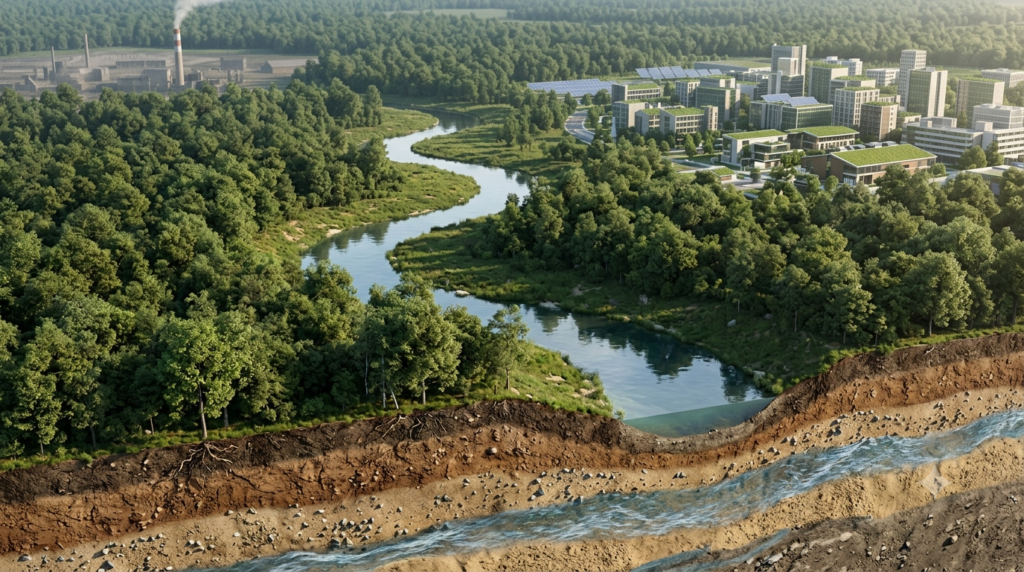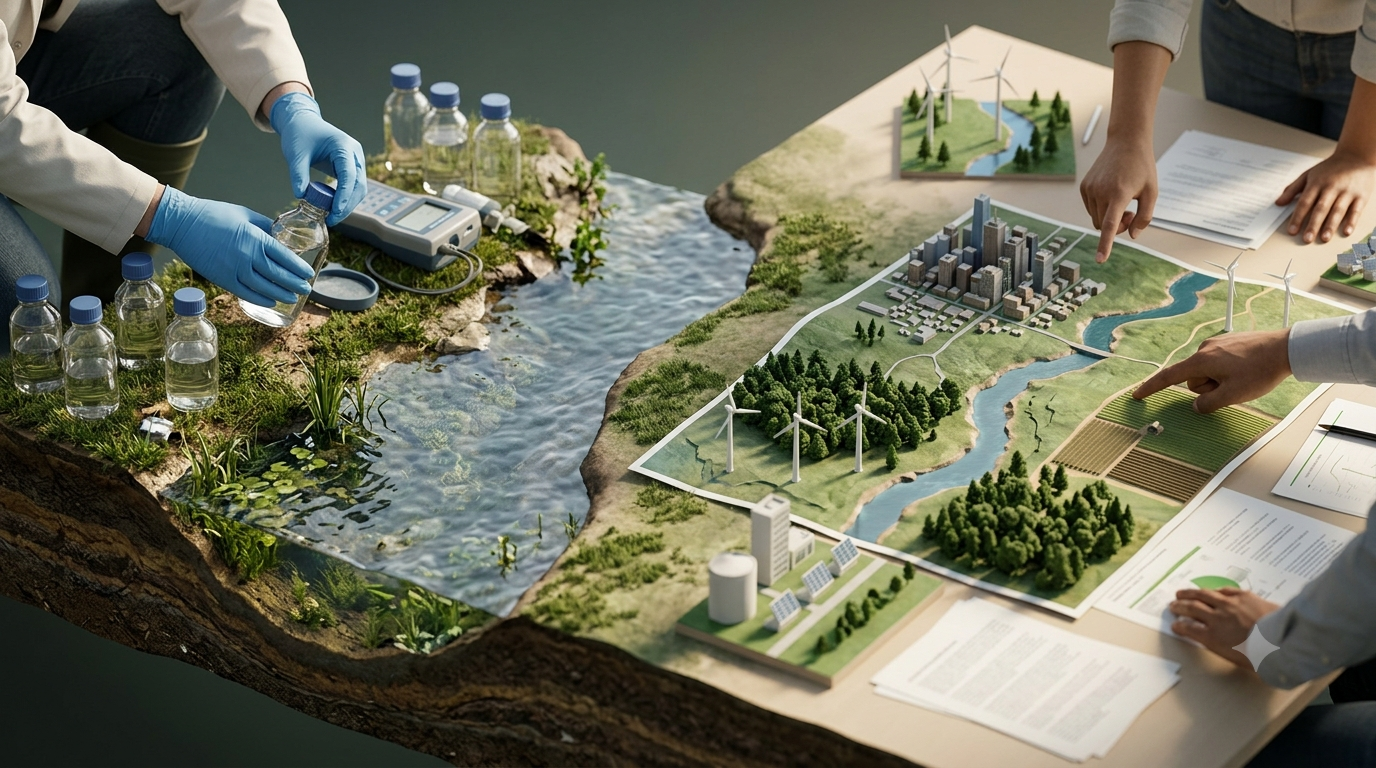
Environmental science and environmental studies are two important fields that help us understand the relationship between humans and the natural world. Both focus on environmental problems, such as climate change, pollution, deforestation, biodiversity loss, and the depletion of natural resources. Although these subjects share many common goals, they differ in their approaches, methods, and areas of emphasis. Environmental science mainly examines environmental systems through scientific principles, experiments, measurements, and data analysis. Environmental studies takes a broader approach by combining scientific knowledge with social sciences, economics, politics, ethics, and other disciplines to understand environmental issues and develop practical solutions. Learning the difference between environmental science and environmental studies helps students and curious readers understand how these fields contribute to environmental protection, sustainable development, and responsible decision-making.
What Is Environmental Science?
Environmental science is an interdisciplinary field that studies the natural environment and the interactions between its physical, chemical, and biological components. It uses scientific methods to investigate how environmental systems function and how human activities affect them.
Environmental scientists examine the atmosphere, water, soil, plants, animals, microorganisms, and the relationships among these components. They investigate environmental problems by collecting samples, conducting experiments, analyzing measurements, and interpreting scientific data.
For example, when a river becomes polluted, environmental scientists may collect water samples to identify harmful chemicals, measure dissolved oxygen levels, examine microorganisms, and determine how pollutants affect aquatic organisms. Their findings help explain the causes and consequences of the pollution.
Environmental science draws knowledge from several scientific disciplines, including biology, chemistry, physics, geology, ecology, and atmospheric science. This combination allows researchers to study environmental problems that cannot be fully understood through a single subject.
Main Areas of Environmental Science
Ecology: Ecology examines the relationships between organisms and their surroundings. It helps scientists understand ecosystems, food chains, biodiversity, and the effects of environmental changes on living organisms.
Environmental chemistry: This area studies the chemical substances present in air, water, and soil. It investigates pollutants, chemical reactions, toxic substances, and the movement of chemicals through the environment.
Atmospheric science: Atmospheric science examines the composition, structure, and behavior of the atmosphere. It contributes to research on air pollution, weather patterns, and climate change.
Soil science: Soil science investigates soil composition, fertility, erosion, contamination, and the interactions between soil organisms and their environment.
Hydrology: Hydrology studies the movement, distribution, and properties of water on Earth. It helps researchers understand groundwater, rivers, rainfall, floods, and water availability.
Environmental toxicology: Environmental toxicology examines the harmful effects of chemicals and other substances on humans, animals, plants, and ecosystems.
Objectives of Environmental Science
The main objective of environmental science is to understand environmental processes and identify the causes of environmental problems. It aims to produce reliable scientific evidence that can support environmental protection and resource management.
Its objectives include identifying pollution sources, measuring environmental changes, studying ecosystem health, assessing the effects of human activities, predicting environmental risks, and evaluating the effectiveness of scientific solutions.
Environmental science also supports the development of cleaner technologies, improved waste treatment methods, renewable energy systems, and strategies for conserving natural resources.
What Is Environmental Studies?
Environmental studies is a broad, interdisciplinary field that examines environmental issues and their relationships with human society. It includes scientific knowledge but also considers social, economic, cultural, political, historical, and ethical factors that influence the environment.
Environmental studies recognizes that environmental problems are not caused by natural processes alone. Human behavior, economic activities, public policies, cultural practices, population growth, and patterns of consumption can also contribute to environmental damage.
For example, reducing plastic pollution requires more than understanding how plastic breaks down in the environment. It also involves examining consumer behavior, waste collection systems, recycling facilities, government regulations, business practices, and public awareness.
Environmental studies brings these different perspectives together to understand why environmental problems occur and how societies can address them effectively.
Main Areas of Environmental Studies
Environmental policy: This area examines laws, regulations, and government decisions designed to protect the environment. It considers how policies are developed, implemented, and evaluated.
Environmental economics: Environmental economics studies the economic causes and consequences of environmental problems. It examines resource use, pollution costs, conservation incentives, and the economic benefits of sustainable practices.
Environmental sociology: This field investigates how social structures, communities, lifestyles, and human behavior influence environmental conditions.
Environmental ethics: Environmental ethics explores moral questions concerning the treatment of animals, the protection of ecosystems, the use of natural resources, and the responsibilities humans have toward future generations.
Environmental education: Environmental education promotes awareness, knowledge, and responsible behavior related to environmental protection.
Sustainable development: This area examines how societies can improve living standards and support economic development while protecting natural resources and maintaining environmental quality.
Environmental management: Environmental management focuses on planning and implementing strategies to reduce environmental damage, conserve resources, and improve the environmental performance of organizations and communities.
Objectives of Environmental Studies
The main objective of environmental studies is to understand environmental challenges in their wider social context and identify ways to address them through informed decisions and collective action.
Its objectives include increasing environmental awareness, examining human attitudes and behavior, understanding environmental laws and policies, promoting sustainable lifestyles, encouraging public participation, and evaluating the social and economic consequences of environmental decisions.
Environmental studies also helps individuals, communities, businesses, and governments understand how their choices influence environmental quality and long-term sustainability.
Key Differences Between Environmental Science and Environmental Studies
Environmental science and environmental studies overlap in many areas, but they differ in their primary focus and methods of investigation.
1. Primary Focus
Environmental science primarily focuses on understanding natural processes and the scientific causes of environmental problems. It investigates how air, water, soil, organisms, and physical systems interact.
Environmental studies focuses on environmental issues from a broader perspective. It examines both natural processes and the human decisions, social conditions, economic systems, and policies that influence environmental outcomes.
For example, environmental science may investigate how fertilizer runoff causes excessive algae growth in a lake. Environmental studies may examine why farmers use certain fertilizers, how agricultural policies influence their choices, and which economic incentives could reduce runoff.
2. Approach to Learning
Environmental science generally follows a science-centered approach. Students learn scientific concepts, conduct laboratory experiments, collect field measurements, and analyze environmental data.
Environmental studies follows a broader interdisciplinary approach. Students may study scientific principles alongside environmental law, economics, geography, sociology, political science, and ethics.
Both approaches can include fieldwork, research projects, and data analysis. The main difference is the balance between scientific investigation and the wider human dimensions of environmental problems.
3. Subjects Included
Environmental science commonly draws from biology, chemistry, physics, geology, ecology, hydrology, and atmospheric science.
Environmental studies may include these scientific subjects as well as economics, sociology, public policy, history, environmental law, philosophy, geography, and development studies.
The exact subjects depend on the institution and the structure of its academic program.
4. Research Methods
Environmental science often uses experiments, field observations, laboratory testing, environmental monitoring, mathematical models, and statistical analysis.
Environmental studies uses a wider range of methods, including scientific research, surveys, interviews, policy analysis, historical research, economic assessments, and community studies.
For instance, researchers investigating urban air pollution might measure pollutant concentrations and analyze weather conditions. A broader environmental studies project might also examine transport choices, public awareness, city planning, and the affordability of cleaner transportation.
5. Main Questions Asked
Environmental science often asks questions such as:
What causes a particular environmental problem?
How does a pollutant move through air, water, or soil?
How does climate change affect ecosystems?
What are the effects of a chemical on living organisms?
How can environmental damage be measured or predicted?
Environmental studies often asks questions such as:
Why do people continue practices that damage the environment?
How can environmental laws be made more effective?
Who bears the economic costs of pollution?
How can communities participate in environmental protection?
How can development meet human needs without exhausting natural resources?
These questions can overlap, and researchers from both fields may work together to answer them.
6. Practical Applications
Environmental science is particularly useful for environmental testing, pollution monitoring, ecosystem assessment, climate research, and the scientific evaluation of environmental technologies.
Environmental studies is especially useful for environmental planning, policy development, public education, sustainability programs, environmental management, and community-based conservation.
However, neither field is limited to these applications. Environmental scientists may contribute to policy decisions, while environmental studies specialists may conduct scientific research depending on their training.
7. Skills Developed
Environmental science develops skills such as scientific observation, laboratory analysis, field sampling, data interpretation, ecological assessment, and environmental modeling.
Environmental studies develops skills such as critical thinking, interdisciplinary research, policy analysis, communication, community engagement, and evaluation of social and economic issues.
Both fields encourage problem-solving, research, collaboration, and an understanding of environmental responsibility.
8. Career Opportunities
Environmental science graduates may pursue careers in environmental monitoring, ecological research, water quality testing, pollution control, environmental consulting, conservation science, or climate-related research.
Environmental studies graduates may pursue careers in sustainability coordination, environmental education, policy research, environmental communication, community development, conservation program management, or environmental advocacy.
Career opportunities depend on the qualification earned, practical experience, local employment requirements, and any additional professional training. Some technical positions require specialized degrees or certifications.
Comparison Table
| Basis of Comparison | Environmental Science | Environmental Studies |
|---|---|---|
| Main focus | Scientific understanding of environmental systems | Environmental issues and their relationship with society |
| Approach | Primarily science-centered | Broadly interdisciplinary |
| Core subjects | Biology, chemistry, physics, ecology, geology | Science, economics, sociology, policy, ethics, and law |
| Common methods | Experiments, sampling, monitoring, modeling | Surveys, interviews, policy analysis, research, and scientific methods |
| Key concern | How environmental systems work and change | How environmental problems arise and how society can address them |
| Practical applications | Pollution testing, ecosystem assessment, environmental research | Sustainability planning, environmental policy, education, and management |
| Typical skills | Laboratory work, field research, scientific data analysis | Communication, policy evaluation, social research, and interdisciplinary analysis |
| Career examples | Environmental scientist, water quality analyst, ecological researcher | Sustainability coordinator, environmental educator, policy researcher |
These distinctions describe general tendencies rather than strict boundaries. Universities may use the terms differently, and some programs combine both fields into a single degree.
Similarities Between Environmental Science and Environmental Studies
Despite their differences, environmental science and environmental studies share several important characteristics.
Both Focus on Environmental Protection
Both fields seek to improve understanding of environmental problems and support actions that protect natural systems. They address issues such as climate change, air and water pollution, habitat destruction, biodiversity loss, and waste management.
Both Encourage Sustainable Development
Sustainable development involves meeting present needs without compromising the ability of future generations to meet their own needs. Environmental science contributes scientific information about resource availability and ecosystem limits, while environmental studies examines the social, economic, and policy decisions needed to achieve sustainability.
Both Examine Human Impacts
Human activities can change the environment through industrial production, transportation, agriculture, construction, mining, and the consumption of natural resources.
Environmental science measures and explains these effects. Environmental studies examines the behaviors, institutions, economic incentives, and policies behind them.
Both Support Environmental Decision-Making
Reliable environmental decisions require accurate information and an understanding of human needs. Scientists may identify the risks associated with a proposed industrial project, while environmental studies specialists may assess its social consequences, regulatory requirements, and effects on nearby communities.
Together, their contributions can support more balanced decisions.
Both Offer Diverse Career Paths
People trained in either field can work in government departments, research institutions, nonprofit organizations, educational institutions, private companies, and environmental consulting firms.
Many roles require professionals from both disciplines to collaborate.
Real-Life Examples That Explain the Difference
Practical examples make the distinction between environmental science and environmental studies easier to understand.
Example 1: Air Pollution in a City
An environmental scientist may measure concentrations of particulate matter and other pollutants, investigate their sources, and study how weather conditions affect air quality.
An environmental studies specialist may examine traffic policies, public transportation access, industrial regulations, public awareness, and the economic challenges of reducing emissions.
Both perspectives are necessary to understand the problem and develop effective solutions.
Example 2: Plastic Pollution in Oceans
Environmental science investigates how plastic breaks into smaller particles, how marine organisms interact with plastic waste, and how pollutants move through marine ecosystems.
Environmental studies examines plastic consumption, packaging industries, waste collection systems, recycling policies, consumer behavior, and international cooperation.
The scientific evidence explains the environmental consequences, while the broader social analysis helps identify ways to prevent plastic waste from entering the ocean.
Example 3: Deforestation
Environmental scientists study how deforestation affects soil erosion, rainfall patterns, carbon storage, wildlife habitats, and biodiversity.
Environmental studies examines the social and economic reasons forests are cleared, including agricultural expansion, timber demand, infrastructure development, land ownership, and the livelihoods of local communities.
Combining these approaches can help create forest conservation strategies that protect ecosystems while considering human needs.
Example 4: Climate Change
Environmental science investigates greenhouse gases, rising global temperatures, changing precipitation patterns, melting ice, and their effects on ecosystems.
Environmental studies examines climate policies, renewable energy adoption, economic costs, public attitudes, climate justice, and the responsibilities of governments and industries.
Scientific research helps establish what is happening and why, while broader analysis helps societies decide how to respond.
Which Field Should You Choose?
Choosing between environmental science and environmental studies depends on your interests, academic goals, and preferred way of investigating environmental problems.
Choose Environmental Science If You Enjoy Scientific Research
Environmental science may be suitable if you are interested in biology, chemistry, ecology, geology, climate systems, or the scientific causes of pollution. It is a strong option for students who enjoy laboratory experiments, fieldwork, quantitative analysis, and investigating how natural systems function.
You may be interested in careers involving environmental testing, ecological research, water quality, pollution monitoring, or environmental modeling.
Choose Environmental Studies If You Prefer a Broader Perspective
Environmental studies may be suitable if you want to understand environmental issues through a combination of science, society, economics, politics, and public policy.
It can be a good option if you are interested in sustainability, environmental education, conservation planning, environmental law and policy, community engagement, or the relationship between human behavior and environmental change.
Consider Your Career Goals
Before selecting a course, review its curriculum rather than relying on the program title alone. Some environmental studies degrees contain substantial scientific training, while some environmental science programs include policy, management, and sustainability subjects.
Check the required courses, fieldwork opportunities, laboratory facilities, internships, research projects, and qualifications expected for your intended career.
Your choice should reflect the skills you want to develop and the type of environmental work you hope to pursue.
Why Both Fields Are Important
Environmental problems are often too complex to be solved through a single discipline. Scientific evidence may identify the cause of a problem, but implementing a solution can require changes in laws, infrastructure, business practices, and public behavior.
For example, research may show that a river contains unsafe levels of industrial pollutants. Scientific investigation can identify the contaminants and estimate their effects. However, reducing pollution may also require stronger regulations, affordable treatment technology, industrial cooperation, public participation, and effective enforcement.
Environmental science provides essential evidence about environmental conditions and processes. Environmental studies helps connect that evidence with human decisions and practical solutions.
Their combined contribution is especially important as the world faces climate change, growing cities, pressure on natural resources, pollution, and the loss of biodiversity.
Conclusion
Environmental science and environmental studies are closely related fields that approach environmental problems from different but complementary perspectives. Environmental science primarily investigates the natural environment through scientific principles, experiments, measurements, and data analysis. Environmental studies takes a broader approach by examining the scientific, social, economic, political, cultural, and ethical dimensions of environmental issues. While environmental science helps explain how environmental systems function and how they are affected by human activities, environmental studies helps us understand the human decisions and social structures that influence environmental outcomes. Neither field is inherently more important than the other. Both contribute valuable knowledge, skills, and solutions that support environmental protection and sustainable development. Understanding their differences makes it easier to choose a suitable academic path and appreciate the many ways people can contribute to a healthier planet.
FAQs
1. What is the main difference between environmental science and environmental studies?
The main difference between environmental science and environmental studies is their primary focus and approach. Environmental science mainly uses scientific methods to understand the natural environment, including air, water, soil, ecosystems, and living organisms. It involves experiments, field observations, laboratory testing, and data analysis. Environmental studies takes a broader approach by combining environmental science with subjects such as economics, sociology, politics, ethics, and environmental law. It examines how human activities, social systems, and government policies influence environmental problems. Both fields aim to protect the environment, but they approach environmental challenges from different, complementary perspectives.
2. Is environmental science a part of environmental studies?
Environmental science can be considered an important component of environmental studies, although their relationship depends on the academic program. Environmental studies often includes scientific knowledge about ecosystems, pollution, climate change, and natural resources alongside social, economic, and political perspectives. Environmental science focuses more directly on understanding environmental processes through scientific investigation. For example, environmental science may measure water pollution and identify harmful chemicals, while environmental studies may examine the policies, industrial practices, and public behaviors responsible for the pollution. Both disciplines overlap considerably, and some universities combine them within interdisciplinary environmental programs.
3. What subjects are studied in environmental science?
Environmental science includes subjects that help explain how natural systems function and how human activities affect them. Common subjects include biology, chemistry, physics, ecology, geology, hydrology, atmospheric science, soil science, and environmental toxicology. Students may learn about biodiversity, climate change, pollution, ecosystem dynamics, waste management, and natural resource conservation. Depending on the course, they may also study environmental monitoring, geographic information systems, statistics, and scientific modeling. Practical learning can involve laboratory experiments, field surveys, water and soil sampling, and data interpretation. These subjects provide the scientific foundation needed to investigate environmental problems and evaluate possible solutions.
4. What subjects are included in environmental studies?
Environmental studies combines environmental knowledge with subjects from the social sciences, humanities, and natural sciences. Common areas include ecology, environmental economics, sociology, environmental law, public policy, geography, environmental ethics, sustainable development, and environmental management. Students may explore how population growth, industrialization, consumer behavior, government decisions, and economic activities affect the environment. They may also study conservation strategies, environmental education, climate policy, and community participation. The exact curriculum varies between institutions. This broad combination of subjects helps students understand environmental problems from multiple perspectives and develop approaches that consider ecological protection, human well-being, economic needs, and long-term sustainability.
5. Which is better, environmental science or environmental studies?
Neither environmental science nor environmental studies is universally better because each serves different interests and career goals. Environmental science may be more suitable for people who enjoy scientific research, laboratory experiments, fieldwork, ecological investigation, and environmental data analysis. Environmental studies may appeal to those interested in sustainability, environmental policy, education, economics, community development, and social behavior. Both fields contribute to environmental protection and can offer valuable career opportunities. Before choosing a course, examine its curriculum, practical training, internship opportunities, and career requirements. The best option is the one that matches your interests, preferred learning methods, and long-term professional goals.
6. What career opportunities are available in environmental science?
Environmental science offers career opportunities in research, environmental monitoring, pollution control, conservation, and natural resource management. Graduates may work as environmental scientists, water quality analysts, ecological research assistants, environmental consultants, pollution monitoring specialists, or conservation professionals. Some may work with government departments, laboratories, universities, private companies, and environmental organizations. Specialized positions may require postgraduate education, professional certifications, or additional technical training. Skills in laboratory analysis, field sampling, environmental assessment, and data interpretation can be particularly useful. Career opportunities depend on the qualification earned, practical experience, location, and the requirements of the specific employer or professional role.
7. What career opportunities are available in environmental studies?
Environmental studies can lead to careers in sustainability, environmental education, policy research, conservation programs, community engagement, and environmental management. Possible roles include sustainability coordinator, environmental educator, environmental policy researcher, conservation program assistant, environmental communication specialist, and environmental project coordinator. Graduates may work with government agencies, nonprofit organizations, educational institutions, businesses, and community groups. Some positions focus on developing environmental awareness, evaluating policies, promoting sustainable practices, or coordinating conservation initiatives. Additional qualifications may be necessary for specialized roles in environmental law, research, or management. Career options depend on the program, professional experience, and the specific skills developed during study.
8. How do environmental science and environmental studies help solve pollution problems?
Environmental science and environmental studies contribute different but complementary approaches to solving pollution problems. Environmental science identifies pollutants, measures their concentrations, investigates their sources, and studies their effects on humans and ecosystems. Researchers may analyze air samples, test water quality, or examine contaminated soil. Environmental studies investigates the social, economic, and political factors that contribute to pollution. It may examine industrial regulations, waste collection systems, consumer behavior, public awareness, and the costs of pollution prevention. Combining scientific evidence with effective policies, public participation, and practical management strategies helps communities develop more successful pollution prevention and control measures.
9. Can environmental science and environmental studies be studied together?
Yes, environmental science and environmental studies can be studied together because their subjects and objectives overlap. Many academic programs combine scientific principles with environmental management, sustainability, policy, and social research. Studying both areas can provide a more complete understanding of environmental challenges. For example, a student investigating climate change may learn about greenhouse gases and temperature measurements while also examining renewable energy policies, economic incentives, and public behavior. This interdisciplinary knowledge can be valuable for environmental research, sustainability planning, conservation, and environmental consulting. Students should review individual course structures because the balance between scientific and social subjects differs across universities and qualifications.
10. Why are environmental science and environmental studies important for sustainable development?
Environmental science and environmental studies are important for sustainable development because they help societies balance environmental protection with human needs and economic progress. Environmental science provides evidence about ecosystem health, pollution, climate change, and the availability of natural resources. Environmental studies examines how policies, economic decisions, cultural practices, and public behavior influence the use of those resources. Together, they help identify environmental risks, evaluate development projects, promote responsible resource management, and support informed decision-making. Their combined approaches can contribute to cleaner energy, improved waste management, biodiversity conservation, and more sustainable communities while helping protect the environment for present and future generations.