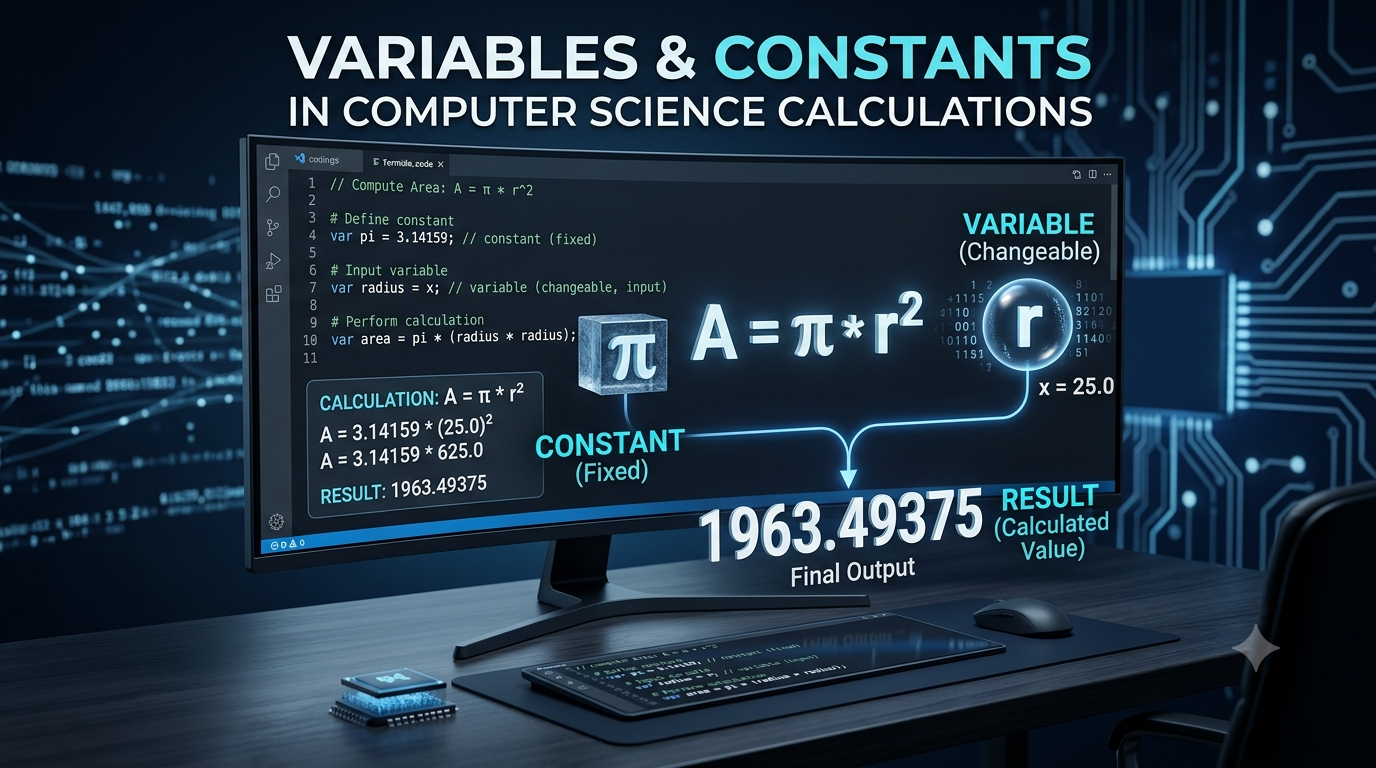
Variables and constants are fundamental concepts in computer science calculations. They help computers store values, perform mathematical operations, process information, and produce results. Whether a program calculates the total price of products, measures the average of several numbers, converts temperatures, or processes scientific data, variables and constants play an important role in determining the final output.
A variable represents a value that can change while a program runs, whereas a constant represents a value that is intended to remain fixed. Both are used in calculations, but they serve different purposes. Understanding how they work helps programmers write accurate, readable, and reliable programs.
In this article, we will explore how variables and constants affect computer science calculations, how they influence results, and why choosing the correct values is essential for successful programming.
What Are Variables in Computer Science?
A variable is a named storage location used to hold a value that a program can access and, when permitted, change. The value stored in a variable may represent a number, a word, a measurement, a Boolean value, or another type of data.
For example, a program that calculates the sum of two numbers can use variables to store the input values and the result.
a = 10
Output:
15In this example, a stores the value 10, b stores the value 5, and total stores the result of adding them together.
If the value of a changes from 10 to 20 and the calculation is performed again, the result becomes 25. This demonstrates how variables influence calculations by providing values that can change.
Variables make programs flexible because the same calculation can be performed with different inputs without rewriting the entire program.
What Are Constants in Computer Science?
A constant is a named value that is intended to remain unchanged throughout a particular part of a program or during its execution. Constants are useful when a calculation requires a fixed value, such as a mathematical constant, a conversion factor, or a predefined rate.
For example, the approximate value of pi can be stored in a constant when calculating the area of a circle.
PI = 3.14159
Output:
78.53975Here, PI represents a fixed mathematical value for the calculation, while radius is a variable that can change.
In Python, uppercase names such as PI are commonly used to indicate constants by convention. However, Python does not automatically prevent a programmer from reassigning such a name. Other programming languages provide different mechanisms for declaring constants and restricting reassignment.
Constants make calculations easier to understand and help prevent accidental changes to important values.
How Variables Affect the Result of a Calculation
Variables directly affect calculation results because their stored values are used in mathematical expressions and logical operations. If a variable changes, the result of a calculation that uses it may also change.
1. Variables determine the input values
Every calculation requires values to process. Variables can store these values and provide them to an expression.
Consider the following example:
length = 8
Output:
32The program calculates the area of a rectangle by multiplying its length by its width.
The formula is:
Area = Length × Width
If the length changes to 10 while the width remains 4, the area becomes 40. Therefore, changing a variable can change the final result.
2. Variables make calculations flexible
A program becomes more useful when it can work with different values. Variables allow the same instructions to process new inputs.
For example:
price = 200
Output:
600If the quantity changes to 5, the total cost becomes 1,000.
The program does not need a new formula for each quantity. It simply uses the updated variable value.
This flexibility is especially useful in calculators, financial applications, scientific simulations, data analysis, and online shopping systems.
3. Variables can influence later calculations
In a program, one calculation may use the result of another calculation. If an earlier variable changes, the values produced by subsequent calculations may also change when those calculations are executed again.
For example:
a = 10
Output:
7.5If a changes to 20 and the statements calculating total and average are executed again, the average becomes 12.5.
This illustrates how variables can influence a chain of calculations.
However, changing a variable does not automatically update every previously calculated value in ordinary procedural code. The relevant statements must run again, or the program must use a mechanism that recalculates the result.
4. Incorrect variable values produce incorrect results
Variables are only useful when they contain appropriate values. If a programmer assigns an incorrect value, the calculation may produce an incorrect answer even when the formula is correct.
For example:
distance = 100
This calculation attempts to divide the distance by zero. In Python, it raises a ZeroDivisionError rather than producing a valid speed.
The correct approach is to check whether the time is greater than zero before performing the division.
distance = 100
Output:
20.0This example shows why programmers must check variable values before using them in calculations.
How Constants Affect the Result of a Calculation
Constants influence calculation results by providing fixed values that remain consistent wherever they are used, unless the program explicitly allows their reassignment.
1. Constants keep important values consistent
Suppose a program calculates the circumference of several circles. The formula requires pi, which is approximately 3.14159.
The formula is:
Circumference = 2 × π × Radius
A program can store the chosen approximation of pi in a constant and reuse it for every circle.
PI = 3.14159
Output:
18.84954Using the same constant helps maintain consistency across calculations. If different approximations of pi were entered manually in different parts of the program, the results could vary unnecessarily.
2. Constants reduce accidental changes
Some values should not be changed casually because doing so could affect many calculations.
For example, a program that converts kilometres into metres can use the conversion factor 1,000.
METRES_PER_KILOMETRE = 1000
Output:
4000The conversion factor represents a fixed relationship between the two units. Keeping it in a clearly named constant helps prevent accidental changes and makes the formula easier to understand.
3. Constants improve readability
A number written directly inside a calculation is sometimes called a magic number when its meaning is not immediately clear.
For example:
total = price * 1.18A reader might not know why the program multiplies the price by 1.18.
A clearer version is:
TAX_MULTIPLIER = 1.18
The constant name communicates the intended purpose of the value, assuming the multiplier represents a total price including an 18% tax.
This improves readability and makes the program easier to maintain. In real applications, tax rates should be selected according to the relevant rules and circumstances rather than assumed to be universally applicable.
4. Incorrect constants can affect many results
Although constants help prevent accidental changes, they can still contain incorrect values.
Suppose a program uses an incorrect conversion factor for kilometres and metres. Every calculation that relies on that constant may produce an incorrect result.
Therefore, constants must be selected carefully, documented when necessary, and updated when the underlying requirements change.
A value being declared constant does not automatically make it correct.
The Difference Between Variables and Constants in Calculations
Variables and constants both provide values for calculations, but their intended roles are different.
| Feature | Variables | Constants |
|---|---|---|
| Main purpose | Store values that may change | Store values intended to remain fixed |
| Value changes | Allowed when the language and declaration permit it | Usually restricted or discouraged |
| Effect on results | Updated values can change later calculations | The same stored value supports consistent calculations |
| Common examples | Price, distance, quantity, radius | Pi, unit conversion factors, fixed configuration values |
| Flexibility | High | Lower by design |
| Main benefit | Supports changing inputs and dynamic calculations | Improves consistency and reduces accidental reassignment |
Consider a circle-area calculation. The radius is a variable because each circle may have a different radius. Pi is a constant because the calculation uses the same mathematical value for every circle.
The formula is:
Area = π × Radius²
If the radius changes, the calculated area changes. If the chosen approximation of pi remains the same, it continues to provide a consistent factor in the calculation.
How Variables and Constants Work Together
Variables and constants are often used together in the same expression. Constants supply fixed values, while variables supply values that may differ from one calculation to another.
Consider a temperature conversion program.
The formula for converting Celsius to Fahrenheit is:
Fahrenheit = (Celsius × 9 / 5) + 32
The values 9, 5, and 32 are fixed in this conversion formula. The Celsius temperature is the variable input.
CELSIUS_SCALE = 9 / 5
Output:
77.0If the Celsius temperature changes to 30, the program calculates 86 degrees Fahrenheit.
The conversion factors remain the same, but the output changes because the input variable changes.
This combination is useful in physics, engineering, mathematics, data processing, and many other areas of computer science.
How Data Types Affect Calculation Results
Variables and constants also have data types, which determine what kinds of values they can represent and how operations behave.
Common numeric data types include integers and floating-point numbers.
1. Integer calculations
An integer represents a whole number without a fractional part.
a = 7
Output:
3In Python, the // operator performs floor division. For these positive numbers, the result is 3 because the fractional part is discarded.
2. Floating-point calculations
Floating-point numbers can represent values with fractional parts.
a = 7
Output:
3.5The / operator in Python performs ordinary division and returns 3.5 in this example.
Choosing the correct data type and operator is important because different operations may produce different results.
3. Precision and rounding
Computers often use finite-precision representations for floating-point numbers. As a result, some decimal values cannot be represented exactly in binary.
For example:
result = 0.1 + 0.2
The displayed output in Python is typically:
0.30000000000000004This small difference occurs because the decimal values 0.1 and 0.2 cannot both be represented exactly as binary floating-point values.
When high precision is required, programmers may need to use suitable numeric types, rounding rules, or decimal arithmetic.
These considerations apply to both variables and constants because either can hold floating-point values.
How Variable Updates and Calculation Order Affect Results
The order in which a program executes operations can affect the final result. Variables may be updated several times, and each update can influence later statements.
Consider this example:
x = 10
Output:
30First, x receives the value 10. The second statement adds 5 to its current value, producing 15. The third statement multiplies the updated value by 2, producing 30.
The expression x = x + 5 is an assignment statement in programming. It does not mean that the two sides are equal as a mathematical equation. Instead, the program calculates the right-hand side and stores the result in x.
Constants, by contrast, are generally not reassigned during normal program execution. Their fixed role helps separate stable values from changing program data.
Understanding execution order is essential when calculations depend on previous results.
Common Mistakes When Using Variables and Constants
Several mistakes can cause inaccurate results or unexpected program behaviour.
1. Using the wrong value
A variable may contain a value that does not match the intended input. Checking inputs and validating data can help prevent this problem.
2. Confusing assignment with comparison
In Python, = assigns a value, while == compares two values. Using the wrong operator can change program behaviour or produce an error.
3. Reassigning important values accidentally
Changing a variable that stores an important intermediate result may affect subsequent calculations. Using meaningful names and keeping related operations organized can reduce confusion.
4. Using unexplained numbers
Writing unexplained numeric values directly in many expressions makes programs harder to understand. Named constants can make their meaning clearer.
5. Ignoring data types
Using an unsuitable type or operator can lead to unexpected results. Programmers should understand whether a calculation requires integers, floating-point values, or another numeric representation.
6. Forgetting to recalculate dependent values
If a variable changes after a result has been calculated, that earlier result may remain unchanged until the calculation is executed again. Programmers should ensure that dependent values are recalculated when needed.
Practical Applications of Variables and Constants
Variables and constants are used in almost every area of computer science.
Financial applications: Variables store prices, quantities, account balances, and transaction amounts. Constants or configuration values may represent fixed conversion factors or predefined calculation rules.
Scientific computing: Variables store experimental measurements, time intervals, distances, and changing simulation values. Constants represent established physical values or fixed parameters selected for a model.
Web development: Variables hold user input, shopping-cart totals, form data, and application state. Constants may define configuration settings or fixed limits.
Game development: Variables track scores, player positions, health points, and elapsed time. Constants can represent fixed movement parameters or predefined game rules.
Data analysis: Variables store observations and calculated results, while constants may represent thresholds or fixed values used in a statistical procedure.
In each case, the quality of the calculation depends on selecting appropriate values, applying the correct formula, and handling data types and updates correctly.
Conclusion
Variables and constants are essential parts of computer science calculations because they determine which values a program uses and how those values contribute to a result. Variables make calculations flexible by allowing inputs and stored values to change. Constants provide consistency by representing values that are intended to remain fixed.
Their effects depend on the formula, data types, operators, and order of execution used in a program. Incorrect inputs, inappropriate constants, precision limitations, and mistakes in updating values can all lead to unexpected results.
By choosing meaningful variable and constant names, validating input values, selecting appropriate data types, and checking calculations carefully, programmers can create accurate, understandable, and reliable programs. Understanding these concepts provides a strong foundation for learning more advanced topics such as algorithms, numerical methods, scientific computing, and software development.
FAQs
1. What is a variable in computer science?
A variable is a named storage location used to hold a value that a program can access and, when permitted, change. Variables can store numbers, text, Boolean values, and other types of data. In calculations, they represent inputs or intermediate results that may change during program execution. For example, a variable named price can store the cost of a product, while another variable named quantity stores the number of products purchased. Multiplying these variables calculates the total cost. Variables make programs flexible because the same calculation can process different values without rewriting the entire program.
2. What is a constant in computer science?
A constant is a named value intended to remain unchanged during a particular part of a program or throughout its execution. Constants are useful for representing fixed mathematical values, conversion factors, and configuration settings. For example, a program can use a constant named PI when calculating the area of a circle. Keeping this value consistent helps avoid accidental changes and makes calculations easier to understand. However, constant enforcement depends on the programming language. In Python, uppercase names indicate constants by convention, but the language does not automatically prevent their reassignment.
3. How do variables affect the result of a calculation?
Variables affect calculation results because their stored values are used in mathematical expressions and operations. When a variable changes, the result of a calculation may also change if that calculation is performed again. For example, multiplying a price of 100 by a quantity of 3 produces a total of 300. If the quantity increases to 5, the total becomes 500. Variables allow programs to work with different inputs dynamically. However, previously calculated results do not automatically update in ordinary procedural code unless the relevant calculation runs again or another mechanism recalculates the result.
4. How do constants affect the accuracy of calculations?
Constants help maintain consistency by providing the same intended value wherever it is used. For example, a program can use a fixed approximation of pi to calculate the areas of different circles. Reusing the same constant prevents inconsistent values from being entered in separate calculations. However, constants do not automatically guarantee accuracy. If a constant contains an incorrect value or an unsuitable approximation, calculations using it may produce incorrect results. Programmers must choose appropriate constants, understand their precision, and verify their values. Accurate calculations require correct inputs, suitable formulas, appropriate data types, and reliable programming logic.
5. What is the main difference between variables and constants?
The main difference is that variables can hold values that change, whereas constants represent values intended to remain fixed. For example, in a circle-area calculation, the radius is a variable because different circles have different radii. Pi is treated as a constant because the same mathematical value is used for each calculation. Variables provide flexibility, while constants support consistency and help reduce accidental reassignment. Both are important in programming because most calculations combine changing inputs with fixed values. Their correct use makes programs easier to understand, maintain, and verify.
6. Can changing a variable affect multiple calculations?
Yes, changing a variable can affect multiple calculations when those calculations use its value and are executed again. For example, a program may use a variable named distance to calculate speed and travel time. If the distance changes, both results may change when recalculated using the updated value. This relationship is common in scientific simulations, financial applications, and data processing. However, an earlier result stored in another variable usually remains unchanged until the program updates it. Programmers must therefore manage dependencies carefully to ensure that related calculations use the correct and current values.
7. How do data types influence variable calculations?
Data types determine what values a variable can represent and how operations involving those values behave. Integers represent whole numbers, while floating-point types represent numbers that can include fractional parts. For example, dividing 7 by 2 using Python’s / operator produces 3.5, whereas 7 // 2 produces 3 because floor division is used. Choosing an inappropriate data type or operator can lead to unexpected results. Floating-point calculations may also involve small precision differences. Programmers should select suitable types and operations based on the mathematical requirements and precision needed for their applications.
8. Why should programmers use named constants instead of unexplained numbers?
Named constants make programs more readable by explaining the purpose of important numerical values. An unexplained number written directly inside an expression is often called a magic number. For example, writing price * 1.18 may leave readers wondering what the multiplier represents. Using a descriptive name such as TAX_MULTIPLIER makes the intention clearer, provided the value is appropriate for the application. Named constants also make maintenance easier because a value can be updated in one defined location. They reduce confusion, improve consistency, and help programmers understand calculations without repeatedly investigating unexplained numbers.
9. What happens when a variable contains an incorrect value?
When a variable contains an incorrect value, a calculation may produce an incorrect result even if its formula is mathematically correct. For example, entering a distance in metres when a program expects kilometres can produce a result that is incorrect by a factor of 1,000. Some invalid values may also cause errors, such as attempting to divide by zero in Python. Programmers can reduce these problems by validating user input, checking units, setting appropriate limits, and handling exceptional situations. Testing calculations with known examples is another useful method for identifying mistakes before a program is used in practice.
10. How can programmers improve calculations using variables and constants?
Programmers can improve calculations by choosing meaningful names, using constants for values intended to remain fixed, and selecting appropriate data types. They should validate inputs, use correct mathematical formulas, and check whether operations such as division are safe. Calculations that depend on updated variables must also be executed again when necessary. Testing with different inputs helps reveal unexpected results and logical mistakes. In addition, documenting important assumptions and using suitable numerical precision can improve reliability. These practices make programs easier to read, maintain, and troubleshoot while helping ensure that calculations produce results appropriate to their intended purpose.