Matrices are an important mathematical tool used in many areas of computer science. They provide a convenient way to organize numbers, represent relationships between data points, and perform calculations on large amounts of information. Although matrices are introduced in mathematics, their applications extend far beyond the classroom. They are used in computer graphics, machine learning, computer vision, data analysis, robotics, scientific computing, and many other fields.
To work effectively with matrices, it is important to understand a few basic operations. Addition, subtraction, scalar multiplication, matrix multiplication, transposition, and related operations form the foundation for many more advanced techniques. Once these operations are understood, it becomes easier to see how computers use matrices to transform data and solve practical problems.
This article explains the basic matrix operations commonly used in computer science in a simple and structured way.
What Is a Matrix?
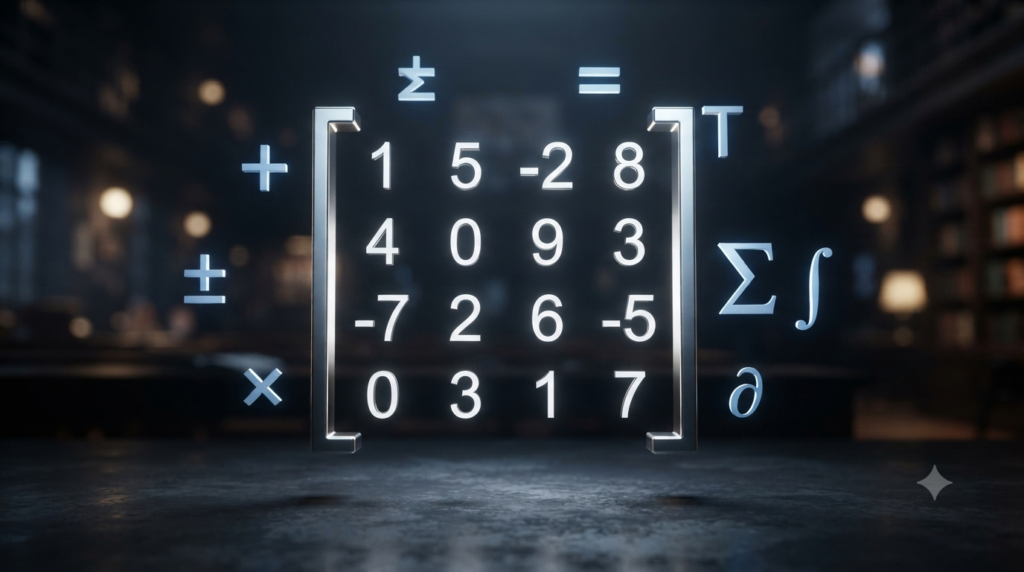
A matrix is a rectangular arrangement of numbers, symbols, or other values organized into rows and columns.
For example, consider the following matrix:
A = [ 2 4 6
This matrix has 2 rows and 3 columns, so its order is 2 × 3.
The individual values inside a matrix are called elements or entries. Each element has a position identified by its row and column.
For example, in matrix A:
A₁₁ = 2
The first number represents the row, while the second represents the column.
Matrices are especially useful in computer science because computers naturally work with structured collections of data. A matrix can store numerical information in a form that is convenient for algorithms and calculations.
Why Are Matrix Operations Important in Computer Science?
Matrix operations allow computers to manipulate structured data efficiently. Instead of processing every value independently, a mathematical operation can be applied to an entire matrix or a large portion of it.
Matrices are commonly used for:
Representing images as numerical data
Transforming objects in computer graphics
Representing datasets in machine learning
Storing relationships between objects
Performing calculations in neural networks
Processing signals and scientific data
Representing transformations in robotics
Solving systems of equations
Working with computer vision algorithms
Understanding basic matrix operations therefore provides a foundation for several important areas of computer science.
Matrix Addition
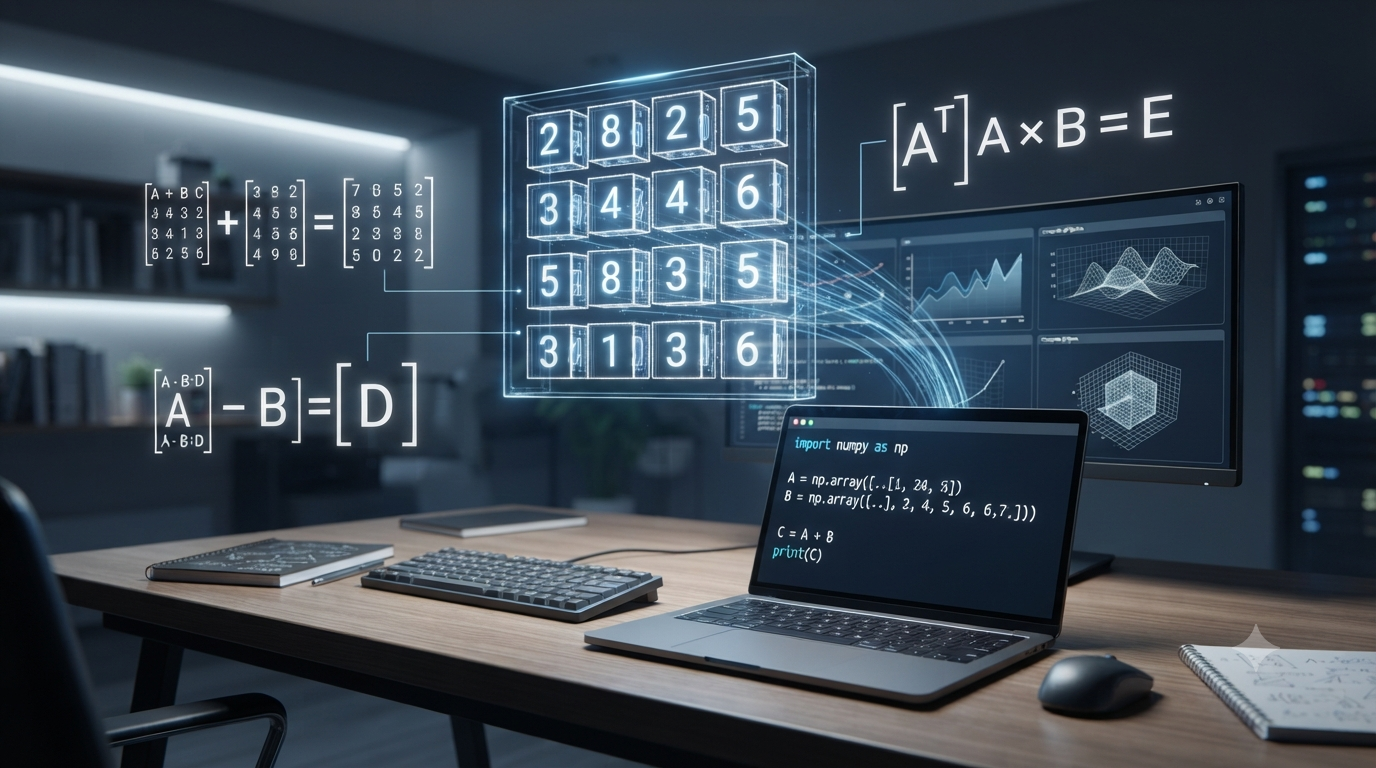
Matrix addition is one of the simplest matrix operations.
Two matrices can be added only when they have the same dimensions. This means they must contain the same number of rows and the same number of columns.
Suppose we have:
A = [ 2 4
To add A and B, corresponding elements are added:
A + B = [ 2+5 4+2
Therefore:
A + B = [ 7 6
The important rule is:
Add corresponding elements of matrices with the same dimensions.
Matrix addition is useful when combining numerical information represented in the same structure. For example, computer programs may use matrix addition when combining data from different sources or updating numerical representations.
Matrix Subtraction
Matrix subtraction works in a similar way to matrix addition.
The matrices must have the same dimensions, and corresponding elements are subtracted.
For example:
A = [ 8 6
Then:
A − B = [ 8−3 6−2
So:
A − B = [ 5 4
Matrix subtraction can be useful when calculating differences between datasets, states, images, or other numerical representations.
Scalar Multiplication
A scalar is a single number. Scalar multiplication means multiplying every element of a matrix by the same number.
For example:
A = [ 2 3
If we multiply A by 3:
3A = [ 3×2 3×3
The result is:
3A = [ 6 9
Scalar multiplication is useful when changing the scale or magnitude of numerical data.
In computer graphics, for example, scaling operations can change the size of an object. In data processing, multiplying a matrix by a scalar can adjust the magnitude of its values.
Matrix Multiplication
Matrix multiplication is one of the most important operations in computer science.
Unlike addition and subtraction, two matrices do not need to have the same dimensions to be multiplied. However, their dimensions must satisfy a specific rule.
If matrix A has dimensions m × n and matrix B has dimensions n × p, then A × B is possible, and the resulting matrix has dimensions:
m × p
For example:
A = [ 1 2
To calculate the first element of the result, multiply the first row of A by the first column of B:
(1 × 5) + (2 × 7) = 19
The second element is:
(1 × 6) + (2 × 8) = 22
Continuing this process gives:
A × B = [ 19 22
Matrix multiplication is extremely important because it allows multiple mathematical transformations and relationships to be combined.
It is widely used in machine learning, computer graphics, neural networks, robotics, and scientific computing.
The Order of Matrix Multiplication Matters
Matrix multiplication generally does not follow the same commutative rule as ordinary numbers.
For ordinary numbers:
2 × 3 = 3 × 2
But for matrices:
A × B ≠ B × A
in general.
Sometimes one of these multiplications may not even be possible because the dimensions do not match.
This is an important concept in computer science because the order in which transformations or calculations are performed can change the final result.
For example, in computer graphics, applying one transformation before another can produce a different position or orientation than applying them in the opposite order.
Matrix Transpose
The transpose of a matrix is created by changing its rows into columns and its columns into rows.
Suppose:
A = [ 1 2 3
This matrix has 2 rows and 3 columns.
Its transpose, written as Aᵀ, is:
Aᵀ = [ 1 4
The original matrix is 2 × 3, while its transpose is 3 × 2.
Transposition is frequently used in computer science when changing the orientation of data. It is also an important operation in machine learning, statistics, numerical computing, and linear algebra.
Identity Matrix
An identity matrix is a square matrix with 1s along the main diagonal and 0s everywhere else.
For example, a 3 × 3 identity matrix is:
I = [ 1 0 0
The identity matrix behaves similarly to the number 1 in ordinary multiplication.
For a compatible matrix A:
A × I = A
and:
I × A = A
Identity matrices are important in algorithms involving matrix multiplication, transformations, systems of equations, and inverse matrices.
Matrix Operations in Computer Graphics
Computer graphics is one of the clearest examples of how matrices are used in computer science.
Objects in a digital scene can be represented using coordinates. Matrices can then be used to transform these coordinates.
Common transformations include:
Translation
Rotation
Scaling
Reflection
Shearing
For example, a rotation matrix can be used to rotate the coordinates of an object. A scaling matrix can increase or decrease its size.
Modern graphics systems perform enormous numbers of these calculations. Matrices make it possible to represent and combine these transformations efficiently.
Matrix Operations in Machine Learning
Matrices are fundamental to machine learning.
A dataset can often be represented as a matrix in which:
Rows represent individual observations
Columns represent features
For example, a dataset containing information about houses might use columns for:
Area | Bedrooms | Age | Price
Each row could represent one house.
Machine learning algorithms perform mathematical operations on these matrices to identify patterns and make predictions.
Neural networks rely heavily on matrix multiplication. During a forward pass, input data is multiplied by weight matrices, and additional calculations are performed to produce an output.
Because modern machine learning models may contain millions or billions of numerical parameters, efficient matrix operations are essential.
Matrix Operations in Computer Vision
Images can also be represented using matrices.
A grayscale image can be represented as a matrix in which each element corresponds to the intensity of a pixel.
For example:
[ 0 50 120
Each number represents a pixel intensity.
Image-processing algorithms can perform mathematical operations on these matrices to detect edges, modify brightness, sharpen images, or identify patterns.
Color images usually require multiple matrices or a multidimensional numerical structure because each pixel contains information for different color channels.
Matrix Operations in Robotics
Robotics also makes extensive use of matrices.
A robot needs to calculate the position and orientation of its parts in three-dimensional space. Transformation matrices can represent movements and rotations.
When several robot joints move together, their transformations can be combined through matrix multiplication.
This allows a computer to calculate where a robot arm, tool, or sensor is located.
These calculations are important in robotic control, navigation, automation, and computer-assisted manufacturing.
Matrix Operations in Data Representation
Matrices can represent relationships between objects as well.
For example, a matrix can represent connections between computers in a network. Another matrix can describe relationships between users, products, or other entities.
A numerical representation makes it possible for algorithms to analyze these relationships efficiently.
This idea is used in areas such as network analysis, recommendation systems, graph algorithms, and data science.
Common Matrix Operations at a Glance
The most important basic matrix operations include:
| Operation | Basic Idea | Main Requirement |
|---|---|---|
| Addition | Add corresponding elements | Same dimensions |
| Subtraction | Subtract corresponding elements | Same dimensions |
| Scalar multiplication | Multiply every element by one number | Any compatible matrix |
| Matrix multiplication | Multiply rows by columns | Inner dimensions must match |
| Transpose | Convert rows into columns | No special dimension requirement |
| Identity operation | Uses the identity matrix | Compatible square matrix |
These operations form the foundation for many more advanced matrix techniques.
Important Rules to Remember
When working with matrices, several rules are especially important.
First, matrix addition and subtraction require matrices with the same dimensions.
Second, matrix multiplication requires the number of columns in the first matrix to equal the number of rows in the second matrix.
Third, matrix multiplication is generally not commutative. In other words, changing the order of multiplication can change the result.
Fourth, transposition changes the dimensions of a matrix. A matrix with dimensions m × n becomes n × m after transposition.
Finally, matrix operations should always be performed carefully because the arrangement of rows and columns has mathematical meaning.
Why Learning Matrix Operations Matters
Matrix operations may initially appear to be simple mathematical procedures, but they provide the foundation for many computational techniques.
A programmer working with machine learning may use matrix multiplication to process model inputs. A graphics programmer may use matrices to rotate and scale objects. A computer vision system may process images as numerical matrices. A robotics system may use transformation matrices to calculate the position of a robotic arm.
The same basic mathematical operations therefore appear in many different areas.
Learning these operations also makes it easier to understand more advanced topics such as determinants, inverse matrices, eigenvalues, linear transformations, vector spaces, and numerical algorithms.
Conclusion
Basic matrix operations are an essential part of the mathematical foundation of computer science. Matrix addition, subtraction, scalar multiplication, matrix multiplication, and transposition provide the tools needed to manipulate structured numerical data.
Their importance becomes especially clear in practical applications. Computer graphics uses matrices for transformations, machine learning uses them to process data and model parameters, computer vision uses them to represent images, and robotics uses them to calculate movement and position.
Understanding the rules behind these operations is therefore more important than simply memorizing formulas. Once the basic ideas become familiar, matrices become a powerful way to understand how computers represent, transform, and process numerical information.
FAQs
1. What are basic matrix operations in computer science?
Basic matrix operations are mathematical procedures used to manipulate matrices and the numerical data stored inside them. The most common operations include matrix addition, subtraction, scalar multiplication, matrix multiplication, and transposition. These operations allow computers to organize, transform, combine, and analyze structured numerical information efficiently. Matrices are widely used in machine learning, computer graphics, computer vision, robotics, data science, and scientific computing. Understanding basic matrix operations provides a foundation for more advanced topics such as linear transformations, inverse matrices, determinants, and eigenvalues. Learning these operations also helps explain how many computer algorithms process numerical data.
2. What is matrix addition?
Matrix addition is an operation in which corresponding elements of two matrices are added together. The matrices must have the same dimensions for addition to be possible. For example, if two matrices both contain two rows and three columns, each element in the first matrix is added to the element in the same position in the second matrix. The result is another matrix with the same dimensions. Matrix addition is useful in computer science when combining numerical data represented in the same structure. It can appear in data processing, machine learning calculations, image processing, and scientific computing.
3. What is matrix subtraction?
Matrix subtraction involves subtracting corresponding elements of one matrix from another. Like matrix addition, subtraction requires both matrices to have the same number of rows and columns. Each element is compared with the element in the corresponding position, and the difference is stored in a new matrix. Matrix subtraction can be useful for finding differences between datasets, images, numerical states, or other structured information. For example, computer programs may use matrix subtraction to compare two numerical representations and determine how their values differ. It is one of the simplest matrix operations and provides an important foundation for computational mathematics.
4. What is scalar multiplication of a matrix?
Scalar multiplication means multiplying every element of a matrix by a single number called a scalar. For example, if a matrix contains the values 2, 4, 6, and 8 and it is multiplied by 3, every element is multiplied by 3. The resulting matrix has the same dimensions as the original matrix. Scalar multiplication is useful for changing the magnitude or scale of numerical data. In computer science, it can appear in graphics transformations, machine learning calculations, numerical analysis, and data processing. It is a straightforward operation but forms an important part of more advanced matrix calculations.
5. What is matrix multiplication?
Matrix multiplication is an operation in which rows of one matrix are multiplied with columns of another matrix to produce a new matrix. Unlike matrix addition, the two matrices do not need to have the same dimensions. However, the number of columns in the first matrix must equal the number of rows in the second matrix. Matrix multiplication is extremely important in computer science because it is used in machine learning, neural networks, computer graphics, robotics, computer vision, and scientific computing. Many complex computational processes can be represented as a sequence of matrix multiplications, making this operation fundamental to modern numerical computing.
6. Why is matrix multiplication important in computer science?
Matrix multiplication is important because it provides an efficient way to perform many calculations involving structured numerical data. In machine learning, it is used to combine input data with model weights. In neural networks, repeated matrix operations help transform information between layers. In computer graphics, matrix multiplication can combine transformations such as rotation and scaling. Robotics systems also use it to calculate positions and orientations. Matrix multiplication is therefore not just a mathematical concept; it is a practical computational operation used by many algorithms and software systems. Efficient matrix multiplication is especially important when working with large datasets and complex models.
7. What is the transpose of a matrix?
The transpose of a matrix is created by changing its rows into columns and its columns into rows. The transpose is commonly represented using the symbol T as a superscript, such as Aᵀ. For example, a matrix containing two rows and three columns becomes a matrix containing three rows and two columns after transposition. Transposition is useful in many areas of computer science, including machine learning, statistics, data analysis, and numerical computing. It can change the orientation of structured data and is often used when arranging matrices for mathematical operations. Understanding transposition is important for working with more advanced matrix calculations.
8. How are matrices used in computer graphics?
Matrices are widely used in computer graphics to represent and perform transformations on objects. A graphics system can use matrices to translate, rotate, scale, reflect, or otherwise transform an object’s coordinates. Several transformations can also be combined using matrix multiplication. For example, a three-dimensional object can be rotated and then scaled using a sequence of transformation matrices. Graphics software and hardware perform these calculations extremely frequently when rendering scenes. Matrices therefore provide an efficient mathematical framework for manipulating objects and their positions in two-dimensional and three-dimensional environments, making them an essential part of modern computer graphics.
9. How are matrices used in machine learning?
Matrices are fundamental to machine learning because many datasets and model parameters can be represented numerically using matrices. A dataset may have rows representing individual observations and columns representing features. Machine learning algorithms then perform mathematical operations on this data to identify patterns and generate predictions. Neural networks make particularly extensive use of matrix multiplication. Input values are multiplied by weight matrices, and the resulting values are processed through different layers of the network. Because modern machine learning models can contain very large numbers of parameters, efficient matrix operations are essential for training and running many artificial intelligence systems.
10. Why should beginners learn matrix operations?
Beginners should learn matrix operations because matrices provide a foundation for understanding many important areas of mathematics and computer science. Basic operations such as addition, subtraction, scalar multiplication, multiplication, and transposition are used in machine learning, computer graphics, computer vision, robotics, data science, and scientific computing. Learning the rules behind these operations also prepares students for advanced topics such as determinants, inverse matrices, eigenvalues, vectors, and linear transformations. More importantly, matrix operations help explain how computers represent and manipulate structured numerical information. A strong understanding of the basics makes advanced computational concepts much easier to understand.