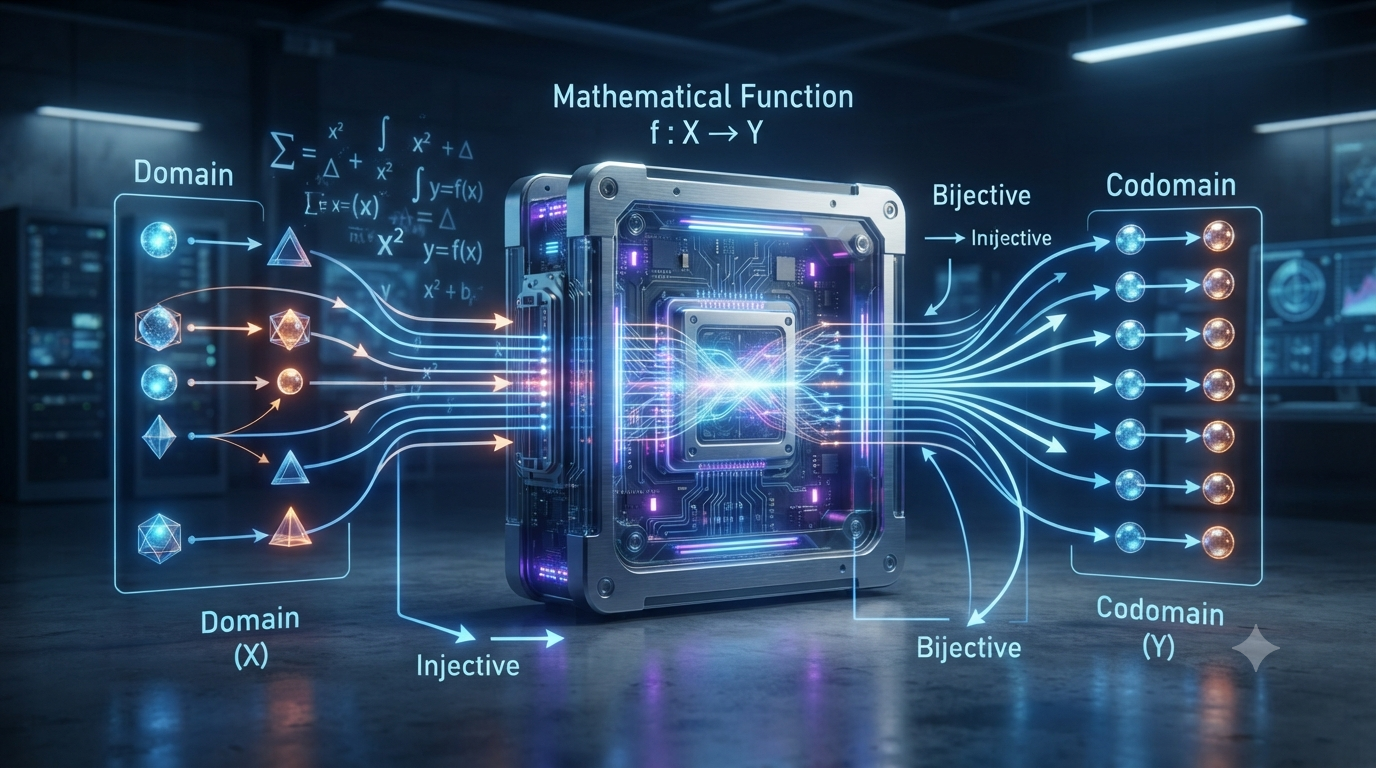
Functions and mappings are fundamental mathematical concepts that play an important role in computer science. They provide a precise way to describe how one set of values is related to another set of values. Whenever a computer takes an input and produces an output, the idea of a function is often involved.
In mathematics, a function defines a relationship between elements of two sets. In computer science, this idea appears in programming functions, algorithms, databases, data structures, cryptography, artificial intelligence, computer graphics, and many other areas. Understanding functions and mappings therefore helps build a strong mathematical foundation for studying computer science.
A function can be thought of as a rule that accepts an input and produces exactly one corresponding output. For example, a function that doubles a number can be written as f(x) = 2x. If the input is 5, the output is 10. Although this example is simple, the same basic idea is used to describe much more complex computational processes.
What Is a Function?
A function is a mathematical relationship in which every allowed input is associated with exactly one output.
Suppose there are two sets, A and B. A function from A to B is written as:
f: A → B
This means that function f maps elements of set A to elements of set B.
Here, set A is called the domain, and set B is called the codomain.
For example:
A = {1, 2, 3, 4}
B = {2, 4, 6, 8, 10}
Consider the function:
f(x) = 2x
The mapping is:
Each element of A has exactly one output in B. Therefore, this relationship is a function.
The important rule is that one input cannot produce two different outputs within the same function.
For example, if we have:
this does not describe a function because the input 1 has two different outputs.
What Is a Mapping?
The word mapping is often used to describe the process of assigning elements from one set to elements of another set.
A mapping can be represented as:
f: A → B
The function takes an element from A and maps it to an element of B.
For example:
A = {a, b, c}
B = {1, 2, 3}
A mapping could be:
This can be represented using arrows between the two sets.
In many mathematical contexts, the terms function and mapping are used almost interchangeably. A mapping emphasizes the assignment or correspondence between sets, while a function emphasizes the mathematical rule that determines the output.
Domain, Codomain, and Range
Three important terms associated with functions are domain, codomain, and range.
Domain
The domain is the set of all valid input values for a function.
For example, consider:
f(x) = x²
If the function accepts all real numbers, then its domain is the set of real numbers.
In computer science, the domain can represent the possible inputs accepted by a program, algorithm, or data-processing operation.
Codomain
The codomain is the set that contains the possible output values specified for the function.
If:
f: A → B
then A is the domain and B is the codomain.
The codomain does not necessarily contain only the outputs that actually occur. It represents the larger set in which the outputs are defined.
Range
The range is the set of actual output values produced by the function.
For example, consider:
f(x) = x²
with domain:
A = {-2, -1, 0, 1, 2}
The outputs are:
4, 1, 0, 1, 4
Therefore, the range is:
{0, 1, 4}
The distinction between codomain and range becomes especially useful when studying different types of functions.
Types of Functions
Functions can be classified in several ways depending on how elements of the domain correspond to elements of the codomain.
One-to-One Function
A one-to-one function, also called an injective function, maps different input values to different output values.
For example:
f(x) = 2x + 1
For different inputs, the outputs are different.
Suppose:
No two different inputs produce the same output.
In computer science, one-to-one relationships can be useful when unique identifiers or reversible relationships are required.
Many-to-One Function
A many-to-one function allows multiple inputs to produce the same output.
For example:
f(x) = x²
Consider:
Two different inputs produce the same output.
This is still a valid function because each individual input has only one output.
Many-to-one relationships are common in computer science. For example, different pieces of input data may be grouped into the same category or mapped to the same classification.
Onto Function
An onto function, also called a surjective function, is a function in which every element of the codomain has at least one corresponding element in the domain.
Suppose:
A = {1, 2, 3}
and:
B = {a, b}
If the mapping is:
both elements of B are used. Therefore, the function is onto.
The important point is that every codomain element must be reached by at least one input.
Into Function
An into function is a function in which at least one element of the codomain is not mapped to by any element of the domain.
For example:
A = {1, 2}
B = {a, b, c}
with:
The element c is not an output. Therefore, the function is into.
Bijective Function
A function is bijective when it is both one-to-one and onto.
This means that every input corresponds to exactly one output and every element of the codomain is used exactly once.
For example:
A = {1, 2, 3}
B = {a, b, c}
with:
This function is both injective and surjective, so it is bijective.
Bijective functions are particularly important because they have an inverse function.
Function Notation
Functions are commonly represented using notation such as:
f(x) = 3x + 2
Here, f is the name of the function, x represents the input, and 3x + 2 is the rule used to calculate the output.
For example:
f(2) = 3(2) + 2
Therefore:
f(2) = 8
The notation clearly separates the input from the rule used to generate the output.
In computer science, this resembles the idea of calling a function with an argument and receiving a return value.
For example, a programming function might accept a number and return its square. Mathematically, this can be represented as:
f(x) = x²
The mathematical notation provides a simple way to describe the behavior of the operation.
Functions and Computer Programming
The concept of mathematical functions is closely related to functions in programming.
A programming function usually accepts one or more inputs, performs a set of operations, and may return an output.
For example, conceptually:
Input → Function → Output
If a function calculates the square of a number:
5 → square function → 25
The mathematical and programming ideas are not exactly identical, but they share an important principle: an input is processed according to a defined rule to produce an output.
Mathematical functions are especially useful for understanding how algorithms transform data.
Functions in Algorithms
Algorithms frequently transform one form of data into another.
For example, an algorithm may take a list of numbers as input and return the largest number.
This process can be viewed as a function:
f(data) → result
Similarly, a sorting algorithm can be considered as a transformation from one arrangement of data to another arrangement.
For example:
[5, 2, 8, 1] → [1, 2, 5, 8]
Thinking about algorithms as functions helps computer scientists reason about inputs, outputs, correctness, and expected behavior.
Functions in Databases
Functions and mappings also appear in databases.
A database may contain a collection of records where one attribute is associated with another.
For example, a student ID may be mapped to a student record.
Student ID → Student Record
If every student ID uniquely identifies one student, the relationship has a function-like structure.
Database keys and relationships can therefore be understood more clearly when the concepts of mappings and functions are familiar.
Functions in Cryptography
Cryptography uses mathematical transformations to protect information.
An encryption process can be represented conceptually as:
Plaintext → Encryption Function → Ciphertext
A decryption process reverses the transformation:
Ciphertext → Decryption Function → Plaintext
Many cryptographic systems depend on carefully designed mathematical functions and transformations.
Understanding functions therefore provides useful background for studying encryption, hashing, digital signatures, and related areas of computer security.
Functions in Artificial Intelligence and Machine Learning
Functions are also central to artificial intelligence and machine learning.
A machine learning model can be viewed as a function that takes input data and produces an output.
For example:
Input features → Model → Prediction
A model might take information about an image and produce a predicted category.
Similarly, a mathematical function can represent the relationship between input variables and predicted values.
Although modern machine learning models can be extremely complex, the fundamental idea of mapping inputs to outputs remains important.
Composition of Functions
Sometimes the output of one function becomes the input of another function. This process is called function composition.
Suppose:
f(x) = 2x
and:
g(x) = x + 3
The composition of the functions can be written as:
g(f(x))
First, apply f:
f(x) = 2x
Then use that result as the input to g:
g(2x) = 2x + 3
Therefore:
g(f(x)) = 2x + 3
Function composition is useful in computer science because complex processes are often constructed by combining smaller operations.
A data-processing pipeline, for example, may apply several transformations one after another.
Inverse Functions
An inverse function reverses the effect of a function.
If:
f(x) = x + 5
then the function adds 5 to the input.
Its inverse subtracts 5:
f⁻¹(x) = x – 5
For a function to have a proper inverse over the relevant sets, it generally needs to be bijective.
The idea of reversing a transformation is important in many areas of computer science, including reversible data transformations, cryptography, encoding, and decoding.
Functions and Sets in Computer Science
Set theory and functions work closely together.
A function describes how elements of one set relate to elements of another set. This makes functions useful for formally describing computational structures.
For example:
Set of users → Set of user IDs
or:
Set of files → Set of file sizes
or:
Set of inputs → Set of outputs
These relationships allow computer scientists to describe systems precisely rather than relying only on informal explanations.
Why Functions and Mappings Matter in Computer Science
Functions and mappings provide a mathematical language for describing transformations and relationships.
They help computer scientists understand:
How inputs are related to outputs
How algorithms transform data
How programming functions behave
How sets and data structures are related
How databases represent relationships
How cryptographic transformations work
How machine learning models produce predictions
How complex processes can be composed from smaller operations
How transformations can sometimes be reversed
How computational systems can be described formally
Learning these concepts also makes more advanced topics easier to understand. Subjects such as discrete mathematics, algorithms, data structures, automata theory, graph theory, probability, and theoretical computer science frequently use functions and mappings.
Simple Example of a Function Mapping
Consider two sets:
A = {1, 2, 3, 4}
B = {10, 20, 30, 40}
Define the function:
f(x) = 10x
The mapping is:
Every element in A has exactly one corresponding element in B.
The function is one-to-one because no two inputs have the same output. It is also onto because every element of B is used.
Therefore, this mapping is bijective.
This simple example demonstrates the basic structure behind many more complicated mathematical and computational transformations.
Conclusion
Functions and mappings are essential concepts in computer science mathematics because they provide a clear way to describe relationships between inputs and outputs. A function assigns exactly one output to every valid input, while a mapping describes the correspondence between elements of sets.
Understanding domain, codomain, range, injective functions, surjective functions, bijective functions, composition, and inverse functions creates a strong foundation for studying computer science. These concepts appear in programming, algorithms, databases, cryptography, artificial intelligence, and many other fields.
The most important idea to remember is simple: a function describes how inputs are systematically transformed into outputs. Once this idea is understood, many mathematical and computational systems become easier to describe, analyze, and understand.
FAQs
1. What is a function in computer science mathematics?
A function is a mathematical relationship that assigns exactly one output to every valid input. It is commonly written as f: A → B, where A is the domain and B is the codomain. For example, if f(x) = 2x, an input of 5 produces an output of 10. Functions are important in computer science because many computational processes can be understood as transformations from inputs to outputs. Programming functions, algorithms, data processing, and mathematical models often follow this basic idea. Understanding functions helps explain how data is transformed and how computational operations behave.
2. What is a mapping in mathematics?
A mapping describes how elements of one set correspond to elements of another set. If f: A → B, the mapping shows how elements of set A are assigned to elements of set B. For example, if A = {1, 2, 3} and B = {10, 20, 30}, a mapping could be 1 → 10, 2 → 20, and 3 → 30. In many mathematical contexts, mapping and function are closely related terms. Mappings are useful in computer science for representing relationships between data, transformations, identifiers, database records, and computational inputs and outputs.
3. What are the domain, codomain, and range of a function?
The domain is the set of all valid inputs of a function. The codomain is the set in which the outputs are defined. The range is the set of actual outputs produced by the function. For example, consider f(x) = x² with domain {-2, -1, 0, 1, 2}. The outputs are 4, 1, 0, 1, and 4, so the range is {0, 1, 4}. The codomain could be a larger set containing these values. Understanding these three concepts is important when analyzing functions, mappings, algorithms, and mathematical models.
4. What is a one-to-one function?
A one-to-one function, also called an injective function, is a function in which different input values produce different output values. In other words, no two different elements of the domain are mapped to the same element of the codomain. For example, consider f(x) = 2x + 1. The inputs 1, 2, and 3 produce 3, 5, and 7 respectively. Each output is unique. One-to-one functions are important in computer science when unique relationships are required. They are also useful when studying inverse functions because an injective function does not have different inputs producing the same output.
5. What is a many-to-one function?
A many-to-one function is a function in which two or more different input values can produce the same output. It is still a valid function because each individual input must have exactly one output. For example, f(x) = x² is many-to-one over the real numbers because f(2) = 4 and f(-2) = 4. Different inputs are mapped to the same output. Many-to-one relationships are common in computer science. Different data values may be classified into the same category, grouped together, or transformed into a common result. Understanding this type of mapping helps explain data classification and information processing.
6. What is a bijective function?
A bijective function is a function that is both one-to-one (injective) and onto (surjective). This means every input has a unique output, and every element of the codomain is reached by exactly one input. For example, if A = {1, 2, 3} and B = {a, b, c}, the mapping 1 → a, 2 → b, 3 → c is bijective. Bijective functions are especially important because they have inverse functions. In computer science, bijections are useful when studying reversible transformations, encoding systems, cryptography, permutations, and situations where every item must correspond uniquely to another item.
7. What is function composition?
Function composition occurs when the output of one function becomes the input of another function. If two functions are f and g, their composition can be written as g(f(x)). For example, suppose f(x) = 2x and g(x) = x + 3. First, f transforms x into 2x. Then g adds 3 to that result. Therefore, g(f(x)) = 2x + 3. Function composition is important in computer science because complex processes are often created by combining smaller operations. Data-processing pipelines, algorithms, and mathematical transformations frequently involve several functions applied sequentially.
8. What is an inverse function?
An inverse function reverses the transformation performed by an original function. If a function changes an input into an output, its inverse changes that output back into the original input. For example, consider f(x) = x + 5. The function adds 5, so its inverse is f⁻¹(x) = x – 5, which subtracts 5. A function generally needs to be one-to-one over the relevant domain and codomain to have an inverse function. In computer science, the idea of reversing transformations is useful in encryption and decryption, encoding and decoding, reversible computations, and other processes involving transformations.
9. How are mathematical functions related to programming functions?
Mathematical functions and programming functions share the basic idea of processing inputs according to defined rules to produce outputs. A mathematical function such as f(x) = x² takes an input and produces its square. A programming function can similarly accept a value, perform calculations, and return a result. However, programming functions can also perform actions without returning a mathematical value. Understanding mathematical functions helps programmers reason about inputs, outputs, transformations, and predictable behavior. Functions are fundamental to programming because they allow large programs to be divided into smaller, organized, reusable operations.
10. Why are functions and mappings important in computer science?
Functions and mappings are important because they provide a precise mathematical way to describe relationships and transformations. They help explain how algorithms convert inputs into outputs, how databases connect records, how programs process data, and how mathematical models produce results. Functions are also used in areas such as cryptography, artificial intelligence, machine learning, computer graphics, and theoretical computer science. Concepts such as domain, range, injective functions, surjective functions, bijections, composition, and inverse functions provide a foundation for understanding more advanced topics. Learning functions and mappings therefore strengthens the mathematical reasoning needed to study and analyze computer systems.