Mathematics contains many statements that use symbols, variables, numbers, and operations. Some of these statements are true for every allowed value of the variables, while others are true only for particular values. Although both types may look similar when written as equations, they have very different meanings and uses.
An important example is the difference between a mathematical identity and an equation that is true only for certain values. Understanding this difference helps us work correctly with algebraic expressions, formulas, equations, and mathematical proofs.
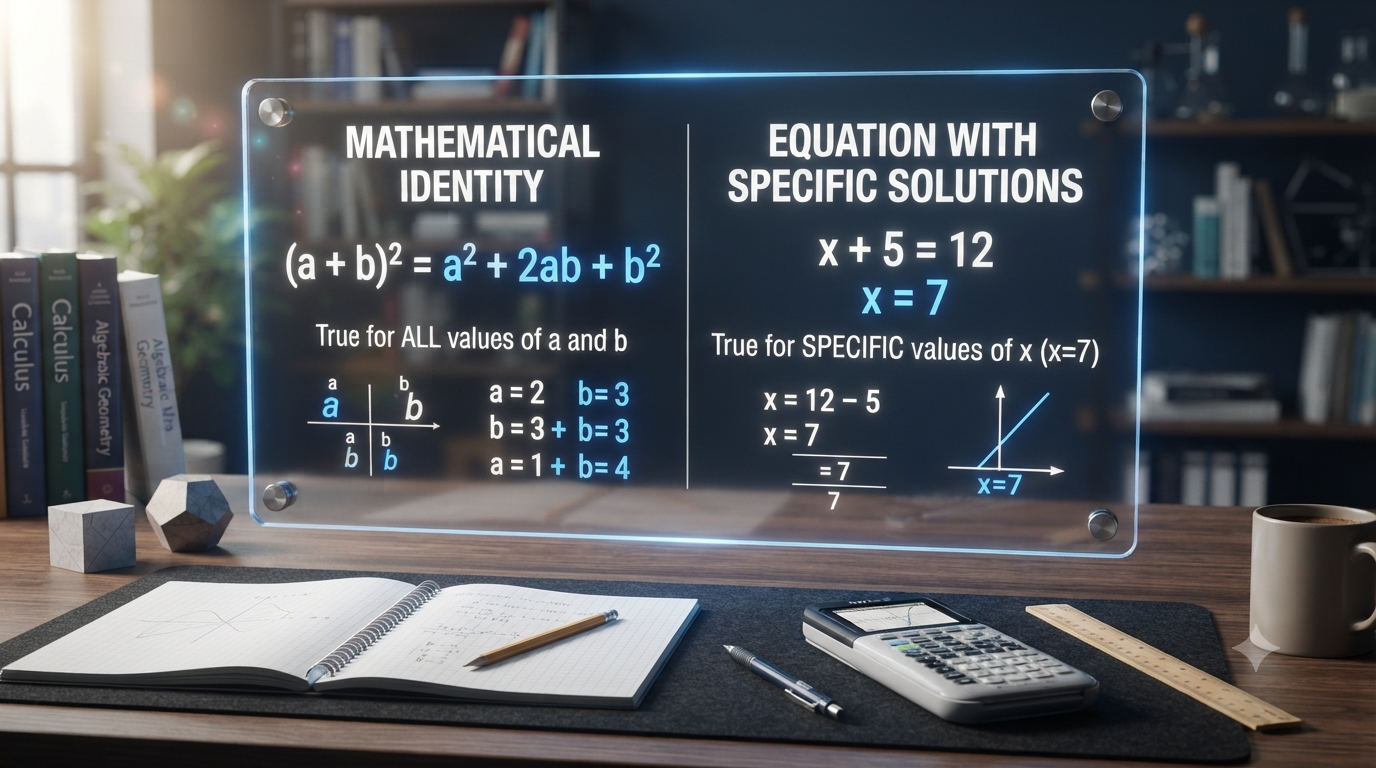
For example, the statement
(a + b)² = a² + 2ab + b²
is true for every value of a and b. It is therefore an identity.
On the other hand,
x + 5 = 12
is true only when x = 7. It is an equation that has a particular solution, not an identity.
The two statements both use an equals sign, but the purpose of the equals sign is different in each case. Let us examine the difference carefully.
What Is a Mathematical Identity?
A mathematical identity is an equality that remains true for all permissible values of its variables.
The word “permissible” is important because some expressions have restrictions. For example,
x/x = 1
is true whenever x ≠ 0, but it is not defined when x = 0. Therefore, the identity is valid over its allowed domain, not literally every possible number.
An identity usually expresses a general mathematical relationship between expressions. It does not require us to find one particular value of a variable.
For example:
2(x + 3) = 2x + 6
This statement is true for every value of x. We can test it using different values.
If x = 1:
Left side = 2(1 + 3) = 8
Right side = 2(1) + 6 = 8
If x = 10:
Left side = 2(10 + 3) = 26
Right side = 2(10) + 6 = 26
The equality continues to hold regardless of which value of x we choose.
That is the essential feature of an identity.
What Is an Equation That Is True Only for Certain Values?
An equation can contain a variable and be true only for particular values of that variable.
Consider:
2x + 6 = 20
This equation is not true for every value of x. We can solve it to find the value that makes both sides equal.
Subtract 6 from both sides:
2x = 14
Divide by 2:
x = 7
When x = 7:
2(7) + 6 = 20
So the equation is true when x = 7.
But if x = 5:
2(5) + 6 = 16
The two sides are not equal.
Therefore, this is not an identity. It is an equation with a specific solution.
The Main Difference Between an Identity and an Equation
The simplest way to distinguish them is to ask:
“For how many values of the variable is the statement true?”
If it is true for all permissible values, it is an identity.
If it is true for only some values, it is an equation or relationship with a restricted set of solutions.
Consider these two examples:
x + x = 2x
This is true for every value of x. It is an identity.
x + 5 = 2x
This is true only when:
x = 5
So the second statement is an equation with one solution.
The appearance of an equals sign does not by itself tell us whether a statement is an identity. We need to consider how widely the equality applies.
Identities Describe General Mathematical Rules
An identity often represents a general rule that can be used repeatedly.
For example:
(x + y)² = x² + 2xy + y²
This identity is valid for all real values of x and y.
It can therefore be used to expand an expression without selecting particular values for the variables.
Suppose we want to expand:
(5 + y)²
Using the identity:
(a + b)² = a² + 2ab + b²
we get:
(5 + y)² = 25 + 10y + y²
The identity provides a general method that works for any value of y.
This is why identities are especially important in algebra. They allow us to transform expressions while preserving their value.
Equations Usually Ask Us to Find Values
An equation often has a different purpose. Instead of providing a rule that is always true, it gives a condition that a variable must satisfy.
For example:
3x + 2 = 17
We solve the equation:
3x = 15
Therefore:
x = 5
The equation tells us which value of x makes the relationship true.
If we substitute x = 5:
3(5) + 2 = 17
The statement is true.
But if x = 4:
3(4) + 2 = 14
The statement is false.
Therefore, the equality describes a condition rather than a universal identity.
An Identity Can Be Used to Simplify Expressions
One important use of identities is simplifying or rewriting expressions.
For example:
a² − b² = (a − b)(a + b)
This is an identity because it is true for all values of a and b for which the expressions are defined.
Suppose:
a = 10 and b = 3
Then:
a² − b² = 100 − 9 = 91
and:
(a − b)(a + b) = (10 − 3)(10 + 3) = 7 × 13 = 91
The two expressions represent the same value.
The identity remains valid if we replace 10 and 3 with other permissible values.
An Equation Can Become an Identity After Simplification
Sometimes an equation that initially looks like a problem to solve turns out to be an identity.
Consider:
2(x + 4) = 2x + 8
Expanding the left side gives:
2x + 8 = 2x + 8
Both sides are identical.
This means the equation is true for every value of x. Therefore, it is an identity.
Now compare:
2(x + 4) = 2x + 10
Expanding gives:
2x + 8 = 2x + 10
Subtracting 2x from both sides gives:
8 = 10
This is never true.
Therefore, this equation has no solution.
This illustrates an important point: simplifying both sides can reveal whether an equation is an identity, has particular solutions, or has no solutions.
An Equation Can Have One or More Solutions
Not every equation that is not an identity has exactly one solution.
For example:
x² = 9
This equation is true when:
x = 3
or:
x = −3
Therefore, it has two solutions.
But it is not an identity because it is not true for every value of x.
For example, if x = 2:
2² = 4
and 4 is not equal to 9.
So the equation is true only for a limited set of values.
Some equations can have one solution, several solutions, infinitely many solutions, or no solutions.
An identity is different because it is true for every value within its permitted domain.
The Difference Between an Identity and a Formula
Identities and formulas can sometimes look very similar.
For example:
A = l × w
is a formula for the area of a rectangle.
It tells us how area is related to length and width.
An identity, such as:
(a + b)² = a² + 2ab + b²
states that two algebraic expressions are equivalent for all permissible values.
A formula is generally used to calculate a quantity from other quantities, while an identity expresses an equality that remains true throughout its domain.
However, the boundary between these terms can depend on context. A mathematical relationship may be described differently depending on how it is being used.
Identities Usually Use an Equality That Is Universally Valid
When we see a statement such as:
sin²θ + cos²θ = 1
we know that it is a trigonometric identity.
It is true for every angle θ for which the functions are defined.
This differs from an equation such as:
sin θ = 1
which is true only for particular angles.
For example:
θ = 90°
is one solution, and other equivalent angles also satisfy the equation.
The first statement gives a general rule. The second asks us to identify values that satisfy a condition.
Domain Restrictions Matter
An identity must always be considered together with the values for which its expressions are defined.
For example:
(x² − 1)/(x − 1) = x + 1
This relationship is true when:
x ≠ 1
because the original expression contains division by x − 1. When x = 1, the denominator becomes zero, so the original expression is undefined.
Therefore, we should not simply say that the identity is true for every value of x. A more accurate statement is:
The identity is true for every permissible value of x, where x ≠ 1.
This is why mathematical identities are always connected to their domains and restrictions.
How to Test Whether a Relationship Is an Identity
There are several ways to determine whether an equality is an identity.
1. Simplify Both Sides
Start by simplifying the expressions on both sides.
For example:
3(x + 2) = 3x + 6
Expanding the left side gives:
3x + 6 = 3x + 6
The two sides are identical, so the relationship is an identity.
2. Compare the Expressions
If both sides simplify to exactly the same expression, the equality is an identity, subject to any domain restrictions.
For example:
x² + 4x + 4 = (x + 2)²
Expanding the right side gives:
x² + 4x + 4
Therefore, both sides are equivalent.
3. Look for Specific Solutions
If solving the equation produces particular values rather than all permissible values, it is not an identity.
For example:
x² − 4 = 0
Factor:
(x − 2)(x + 2) = 0
Therefore:
x = 2 or x = −2
Since the equation is not true for every value of x, it is not an identity.
Why Substitution Alone Cannot Always Prove an Identity
Testing a few values can help us understand an expression, but it does not generally prove that an equality is an identity.
Suppose we have a statement involving x and test:
x = 1, 2, 3, 4
If both sides agree for all four values, that is useful evidence, but it does not establish that they will agree for every possible value.
For example, two expressions might produce the same result for several values and differ for another value.
A mathematical proof of an identity usually requires algebraic reasoning that establishes equality for the entire permitted domain.
Therefore, substitution is useful for checking, but algebraic proof is generally more reliable.
Examples of Common Mathematical Identities
Several identities appear frequently in mathematics.
Square of a Sum
(a + b)² = a² + 2ab + b²
Square of a Difference
(a − b)² = a² − 2ab + b²
Difference of Two Squares
a² − b² = (a − b)(a + b)
Cube of a Sum
(a + b)³ = a³ + 3a²b + 3ab² + b³
Cube of a Difference
(a − b)³ = a³ − 3a²b + 3ab² − b³
Each of these expresses an equality that holds for all permissible values of the variables.
Examples of Relationships That Are True Only for Certain Values
Now consider some ordinary equations.
x + 8 = 15
This is true only when:
x = 7
Another example is:
2x − 4 = 10
This is true only when:
x = 7
Another example is:
x² = 16
This is true when:
x = 4 or x = −4
None of these equations is an identity because the equality does not hold for every value of x.
A Simple Comparison
The difference can be summarized using one pair of examples.
Identity:
x + x = 2x
This is true for every value of x.
Equation:
x + x = 10
This is true only when:
x = 5
The first statement describes a universal algebraic relationship.
The second statement gives a condition that determines a particular value.
Why the Difference Is Important
Understanding identities and equations prevents several common algebraic mistakes.
When working with an identity, we are usually transforming an expression into an equivalent form. The variables remain general.
When solving an equation, we are looking for the values that make the equality true.
For example, if we have:
(x + 3)² = x² + 6x + 9
we do not need to solve for x. The relationship is already true for every value of x.
But if we have:
(x + 3)² = 25
we need to find the values of x that satisfy the equation.
Expanding:
x² + 6x + 9 = 25
Then:
x² + 6x − 16 = 0
Factoring:
(x + 8)(x − 2) = 0
Therefore:
x = −8 or x = 2
The goal here is to find solutions, not to establish a universal identity.
A Useful Way to Remember the Difference
A simple question can help you distinguish the two:
“Does this equality remain true when I replace the variable with any permissible value?”
If the answer is yes, the relationship is an identity.
If the answer is no, and only certain values make the equality true, it is an equation with a restricted solution set.
You can also remember the difference this way:
Identity → true for all permissible values
Equation → true for one or more particular values
This distinction becomes especially useful when studying algebraic identities, equations, functions, formulas, and mathematical proofs.
Conclusion
Mathematical identities and equations that are true only for certain values may look similar because both can contain an equals sign. Their meanings, however, are fundamentally different.
An identity expresses a relationship that remains true for every permissible value of its variables. Examples include (a + b)² = a² + 2ab + b² and a² − b² = (a − b)(a + b).
An equation that is true only for certain values gives a condition that the variables must satisfy. For example, x + 5 = 12 is true only when x = 7.
The key difference is therefore the range of values for which the equality holds. Learning to recognize this difference makes algebraic manipulation, equation solving, and mathematical reasoning much clearer.
FAQs
1. What is a mathematical identity?
A mathematical identity is an equality that remains true for all permissible values of its variables. It describes a general relationship between two mathematical expressions rather than a condition that must be satisfied by particular values. For example, (a + b)² = a² + 2ab + b² is an identity because it remains true regardless of the values assigned to a and b. Mathematical identities are commonly used to expand, factor, simplify, and transform algebraic expressions. When using an identity, we do not normally need to find a specific value of the variable because the relationship is already universally valid within its domain.
2. How is an identity different from an equation?
The main difference is the number of values for which the equality is true. A mathematical identity is true for every permissible value of its variables. An equation, however, may be true only for particular values. For example, x + 5 = 12 is true only when x = 7, so it is an equation with a specific solution. In contrast, 2(x + 3) = 2x + 6 is true for every value of x, making it an identity. Therefore, an identity expresses a universal mathematical relationship, while an equation usually gives a condition that must be satisfied.
3. How can you tell whether an equation is an identity?
You can determine whether an equation is an identity by simplifying both sides and checking whether they become the same expression. For example, consider 3(x + 2) = 3x + 6. Expanding the left side gives 3x + 6, which is exactly the expression on the right side. Therefore, the equation is an identity and is true for every value of x. If simplification instead produces specific values for the variable, the relationship is an ordinary equation rather than an identity. It is important to consider any restrictions on the variables when determining whether an identity holds.
4. Can an identity have restrictions on its variables?
Yes. An identity can have restrictions because some mathematical expressions are not defined for every possible value of a variable. For example, (x² − 1)/(x − 1) = x + 1 is valid when x ≠ 1. At x = 1, the original expression has a denominator of zero and is therefore undefined. Consequently, the identity is true for every permissible value of x, but not at the excluded value. This shows why the phrase “for all permissible values” is important when defining an identity. Domain restrictions must always be considered when working with identities involving fractions, roots, logarithms, or other restricted expressions.
5. Is x² = 9 a mathematical identity?
No. x² = 9 is not a mathematical identity because it is true only for particular values of x. Solving the equation gives x = 3 or x = −3. If we choose another value, such as x = 2, then x² = 4, which is not equal to 9. Therefore, the equality does not hold for every value of x. It is an equation with two solutions. A mathematical identity, by comparison, must remain true for every permissible value of the variable. This distinction helps us understand whether we should simplify an expression or solve for unknown values.
6. Are algebraic identities useful in solving equations?
Yes, algebraic identities can be very useful when solving equations. They allow expressions to be expanded, factored, or rewritten into equivalent forms, which can make an equation easier to solve. For example, the identity a² − b² = (a − b)(a + b) can help factor an equation such as x² − 25 = 0 into (x − 5)(x + 5) = 0. We can then find the solutions x = 5 and x = −5. The identity itself remains true for all permissible values, while the equation uses the resulting factorization to identify particular values that satisfy the given condition.
7. Does an equals sign always mean that an equation is an identity?
No. An equals sign simply indicates that two expressions have equal values under the stated conditions. It does not automatically mean that the relationship is an identity. For example, x + 4 = 10 contains an equals sign but is true only when x = 6. In contrast, x + x = 2x is true for every value of x and is therefore an identity. To determine which type of relationship you have, you need to examine whether the equality holds for all permissible values or only for particular values. The meaning depends on the mathematical relationship, not merely the equals sign.
8. Can an equation have more than one solution without being an identity?
Yes. An equation can have several solutions and still not be an identity. For example, x² = 16 has two solutions: x = 4 and x = −4. However, it is not true for every value of x. For instance, when x = 2, the left side becomes 4 rather than 16. Therefore, the equation is true only for a specific set of values. An identity is different because every permissible value satisfies the equality. Equations can have one solution, multiple solutions, infinitely many solutions, or no solutions, depending on their mathematical structure.
9. Can testing a few values prove that an equation is an identity?
Testing a few values can help check whether a relationship appears to be true, but it generally cannot prove that the relationship is an identity. For example, two expressions might give the same result for several selected values and still differ for another value. To prove an identity, we normally use algebraic manipulation to show that both sides are equivalent for every permissible value. For example, expanding (x + 2)² gives x² + 4x + 4, proving that (x + 2)² = x² + 4x + 4 is an identity. Algebraic proof establishes the relationship generally rather than experimentally.
10. Why is it important to understand the difference between identities and equations?
Understanding the difference helps you know what mathematical task you are performing. When working with an identity, you usually transform or simplify an expression while preserving its value for all permissible variable values. When solving an equation, your goal is usually to find the particular values that make the equality true. For example, (x + 3)² = x² + 6x + 9 is an identity, while x + 3 = 10 requires solving for x = 7. Recognizing the difference prevents incorrect methods and makes algebraic reasoning clearer. It is especially important when studying formulas, identities, equations, factoring, and mathematical proofs.