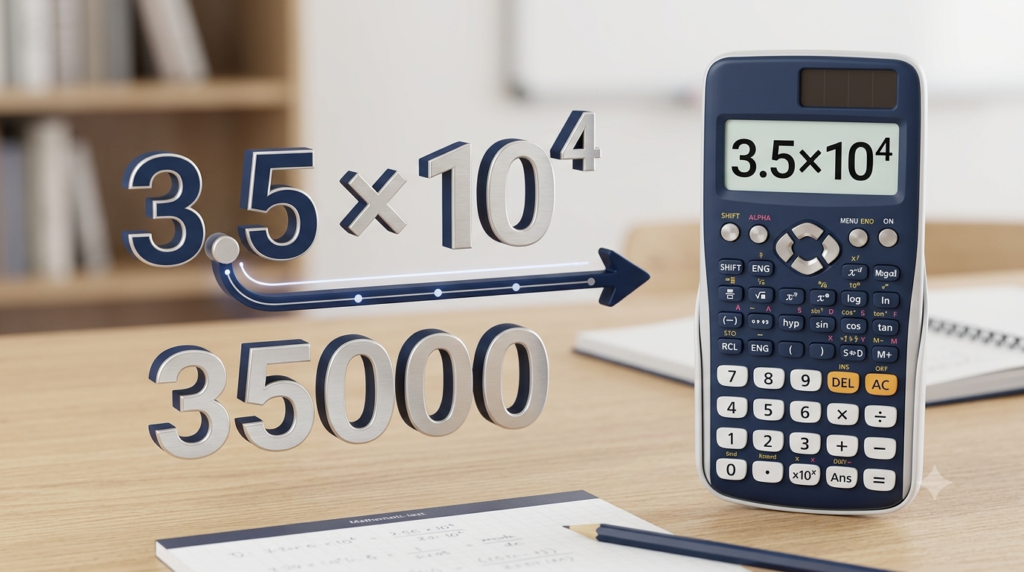
Scientific Notation Calculator
Convert decimal numbers into scientific notation or convert scientific notation into decimal form.
a × 10ⁿ
a is the coefficient and n is the integer exponent.
Example: 450000 = 4.5 × 10⁵
Small number: 0.00072 = 7.2 × 10⁻⁴
Tip: For a nonzero number in normalized scientific
notation, the absolute value of the coefficient is at least 1 and
less than 10.
A Scientific Notation Calculator is an online tool that helps you convert very large and very small numbers into scientific notation or change scientific notation back into decimal form. It makes working with numbers easier, especially when dealing with scientific measurements, mathematical calculations, physics problems, chemistry equations, and astronomical distances.
Scientific notation is a standard way of expressing numbers using a coefficient and a power of 10. Instead of writing a long number with many zeros, you can represent it in a shorter and more manageable form. For example, 1,500,000 can be written as 1.5 × 10⁶, while 0.00042 can be written as 4.2 × 10⁻⁴.
Our Scientific Notation Calculator allows you to perform these conversions quickly without manually counting decimal places. You can enter a decimal number to obtain its scientific notation or provide a coefficient and exponent to convert a scientific notation expression into a decimal number.
This tool is useful for students, teachers, researchers, science enthusiasts, and anyone who regularly works with large or small numerical values.
What Is a Scientific Notation Calculator?
A Scientific Notation Calculator is an online calculator designed to convert numbers between decimal form and scientific notation. It simplifies numerical expressions and helps users work with values that may otherwise be difficult to read or write.
For example, consider the number 850,000,000. Writing this number requires several digits and zeros. In scientific notation, the same number becomes 8.5 × 10⁸.
Similarly, a very small number such as 0.0000063 can be expressed as 6.3 × 10⁻⁶.
The calculator performs these conversions automatically. You do not need to count the zeros or determine the position of the decimal point manually.
Depending on the conversion you need, you can use the calculator in two ways:
Decimal to scientific notation: Enter an ordinary decimal number to convert it into scientific notation.
Scientific notation to decimal: Enter the coefficient and exponent to obtain the corresponding decimal value.
The calculator is designed to work on desktop computers, tablets, and mobile devices, making it convenient to use whenever you need to convert numbers.
How to Use the Scientific Notation Calculator
Using the Scientific Notation Calculator is straightforward. Choose the conversion mode that matches your calculation, enter the required values, and select the conversion button.
Converting a Decimal Number to Scientific Notation
Follow these steps to convert a decimal number into scientific notation.
Open the Scientific Notation Calculator.
Select the Decimal to Scientific option.
Enter the number you want to convert.
Click the Convert to Scientific Notation button.
Read the scientific notation result displayed by the calculator.
Use the Copy Result button if you want to copy the answer.
For example, suppose you want to convert 720,000 into scientific notation.
Enter 720000 into the calculator. The result is 7.2 × 10⁵.
You can use the same method for small decimal values. Entering 0.00036 produces 3.6 × 10⁻⁴.
The calculator handles positive numbers, negative numbers, whole numbers, and decimal numbers.
Converting Scientific Notation to Decimal Form
You can also convert a scientific notation expression into an ordinary decimal number.
Follow these steps:
Select the Scientific to Decimal option.
Enter the coefficient in the coefficient field.
Enter the exponent in the exponent field.
Click the Convert to Decimal button.
Read the decimal result.
Copy the result if needed.
For example, consider the scientific notation expression 4.8 × 10³.
Enter 4.8 as the coefficient and 3 as the exponent. The calculator returns 4800.
For a negative exponent, consider 6.2 × 10⁻⁴. Enter 6.2 as the coefficient and -4 as the exponent. The corresponding decimal number is 0.00062.
Always check that the coefficient and exponent match the expression you want to convert.
What Is Scientific Notation?
Scientific notation is a method of representing numbers as the product of a coefficient and a power of 10. It is particularly useful when numbers contain many zeros or when values are extremely large or small.
The general form of scientific notation is:
a × 10ⁿ
Here:
a is the coefficient, also called the significand.
10 is the base.
n is the exponent, which indicates the power to which 10 is raised.
In normalized scientific notation, the absolute value of the coefficient is at least 1 but less than 10 for any nonzero number.
For example:
3,400 = 3.4 × 10³
92,000 = 9.2 × 10⁴
0.0056 = 5.6 × 10⁻³
0.000081 = 8.1 × 10⁻⁵
This representation makes numbers easier to read and can simplify multiplication, division, and comparisons involving different orders of magnitude.
Scientific notation is widely used in mathematics, physics, chemistry, astronomy, engineering, and other scientific fields.
Understanding the Coefficient and Exponent
To use a Scientific Notation Calculator correctly, it is important to understand the two main parts of scientific notation: the coefficient and the exponent.
The Coefficient
The coefficient is the number written before the multiplication sign in a scientific notation expression.
For example, in 5.7 × 10⁴, the coefficient is 5.7.
In normalized scientific notation, the coefficient’s absolute value must be at least 1 and less than 10 for a nonzero number.
The coefficient contains the significant digits of the number, while the exponent indicates the scale of the value.
The Exponent
The exponent indicates how many powers of 10 are used to express the number.
For example, in 5.7 × 10⁴, the exponent is 4. Since 10⁴ equals 10,000, multiplying 5.7 by 10,000 gives 57,000.
A positive exponent generally represents a number whose magnitude is 10 or more when the expression is normalized. A negative exponent represents a nonzero number whose magnitude is less than 1.
For example:
2.4 × 10² = 240
2.4 × 10⁻² = 0.024
The coefficient can be the same in both expressions, but the exponent determines the position of the decimal point and the resulting value.
How to Convert Decimal Numbers to Scientific Notation
You can convert a decimal number into scientific notation by moving the decimal point until the coefficient meets the normalized scientific notation requirement.
Converting Large Numbers
For a large number, move the decimal point to the left until only one nonzero digit remains to its left.
Count the number of places the decimal point moves. This count becomes the positive exponent of 10.
For example, convert 560,000 into scientific notation.
First, write the number with a decimal point at the end: 560000.0.
Move the decimal point five places to the left to obtain 5.6.
Therefore, the scientific notation is 5.6 × 10⁵.
Another example is 8,200,000, which becomes 8.2 × 10⁶.
The positive exponent indicates that the original number is obtained by multiplying the coefficient by a positive power of 10.
Converting Small Numbers
For a nonzero number smaller than 1, move the decimal point to the right until the coefficient has an absolute value of at least 1 and less than 10.
Count the places moved. The exponent is negative.
For example, convert 0.00074 into scientific notation.
Move the decimal point four places to the right to obtain 7.4.
The result is 7.4 × 10⁻⁴.
Similarly, 0.0000091 becomes 9.1 × 10⁻⁶.
The negative exponent indicates that the coefficient is multiplied by a fraction equal to a negative power of 10.
Converting Negative Numbers
Scientific notation can also represent negative numbers. The negative sign remains part of the coefficient.
For example:
-45,000 = -4.5 × 10⁴
-0.00032 = -3.2 × 10⁻⁴
The exponent indicates the magnitude scale, while the negative coefficient indicates the sign of the original number.
How to Convert Scientific Notation to Decimal Form
Converting scientific notation into decimal form involves moving the decimal point according to the exponent.
Using a Positive Exponent
When the exponent is positive, move the decimal point to the right by the number of places indicated by the exponent.
For example:
3.6 × 10⁴ = 36,000
The decimal point in 3.6 moves four places to the right. Zeros are added where necessary.
Another example is 1.25 × 10³, which equals 1,250.
Using a Negative Exponent
When the exponent is negative, move the decimal point to the left by the absolute value of the exponent.
For example:
4.2 × 10⁻³ = 0.0042
The decimal point moves three places to the left.
Similarly, 7.5 × 10⁻⁵ = 0.000075.
A negative exponent does not make the number negative. It indicates that the coefficient is multiplied by a fractional power of 10.
Using the Calculator for Conversion
The Scientific Notation Calculator performs these operations automatically. Enter the coefficient and exponent, and the tool calculates the decimal value.
This is especially useful when working with several numbers or exponents because it reduces the need to count decimal places manually.
Examples of Scientific Notation Conversions
The following examples show how different values can be expressed in scientific notation and decimal form.
| Decimal Number | Scientific Notation |
|---|---|
| 1,000 | 1 × 10³ |
| 25,000 | 2.5 × 10⁴ |
| 680,000 | 6.8 × 10⁵ |
| 7,200,000 | 7.2 × 10⁶ |
| 0.5 | 5 × 10⁻¹ |
| 0.0084 | 8.4 × 10⁻³ |
| 0.00027 | 2.7 × 10⁻⁴ |
| 0.0000065 | 6.5 × 10⁻⁶ |
These examples demonstrate that scientific notation can represent both large and small values in a consistent format.
When converting a number, ensure that the coefficient and exponent together represent the original value. A change in the exponent can significantly change the result.
Benefits of Using a Scientific Notation Calculator
A Scientific Notation Calculator offers several advantages for mathematical and scientific calculations.
Saves Time
Manually converting numbers requires moving the decimal point and counting the number of places. The calculator automates this process and provides the result quickly.
This is useful when solving multiple problems or working with measurements that involve many digits.
Reduces Calculation Errors
Counting decimal places incorrectly can lead to an incorrect exponent or decimal value. Using a calculator helps reduce these common conversion errors.
However, it is still important to enter the correct values and check whether the result is reasonable.
Makes Large Numbers Easier to Read
Numbers such as 602,000,000,000,000,000,000,000 can be difficult to read and compare in ordinary decimal form.
Scientific notation expresses such values in a compact form, making calculations and scientific communication more convenient.
Simplifies Small Number Representation
Very small numbers can contain several zeros after the decimal point. Scientific notation makes these values shorter and easier to compare.
For example, 0.00000048 can be written as 4.8 × 10⁻⁷.
Supports Learning
Students can use the calculator to check homework, practice scientific notation conversions, and understand the relationship between coefficients, exponents, and decimal numbers.
Comparing manually calculated answers with calculator results can also help identify mistakes.
Works Across Devices
A mobile-friendly calculator allows users to perform conversions on smartphones, tablets, and desktop computers. This makes the tool convenient for studying, teaching, and working with scientific measurements.
Applications of Scientific Notation
Scientific notation is used in many fields where numerical values span a wide range of magnitudes.
Physics
Physics often involves extremely large and small quantities, including distances, masses, energies, and particle measurements.
For example, the speed of light in a vacuum is approximately 3 × 10⁸ metres per second.
Scientific notation makes it easier to write and use such values in equations.
Chemistry
Chemistry involves atomic masses, molecular quantities, concentrations, and measurements at very small scales.
Avogadro’s constant is approximately 6.022 × 10²³ per mole. Expressing this value in scientific notation makes it more manageable in chemical calculations.
Astronomy
Astronomers work with enormous distances between planets, stars, and galaxies.
Scientific notation provides a compact way to represent these distances and compare the scales of astronomical objects.
Biology
Scientific notation can be used to describe microscopic measurements, population estimates, cell sizes, and other biological quantities.
It is especially useful when values contain many decimal places or large numbers of digits.
Engineering and Technology
Engineers use scientific notation when working with electrical measurements, frequencies, signal strengths, physical constants, and extremely small or large quantities.
For example, scientific notation can simplify the representation of capacitance, resistance, and other quantities encountered in electronics.
Mathematics and Education
Scientific notation is an important mathematical skill used in arithmetic, algebra, exponents, and numerical problem-solving.
A calculator can help learners practise conversions and verify their understanding of powers of 10.
Common Mistakes to Avoid
Although scientific notation follows a simple rule, several mistakes can occur during conversion.
Using the Wrong Exponent Sign
Large numbers generally have positive exponents in normalized scientific notation, while nonzero numbers smaller than 1 have negative exponents.
For example, 450,000 = 4.5 × 10⁵, not 4.5 × 10⁻⁵.
Similarly, 0.00045 = 4.5 × 10⁻⁴, not 4.5 × 10⁴.
Counting Decimal Places Incorrectly
The exponent must match the number of decimal places moved.
For example, 72,000 = 7.2 × 10⁴ because the decimal point moves four places to the left.
Always check the number of places before finalizing the result.
Using an Invalid Coefficient
In normalized scientific notation, the absolute value of the coefficient must be at least 1 and less than 10 for a nonzero number.
For example, 45 × 10³ represents a number, but it is not normalized scientific notation. The normalized form is 4.5 × 10⁴.
Confusing a Negative Exponent with a Negative Number
A negative exponent does not mean the resulting number is negative.
For example, 3 × 10⁻² = 0.03, which is positive.
The sign of the coefficient determines whether the number itself is positive or negative.
Entering Incorrect Values
When using the Scientific Notation Calculator, ensure that the coefficient and exponent are entered in the correct fields.
For example, to convert 2.5 × 10⁶, enter 2.5 as the coefficient and 6 as the exponent. Entering -6 instead will produce a completely different value.
Tips for Getting Accurate Results
Follow these practical tips when using the calculator:
Check the original number before entering it.
Use the correct conversion mode.
Enter negative signs where necessary.
Remember that exponents must be whole numbers in the scientific-to-decimal mode.
Verify the exponent sign before accepting the answer.
Use normalized scientific notation when comparing results.
Copy the displayed result to avoid transcription mistakes.
For extremely large or small values, be aware that digital calculators may have limits on numerical precision and display.
These habits can help you obtain reliable results and understand the conversions more effectively.
Conclusion
The Scientific Notation Calculator is a convenient online tool for converting decimal numbers into scientific notation and converting scientific notation back into decimal form. It simplifies the representation of very large and very small values, making numerical calculations easier to understand and manage.
By entering a decimal number or supplying a coefficient and exponent, you can quickly obtain the corresponding result without manually moving the decimal point. The calculator is useful for mathematics, physics, chemistry, astronomy, engineering, education, and many other applications.
Understanding how coefficients and exponents work will help you interpret the results correctly. Whether you are checking homework, solving scientific problems, or working with measurements, the Scientific Notation Calculator provides a simple way to perform everyday scientific notation conversions.
FAQs
1. What is a Scientific Notation Calculator?
A Scientific Notation Calculator is an online tool that converts numbers between decimal form and scientific notation. It represents very large or very small numbers using a coefficient multiplied by a power of 10. For example, 2500000 can be written as 2.5 × 10⁶. Similarly, 0.00036 can be expressed as 3.6 × 10⁻⁴. This calculator performs conversions automatically, saving time and reducing mistakes when counting decimal places. It is useful for students, teachers, researchers, and anyone working with mathematical or scientific measurements.
2. How do I use a Scientific Notation Calculator?
To use a Scientific Notation Calculator, first select the conversion mode you need. For decimal-to-scientific conversion, enter the number and click the conversion button. The calculator displays the result in scientific notation. For scientific-to-decimal conversion, enter the coefficient and exponent in their respective fields. Then select the conversion button to obtain the decimal value. You can copy the result for use in assignments, calculations, or notes. Always check the input values and the exponent sign to ensure that the result matches the original number.
3. What is the formula for scientific notation?
The general formula for scientific notation is a × 10ⁿ, where a represents the coefficient and n represents the exponent. The base is always 10. In normalized scientific notation, the absolute value of the coefficient must be at least 1 and less than 10 for a nonzero number. For example, 45000 is written as 4.5 × 10⁴. The coefficient is 4.5, and the exponent is 4. This format makes large and small numbers easier to read, compare, write, and use in scientific calculations.
4. How do I convert a large number into scientific notation?
To convert a large number into scientific notation, move the decimal point to the left until only one nonzero digit remains before it. Count how many places the decimal point moves. This count becomes the positive exponent of 10. For example, 780000 becomes 7.8 × 10⁵ because the decimal point moves five places to the left. You can enter the original number into the Scientific Notation Calculator to obtain the result automatically. The positive exponent indicates the power of 10 used to represent the original number.
5. How do I convert a small decimal number into scientific notation?
To convert a small decimal number into scientific notation, move the decimal point to the right until the absolute value of the coefficient is at least 1 and less than 10. Count the number of places moved and use that number as a negative exponent. For example, 0.00052 becomes 5.2 × 10⁻⁴ because the decimal point moves four places to the right. The Scientific Notation Calculator performs this conversion automatically. Negative exponents are particularly useful for representing tiny measurements in chemistry, physics, biology, and other scientific fields.
6. What is the difference between a positive and a negative exponent?
A positive exponent indicates a positive power of 10, while a negative exponent represents the reciprocal of a positive power of 10. For example, 3.5 × 10³ equals 3500, whereas 3.5 × 10⁻³ equals 0.0035. The positive exponent shifts the decimal point to the right when converting to decimal form, while the negative exponent shifts it to the left. A negative exponent does not automatically make a number negative. The sign of the coefficient determines whether the represented number is positive or negative.
7. Can a Scientific Notation Calculator handle negative numbers?
Yes, a Scientific Notation Calculator can convert negative numbers into scientific notation and convert scientific notation with negative coefficients into decimal form. For example, -56000 can be expressed as -5.6 × 10⁴. Similarly, -0.00084 becomes -8.4 × 10⁻⁴. The negative sign remains attached to the coefficient, while the exponent indicates the number’s magnitude. When using the calculator, enter the negative sign along with the number or coefficient. Make sure you distinguish between a negative coefficient and a negative exponent because they represent different mathematical properties.
8. Why is scientific notation important in science and mathematics?
Scientific notation is important because it provides a compact way to express numbers that contain many digits or decimal places. Scientists use it to represent quantities such as the speed of light, atomic measurements, astronomical distances, and molecular quantities. It also simplifies calculations involving multiplication, division, and powers of 10. In mathematics, scientific notation helps learners understand exponents and compare numbers with different magnitudes. A Scientific Notation Calculator makes these conversions faster and easier, allowing users to focus on solving problems rather than manually counting decimal places.
9. Is a Scientific Notation Calculator useful for students?
Yes, a Scientific Notation Calculator is useful for students studying mathematics, physics, chemistry, astronomy, and other scientific subjects. It helps them convert ordinary numbers into scientific notation and check scientific notation expressions by converting them back into decimal form. Students can use it to verify homework answers, practise exponent rules, and understand the relationship between coefficients and powers of 10. However, learning the conversion process is also important. Students should practise moving decimal points and identifying exponent signs so that they can solve scientific notation problems confidently, even without a calculator.
10. Is the Scientific Notation Calculator free to use?
The Scientific Notation Calculator provided on this page can be used directly in your browser without installing additional software. You can enter numbers, convert decimal values into scientific notation, and convert scientific notation into decimal form. The tool is designed to work on desktop computers, tablets, and mobile devices. It is suitable for everyday educational and scientific calculations. However, extremely large or small values may exceed the precision limits of standard browser number calculations. For calculations requiring specialized numerical precision, use software designed for high-precision arithmetic and verify important results independently.