Unit Circle Calculator
Calculate trigonometric values and explore angles on the unit circle.
Calculation Results
The circle has radius 1 and center (0, 0).
Trigonometric Values
| Function | Value |
|---|---|
| sin θ | 0.707107 |
| cos θ | 0.707107 |
| tan θ | 1 |
| csc θ | 1.414214 |
| sec θ | 1.414214 |
| cot θ | 1 |
Values are rounded to six decimal places. Undefined trigonometric values are shown where a denominator equals zero.
A Unit Circle Calculator is an online mathematics tool that helps you calculate trigonometric values for different angles. It makes it easier to find sine, cosine, tangent, cosecant, secant, and cotangent without performing lengthy calculations manually. The calculator can also show the coordinates of a point on the unit circle, identify its quadrant, determine its reference angle, and display a visual representation of the selected angle.
The unit circle is an important concept in trigonometry because it connects angles with coordinates and trigonometric functions. It is useful for learning mathematics, solving trigonometric equations, studying periodic functions, and understanding relationships between angles and their corresponding values.
With a Unit Circle Calculator, you can enter an angle in degrees or radians and obtain the corresponding results quickly. Whether you are learning basic trigonometry or working with more advanced mathematical problems, this tool provides a convenient way to explore the unit circle and understand how trigonometric values change with different angles.
What Is a Unit Circle Calculator?
A Unit Circle Calculator is a digital tool designed to calculate and display mathematical values associated with the unit circle. It uses the selected angle to determine the corresponding point on the circle and calculate its trigonometric functions.
A unit circle is a circle with a radius of 1 unit and its center at the origin of a coordinate plane. The origin is the point where the horizontal x-axis and vertical y-axis intersect. Every point on the unit circle has coordinates that satisfy the equation x² + y² = 1.
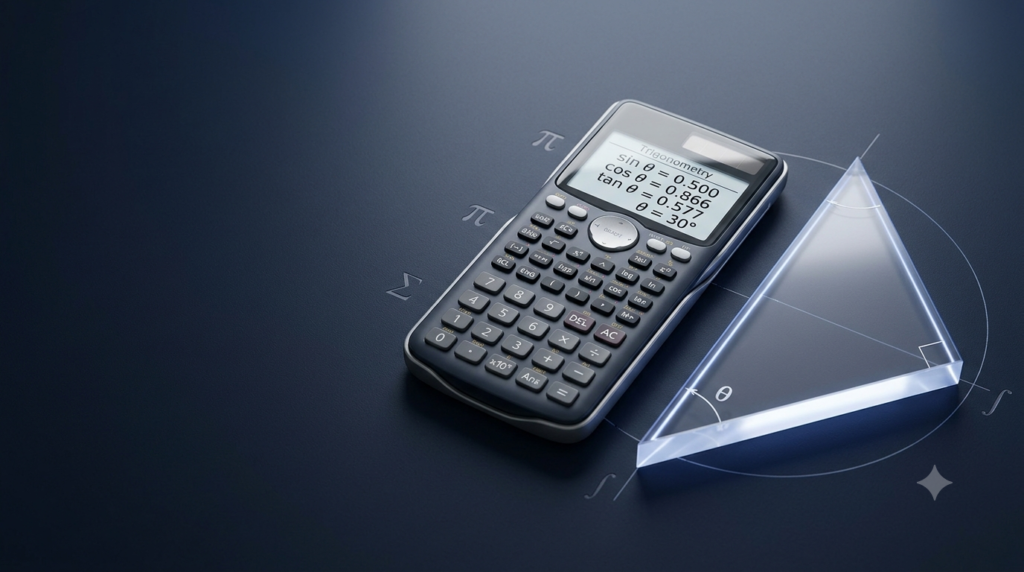
For any angle θ measured from the positive x-axis, the corresponding point on the unit circle has coordinates (cos θ, sin θ). This means the x-coordinate represents the cosine of the angle, while the y-coordinate represents its sine.
The calculator uses these relationships to find trigonometric values. For example, when you enter an angle of 45°, the corresponding coordinates are approximately (0.707107, 0.707107). Therefore, the sine and cosine of 45° are both approximately 0.707107.
Instead of calculating every value separately, the calculator presents the results together. This makes it useful for checking answers, studying standard angles, and understanding the relationship between geometry and trigonometry.
How to Use the Unit Circle Calculator
Using the Unit Circle Calculator is straightforward. You only need to enter an angle, choose the appropriate angle unit, and calculate the result.
Step 1: Enter the Angle
Enter the angle you want to calculate in the angle input field. You can use positive or negative angles, including angles greater than 360°.
For example, you can enter 30, 45, 90, 180, 270, or 450 degrees. The calculator can also work with angles expressed in radians.
Step 2: Select the Angle Unit
Choose whether your input is measured in degrees or radians.
Degrees are commonly used in introductory geometry and trigonometry. Radians are frequently used in advanced mathematics, calculus, and physics.
For example, 180° is equivalent to π radians, and 90° is equivalent to π/2 radians.
Always select the correct unit before calculating the result. An angle of 90 degrees is not the same as an angle of 90 radians.
Step 3: Calculate the Results
Click the Calculate button to obtain the results. The calculator determines the angle in degrees, its coterminal angle, the quadrant or axis, and the reference angle.
It also calculates the coordinates of the corresponding point and displays the six primary trigonometric functions.
Step 4: Understand the Unit Circle Diagram
The visual diagram shows the unit circle, coordinate axes, selected point, and radius connecting the center to that point.
The horizontal coordinate corresponds to cosine, while the vertical coordinate corresponds to sine. The diagram helps you understand how the angle determines the position of a point on the circle.
Step 5: Copy the Results
Use the Copy Results button to copy the calculated values when you need them for notes, homework, mathematical exercises, or further calculations.
You can change the input angle at any time to explore another point on the unit circle.
Unit Circle Formula
The unit circle is based on the equation of a circle with radius 1 and center at the origin.
Unit circle equation:
x² + y² = 1
In trigonometry, the coordinates of a point corresponding to an angle θ are:
x = cos θ
y = sin θ
Substituting these coordinate relationships into the circle equation gives the fundamental trigonometric identity:
cos² θ + sin² θ = 1
This identity holds for every real angle θ.
The formula explains why sine and cosine values are connected. Their squares always add up to 1 because the corresponding point remains on a circle with radius 1.
For example, at 60°, cosine is 1/2 and sine is √3/2. Squaring both values and adding them gives 1/4 + 3/4 = 1.
The unit circle therefore provides a geometric way to understand one of the most important identities in trigonometry.
Trigonometric Functions Calculated by the Tool
The Unit Circle Calculator calculates six common trigonometric functions. Each function describes a different relationship associated with an angle.
1. Sine (sin θ)
Sine represents the y-coordinate of the corresponding point on the unit circle.
sin θ = y
For example, sin 30° = 1/2, which is equal to 0.5.
Sine values are positive in Quadrants I and II and negative in Quadrants III and IV. At angles where the point lies on the horizontal axis, the sine value is zero.
2. Cosine (cos θ)
Cosine represents the x-coordinate of the corresponding point on the unit circle.
cos θ = x
For example, cos 60° = 1/2, which is equal to 0.5.
Cosine is positive in Quadrants I and IV and negative in Quadrants II and III. Its value indicates the horizontal position of the point relative to the center.
3. Tangent (tan θ)
Tangent is the ratio of sine to cosine.
tan θ = sin θ / cos θ
For example, tan 45° = 1 because sine and cosine have the same value at 45°.
Tangent is undefined whenever cosine equals zero, such as at 90° and 270°, including coterminal angles. At these angles, division by zero is not mathematically defined.
4. Cosecant (csc θ)
Cosecant is the reciprocal of sine.
csc θ = 1 / sin θ
For example, csc 30° = 2 because sin 30° = 1/2.
Cosecant is undefined whenever sine equals zero, including angles such as 0°, 180°, and 360°.
5. Secant (sec θ)
Secant is the reciprocal of cosine.
sec θ = 1 / cos θ
For example, sec 60° = 2 because cos 60° = 1/2.
Secant is undefined whenever cosine equals zero.
6. Cotangent (cot θ)
Cotangent is the reciprocal of tangent when the relevant values are defined. It can also be expressed as the ratio of cosine to sine.
cot θ = cos θ / sin θ
For example, cot 45° = 1.
Cotangent is undefined whenever sine equals zero, because its formula requires division by sine.
Understanding these functions helps you interpret the results displayed by the calculator and recognize why some values are undefined.
Understanding Unit Circle Coordinates
Every angle corresponds to a point on the unit circle. The coordinates of this point are written as (cos θ, sin θ).
The first coordinate represents the horizontal position, and the second represents the vertical position.
For example, the point associated with 0° is (1, 0). At 90°, the point is (0, 1). At 180°, it is (-1, 0), and at 270°, it is (0, -1).
These four angles are especially important because they lie directly on the coordinate axes.
For an angle of 45°, both coordinates are positive and equal to √2/2. For an angle of 135°, the x-coordinate is negative while the y-coordinate remains positive.
The signs of the coordinates depend on the quadrant in which the point lies. The calculator displays these coordinates as decimal values, making it easier to compare angles and understand the position of each point.
Coordinates are particularly useful when solving trigonometric equations, studying periodic functions, and identifying exact values for common angles.
Understanding Quadrants on the Unit Circle
The coordinate plane is divided into four quadrants by the x-axis and y-axis. Each quadrant contains angles with a particular combination of positive and negative sine and cosine values.
Quadrant I
Quadrant I contains angles between 0° and 90°. Both x and y coordinates are positive. Therefore, sine and cosine are positive, and the other trigonometric functions are also positive wherever defined.
Quadrant II
Quadrant II contains angles between 90° and 180°. The x-coordinate is negative, while the y-coordinate is positive. Consequently, cosine is negative and sine is positive.
Quadrant III
Quadrant III contains angles between 180° and 270°. Both coordinates are negative. Sine and cosine are therefore negative, while tangent is positive wherever defined.
Quadrant IV
Quadrant IV contains angles between 270° and 360°. The x-coordinate is positive, and the y-coordinate is negative. Cosine is positive, while sine is negative.
Angles that lie exactly on an axis are not inside a quadrant. For example, 90° lies on the positive y-axis, while 180° lies on the negative x-axis.
Identifying the correct quadrant helps you determine the expected signs of trigonometric values before calculating them.
What Is a Reference Angle?
A reference angle is the smallest positive angle between the terminal side of an angle and the x-axis. It is generally between 0° and 90°, inclusive for common axis cases depending on the convention used.
Reference angles help you calculate trigonometric values for angles outside the first quadrant.
For example, the reference angle of 150° is 30° because the angle is 30° away from 180°. Similarly, the reference angle of 210° is 30°, and the reference angle of 330° is also 30°.
The trigonometric values for these angles are related to the values of their reference angles. However, the signs depend on the quadrant.
For example, sin 30° = 1/2, while sin 210° = -1/2. Both angles have the same reference angle, but their sine values have opposite signs because they lie in different quadrants.
The calculator determines the reference angle automatically, helping you recognize these relationships without calculating them manually.
Degrees and Radians
Degrees and radians are two different units used to measure angles.
A complete revolution around the unit circle is 360°, which is equivalent to 2π radians. A half revolution is 180° or π radians, and a quarter revolution is 90° or π/2 radians.
To convert degrees into radians, multiply the angle in degrees by π/180.
Radians = Degrees × π / 180
To convert radians into degrees, multiply the angle in radians by 180/π.
Degrees = Radians × 180 / π
For example, 60° is equivalent to π/3 radians, while π radians is equivalent to 180°.
Degrees are convenient for learning common angles, while radians are essential in many calculus formulas and scientific applications. The Unit Circle Calculator supports both units so that you can work with different mathematical problems.
Coterminal Angles and Their Importance
Coterminal angles are angles that share the same initial side and terminal side. They differ by a whole number of complete rotations.
For example, 30°, 390°, and -330° are coterminal angles because each points in the same direction on the unit circle.
To find a coterminal angle between 0° and 360°, add or subtract multiples of 360° until the result falls within that range.
Coterminal angles have identical sine, cosine, tangent, and other defined trigonometric values because they terminate at the same point on the unit circle.
The calculator displays a normalized coterminal angle to make it easier to identify the corresponding position, even when the original angle is negative or greater than 360°.
This feature is useful for simplifying trigonometric calculations and understanding the periodic nature of trigonometric functions.
Common Unit Circle Values
Several angles appear frequently in trigonometry. Learning their sine and cosine values makes many mathematical problems easier to solve.
| Angle | Radians | cos θ | sin θ |
|---|---|---|---|
| 0° | 0 | 1 | 0 |
| 30° | π/6 | √3/2 | 1/2 |
| 45° | π/4 | √2/2 | √2/2 |
| 60° | π/3 | 1/2 | √3/2 |
| 90° | π/2 | 0 | 1 |
| 180° | π | -1 | 0 |
| 270° | 3π/2 | 0 | -1 |
| 360° | 2π | 1 | 0 |
These values are based on exact mathematical relationships. The calculator generally displays decimal approximations, so a displayed value may differ slightly from an exact fraction or radical because of rounding.
For example, √3/2 is approximately 0.866025. Both forms represent the same value, but the radical form is exact while the decimal form is an approximation.
Applications of the Unit Circle
The unit circle is useful in many areas of mathematics, science, and engineering.
Learning Trigonometry
Students and independent learners can use the unit circle to understand sine, cosine, tangent, and the relationships between angles and coordinates. Visualizing the circle makes abstract trigonometric concepts easier to understand.
Solving Trigonometric Equations
Many equations require finding angles that produce a particular sine or cosine value. The unit circle helps identify possible solutions and determine the quadrants in which those solutions occur.
Studying Periodic Functions
Sine and cosine repeat their values after a complete rotation of 360° or 2π radians. The unit circle provides a geometric explanation for this periodic behavior.
Physics and Engineering
Trigonometric functions are used to analyze waves, oscillations, circular motion, alternating current, and vector components. The unit circle helps establish the mathematical relationships needed in these applications.
Mathematics and Calculus
Radians and trigonometric functions play an important role in calculus. Understanding the unit circle helps learners study derivatives, integrals, limits, and the behavior of periodic functions.
Benefits of Using an Online Unit Circle Calculator
An online Unit Circle Calculator offers several practical benefits.
Fast calculations: It calculates multiple trigonometric values from a single angle input.
Visual learning: The unit circle diagram shows the selected angle and the corresponding point, making coordinate relationships easier to understand.
Support for degrees and radians: You can work with either angle unit without manually converting every input.
Quadrant identification: The calculator helps determine whether an angle lies in Quadrant I, II, III, IV, or directly on a coordinate axis.
Reference angle calculation: It provides the reference angle for understanding trigonometric values in different quadrants.
Convenient result copying: You can copy the calculated values for notes, assignments, and further mathematical work.
Recognition of undefined values: The calculator identifies trigonometric functions that are undefined because their formulas require division by zero.
These features make the tool useful for learning, checking calculations, and exploring trigonometric relationships.
Limitations and Accuracy
Although an online calculator makes trigonometric calculations easier, it is important to understand how its results are presented.
Most calculated values are displayed as decimals rounded to six decimal places. This is sufficient for many everyday mathematical tasks, but some problems require exact values such as 1/2, √2/2, or √3/2.
For exact answers, you should recognize the standard unit circle values or express the result using fractions and radicals when appropriate.
The calculator also displays undefined values when a trigonometric function requires division by zero. An undefined result is different from zero and should not be treated as a numerical answer.
For extremely large angles, numerical precision may become limited by the computer’s floating-point calculations. For the most reliable results, use reasonable angle values and verify exact answers when working on advanced mathematical problems.
Remember that the unit circle is a mathematical model. Its radius is exactly 1, and every point on the circle satisfies x² + y² = 1. Small discrepancies in displayed decimal values are caused by rounding and numerical approximation rather than a change in the underlying mathematical relationship.
Conclusion
The Unit Circle Calculator is a practical tool for calculating trigonometric values and exploring the relationships between angles, coordinates, and the unit circle. It helps you find sine, cosine, tangent, cosecant, secant, and cotangent while displaying the corresponding point, quadrant, reference angle, and coterminal angle.
By supporting both degrees and radians, the calculator is useful for a wide range of mathematical problems. Its visual representation also makes it easier to understand why sine corresponds to the y-coordinate and cosine corresponds to the x-coordinate.
Whether you are learning the fundamentals of trigonometry, checking your calculations, or studying more advanced mathematical concepts, the Unit Circle Calculator can save time and improve your understanding. Use it to explore different angles, compare their values, and build a stronger foundation in trigonometry.
FAQs
1. What is a Unit Circle Calculator?
A Unit Circle Calculator is an online mathematics tool that calculates trigonometric values for a given angle. It helps you find sine, cosine, tangent, cosecant, secant, and cotangent. The calculator can also display the coordinates of a point on the unit circle, identify the quadrant, calculate the reference angle, and determine a coterminal angle. You can enter angles in degrees or radians, depending on your requirements. This tool is useful for students, teachers, and anyone learning trigonometry because it simplifies calculations and provides a visual representation of the relationship between angles and coordinates.
2. How does a Unit Circle Calculator work?
A Unit Circle Calculator uses the mathematical relationships between angles, coordinates, and trigonometric functions. For an angle θ, the corresponding point on the unit circle has coordinates (cos θ, sin θ). The calculator determines these coordinates and uses them to calculate the six common trigonometric functions. It also identifies the angle’s quadrant or axis and calculates its reference angle. When you enter an angle and select degrees or radians, the tool processes the input and displays the results. A visual diagram can help you understand the point’s position and the relationship between the angle and its trigonometric values.
3. What is the formula for the unit circle?
The standard equation of the unit circle is x² + y² = 1. This equation represents a circle centered at the origin with a radius of one unit. In trigonometry, the coordinates of a point corresponding to an angle θ are x = cos θ and y = sin θ. Substituting these relationships into the circle equation gives the identity cos² θ + sin² θ = 1. This identity is valid for every real angle. A Unit Circle Calculator uses these relationships to determine coordinates and trigonometric values, making it easier to solve problems and understand the geometric foundation of trigonometry.
4. Can I calculate angles in degrees and radians?
Yes, a Unit Circle Calculator can support both degrees and radians. Degrees measure a complete revolution as 360°, while radians measure the same revolution as 2π radians. For example, 180° equals π radians, and 90° equals π/2 radians. To convert degrees into radians, multiply the degree value by π/180. To convert radians into degrees, multiply the radian value by 180/π. Selecting the correct angle unit is important because the same numerical input represents different angles in these two systems. Radians are especially useful in calculus, physics, and advanced mathematical calculations.
5. How do I find sine and cosine using a unit circle?
You can find sine and cosine by identifying the coordinates of the point corresponding to an angle on the unit circle. The x-coordinate represents cosine, while the y-coordinate represents sine. Therefore, the coordinates are written as (cos θ, sin θ). For example, at 45°, both coordinates equal √2/2, approximately 0.707107. Thus, sine and cosine have the same value at this angle. A Unit Circle Calculator determines these values automatically and displays the corresponding point. Understanding this relationship helps you recognize standard trigonometric values and solve problems involving angles, coordinates, and trigonometric identities.
6. What are the six trigonometric functions calculated by this tool?
The six common trigonometric functions are sine, cosine, tangent, cosecant, secant, and cotangent. Sine represents the y-coordinate of a unit circle point, while cosine represents its x-coordinate. Tangent is the ratio of sine to cosine. Cosecant is the reciprocal of sine, secant is the reciprocal of cosine, and cotangent is the ratio of cosine to sine. These functions describe different mathematical relationships associated with an angle. A Unit Circle Calculator calculates all six values whenever they are defined. It also identifies undefined results when a function requires division by zero, helping you avoid incorrect interpretations.
7. What is a reference angle on the unit circle?
A reference angle is the smallest nonnegative angle between the terminal side of an angle and the x-axis. It helps you determine trigonometric values for angles in different quadrants. For example, the reference angle of 150° is 30°, while the reference angles of 210° and 330° are also 30°. Although these angles share the same reference angle, their trigonometric values may have different signs depending on their quadrants. A Unit Circle Calculator calculates the reference angle automatically. This feature is useful for simplifying trigonometric problems and understanding how standard angle values relate to angles outside the first quadrant.
8. What are coterminal angles, and how are they calculated?
Coterminal angles are angles that share the same initial side and terminal side. They differ by a whole number of complete rotations. In degrees, coterminal angles can be found by adding or subtracting multiples of 360°. For example, 30°, 390°, and -330° are coterminal because they point in the same direction. Coterminal angles have identical sine and cosine values, as well as identical values for other trigonometric functions wherever those functions are defined. A Unit Circle Calculator can display a coterminal angle between 0° and 360°, making it easier to understand the angle’s position on the circle.
9. Why are some trigonometric values undefined?
Some trigonometric values are undefined because their formulas require division by zero. For example, tangent is calculated by dividing sine by cosine, so tangent is undefined whenever cosine equals zero. These angles include 90° and 270°, along with their coterminal angles. Similarly, cosecant and cotangent are undefined when sine equals zero, while secant is undefined when cosine equals zero. An undefined value is not the same as zero. A Unit Circle Calculator identifies these situations instead of displaying an incorrect numerical result. Recognizing undefined values is essential for understanding trigonometric functions and solving mathematical problems accurately.
10. Who can benefit from using a Unit Circle Calculator?
A Unit Circle Calculator is useful for students, teachers, independent learners, and professionals who work with trigonometry. Students can use it to understand standard angles, verify homework answers, and learn the relationships between sine, cosine, and coordinates. Teachers can use the visual representation to explain quadrants, reference angles, and coterminal angles. Learners studying calculus, physics, engineering, or other technical subjects can also benefit from its calculations. The tool supports degrees and radians, making it suitable for basic and advanced mathematical work. However, understanding the underlying formulas and exact values remains important for developing strong mathematical skills.