Mixed Number Calculator
Add, subtract, multiply, or divide mixed numbers and fractions. Get a simplified answer with step-by-step working.
Result
Step-by-Step Solution
A Mixed Number Calculator is an online math tool that helps you add, subtract, multiply, and divide mixed numbers quickly and accurately. It also allows you to work with fractions, simplify answers, and understand the calculation process through step-by-step solutions. Whether you are learning fractions for the first time, completing school assignments, or checking mathematical problems, this calculator makes working with mixed numbers easier.
Mixed numbers are commonly used in mathematics and everyday situations, such as measuring ingredients, calculating distances, dividing quantities, and working with lengths. However, performing arithmetic operations with mixed numbers can sometimes be confusing, especially when the denominators are different or the final answer needs to be simplified.
Using a Mixed Number Calculator saves time and helps reduce calculation errors. Instead of performing every step manually, you can enter your numbers, select the required operation, and get the result instantly. Understanding how the calculator works can also help you improve your fraction skills and solve similar problems independently.
What Is a Mixed Number Calculator?
A Mixed Number Calculator is a mathematical tool designed to perform arithmetic operations involving mixed numbers and fractions. A mixed number consists of a whole number and a proper fraction written together.
For example, 2 1/3 is a mixed number. It contains the whole number 2 and the fraction 1/3.
A mixed number represents a quantity greater than or equal to one whole when written as a positive number with a nonzero fractional part. Mixed numbers are useful when a quantity is not an exact whole number but needs to be expressed in a familiar form.
The calculator converts mixed numbers into improper fractions when necessary, performs the selected mathematical operation, and simplifies the result. Depending on the tool, the answer may be displayed as a mixed number, an improper fraction, a decimal, or a combination of these formats.
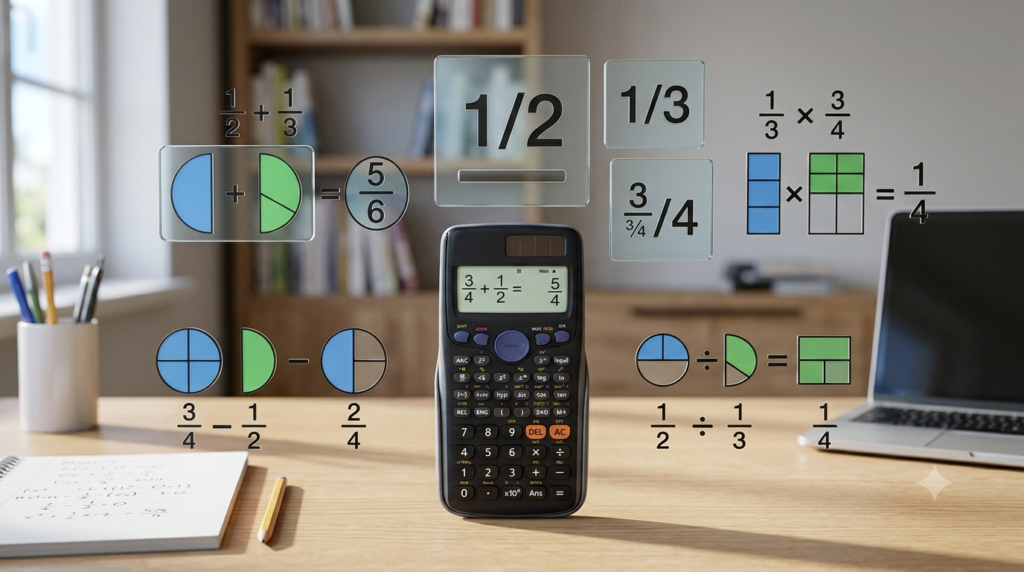
For example, if you enter 2 1/3 and 1 1/2 and select addition, the calculator produces the answer 3 5/6.
This makes the tool useful for students, teachers, parents, and anyone who regularly works with fractions.
What Is a Mixed Number?
A mixed number is a number that combines a whole number with a proper fraction.
For example:
1 1/2
2 3/4
4 2/5
7 1/8
In the mixed number 3 2/5, the whole number is 3, the numerator is 2, and the denominator is 5.
The numerator represents the number of fractional parts being considered, while the denominator represents the number of equal parts into which a whole is divided.
A mixed number can also be converted into an improper fraction. An improper fraction has a numerator that is greater than or equal to its denominator.
For example:
3 2/5 = 17/5
To convert a mixed number into an improper fraction, multiply the whole number by the denominator and add the numerator. Place the result over the original denominator.
The calculation is:
3 × 5 + 2 = 17
Therefore, 3 2/5 = 17/5.
This conversion is particularly important because multiplication and division of mixed numbers are easier when the numbers are expressed as improper fractions.
How to Use the Mixed Number Calculator
Using a Mixed Number Calculator is straightforward. You only need to enter the required numbers and choose the mathematical operation.
Step 1: Enter the First Mixed Number
Enter the whole number, numerator, and denominator of the first number in their respective fields.
For example, to enter 2 1/3, type 2 as the whole number, 1 as the numerator, and 3 as the denominator.
If the calculator provides a sign option, select whether the number is positive or negative.
Step 2: Enter the Second Mixed Number
Enter the whole number, numerator, and denominator of the second number.
For example, to enter 1 1/2, type 1 as the whole number, 1 as the numerator, and 2 as the denominator.
Make sure the denominator is greater than zero. A denominator of zero is mathematically undefined and cannot be used in a valid fraction.
Step 3: Choose the Operation
Select the mathematical operation you want to perform.
The common operations are:
Addition (+)
Subtraction (−)
Multiplication (×)
Division (÷)
Each operation follows a different calculation method.
Step 4: Calculate the Answer
Click the Calculate Answer button. The calculator processes the entered values and displays the result.
Depending on the calculator’s features, you may see the simplified mixed number, the equivalent improper fraction, the decimal value, and an explanation of the calculation steps.
Step 5: Review the Result
Check the final answer and review the calculation steps to understand how the result was obtained.
If you want to solve another problem, change the input values or use the Reset button to restore the original values.
How to Add Mixed Numbers
Adding mixed numbers involves combining their whole-number parts and fractional parts. If the fractions have different denominators, you must first find a common denominator.
Consider the following example:
2 1/3 + 1 1/2
First, convert both mixed numbers into improper fractions.
2 1/3 = 7/3
1 1/2 = 3/2
The denominators are 3 and 2. Their least common denominator is 6.
Convert both fractions to equivalent fractions with denominator 6.
7/3 = 14/6
3/2 = 9/6
Now add the numerators.
14/6 + 9/6 = 23/6
Convert the improper fraction into a mixed number.
23/6 = 3 5/6
Therefore, the answer is 3 5/6.
A Mixed Number Calculator performs these steps automatically, making addition faster and reducing the possibility of errors when finding common denominators.
How to Subtract Mixed Numbers
Subtracting mixed numbers requires careful attention to the whole-number and fractional parts. Converting both numbers into improper fractions is one reliable method.
Consider this example:
4 1/2 − 2 1/3
Convert the mixed numbers into improper fractions.
4 1/2 = 9/2
2 1/3 = 7/3
The least common denominator of 2 and 3 is 6.
Convert the fractions.
9/2 = 27/6
7/3 = 14/6
Subtract the numerators.
27/6 − 14/6 = 13/6
Convert the improper fraction into a mixed number.
13/6 = 2 1/6
Therefore, the answer is 2 1/6.
When subtracting mixed numbers manually, borrowing may sometimes be necessary if the fractional part of the first number is smaller than the fractional part of the second number. Converting to improper fractions avoids this particular difficulty.
How to Multiply Mixed Numbers
Multiplication of mixed numbers becomes easier when each mixed number is converted into an improper fraction.
Consider the following example:
1 1/2 × 2 1/3
Convert the mixed numbers.
1 1/2 = 3/2
2 1/3 = 7/3
Multiply the numerators together and the denominators together.
3/2 × 7/3 = 21/6
Simplify the fraction.
21/6 = 7/2
Convert the improper fraction into a mixed number.
7/2 = 3 1/2
Therefore, the answer is 3 1/2.
When multiplying fractions, you do not need to find a common denominator. You multiply the numerators and denominators directly, then simplify the result.
The calculator follows the same method and displays the final answer in a convenient format.
How to Divide Mixed Numbers
Dividing mixed numbers requires converting them into improper fractions and multiplying the first fraction by the reciprocal of the second fraction.
Consider this example:
3 1/2 ÷ 1 1/4
Convert both mixed numbers into improper fractions.
3 1/2 = 7/2
1 1/4 = 5/4
To divide fractions, keep the first fraction, change the division sign to multiplication, and reverse the numerator and denominator of the second fraction.
7/2 ÷ 5/4 = 7/2 × 4/5
Multiply the numerators and denominators.
7 × 4 / (2 × 5) = 28/10
Simplify the fraction.
28/10 = 14/5
Convert it into a mixed number.
14/5 = 2 4/5
Therefore, the answer is 2 4/5.
Remember that division by zero is undefined. If the second mixed number represents zero, the calculation cannot produce a valid result.
Mixed Numbers and Improper Fractions
Mixed numbers and improper fractions are two different ways of representing the same value.
For example:
2 3/4 = 11/4
Both expressions represent the same quantity. The mixed number shows the whole-number part separately, while the improper fraction expresses the entire quantity as fractional parts.
Mixed numbers are often easier to interpret in everyday situations. Improper fractions, however, are usually more convenient for performing arithmetic operations.
A Mixed Number Calculator can use improper fractions during calculations and then convert the answer back into a mixed number.
This approach combines computational convenience with an easy-to-understand final result.
How to Simplify Mixed Number Results
Simplification means expressing a fraction in its lowest terms without changing its value.
For example:
12/18 = 2/3
Both fractions represent the same value, but 2/3 is simpler because its numerator and denominator have no common factor greater than 1.
To simplify a fraction, find the greatest common divisor (GCD) of its numerator and denominator. Divide both numbers by that divisor.
For example:
15/6
The greatest common divisor of 15 and 6 is 3.
15 ÷ 3 = 5
6 ÷ 3 = 2
Therefore:
15/6 = 5/2 = 2 1/2
The final mixed number is 2 1/2.
Simplifying answers makes them easier to read, compare, and use in further calculations.
Mixed Number Calculator vs. Manual Calculation
Both a calculator and manual calculation can produce the correct answer when used properly. However, each method has different advantages.
A calculator is useful when you need quick results, want to check homework, or have several calculations to complete. It reduces repetitive arithmetic and can display simplified answers immediately.
Manual calculation is valuable for understanding mathematical rules and developing problem-solving skills. Working through the steps helps you learn how common denominators, improper fractions, reciprocals, and simplification work.
A practical approach is to solve a problem manually first and then use the calculator to check the result. If the answers differ, review the conversion and arithmetic steps to identify the mistake.
The calculator should support your learning rather than replace your understanding of fractions.
Practical Uses of a Mixed Number Calculator
Mixed numbers appear in many everyday activities and mathematical problems.
Cooking and Baking
Recipes frequently use measurements such as 1 1/2 cups of flour or 2 1/4 teaspoons of an ingredient. When adjusting a recipe for more or fewer servings, you may need to add, subtract, multiply, or divide these quantities.
A Mixed Number Calculator helps you calculate the new measurements accurately.
Measuring Lengths
Carpenters, builders, and DIY enthusiasts often work with fractional measurements. For example, adding two pieces of wood measuring 3 1/2 inches and 2 3/4 inches requires fraction arithmetic.
The calculator makes these measurements easier to combine.
School Mathematics
Students regularly encounter mixed numbers while studying fractions, arithmetic, and related mathematical topics.
Using the calculator to verify answers helps students identify mistakes and understand the correct calculation process.
Sharing Quantities
Mixed numbers can describe quantities that need to be divided into equal parts. For example, dividing a quantity of 5 1/2 units among several people may require fraction division.
The calculator can help determine the amount each person receives.
Checking Homework and Practice Problems
Teachers, parents, and students can use the tool to check arithmetic exercises. Comparing manual work with the calculator’s answer helps reinforce the rules of fraction operations.
Common Mistakes When Working With Mixed Numbers
Although mixed numbers are relatively simple once the basic rules are understood, several mistakes can affect the final answer.
Adding Denominators Directly
When adding fractions, add the numerators only after obtaining a common denominator. For example, 1/2 + 1/3 is not 2/5.
The correct calculation is 3/6 + 2/6 = 5/6.
Forgetting to Convert Mixed Numbers
Multiplying or dividing mixed numbers directly without applying the correct method can lead to incorrect results. Converting them into improper fractions first provides a consistent approach.
Using the Wrong Reciprocal
When dividing fractions, reverse only the second fraction and change division into multiplication. Reversing the first fraction instead will produce an incorrect answer.
Forgetting to Simplify
A fraction such as 8/4 is correct but can be simplified to 2. Similarly, 10/4 can be expressed as 5/2 or 2 1/2.
Simplifying makes the final answer clearer.
Entering an Invalid Denominator
A denominator must never be zero. If a denominator is entered incorrectly, the calculation is invalid. Always check the denominator before calculating.
Ignoring Negative Signs
Negative mixed numbers require careful attention to their signs. For example, −2 1/3 represents −7/3, not −5/3.
Selecting the correct sign is important when working with positive and negative values.
Benefits of Using an Online Mixed Number Calculator
An online Mixed Number Calculator offers several advantages for everyday mathematics.
Fast calculations: It performs fraction operations in seconds, reducing the time needed for repetitive arithmetic.
Simplified answers: It can express results in reduced fractional form and convert improper fractions into mixed numbers.
Step-by-step learning: Explanations of the calculation process help users understand the mathematical rules behind each answer.
Convenient access: A browser-based calculator can be used on computers, tablets, and smartphones without installing additional software.
Fewer arithmetic errors: Automated calculations reduce common mistakes involving multiplication, division, and fraction simplification, although inputs should still be checked carefully.
Useful for different skill levels: Beginners can use the tool to learn fraction operations, while more experienced users can use it to verify answers quickly.
These benefits make the calculator a practical resource for both learning and everyday problem-solving.
Conclusion
A Mixed Number Calculator is a useful online tool for performing addition, subtraction, multiplication, and division with mixed numbers and fractions. It simplifies the calculation process by converting mixed numbers into improper fractions, applying the correct arithmetic rules, and presenting the result in a convenient form.
Understanding how mixed numbers work is still important. Learning to find common denominators, multiply fractions, use reciprocals, and simplify answers helps build a strong foundation in mathematics.
Whether you are solving school exercises, adjusting recipe measurements, checking lengths, or working with fractional quantities, a Mixed Number Calculator can make calculations faster and easier. Use it to verify your work, understand each step, and develop greater confidence when solving fraction problems.
FAQs
1. What is a Mixed Number Calculator?
A Mixed Number Calculator is an online mathematical tool used to add, subtract, multiply, and divide mixed numbers. A mixed number contains a whole number and a fraction, such as 2 1/3 or 4 1/2. The calculator processes the entered numbers and provides the result in a simplified form. Depending on its features, it may also display an equivalent improper fraction, a decimal value, and step-by-step calculations. This tool is helpful for students, teachers, and anyone who works with fractions in mathematics or everyday situations. It saves time and helps reduce common calculation errors.
2. How do you use a Mixed Number Calculator?
To use a Mixed Number Calculator, enter the whole number, numerator, and denominator of the first mixed number. Repeat the process for the second number. Next, select the required operation, such as addition, subtraction, multiplication, or division. Click the Calculate button to obtain the answer. The calculator processes the numbers and displays the result. Some calculators also show the simplified fraction, decimal equivalent, and calculation steps. Always check that the denominator is greater than zero and that all entered values are correct. You can reset the calculator whenever you want to solve another problem.
3. How do you convert a mixed number into an improper fraction?
To convert a mixed number into an improper fraction, multiply the whole number by the denominator and add the numerator. Write the resulting number over the original denominator. For example, consider 3 2/5. Multiply 3 by 5 to get 15, then add 2 to obtain 17. Keep the denominator as 5. Therefore, 3 2/5 becomes 17/5. This method works for positive mixed numbers and can also be applied to the magnitude of negative mixed numbers while preserving the negative sign. Converting mixed numbers into improper fractions makes arithmetic operations easier to perform.
4. How do you add two mixed numbers?
To add two mixed numbers, convert them into improper fractions or add their whole-number and fractional parts separately. When using improper fractions, find a common denominator before adding the numerators. For example, 2 1/3 + 1 1/2 becomes 7/3 + 3/2. The common denominator is 6, so the calculation becomes 14/6 + 9/6 = 23/6. Convert the result into a mixed number to obtain 3 5/6. Finally, simplify the fraction if necessary. A Mixed Number Calculator performs these steps automatically and helps you check the accuracy of your calculations.
5. How do you subtract mixed numbers?
To subtract mixed numbers, convert both numbers into improper fractions and find a common denominator. Subtract the second numerator from the first while keeping the common denominator unchanged. For example, 4 1/2 − 2 1/3 becomes 9/2 − 7/3. Using 6 as the common denominator gives 27/6 − 14/6 = 13/6. Converting this improper fraction produces 2 1/6. Another method involves subtracting the whole-number and fractional parts separately, sometimes borrowing from the whole-number part. A Mixed Number Calculator makes subtraction easier by handling the conversion, arithmetic, and simplification automatically.
6. How do you multiply mixed numbers?
To multiply mixed numbers, first convert each number into an improper fraction. Multiply the numerators together and the denominators together, then simplify the resulting fraction. For example, 1 1/2 × 2 1/3 becomes 3/2 × 7/3. Multiplying gives 21/6, which simplifies to 7/2. Converting the improper fraction into a mixed number gives 3 1/2. Unlike addition and subtraction, multiplication does not require finding a common denominator. A Mixed Number Calculator performs these operations quickly and displays the simplified answer, making it useful for checking homework and solving practical mathematical problems.
7. How do you divide mixed numbers?
To divide mixed numbers, convert both numbers into improper fractions. Keep the first fraction, change the division sign to multiplication, and reverse the numerator and denominator of the second fraction. For example, 3 1/2 ÷ 1 1/4 becomes 7/2 ÷ 5/4. Rewrite it as 7/2 × 4/5, which equals 28/10. Simplifying gives 14/5, or 2 4/5. This method is known as multiplying by the reciprocal. Remember that division by zero is undefined, so the second number must not equal zero. A calculator can perform these steps automatically and display the final answer.
8. Can a Mixed Number Calculator simplify fractions?
Yes, a Mixed Number Calculator can simplify fractions when that feature is included. Simplification means reducing a fraction to its lowest terms without changing its value. For example, 12/18 can be simplified to 2/3 by dividing both the numerator and denominator by their greatest common divisor, which is 6. Similarly, 15/6 simplifies to 5/2, equivalent to the mixed number 2 1/2. Simplified answers are easier to read, compare, and use in further calculations. After completing an operation, check whether the numerator and denominator share a common factor greater than one.
9. What is the difference between a mixed number and an improper fraction?
A mixed number contains a whole-number part and a fractional part, while an improper fraction has a numerator greater than or equal to its denominator. Both forms can represent the same mathematical value. For example, 2 3/4 and 11/4 are equivalent because they represent the same quantity. Mixed numbers are often easier to understand in everyday contexts, such as measurements and recipes. Improper fractions are usually more convenient for performing multiplication and division. A Mixed Number Calculator may convert mixed numbers into improper fractions during calculations and then display the final answer as a simplified mixed number.
10. Why should you use an online Mixed Number Calculator?
An online Mixed Number Calculator helps you perform fraction calculations quickly and conveniently. It can handle addition, subtraction, multiplication, and division while reducing the effort required for manual arithmetic. Many calculators also simplify answers and provide step-by-step solutions, helping users understand how results are obtained. Students can use the tool to check homework, practise fraction operations, and identify calculation mistakes. It is also useful for everyday tasks involving measurements, cooking quantities, and dividing resources. For the best learning experience, try solving a problem manually before checking the result with the calculator. This approach develops mathematical understanding and confidence.