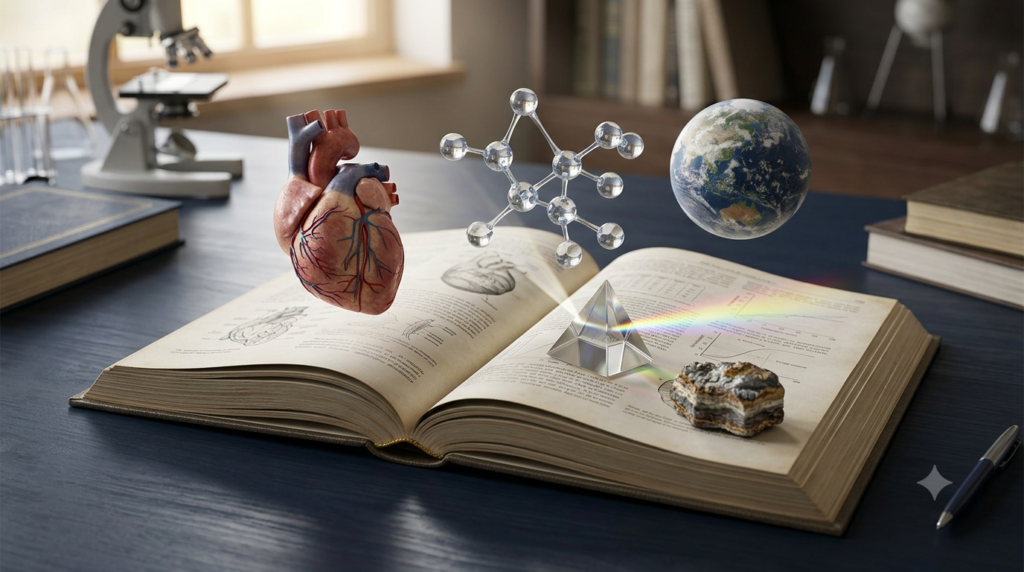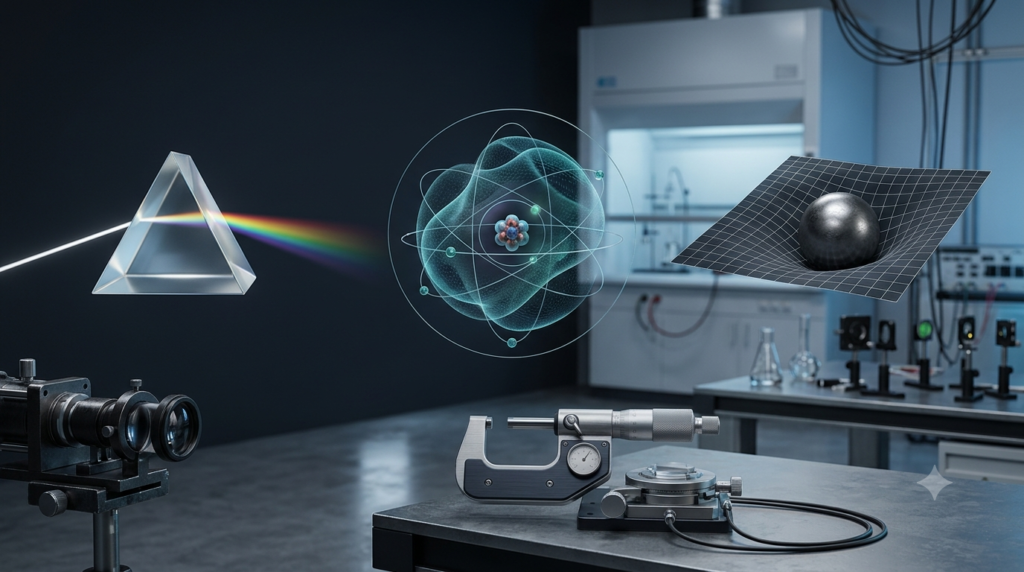
Science is an important part of everyday life. From the food we eat and the medicines we use to the smartphones we carry and the vehicles we travel in, science helps us understand how the world works. It explains natural events, answers questions about the universe, and provides practical solutions to many problems. But what exactly is science? Is it simply a collection of facts, or is it a way of discovering new knowledge?
Science is a systematic way of studying the natural world through observation, evidence, experimentation, and logical reasoning. It helps people understand how things work, why events happen, and what may happen under certain conditions. Science is not limited to laboratories or professional researchers. Anyone who observes something carefully, asks questions, and looks for reliable answers is using the basic principles of scientific thinking.
In this article, we will explore the definition and meaning of science, its main branches, basic concepts, scientific methods, and importance in everyday life.
What Is Science?
Science is the systematic study of the natural world through observation, investigation, experimentation, and evidence-based reasoning. It aims to develop reliable explanations for natural phenomena and improve our understanding of the universe.
For example, scientists study why objects fall toward the ground, how plants grow, how diseases spread, and how stars form. They collect information, test possible explanations, and compare their findings with available evidence.
Science does not depend only on personal opinions or assumptions. Scientific explanations must be supported by evidence and should be open to testing and revision when new information becomes available.
Consider a simple example. If a plant kept in sunlight grows differently from a similar plant kept in darkness, we may wonder whether sunlight affects plant growth. By observing plants under controlled conditions and comparing their growth, we can investigate this question scientifically.
This example shows that science is both a body of knowledge and a process for developing that knowledge.
What Is the Meaning of Science?
The word science comes from the Latin word scientia, which means knowledge. In modern usage, science refers to organized knowledge developed through systematic investigation and evidence.
However, science means more than simply knowing facts. It also involves understanding how those facts were discovered, evaluating the evidence behind them, and determining whether an explanation is reliable.
For example, knowing that water freezes at approximately 0°C under standard atmospheric pressure is a scientific fact. Understanding how temperature affects the movement of water molecules provides a deeper scientific explanation.
Science also encourages curiosity. When people ask questions such as why the sky appears blue, how electricity works, or what causes earthquakes, they begin exploring scientific ideas.
The central purpose of science is to build and improve our understanding of the natural world using methods that other people can examine, test, and verify.
What Are the Main Characteristics of Science?
Science has several important characteristics that distinguish it from other ways of understanding the world.
1. Observation
Observation is the process of gathering information by using our senses or scientific instruments. Scientists observe objects, events, patterns, and changes to understand what is happening.
For example, observing the phases of the Moon over several weeks helps us identify a repeating pattern in its appearance.
2. Evidence-Based Knowledge
Scientific explanations are supported by evidence collected through observations, experiments, measurements, or other appropriate investigations.
A claim does not become scientifically reliable simply because many people believe it. The evidence supporting the claim must be examined carefully.
3. Experimentation
Experiments allow scientists to investigate questions under specific conditions. By changing one factor and measuring its effects while controlling other relevant factors, researchers can better understand relationships between variables.
For example, an experiment comparing plant growth under different light conditions can help investigate the role of light in plant development.
4. Logical Reasoning
Science uses logical reasoning to interpret observations and draw conclusions. Scientists compare evidence, identify patterns, consider alternative explanations, and check whether their conclusions follow from the available information.
5. Testability
Scientific explanations should generally lead to observations or predictions that can be tested. If a proposed explanation cannot be investigated or evaluated using evidence, it may fall outside the scope of scientific testing.
6. Revisability
Scientific knowledge can change when new and more reliable evidence becomes available. This does not mean that scientific knowledge is unreliable. It means that science has a way to correct errors and improve explanations over time.
For example, scientific understanding of atoms has developed considerably as researchers have gained access to better experimental methods and instruments.
7. Reproducibility and Verification
Scientific findings become more convincing when other researchers can examine the methods, analyze the evidence, and obtain compatible results. Some investigations are difficult to reproduce exactly, but independent verification remains an important part of scientific research.
What Are the Main Branches of Science?
Science covers a wide range of subjects. Each branch focuses on particular aspects of the natural world, although many scientific fields overlap.
1. Physics
Physics studies matter, energy, motion, forces, and the fundamental principles governing the physical universe.
It explains phenomena such as gravity, light, sound, electricity, magnetism, and heat.
For example, physics helps explain why objects fall toward Earth, how mirrors reflect light, and how electrical energy powers household appliances.
2. Chemistry
Chemistry studies matter, including its composition, structure, properties, and the changes it undergoes.
It explains how substances interact, how chemical reactions occur, and how new materials are formed.
Cooking food, rusting iron, burning fuel, and producing medicines all involve chemical processes.
3. Biology
Biology is the study of living organisms and their life processes.
It includes subjects such as cells, genetics, evolution, ecology, anatomy, and microbiology.
Biology helps us understand how plants make food, how the human body functions, how organisms reproduce, and how living things interact with their environments.
4. Earth Science
Earth science focuses on Earth, its structure, materials, history, and natural processes.
It includes geology, meteorology, oceanography, and other related fields.
Earth scientists investigate earthquakes, volcanoes, weather patterns, rocks, minerals, oceans, and changes in Earth’s climate.
5. Space Science and Astronomy
Astronomy studies celestial objects and phenomena beyond Earth, including planets, stars, galaxies, and the universe.
Space science also investigates space environments, planetary systems, and the technology used to explore space.
These fields help scientists understand how the universe developed, how stars form, and whether other planets may have conditions suitable for life.
6. Environmental Science
Environmental science studies the relationships between living organisms, human activities, and the natural environment.
It investigates issues such as air pollution, water pollution, climate change, biodiversity loss, and waste management.
This knowledge helps people develop strategies to protect ecosystems and use natural resources more responsibly.
7. Computer Science
Computer science studies computation, algorithms, information processing, and computer systems.
It includes areas such as programming, artificial intelligence, data science, cybersecurity, and software development.
Computer science supports modern communication, scientific research, automation, and many technologies used in everyday life.
What Are the Basic Concepts of Science?
Several fundamental concepts help us understand scientific explanations and investigations.
1. Matter
Matter is anything that has mass and occupies space. Air, water, rocks, plants, and the human body are examples of matter.
Matter is made up of particles, such as atoms and molecules. It can exist in different physical states, including solids, liquids, and gases. Under suitable conditions, matter can also exist as plasma.
Understanding matter is essential to chemistry, physics, biology, and many other scientific fields.
2. Energy
Energy is the capacity to cause change or do work. It exists in different forms, including kinetic, potential, thermal, chemical, electrical, and radiant energy.
For example, moving vehicles have kinetic energy, food stores chemical energy, and sunlight carries energy that supports life on Earth.
Energy can be transferred or transformed from one form to another. In many physical processes, the total energy of an isolated system remains conserved.
3. Force and Motion
A force is an interaction that can change an object’s motion or deform it. Motion describes a change in an object’s position over time.
Pushing a door, kicking a ball, and pulling a cart are everyday examples involving forces.
Physics studies how forces affect motion and explains these relationships through principles such as Newton’s laws of motion.
4. Space and Time
Space describes the positions and distances between objects, while time helps us describe the order and duration of events.
These concepts are important in understanding motion, planetary orbits, the movement of light, and the evolution of the universe.
Modern physics also shows that space and time are closely related, particularly in Einstein’s theory of relativity.
5. Living Organisms
Living organisms include plants, animals, fungi, and microorganisms. They display characteristics such as cellular organization, metabolism, growth, and responses to their environments.
Biology investigates how living things function, reproduce, adapt, and interact with one another.
6. Systems and Interactions
A system is a collection of related components that interact with one another. Scientific systems can be small, such as a cell, or enormous, such as the solar system.
For example, an ecosystem includes organisms and non-living elements such as water, air, soil, and sunlight. Changes in one component can affect other parts of the system.
7. Patterns and Relationships
Scientists look for patterns and relationships to explain observations and make predictions.
For instance, studying the relationship between temperature and the volume of a gas under controlled conditions helps scientists understand gas behavior.
Recognizing patterns is useful in mathematics, astronomy, climate science, biology, and many other fields.
What Is the Scientific Method?
The scientific method is a systematic approach used to investigate questions and develop explanations based on evidence. Scientific investigations do not always follow one fixed sequence, but they commonly involve several related steps.
Step 1: Ask a Question
A scientific investigation often begins with a question about an observation.
For example, why do some seeds germinate faster than others?
Step 2: Conduct Background Research
Researchers gather existing information to understand what is already known and identify possible explanations for the question.
Step 3: Form a Hypothesis
A hypothesis is a proposed explanation that can be tested through investigation.
For example, a researcher might hypothesize that seeds exposed to suitable levels of moisture germinate faster than seeds kept under drier conditions.
Step 4: Design and Conduct an Investigation
Scientists plan an experiment or another suitable investigation. They identify the variables, select appropriate equipment, and decide how to collect reliable data.
In a seed-germination experiment, researchers might keep seed type, temperature, and light conditions consistent while varying the amount of water.
Step 5: Collect and Analyze Data
Scientists record observations and measurements. They then organize and analyze the data to identify patterns, differences, or relationships.
Step 6: Draw a Conclusion
Researchers compare their results with the original question and hypothesis. The evidence may support the hypothesis, contradict it, or indicate that more investigation is needed.
Step 7: Communicate and Verify Results
Scientific findings are shared through reports, publications, presentations, and datasets. Other researchers can evaluate the methods and investigate whether the conclusions are supported by further evidence.
The scientific method is not limited to laboratories. It can also be used to investigate everyday questions, provided the investigation is appropriate and the evidence is collected carefully.
What Is the Difference Between a Scientific Fact, Hypothesis, Theory, and Law?
These terms have specific meanings in science and should not be treated as interchangeable.
Scientific Fact
A scientific fact is an observation or finding that is well established through reliable evidence.
For example, under ordinary terrestrial conditions, pure water freezes at approximately 0°C at standard atmospheric pressure.
Hypothesis
A hypothesis is a proposed explanation that can be tested. It may be supported or rejected as evidence is collected.
Hypotheses help scientists develop questions and design investigations.
Scientific Theory
A scientific theory is a well-supported explanation of natural phenomena based on a substantial body of evidence.
The theory of evolution explains how populations of living organisms change over generations. The germ theory of disease explains how microorganisms can cause many diseases.
In science, a theory is not merely an untested guess. It is an explanatory framework supported by extensive evidence.
Scientific Law
A scientific law describes a consistent pattern or relationship observed in nature, often using mathematical expressions.
For example, Newton’s law of universal gravitation describes the gravitational attraction between objects with mass.
A scientific law generally describes what happens under specified conditions, while a theory helps explain why or how natural phenomena occur. A theory does not automatically become a law after receiving enough evidence; the two serve different purposes.
Why Is Science Important in Everyday Life?
Science plays a major role in modern society. Its importance can be seen in healthcare, communication, transportation, agriculture, education, and environmental protection.
1. Improving Healthcare
Scientific research helps researchers understand diseases, develop medicines, improve diagnostic tests, and create vaccines. Medical treatments and public health strategies rely on evidence gathered through scientific investigation.
2. Developing Technology
Scientific knowledge supports the development of computers, smartphones, satellites, electrical systems, and renewable energy technologies.
Engineering often applies scientific principles to design devices and systems that solve practical problems.
3. Improving Agriculture
Agricultural science helps farmers understand soil quality, plant nutrition, pests, irrigation, and crop diseases.
These insights can improve crop production and support more efficient use of water and other resources.
4. Protecting the Environment
Environmental research helps identify pollution sources, monitor ecosystems, understand climate change, and evaluate conservation strategies.
Scientific evidence supports informed decisions about protecting natural resources and reducing environmental damage.
5. Understanding Natural Events
Science explains many natural events, including thunderstorms, earthquakes, eclipses, tides, and volcanic eruptions.
These explanations improve our understanding of the world and help communities prepare for certain natural hazards.
6. Developing Critical Thinking
Learning science encourages people to ask questions, examine evidence, identify misleading claims, and distinguish reliable information from unsupported statements.
These skills are useful when evaluating health information, news reports, advertisements, and claims about new technologies.
How Is Science Different from Technology?
Science and technology are closely related, but they are not the same.
Science primarily aims to understand natural phenomena and develop reliable knowledge. Technology involves applying knowledge, skills, and practical methods to create tools, products, processes, and systems that meet human needs.
For example, scientists investigate the properties of semiconductors and the behavior of electric current. Engineers and technology specialists apply this knowledge to develop computer chips and electronic devices.
The relationship works in both directions. Scientific discoveries can lead to new technologies, while technological advances provide scientists with better instruments for research.
A telescope, for instance, is a technological tool that allows astronomers to observe distant objects and investigate questions about the universe.
What Are the Limitations of Science?
Science is powerful, but it has limitations. Understanding these limitations helps people interpret scientific findings responsibly.
First, scientific explanations depend on the quality and quantity of available evidence. Limited data, measurement errors, and experimental limitations can affect results.
Second, scientific knowledge can be revised when new evidence becomes available. Some questions remain uncertain because researchers do not yet have enough information to reach strong conclusions.
Third, science investigates questions that can be examined through appropriate evidence and systematic inquiry. Questions about personal values, moral duties, or the meaning of life may involve philosophical, cultural, or ethical reasoning beyond scientific investigation alone.
Finally, scientific findings do not automatically determine how society should use new knowledge. Decisions about technologies, medical treatments, and environmental policies may also involve ethical considerations, social priorities, and practical constraints.
Recognizing these limitations does not reduce the value of science. Instead, it encourages careful reasoning, honest communication, and responsible use of evidence.
Conclusion
Science is a systematic way of understanding the natural world through observation, experimentation, evidence, and logical reasoning. It helps explain how matter, energy, living organisms, Earth, and the universe behave. Its major branches include physics, chemistry, biology, Earth science, astronomy, environmental science, and computer science.
The basic concepts of science provide a foundation for understanding natural phenomena, while the scientific method offers a structured way to investigate questions and evaluate possible explanations. Scientific facts, hypotheses, theories, and laws each play different roles in building knowledge.
Science is also essential to modern life because it supports healthcare, technology, agriculture, environmental protection, and critical thinking. By remaining curious, examining evidence, and being willing to revise our understanding, we can use scientific thinking to make better decisions and develop a deeper appreciation of the world around us.
FAQs
1. What is science in simple words?
Science is a systematic way of learning about the natural world through observation, experiments, and evidence. It helps us understand how things work and why different events happen. For example, science explains why objects fall toward the ground, how plants grow, and how electricity powers our homes. It involves asking questions, collecting information, testing possible explanations, and drawing conclusions based on evidence. Science is not limited to laboratories or scientists. Anyone can use scientific thinking by observing things carefully and looking for reliable answers. Science helps people develop knowledge, solve problems, and make better decisions in everyday life.
2. What is the main purpose of science?
The main purpose of science is to understand the natural world and explain the processes that occur within it. Science helps people investigate natural events, discover patterns, test ideas, and develop reliable explanations. It also supports the development of technologies, medicines, and practical solutions to human problems. For example, scientific research helps doctors understand diseases and develop effective treatments. Similarly, environmental scientists study pollution and climate change to identify possible solutions. Science also encourages curiosity and critical thinking by teaching people to question assumptions and examine evidence. Its purpose is not only to collect facts but also to improve understanding through continuous investigation.
3. What are the main branches of science?
The main branches of science include physics, chemistry, biology, Earth science, astronomy, and environmental science. Physics studies matter, energy, motion, and forces. Chemistry investigates the composition, properties, and reactions of substances. Biology focuses on living organisms and their life processes. Earth science explores Earth’s structure, rocks, oceans, weather, and geological processes. Astronomy studies planets, stars, galaxies, and the universe. Environmental science examines relationships between living organisms, human activities, and the environment. These branches often overlap because natural phenomena involve several scientific principles. Together, they help us understand the world, from the smallest particles to enormous structures throughout the universe.
4. What is the scientific method?
The scientific method is a systematic approach to investigating questions and developing explanations using evidence. It commonly involves making observations, asking a question, conducting background research, forming a hypothesis, testing it, analyzing the results, and drawing a conclusion. For example, a person may investigate whether sunlight affects plant growth by comparing plants kept under different light conditions. The results help determine whether the evidence supports the original hypothesis. Scientific investigations may follow different sequences depending on the research question, so the method is not always a rigid set of steps. Its main purpose is to encourage careful investigation and evidence-based conclusions.
5. What is the difference between science and technology?
Science and technology are closely related, but they have different purposes. Science focuses on understanding the natural world by investigating questions and developing explanations supported by evidence. Technology applies scientific knowledge, practical skills, and engineering methods to create tools, products, and systems that solve problems. For example, scientific research helps explain how electricity and semiconductors work, while technology uses this knowledge to produce computers, smartphones, and electronic devices. The relationship also works in reverse because advanced technology provides scientists with better instruments for research. Science expands our understanding, while technology often turns that understanding into practical applications that improve everyday life.
6. Why is science important in everyday life?
Science is important in everyday life because it helps people understand their surroundings and use modern technology effectively. It contributes to healthcare, communication, transportation, agriculture, food production, and environmental protection. Medicines and vaccines are developed through scientific research, while scientific principles help explain how refrigerators, televisions, and smartphones work. Science also helps farmers improve crop production and enables researchers to monitor pollution and climate change. In addition, learning science develops critical thinking, problem-solving, and decision-making skills. These abilities help people evaluate information, recognize unsupported claims, and make informed choices. Science therefore influences both our daily activities and the development of modern society.
7. What is the difference between a scientific fact, hypothesis, theory, and law?
A scientific fact is an observation or finding established through reliable evidence. A hypothesis is a proposed explanation that can be tested through investigation. A scientific theory is a well-supported explanation of natural phenomena based on extensive evidence. A scientific law describes a consistent pattern or relationship observed in nature, sometimes using mathematics. For example, the theory of evolution explains how populations change over generations, while Newton’s law of universal gravitation describes gravitational attraction between objects with mass. These terms have different meanings in science. A theory does not automatically become a law when more evidence supports it because theories explain and laws describe.
8. How does science help us understand the natural world?
Science helps us understand the natural world by investigating events, identifying patterns, and explaining how natural processes work. Scientists study everything from microscopic cells and atoms to planets, stars, and galaxies. They use observations, experiments, measurements, and mathematical models to develop explanations. For example, astronomy helps explain planetary motion, biology explains how living organisms function, and geology investigates how mountains and volcanoes form. Scientific research also helps explain weather patterns, ocean currents, and the movement of energy through ecosystems. As new evidence becomes available, scientists improve their explanations, allowing people to develop a more detailed and accurate understanding of the natural world.
9. Can scientific knowledge change over time?
Yes, scientific knowledge can change when new evidence, improved instruments, or better explanations become available. Science is designed to evaluate existing ideas and correct errors rather than treat every explanation as permanently final. For example, scientists’ understanding of atoms developed as new experiments revealed details about their internal structure. Earlier models were modified to explain discoveries that existing models could not fully account for. However, scientific knowledge does not change randomly. Revisions must be supported by reliable evidence and careful investigation. Many well-established scientific findings remain highly reliable within their known limits, while other explanations continue to develop as research advances.
10. How can beginners start learning science?
Beginners can start learning science by observing everyday events, asking questions, and studying basic concepts in subjects such as physics, chemistry, biology, and Earth science. Reading beginner-friendly articles, watching educational demonstrations, and performing safe experiments can make scientific ideas easier to understand. For example, observing how shadows change during the day can introduce concepts related to light and Earth’s rotation. Learners should focus on understanding explanations rather than memorizing facts alone. They can also practise comparing evidence, checking reliable sources, and recording observations. Most importantly, beginners should remain curious and patient. Regular learning and thoughtful questioning help build a strong foundation in science.