Equivalent Fraction Generator
Generate equivalent fractions by multiplying the numerator and denominator by the same number.
Generated Results
Equivalent Fractions
Simplified Fraction:
Method:
Explanation:
Fractions are an important part of mathematics, but working with them can sometimes be confusing, especially when their numerators and denominators are different. Understanding how fractions can represent the same value is an essential skill for solving mathematical problems, comparing quantities, and performing calculations.
An Equivalent Fraction Generator is a useful online tool that helps users generate different fractions with the same value as an original fraction. By entering a numerator and denominator, users can quickly find equivalent fractions without performing repeated calculations manually.
For example, 1/2, 2/4, 3/6, and 4/8 may look different, but they all represent the same value. An equivalent fraction generator makes it easier to understand this relationship and explore how fractions can be changed without changing their actual value.
In this article, you will learn what an equivalent fraction generator is, how it works, how to calculate equivalent fractions manually, and why this tool is useful in mathematics.
What Is an Equivalent Fraction Generator?
An Equivalent Fraction Generator is an online mathematical tool that creates fractions equal in value to a given fraction. It changes the numerator and denominator using the same multiplication factor to produce new equivalent fractions.
For example, if you enter the fraction 2/3, the generator can produce:
4/6
6/9
8/12
10/15
12/18
All these fractions represent the same value as 2/3.
The tool follows a simple mathematical rule: multiply both the numerator and denominator by the same non-zero number. Since the same operation is applied to both parts of the fraction, its overall value remains unchanged.
An equivalent fraction generator is particularly useful for students, teachers, and anyone who wants to understand fractions or check mathematical answers quickly.
What Are Equivalent Fractions?
Equivalent fractions are fractions that have different numerators and denominators but represent the same numerical value.
For example:
1/2 = 2/4 = 3/6 = 4/8
Although the numbers are different, each fraction represents one-half of a whole.
Imagine a pizza divided into two equal pieces. If you take one piece, you have 1/2 of the pizza. Now imagine the same-sized pizza divided into four equal pieces. Taking two pieces gives you 2/4 of the pizza.
The amount of pizza is the same in both situations. Therefore, 1/2 and 2/4 are equivalent fractions.
The same idea applies to other fractions. For example:
1/3 = 2/6 = 3/9
2/5 = 4/10 = 6/15
3/4 = 6/8 = 9/12
2/7 = 4/14 = 6/21
Equivalent fractions help us express the same quantity in different numerical forms.
How Does an Equivalent Fraction Generator Work?
An equivalent fraction generator uses a basic mathematical operation to create fractions with the same value.
To understand how it works, first consider the two main parts of a fraction:
Numerator: The top number of a fraction. It represents the number of parts being considered.
Denominator: The bottom number of a fraction. It represents the total number of equal parts in a whole.
For example, in the fraction 3/5, the numerator is 3 and the denominator is 5.
The generator multiplies both numbers by the same non-zero whole number to produce another fraction with an equal value.
For example, start with:
2/3
Multiply the numerator and denominator by 2:
(2 × 2) / (3 × 2) = 4/6
Multiply both numbers by 3:
(2 × 3) / (3 × 3) = 6/9
Multiply both numbers by 4:
(2 × 4) / (3 × 4) = 8/12
The resulting fractions are equivalent to the original fraction.
An online generator performs these calculations automatically and displays the results, saving time and reducing the possibility of calculation errors.
Formula for Generating Equivalent Fractions
The mathematical formula for generating an equivalent fraction is:
Equivalent Fraction = (Numerator × n) / (Denominator × n)
Here:
Numerator is the original top number.
Denominator is the original bottom number.
n is the same non-zero number multiplied by both parts.
In mathematical form:
a/b = (a × n)/(b × n)
For example, consider the fraction 3/4 and choose 5 as the multiplication factor.
Multiply the numerator:
3 × 5 = 15
Multiply the denominator:
4 × 5 = 20
The new fraction is:
3/4 = 15/20
Therefore, 15/20 is an equivalent fraction of 3/4.
The value remains unchanged because multiplying both parts by the same non-zero number is equivalent to multiplying the original fraction by 1.
How to Use the Equivalent Fraction Generator
Using an equivalent fraction generator is simple. You do not need advanced mathematical knowledge to operate it.
Follow these steps:
Open the Equivalent Fraction Generator tool.
Enter the numerator of your original fraction in the numerator field.
Enter the denominator in the denominator field.
Select how many equivalent fractions you want to generate, if the tool provides that option.
Click the Generate button.
The tool will calculate and display the equivalent fractions.
Review the results and copy the fraction you need.
For example, if you enter 1 as the numerator and 4 as the denominator, the generator may display:
1/4 = 2/8 = 3/12 = 4/16 = 5/20
You can use the generated results for mathematics practice, homework, teaching, or checking calculations.
Examples of Equivalent Fractions
Understanding examples makes it easier to recognize how equivalent fractions work.
Example 1: Equivalent Fractions of 1/2
Start with:
1/2
Multiply both numbers by 2:
(1 × 2) / (2 × 2) = 2/4
Multiply both numbers by 3:
(1 × 3) / (2 × 3) = 3/6
Multiply both numbers by 4:
(1 × 4) / (2 × 4) = 4/8
Therefore:
1/2 = 2/4 = 3/6 = 4/8
Example 2: Equivalent Fractions of 2/5
Start with:
2/5
Multiply the numerator and denominator by 2:
(2 × 2) / (5 × 2) = 4/10
Multiply both by 3:
(2 × 3) / (5 × 3) = 6/15
Multiply both by 4:
(2 × 4) / (5 × 4) = 8/20
Therefore:
2/5 = 4/10 = 6/15 = 8/20
Example 3: Equivalent Fractions of 3/7
Start with:
3/7
Multiply both numbers by 2:
6/14
Multiply both numbers by 3:
9/21
Multiply both numbers by 4:
12/28
Therefore:
3/7 = 6/14 = 9/21 = 12/28
These examples show that multiplying the numerator and denominator by the same number creates equivalent fractions.
Generating Equivalent Fractions by Division
Equivalent fractions can also be created by dividing the numerator and denominator by the same common factor.
This method is useful when you want to reduce a fraction to a simpler form.
For example, consider:
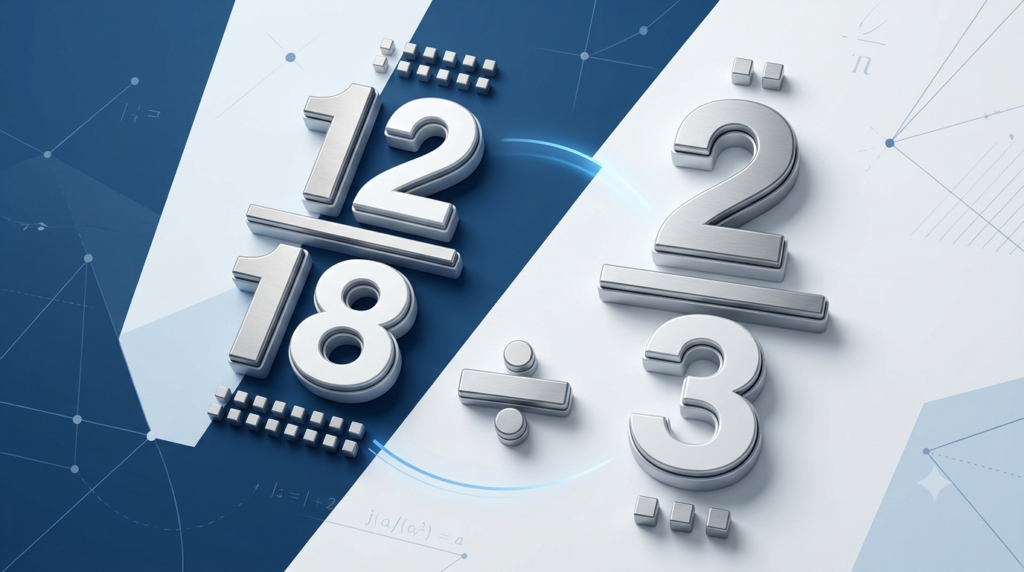
12/18
Both 12 and 18 can be divided by 2.
(12 ÷ 2) / (18 ÷ 2) = 6/9
Now divide both numbers by 3:
(6 ÷ 3) / (9 ÷ 3) = 2/3
Therefore:
12/18 = 6/9 = 2/3
The fraction 2/3 is the simplest form of 12/18.
However, division can only be used when the chosen number divides both the numerator and denominator without leaving a remainder. If there is no common factor other than 1, the fraction is already in its simplest form.
Equivalent Fractions and Simplifying Fractions
Equivalent fractions and simplifying fractions are closely related mathematical concepts.
Generating equivalent fractions usually involves multiplying the numerator and denominator by the same number to create different forms of the original fraction.
Simplifying a fraction involves dividing its numerator and denominator by a common factor to obtain a fraction with smaller numbers.
For example:
8/12
Divide both numbers by 2:
4/6
Divide both numbers by 2 again:
2/3
Therefore:
8/12 = 4/6 = 2/3
The fraction 2/3 is the simplest form because 2 and 3 have no common factor other than 1.
Simplifying fractions makes calculations easier and helps us compare fractions more conveniently.
How to Check Whether Two Fractions Are Equivalent
You can check whether two fractions are equivalent by using cross-multiplication.
Suppose you want to check whether 2/3 and 4/6 are equivalent.
Multiply the numerator of the first fraction by the denominator of the second fraction:
2 × 6 = 12
Now multiply the numerator of the second fraction by the denominator of the first fraction:
4 × 3 = 12
Both products are equal.
Therefore:
2/3 = 4/6
The cross-multiplication method can be used to compare two fractions without converting them into decimals.
For two fractions a/b and c/d, they are equivalent when:
a × d = b × c
This method is useful when checking answers produced by an equivalent fraction generator.
Why Are Equivalent Fractions Important?
Equivalent fractions are used in many areas of mathematics and everyday life. Understanding them makes several mathematical operations easier.
Comparing Fractions
Equivalent fractions help compare fractions with different denominators.
For example, comparing 1/2 and 2/4 becomes easier when you recognize that both fractions represent the same value.
Adding and Subtracting Fractions
When adding or subtracting fractions with different denominators, you often need to convert them into equivalent fractions with a common denominator.
For example:
1/2 + 1/4
Convert 1/2 into 2/4:
2/4 + 1/4 = 3/4
Equivalent fractions make it possible to perform these calculations correctly.
Understanding Ratios
Fractions and ratios are closely connected. Equivalent fractions help express the same relationship using different numbers.
For example, the ratio 2:3 is equivalent to 4:6 because both numbers have been multiplied by 2.
Working with Measurements
Equivalent fractions are useful when measuring ingredients, distances, lengths, and quantities.
For example, 1/2 of a cup is equal to 2/4 of a cup. Recognizing these relationships can make measurement conversions easier.
Learning More Advanced Mathematics
The concept of equivalent fractions provides a foundation for understanding decimals, percentages, ratios, proportions, and algebra.
A strong understanding of fraction equivalence makes it easier to learn these related topics.
Benefits of Using an Equivalent Fraction Generator
An online equivalent fraction generator offers several practical advantages.
Saves Time
Manually calculating multiple equivalent fractions can take time. The generator performs the calculations quickly and displays the results automatically.
Reduces Calculation Errors
Applying multiplication to both parts of a fraction requires care. An online tool helps reduce common arithmetic mistakes.
Supports Mathematics Learning
Students can enter different fractions and observe how their values remain unchanged when the numerator and denominator are multiplied by the same number.
Provides Multiple Results
Instead of calculating one equivalent fraction at a time, users can generate several results from a single input.
Helps with Homework and Practice
The tool can be used to check answers, practice fraction problems, and understand mathematical relationships.
Easy to Use
A simple interface with numerator and denominator fields makes the tool accessible to beginners and experienced users.
Important Rules for Equivalent Fractions
Keep these basic rules in mind when generating or checking equivalent fractions:
Multiply the numerator and denominator by the same non-zero number to generate an equivalent fraction.
Divide both parts by the same common factor to simplify a fraction.
Never multiply only the numerator or only the denominator when generating an equivalent fraction.
Adding or subtracting the same number from the numerator and denominator does not generally produce an equivalent fraction.
The denominator of a fraction cannot be zero.
Equivalent fractions always represent the same numerical value.
A fraction can have many equivalent forms.
Following these rules helps you use the generator correctly and understand the calculations behind its results.
Conclusion
An Equivalent Fraction Generator is a practical online mathematics tool that helps users create fractions with the same value as a given fraction. It uses a simple mathematical rule: multiply the numerator and denominator by the same non-zero number to generate equivalent fractions.
Whether you are learning basic fractions, solving homework problems, comparing values, or performing fraction calculations, this tool can make the process faster and easier.
Understanding equivalent fractions is also important for learning addition, subtraction, simplification, ratios, proportions, and other mathematical concepts. By using the generator and practising the examples explained in this article, you can develop a stronger understanding of fractions and use them with greater confidence.
FAQs
1. What is an Equivalent Fraction Generator?
An Equivalent Fraction Generator is an online mathematical tool that creates different fractions with the same numerical value as an original fraction. You simply enter the numerator and denominator, select how many results you need, and generate equivalent fractions instantly. For example, entering 2/3 can produce 4/6, 6/9, 8/12, and 10/15. All these fractions represent the same value. This tool is useful for students, teachers, and anyone who wants to understand fractions, practise mathematical calculations, or check equivalent fraction examples without performing repeated calculations manually.
2. How do you generate equivalent fractions?
You can generate equivalent fractions by multiplying the numerator and denominator of the original fraction by the same non-zero number. For example, consider 3/4. Multiplying both numbers by 2 gives 6/8. Multiplying both by 3 gives 9/12. Therefore, 3/4, 6/8, and 9/12 are equivalent fractions. You can continue this process using different positive integers to generate more results. An online Equivalent Fraction Generator performs these calculations automatically and displays the results within seconds.
3. Are equivalent fractions always equal in value?
Yes, equivalent fractions always represent the same numerical value, even when their numerators and denominators are different. For example, 1/2, 2/4, 3/6, and 4/8 all represent one-half. This happens because both the numerator and denominator are multiplied or divided by the same non-zero number. The relationship between the parts and the whole remains unchanged. Equivalent fractions are particularly useful when comparing, adding, or subtracting fractions with different denominators.
4. What is the formula for equivalent fractions?
The formula for generating equivalent fractions is (Numerator × n) / (Denominator × n), where n represents any non-zero number. For example, if the original fraction is 2/5 and the multiplier is 3, multiply the numerator and denominator by 3. The calculation becomes (2 × 3)/(5 × 3), resulting in 6/15. Therefore, 6/15 is equivalent to 2/5. This formula is the basic mathematical principle used by equivalent fraction calculators and generators.
5. Can I generate multiple equivalent fractions at once?
Yes, you can generate multiple equivalent fractions at once using an online Equivalent Fraction Generator. Enter the numerator and denominator, choose the number of results you want, and click the generate button. The tool calculates each fraction by multiplying the original numerator and denominator by successive positive integers. For example, selecting 10 results generates ten equivalent fractions. This saves time compared with calculating every fraction manually and makes it easier to study different fraction relationships.
6. What is the difference between equivalent fractions and simplified fractions?
Equivalent fractions are different fractions that represent the same value, whereas a simplified fraction is an equivalent fraction expressed in its lowest terms. For example, 2/4, 3/6, and 4/8 are equivalent fractions. However, 1/2 is their simplified form. A fraction is simplified when its numerator and denominator have no common factor other than 1. Simplifying fractions makes mathematical calculations easier and helps represent fractional values using smaller numbers.
7. How can I check whether two fractions are equivalent?
You can check whether two fractions are equivalent using cross-multiplication. Multiply the numerator of the first fraction by the denominator of the second fraction. Then multiply the denominator of the first fraction by the numerator of the second. If both products are equal, the fractions are equivalent. For example, compare 2/3 and 4/6. The cross-products are 2 × 6 = 12 and 3 × 4 = 12. Since both products are equal, the fractions are equivalent.
8. Can equivalent fractions have different denominators?
Yes, equivalent fractions can have different denominators while representing exactly the same value. For example, 1/2, 2/4, 3/6, and 5/10 have different denominators, but they all represent one-half. This is possible because the numerator and denominator are multiplied by the same non-zero number. Different denominators are particularly important when adding or subtracting fractions, as equivalent fractions help convert fractions into a common denominator before performing calculations.
9. Can every fraction have infinitely many equivalent fractions?
Yes, every valid fraction has infinitely many equivalent fractions. You can generate additional equivalent fractions by multiplying its numerator and denominator by increasingly larger positive integers. For example, 1/3 is equivalent to 2/6, 3/9, 4/12, 5/15, and many more. There is no fixed limit to the number of equivalent fractions you can create. An online generator helps you produce a selected number of these fractions quickly and conveniently.
10. Who can use an Equivalent Fraction Generator?
An Equivalent Fraction Generator can be used by students, teachers, parents, and anyone interested in learning mathematics. Students can use it to understand equivalent fractions and check homework calculations. Teachers can generate examples for classroom explanations and practice exercises. Parents can use it to help children learn basic fraction concepts at home. It is also useful for anyone who wants to simplify fractions, explore numerical relationships, or understand how different fractions can represent the same quantity. No advanced mathematical knowledge is required to use the tool.