Decimal to Standard Form Converter
Convert decimal numbers into scientific notation using powers of 10. Enter a number below to get your answer instantly.
Try These Examples
Standard form, also called scientific notation, represents a number as a coefficient multiplied by a power of 10. For nonzero numbers, the coefficient's absolute value is at least 1 and less than 10. Zero is represented as 0.
A Decimal to Standard Form Converter is an online mathematical tool that converts ordinary decimal numbers into standard form, also known as scientific notation. It makes it easier to write, read, and work with very large numbers and very small numbers. Instead of writing a long number with many zeros, you can express it using a coefficient and a power of 10.
For example, the number 450000 can be written as 4.5 × 10⁵, while the decimal number 0.00072 can be written as 7.2 × 10⁻⁴. Both forms represent exactly the same numerical values, but standard form provides a shorter and more convenient way to represent them.
This converter is useful for students, teachers, scientists, engineers, and anyone who works with mathematical calculations. It helps users understand scientific notation, check their answers, and convert decimal numbers quickly without performing every step manually.
In this article, you will learn what standard form means, how a Decimal to Standard Form Converter works, how to convert decimal numbers into standard form, and why this mathematical tool is useful in everyday calculations and scientific applications.
What Is Standard Form?
Standard form is a method of writing a number as a coefficient multiplied by a power of 10. It is commonly used in mathematics and science to represent extremely large or extremely small numbers in a compact format.
A number written in standard form follows this general pattern:
a × 10ⁿ
Here, a represents the coefficient, 10 is the base, and n is the exponent.
For a nonzero number in normalized standard form, the absolute value of the coefficient must be greater than or equal to 1 and less than 10. The exponent can be positive, negative, or zero.
For example:
6000 = 6 × 10³
85000 = 8.5 × 10⁴
0.004 = 4 × 10⁻³
0.00091 = 9.1 × 10⁻⁴
32 = 3.2 × 10¹
When the exponent is positive, the number is generally greater than or equal to 10 when written in normalized form with a positive exponent. When the exponent is negative, the number has a coefficient multiplied by a fraction of 1, making it useful for representing small nonzero values.
Zero is a special case and is simply written as 0.
Standard form is particularly helpful when a number contains many digits or several zeros. It allows the size of a number to be understood more easily without writing the entire decimal representation.
What Is a Decimal to Standard Form Converter?
A Decimal to Standard Form Converter is a digital tool that automatically transforms an ordinary decimal number into scientific notation.
Users enter a number into the input field, and the converter calculates the appropriate coefficient and exponent. The result is then displayed in standard form.
For example, if you enter 7200000, the converter produces:
7.2 × 10⁶
Similarly, entering 0.000056 produces:
5.6 × 10⁻⁵
The tool determines how many places the decimal point must move to create a coefficient whose absolute value is at least 1 and less than 10. It then uses that movement to calculate the corresponding power of 10.
A positive exponent is used when the decimal point moves to the left to represent a large number. A negative exponent is used when the decimal point moves to the right to represent a small nonzero number.
The converter performs these calculations automatically, helping users obtain results quickly and reduce common calculation mistakes.
How Does the Decimal to Standard Form Converter Work?
The converter follows a mathematical process to transform an input number into standard form. Although the process happens automatically, understanding its basic operation helps users learn the concept more effectively.
1. Enter a Decimal Number
Begin by entering a valid number into the converter’s input field.
Examples include:
4500
125.6
0.00072
830000
-35000
You can enter whole numbers, decimal numbers, and negative numbers. The converter analyzes the input and determines the appropriate standard form representation.
2. Identify the Coefficient
The coefficient is the number placed before the multiplication sign in standard form.
For example, in the expression 4.5 × 10³, the coefficient is 4.5.
To find the coefficient, the decimal point is moved until the number has only one nonzero digit before the decimal point. For negative numbers, the negative sign remains part of the coefficient.
For example, 56000 becomes 5.6 × 10⁴. The coefficient is 5.6.
Similarly, 0.0078 becomes 7.8 × 10⁻³. The coefficient is 7.8.
3. Calculate the Exponent
The exponent indicates the power of 10 required to preserve the original value.
Count how many places the decimal point moves to obtain the coefficient.
For example, when converting 4500 to 4.5, the decimal point moves three places to the left. Therefore, the exponent is 3.
The result is:
4500 = 4.5 × 10³
For 0.00072, the decimal point moves four places to the right to obtain 7.2. Therefore, the exponent is −4.
The result is:
0.00072 = 7.2 × 10⁻⁴
4. Display the Result
Once the coefficient and exponent have been calculated, the converter displays the final result in standard form.
Depending on the tool’s features, users may also see the coefficient and exponent separately or copy the result for use in homework, notes, reports, and calculations.
How to Convert Decimal Numbers into Standard Form
You can convert a decimal number into standard form manually by following a few simple steps.
Step 1: Write the Original Number
Start with the number you want to convert.
For example:
68000
Step 2: Move the Decimal Point
Move the decimal point until the number has one nonzero digit before it.
For 68000, move the decimal point four places to the left.
68000 becomes 6.8.
Step 3: Determine the Exponent
Because the decimal point moved four places to the left, the exponent is positive 4.
Step 4: Write the Final Expression
Multiply the coefficient by 10 raised to the calculated exponent.
68000 = 6.8 × 10⁴
The original number and its standard form are mathematically equivalent.
For small numbers, the procedure is similar, but the exponent is negative.
For example, consider 0.00034.
Move the decimal point five places to the right to obtain 3.4. Since the number is less than 1, the exponent is −5.
Therefore:
0.00034 = 3.4 × 10⁻⁵
The Decimal to Standard Form Converter performs these steps automatically, making the conversion faster and more convenient.
Examples of Decimal to Standard Form Conversion
The following examples demonstrate how different types of numbers can be expressed in standard form.
Example 1: Converting 5000
The number 5000 is a whole number with three zeros after 5.
Move the decimal point three places to the left to obtain 5.
Therefore:
5000 = 5 × 10³
The coefficient is 5, and the exponent is 3.
Example 2: Converting 73500
The number 73500 can be converted by moving the decimal point four places to the left.
73500 = 7.35 × 10⁴
The coefficient is 7.35, and the exponent is 4.
Example 3: Converting 0.0064
The number 0.0064 is smaller than 1.
Move the decimal point three places to the right to obtain 6.4. This requires a negative exponent.
0.0064 = 6.4 × 10⁻³
The coefficient is 6.4, and the exponent is −3.
Example 4: Converting 0.0000082
The number contains several zeros after the decimal point before the first nonzero digit.
Move the decimal point six places to the right to obtain 8.2.
Therefore:
0.0000082 = 8.2 × 10⁻⁶
The negative exponent indicates that the original number is very small.
Example 5: Converting 125.6
The number 125.6 must be expressed with a coefficient between 1 and 10 in absolute value.
Move the decimal point two places to the left to obtain 1.256.
Therefore:
125.6 = 1.256 × 10²
Example 6: Converting a Negative Number
Negative numbers can also be written in standard form.
Consider −45000.
Move the decimal point four places to the left to obtain −4.5.
Therefore:
−45000 = −4.5 × 10⁴
The negative sign remains part of the coefficient. The exponent is positive because the magnitude of the original number is large.
Positive and Negative Exponents Explained
Understanding the exponent is one of the most important parts of converting decimal numbers into standard form.
Positive Exponents
Positive exponents are commonly used to represent large numbers.
For example:
3 × 10² = 300
4.5 × 10³ = 4500
6.2 × 10⁵ = 620000
A positive exponent tells you how many times the base 10 is multiplied by itself. When a coefficient is multiplied by a positive power of 10, its decimal point effectively shifts to the right.
For instance, 2.5 × 10³ equals 2500.
Negative Exponents
Negative exponents are commonly used to represent small nonzero numbers.
For example:
5 × 10⁻¹ = 0.5
7.2 × 10⁻³ = 0.0072
4.1 × 10⁻⁵ = 0.000041
A negative exponent represents the reciprocal of a positive power of 10.
For example:
10⁻³ = 1 ÷ 1000 = 0.001
Therefore, 7.2 × 10⁻³ equals 0.0072.
The negative exponent does not mean that the number itself is negative. It indicates that the power of 10 is a fraction. A number with a negative coefficient can also have a positive or negative exponent.
Features of a Decimal to Standard Form Converter
An online converter can make mathematical calculations easier by combining several useful features in one interface.
Instant Conversion
The converter calculates standard form automatically when you submit a valid number. You do not need to count decimal places manually or calculate the exponent yourself.
This is particularly helpful when working with numbers containing many zeros.
Support for Large and Small Numbers
The tool can convert large numbers, such as 4500000, and small decimal numbers, such as 0.0000045.
Both types can be expressed in a compact form using powers of 10.
Negative Number Support
Negative numbers can also be converted into standard form. The negative sign is preserved in the coefficient, while the exponent represents the decimal-point movement needed to normalize the number.
Clear Result Display
The converted number is displayed with its coefficient and exponent, making the result easier to understand.
Some converters also display these components separately to help users learn how standard form is constructed.
Copy Result Function
A copy feature allows users to copy the converted expression and paste it into notes, assignments, documents, or other applications.
Depending on the converter, the copied exponent may appear as plain text, such as 10^3, rather than as a superscript character.
Mobile-Friendly Design
A responsive converter can work on desktop computers, laptops, tablets, and smartphones.
A mobile-friendly interface uses readable text, appropriately sized input fields, and touch-friendly buttons so users can perform conversions conveniently on different devices.
Why Is Standard Form Important?
Standard form is widely used because it simplifies the representation of numbers that would otherwise be difficult to write and interpret.
Makes Large Numbers Easier to Read
Writing 8500000000000 requires many digits. In standard form, the same number is expressed as 8.5 × 10¹².
This representation is shorter and makes the magnitude of the number easier to recognize.
Simplifies Small Decimal Numbers
Very small numbers often contain multiple zeros after the decimal point. Standard form provides a concise alternative.
For example:
0.000000031 = 3.1 × 10⁻⁸
This format reduces the chance of overlooking a zero when copying or reading the number.
Supports Scientific Calculations
Scientists frequently work with quantities that vary enormously in magnitude. Standard form helps represent these quantities in a consistent way.
It is useful in physics, chemistry, astronomy, biology, engineering, and other scientific disciplines.
Helps With Multiplication and Division
Scientific notation can simplify calculations involving large and small numbers.
When multiplying two numbers in standard form, multiply the coefficients and add the exponents.
For example:
(2 × 10³) × (3 × 10²) = 6 × 10⁵
When dividing two nonzero numbers in standard form, divide the coefficients and subtract the exponent in the denominator from the exponent in the numerator.
For example:
(8 × 10⁶) ÷ (2 × 10²) = 4 × 10⁴
These rules make many scientific calculations more manageable.
Applications of Standard Form in Science and Mathematics
Standard form is not limited to classroom mathematics. It is also useful in practical and scientific situations.
Physics
Physics involves measurements such as the speed of light, distances, energies, and particle masses. Some of these quantities are extremely large, while others are extremely small.
Scientific notation allows physicists to express measurements more conveniently and perform calculations without repeatedly writing long strings of zeros.
Chemistry
Chemistry often deals with microscopic particles, molecular quantities, and extremely small masses.
Standard form helps chemists represent these values clearly and use them in calculations involving atoms, molecules, concentrations, and other quantities.
Astronomy
Astronomy involves enormous distances between planets, stars, and galaxies.
Expressing these distances in standard form makes them easier to write and compare. For example, a distance of 150000000000 metres can be written as 1.5 × 10¹¹ metres.
Biology
Biology includes measurements of cells, microorganisms, and microscopic structures.
Small dimensions can be represented using negative powers of 10, making scientific measurements easier to record and interpret.
Engineering and Technology
Engineers frequently work with measurements involving electrical components, signal frequencies, physical dimensions, and energy values.
Standard form makes it easier to express quantities that vary across many orders of magnitude.
Mathematics Education
Students learn standard form as part of number representation, powers of 10, exponents, and scientific notation.
Using an online converter allows them to check their calculations and compare manual methods with automatically generated results.
Common Mistakes to Avoid
Although converting decimal numbers into standard form is straightforward, several mistakes can lead to incorrect answers.
Using the Wrong Exponent Sign
One common mistake is assigning a positive exponent to a small nonzero decimal number.
For example, 0.004 should be written as 4 × 10⁻³, not 4 × 10³.
Always check whether the original number is smaller or larger than 1.
Counting Decimal Places Incorrectly
The exponent depends on the number of places the decimal point moves.
For example, 72000 becomes 7.2 × 10⁴ because the decimal point moves four places to the left.
Carefully counting the movement helps prevent errors.
Writing an Incorrect Coefficient
In normalized standard form, the absolute value of the coefficient must be at least 1 and less than 10 for any nonzero number.
For example, 45 × 10² is mathematically equal to 4500, but it is not in normalized standard form. The normalized representation is 4.5 × 10³.
Forgetting the Negative Sign
When converting a negative number, the sign must remain unchanged.
For example:
−6200 = −6.2 × 10³
The coefficient is negative, but the exponent is positive.
Confusing a Negative Exponent With a Negative Number
A negative exponent does not automatically make the entire number negative.
For example, 3 × 10⁻² equals 0.03, which is positive.
By contrast, −3 × 10⁻² equals −0.03.
Understanding the difference between the sign of the coefficient and the sign of the exponent is essential.
Decimal to Standard Form Converter vs Manual Conversion
Both online conversion and manual calculation can produce the same mathematical result, but each method has its own advantages.
Manual conversion helps learners understand decimal-point movement, coefficients, and powers of 10. It is especially valuable when studying the underlying mathematical concepts.
An online converter is useful when you need a quick result, want to verify an answer, or need to convert several numbers efficiently.
The best approach is to understand the manual method first and then use the converter to check your work. This combines conceptual learning with the convenience of an automated tool.
How to Use the Decimal to Standard Form Converter Effectively
To get the best results from an online converter, follow these simple guidelines.
Enter the complete number you want to convert.
Check that the input contains only a valid numerical value.
Select the Convert button to calculate the result.
Read the coefficient and exponent displayed by the tool.
Check that the coefficient is normalized and that the exponent has the correct sign.
Use the Copy Result button if you need to paste the expression into another document.
Try different example numbers to become familiar with large numbers, small decimals, and negative values.
If the input is empty or contains unsupported characters, correct it and try again.
Remember that standard form changes how a number is represented, not its actual value. The converted expression should always be mathematically equivalent to the original number.
Conclusion
A Decimal to Standard Form Converter is a practical online mathematical tool that transforms ordinary decimal numbers into scientific notation quickly and conveniently. It represents numbers as a coefficient multiplied by a power of 10, making extremely large and extremely small values easier to read, compare, and calculate.
Understanding the relationship between decimal-point movement and the exponent is essential for using standard form correctly. Positive exponents commonly represent large magnitudes, while negative exponents represent small nonzero magnitudes. The coefficient must have an absolute value between 1 and 10 for a nonzero number in normalized standard form.
Whether you are studying mathematics, completing scientific calculations, or checking numerical results, this converter can save time and help reduce common mistakes. Use it alongside manual practice to strengthen your understanding of decimal numbers, powers of 10, and scientific notation.
FAQs
1. What is a Decimal to Standard Form Converter?
A Decimal to Standard Form Converter is an online mathematical tool that changes ordinary numbers into standard form, also known as scientific notation. It expresses a number as a coefficient multiplied by a power of 10. For example, 4500 becomes 4.5 × 10³, while 0.00072 becomes 7.2 × 10⁻⁴. This format makes large and small numbers easier to read, write, and calculate. The converter performs the calculation automatically, helping students, teachers, and science enthusiasts obtain accurate results quickly without manually counting decimal places.
2. How do you convert a decimal number into standard form?
To convert a decimal number into standard form, move the decimal point until the absolute value of the number is at least 1 but less than 10. Count how many places the decimal point moves. If it moves to the left, the exponent is positive. If it moves to the right, the exponent is negative. For example, 56000 becomes 5.6 × 10⁴, while 0.0056 becomes 5.6 × 10⁻³. Multiply the resulting coefficient by the appropriate power of 10 to express the original number in standard form.
3. What is the formula for standard form?
The general mathematical expression for standard form is a × 10ⁿ, where a represents the coefficient and n represents an integer exponent. For a nonzero number in normalized standard form, the absolute value of a must be greater than or equal to 1 and less than 10. For example, 72000 can be written as 7.2 × 10⁴. Similarly, 0.00072 becomes 7.2 × 10⁻⁴. The exponent determines the power of 10 used in the expression. Zero is a special case and is represented simply as 0.
4. What is the difference between positive and negative exponents in standard form?
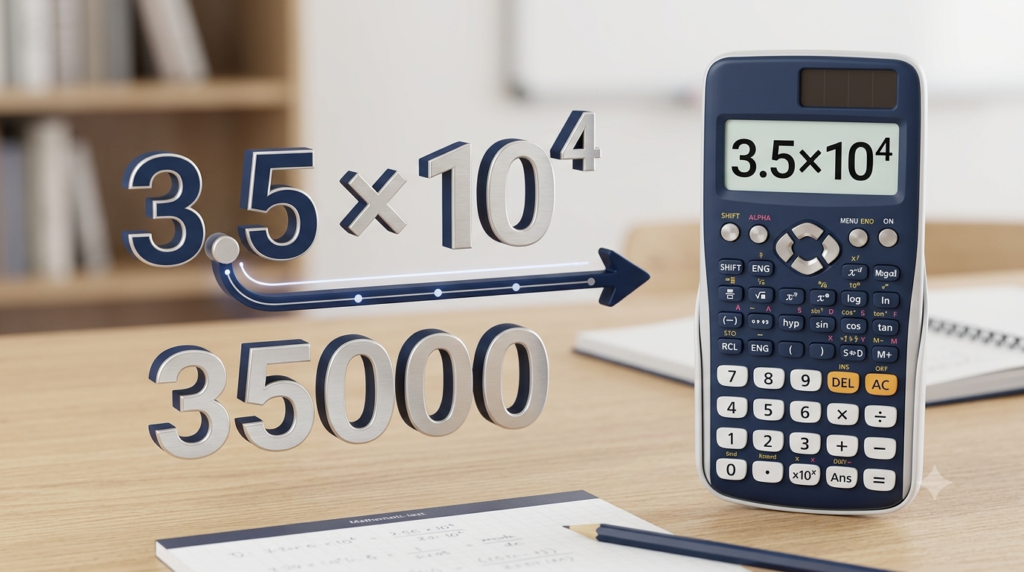
Positive and negative exponents indicate different powers of 10. A positive exponent commonly represents large numbers, while a negative exponent represents fractions of 1 and is useful for small nonzero numbers. For example, 3.5 × 10³ equals 3500 because 10³ equals 1000. In contrast, 3.5 × 10⁻³ equals 0.0035 because 10⁻³ equals 0.001. Remember that a negative exponent does not automatically make the entire number negative. The sign of the coefficient determines whether the represented number is positive or negative.
5. Can a Decimal to Standard Form Converter handle negative numbers?
Yes, a Decimal to Standard Form Converter can handle negative numbers if the tool supports signed numerical inputs. The negative sign remains part of the coefficient, while the exponent represents the power of 10 required to express the number in normalized form. For example, −45000 becomes −4.5 × 10⁴, and −0.0032 becomes −3.2 × 10⁻³. The conversion process is otherwise similar to that used for positive numbers. Always check that the negative sign is preserved in the result when converting negative decimal values.
6. Why is standard form useful in mathematics and science?
Standard form is useful because it provides a compact way to represent numbers that contain many digits or zeros. Scientists and mathematicians often work with extremely large distances, tiny particles, and measurements that are difficult to write in ordinary decimal notation. For example, 150000000000 can be expressed as 1.5 × 10¹¹. Similarly, 0.00000045 becomes 4.5 × 10⁻⁷. This notation simplifies reading, comparing, multiplying, and dividing numerical values. It is widely used in physics, chemistry, astronomy, biology, engineering, and other fields involving numerical calculations.
7. Is standard form the same as scientific notation?
Standard form and scientific notation are often used to describe the same numerical format, particularly in science and international mathematics education. Both commonly express a number as a coefficient multiplied by a power of 10, with the coefficient’s absolute value between 1 and 10 for nonzero numbers. For example, 620000 is written as 6.2 × 10⁵. However, terminology can vary by country and educational system. In some British mathematics curricula, standard form specifically refers to this format, while other contexts may use the term standard form differently.
8. Can I convert very small decimal numbers into standard form?
Yes, very small nonzero decimal numbers can be converted into standard form using negative exponents. Move the decimal point to the right until the coefficient’s absolute value is at least 1 and less than 10. Count the number of places moved and use that number as a negative exponent. For example, 0.0000084 becomes 8.4 × 10⁻⁶ because the decimal point moves six places to the right. An online converter performs this process automatically, helping you avoid errors when working with decimal numbers containing several zeros.
9. Is an online Decimal to Standard Form Converter accurate?
An online Decimal to Standard Form Converter can provide reliable results when it uses correct mathematical calculations and receives valid input. However, accuracy may depend on the tool’s numerical precision, supported input range, and rounding rules. Some converters round long decimal values, which can slightly change the displayed approximation. For ordinary school-level calculations, a well-designed converter is generally convenient for checking answers. For very large numbers, very small numbers, or precision-sensitive scientific work, verify the result and consider whether significant digits or rounding are appropriate for your calculation.
10. How can I use a Decimal to Standard Form Converter?
To use a Decimal to Standard Form Converter, enter a valid number in the input field and select the Convert button. The tool will display the number in standard form, including its coefficient and exponent. For example, entering 125.6 produces 1.256 × 10². You can then check the result or use the Copy Result button, if available, to copy it into your notes or assignments. Try converting both large numbers and small decimal values to understand how positive and negative exponents work. Always check the result when accuracy is important.