Basic arithmetic symbols are the mathematical signs used to perform calculations and express relationships between numbers. They help us understand whether numbers should be added, subtracted, multiplied, or divided. These symbols are among the first concepts people learn when studying mathematics because they form the foundation of everyday calculations and more advanced mathematical topics.
For example, when calculating the total price of items, finding the difference between two numbers, or sharing something equally among several people, arithmetic symbols make the process easier to understand. Symbols such as plus (+), minus (−), multiplication (×), and division (÷) are commonly used in schools, workplaces, shops, and daily life.
Learning these symbols involves more than memorizing their names. It also requires understanding their meanings, knowing when to use them, and recognizing how they work with numbers. In this article, we will explore the basic arithmetic symbols in mathematics, their uses, examples, and importance in everyday calculations.
What Are Basic Arithmetic Symbols?
Basic arithmetic symbols are signs used to represent fundamental mathematical operations involving numbers. They communicate what type of calculation needs to be performed and help present mathematical expressions in a short, clear, and standardized form.
For example, the expression 5 + 3 tells us to add 5 and 3. The expression 9 − 4 tells us to subtract 4 from 9. Instead of describing every calculation in words, we can use mathematical symbols to express it efficiently.
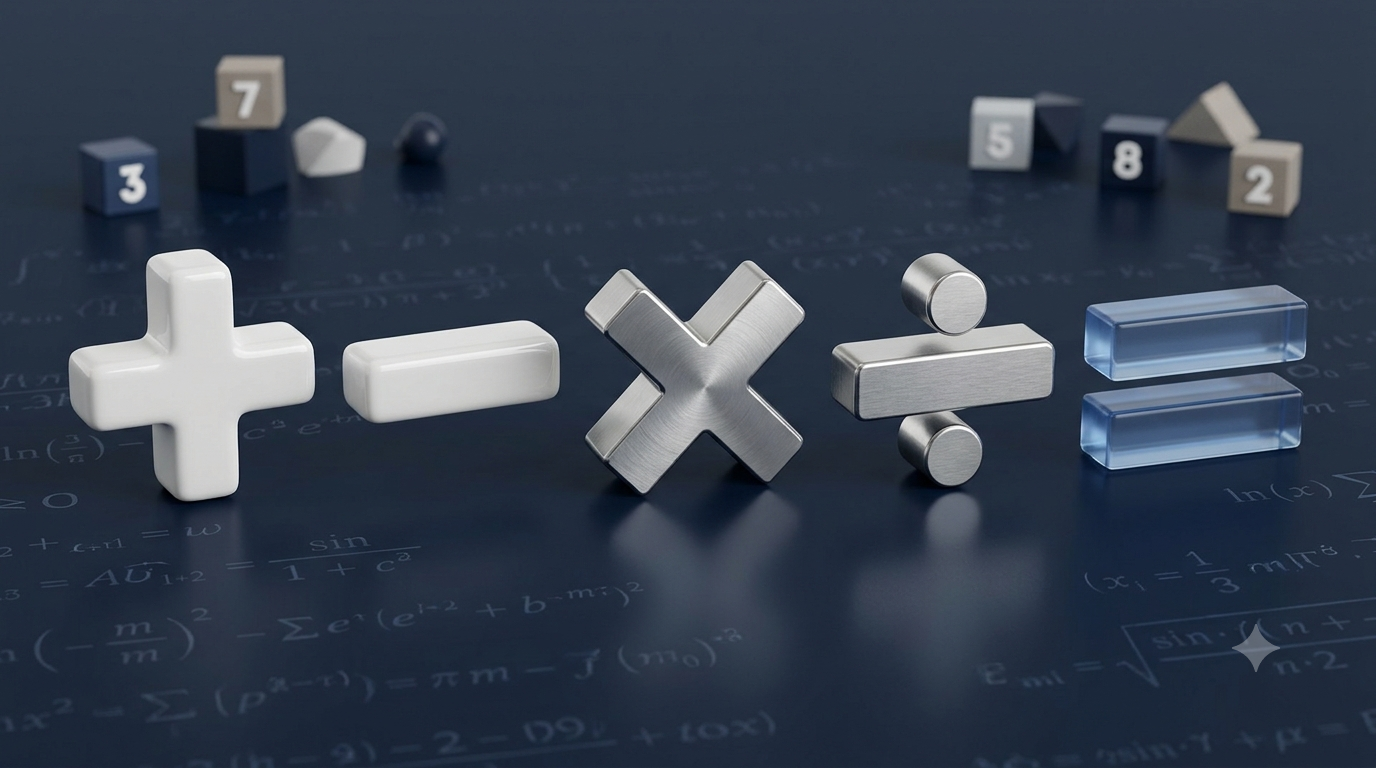
The four main arithmetic operations are addition, subtraction, multiplication, and division. Their corresponding symbols are +, −, ×, and ÷.
Other symbols, such as the equals sign (=), parentheses ( ), and percentage sign (%), are also important when working with arithmetic. They help express equality, organize calculations, and represent percentages.
Understanding these symbols allows learners to read mathematical expressions correctly and solve numerical problems with greater confidence.
The Four Main Arithmetic Symbols
1. Addition Symbol (+)
The plus sign (+) is the symbol used for addition. Addition means combining two or more numbers to find their total or sum.
For example, if you have 4 apples and receive 3 more apples, you can use addition to calculate the total number of apples.
Example:
4 + 3 = 7
In this example, 4 and 3 are the numbers being added, and 7 is their sum.
Addition can be used with whole numbers, fractions, decimals, and many other types of numbers.
More examples:
8 + 5 = 13
12 + 7 = 19
2.5 + 1.5 = 4
1/4 + 1/4 = 1/2
Common uses of addition:
Calculating the total cost of several items.
Finding the total number of objects in different groups.
Adding marks obtained in different subjects.
Calculating the combined distance travelled during separate journeys.
The plus sign is one of the most frequently used mathematical symbols because addition appears in many everyday situations.
2. Subtraction Symbol (−)
The minus sign (−) represents subtraction. Subtraction is used to find the difference between numbers or determine how much remains after taking one quantity away from another.
For example, suppose you have 10 pencils and give 4 pencils to a friend. Subtraction helps you calculate how many pencils remain.
Example:
10 − 4 = 6
Here, 10 is the number from which another number is subtracted, 4 is the number being subtracted, and 6 is the difference.
More examples:
15 − 6 = 9
20 − 8 = 12
7.5 − 2.5 = 5
3/4 − 1/4 = 1/2
Common uses of subtraction:
Calculating the change received after a purchase.
Finding the difference between two measurements.
Determining how many items remain after some are removed.
Comparing the scores of two players.
Calculating the time remaining before an event.
Subtraction is especially useful when comparing quantities or finding the amount by which one number is greater or smaller than another.
3. Multiplication Symbol (×)
The multiplication sign (×) represents multiplication. Multiplication is a mathematical operation that can be understood as repeated addition when working with whole numbers.
For example, if four boxes contain 3 balls each, multiplication can be used to calculate the total number of balls.
Example:
4 × 3 = 12
This means that 3 is added four times, giving a total of 12.
3 + 3 + 3 + 3 = 12
Multiplication is particularly useful when the same quantity occurs repeatedly.
More examples:
5 × 2 = 10
7 × 6 = 42
9 × 4 = 36
2.5 × 4 = 10
The multiplication symbol is often used in elementary arithmetic. In algebra and other areas of mathematics, multiplication may also be represented by a dot (·) or by writing numbers and variables next to each other.
For example, 3 · 4 and 3 × 4 both represent multiplication. In algebra, 3a means 3 multiplied by a.
Common uses of multiplication:
Calculating the total price of several identical items.
Finding the total number of objects arranged in equal groups.
Calculating the area of a rectangle.
Working with repeated quantities and mathematical formulas.
Multiplication makes calculations involving repeated addition faster and more convenient.
4. Division Symbol (÷)
The division sign (÷) represents division. Division is used to split a quantity into equal groups or determine how many times one number fits into another.
For example, if 12 chocolates are shared equally among 4 children, division tells us how many chocolates each child receives.
Example:
12 ÷ 4 = 3
Each child receives 3 chocolates.
More examples:
20 ÷ 5 = 4
36 ÷ 6 = 6
18 ÷ 3 = 6
15 ÷ 2 = 7.5
Division is closely related to multiplication. If 4 × 3 = 12, then 12 ÷ 4 = 3 and 12 ÷ 3 = 4.
However, division requires special care because division by zero is undefined in ordinary arithmetic. For example, 8 ÷ 0 does not have a defined value.
Common uses of division:
Sharing items equally among people.
Calculating the cost of one item when the total cost is known.
Finding the average when a total is divided by the number of values.
Converting quantities into equal portions.
Solving problems involving rates and measurements.
Division is essential for understanding fractions, ratios, averages, and many other mathematical concepts.
Other Important Arithmetic Symbols
The four main operations are the foundation of arithmetic, but several additional symbols are frequently used when performing calculations.
1. Equals Sign (=)
The equals sign (=) indicates that the mathematical expressions on its left and right sides have the same value.
For example:
6 + 2 = 8
Both sides represent the number 8. Therefore, the statement is correct.
The equals sign does not simply mean that an answer follows a calculation. It expresses equality between two quantities or expressions.
Examples:
10 − 5 = 5
3 × 4 = 12
16 ÷ 4 = 4
7 + 3 = 6 + 4
The last example shows that two different calculations can have the same value.
The equals sign is important in arithmetic, algebra, equations, and scientific calculations.
2. Percentage Sign (%)
The percentage sign (%) represents a value expressed as a proportion out of 100.
The word percentage means “per hundred.” Therefore, 25% means 25 out of every 100.
For example, if a student answers 80 questions correctly out of 100, the score is 80%.
Example:
25% of 200 = 50
This is because 25% is equivalent to 25/100, and 25/100 × 200 = 50.
Percentages are commonly used to calculate discounts, examination scores, interest rates, price increases, and changes in quantities.
3. Parentheses ( )
Parentheses are used to group numbers and operations together. They indicate which part of an expression should be evaluated first according to the rules of arithmetic.
For example:
(3 + 2) × 4 = 20
First, calculate the expression inside the parentheses: 3 + 2 = 5. Then multiply 5 by 4 to obtain 20.
Without parentheses, the expression 3 + 2 × 4 gives 11 because multiplication is performed before addition.
Parentheses help prevent confusion and make complex calculations easier to interpret.
4. Exponent or Power Symbol
An exponent indicates how many times a number is multiplied by itself. Exponents are commonly written as small numbers positioned above and to the right of a base number.
For example:
2² = 2 × 2 = 4
Similarly:
3³ = 3 × 3 × 3 = 27
The small number 2 in 2² is called the exponent, while 2 is the base.
Exponents are useful when working with squares, cubes, large numbers, scientific notation, and mathematical formulas.
5. Decimal Point (.)
A decimal point separates the whole-number part of a decimal from its fractional part.
For example, 4.75 represents four whole units and seventy-five hundredths.
Decimal numbers are useful when working with money, measurements, weights, distances, and quantities that are not whole numbers.
Examples:
2.5
7.25
0.75
12.08
The decimal point is important because its position affects the value of a number.
Summary of Basic Arithmetic Symbols
The following table summarizes the main arithmetic symbols and some other commonly used mathematical signs.
| Symbol | Name | Main purpose | Example |
|---|---|---|---|
| + | Plus | Addition | 5 + 3 = 8 |
| − | Minus | Subtraction | 9 − 4 = 5 |
| × | Multiplication sign | Multiplication | 4 × 3 = 12 |
| ÷ | Division sign | Division | 12 ÷ 4 = 3 |
| = | Equals sign | Shows equality | 6 + 2 = 8 |
| % | Percentage sign | Represents a value per hundred | 25% of 100 = 25 |
| ( ) | Parentheses | Groups operations | (2 + 3) × 4 = 20 |
| ² | Squared notation | Represents a power of two | 5² = 25 |
| ³ | Cubed notation | Represents a power of three | 2³ = 8 |
| . | Decimal point | Separates whole and fractional parts | 3.5 |
These symbols are used in different ways, but all help communicate mathematical information clearly.
How to Use Arithmetic Symbols Correctly
Knowing the names of arithmetic symbols is only the first step. It is equally important to understand how to use them correctly when solving mathematical expressions.
Follow the Order of Operations
When an expression contains several operations, they must be performed in the correct order. A commonly used rule is BODMAS, which stands for Brackets, Orders, Division, Multiplication, Addition, and Subtraction.
For example:
6 + 2 × 3 = 12
Multiplication comes before addition, so first calculate 2 × 3 = 6. Then add 6 to obtain 12.
The expression would produce a different result if addition were performed first.
When multiplication and division occur together, they are generally evaluated from left to right. Addition and subtraction follow the same left-to-right rule when they occur together, unless parentheses or other grouping conventions change the order.
Understand the Difference Between Similar Symbols
Some mathematical symbols look similar but have different meanings.
For example, the minus sign (−) represents subtraction, while the plus sign (+) represents addition. The multiplication sign (×) should not be confused with the letter x, which is often used as a variable in algebra.
Similarly, the equals sign (=) indicates equality, not addition or subtraction.
Understanding these differences helps prevent errors when reading expressions or solving problems.
Check Your Answers
One useful way to check an arithmetic calculation is to use the related inverse operation.
For example, if you calculate 14 − 6 = 8, you can check the result using addition:
8 + 6 = 14
If the original number is obtained, the subtraction is correct.
Division can also be checked using multiplication. If 20 ÷ 5 = 4, then 4 × 5 = 20.
Checking calculations helps identify mistakes and strengthens understanding of the relationship between arithmetic operations.
Why Are Basic Arithmetic Symbols Important?
Basic arithmetic symbols are important because they provide a common language for expressing numerical information. People can understand mathematical expressions without needing lengthy written explanations.
They Make Calculations Easier
Symbols allow calculations to be written in a short and organized form. For example, 15 + 10 = 25 is simpler to write and interpret than a sentence describing the addition of fifteen and ten.
They Support Everyday Activities
Arithmetic symbols are used when shopping, managing money, measuring ingredients, calculating travel distances, comparing prices, and dividing quantities.
For example, a shopkeeper may use subtraction to calculate change, while a customer may use percentages to understand a discount.
They Build a Foundation for Advanced Mathematics
Arithmetic symbols introduce learners to the basic operations used in algebra, geometry, statistics, physics, chemistry, economics, and computer science.
Understanding these symbols makes it easier to learn equations, formulas, functions, and more advanced mathematical methods.
They Improve Mathematical Communication
Mathematical symbols have standardized meanings that help people communicate calculations accurately. This is especially useful in textbooks, examinations, scientific reports, and technical documents.
A correct understanding of symbols reduces ambiguity and makes mathematical reasoning easier to follow.
Common Mistakes When Using Arithmetic Symbols
Beginners sometimes make mistakes when interpreting or applying arithmetic symbols. Understanding these errors can help improve accuracy.
Confusing multiplication with addition: Multiplication and addition are different operations. For example, 4 + 3 = 7, whereas 4 × 3 = 12.
Ignoring the order of operations: In the expression 5 + 2 × 3, multiplication must be performed first. The correct answer is 11, not 21.
Misunderstanding division: Division does not always produce a whole number. For example, 7 ÷ 2 = 3.5.
Using the equals sign incorrectly: The equals sign indicates that both sides have the same value. It should not be used merely to separate unrelated steps or expressions.
Making decimal-place errors: The position of a decimal point changes a number’s value. For example, 2.5 and 25 are not equal.
Forgetting parentheses: Parentheses can change the order in which operations are performed. Always check whether an expression contains grouping symbols before calculating.
Practising simple examples and checking answers with inverse operations can help learners avoid these common mistakes.
Conclusion
Basic arithmetic symbols are essential tools for understanding and performing mathematical calculations. The four main symbols—plus (+), minus (−), multiplication (×), and division (÷)—represent the fundamental operations used to work with numbers. Other symbols, including the equals sign (=), percentage sign (%), parentheses, exponents, and decimal point, also play important roles in arithmetic.
Learning these symbols helps people solve everyday problems, understand numerical information, and develop the skills needed for advanced mathematics. The most effective way to learn them is to understand what each symbol means, practise using it in different situations, and check calculations carefully.
With a strong understanding of basic arithmetic symbols, learners can build a solid mathematical foundation and approach more complex numerical problems with confidence.
FAQs
1. What are basic arithmetic symbols in mathematics?
Basic arithmetic symbols are mathematical signs used to perform calculations and express relationships between numbers. The four main arithmetic symbols are the plus sign (+), minus sign (−), multiplication sign (×), and division sign (÷). These symbols represent addition, subtraction, multiplication, and division, respectively. Other commonly used symbols include the equals sign (=), percentage sign (%), and parentheses ( ). Arithmetic symbols make mathematical expressions easier to read, write, and understand. They are used in everyday activities such as shopping, measuring quantities, calculating expenses, and solving mathematical problems. Learning these symbols provides a foundation for understanding more advanced mathematics.
2. What are the four main arithmetic symbols?
The four main arithmetic symbols are plus (+), minus (−), multiplication (×), and division (÷). The plus sign is used to add numbers, while the minus sign helps subtract one number from another. The multiplication sign represents repeated addition or the multiplication of quantities. The division sign is used to split a quantity into equal groups or determine how many times one number fits into another. For example, 5 + 3 = 8, 9 − 4 = 5, 4 × 3 = 12, and 12 ÷ 4 = 3. These four operations form the foundation of basic arithmetic and everyday calculations.
3. What does the plus sign (+) mean in mathematics?
The plus sign (+) represents addition in mathematics. It indicates that two or more numbers should be combined to find their total or sum. For example, 6 + 4 = 10 means that adding 6 and 4 gives a result of 10. Addition can be performed with whole numbers, fractions, decimals, and other types of numbers. It is commonly used when calculating the total cost of items, combining quantities, adding examination marks, and determining the total distance travelled. The plus sign is one of the most frequently used mathematical symbols because addition is an essential part of everyday life.
4. What does the minus sign (−) mean in mathematics?
The minus sign (−) represents subtraction. It is used to find the difference between numbers or calculate how much remains after a quantity is removed. For example, 15 − 7 = 8 means that subtracting 7 from 15 gives a result of 8. Subtraction is useful when calculating the change received after shopping, comparing measurements, finding the difference between scores, or determining how many objects remain. It also helps solve problems involving decreases in quantities. The minus sign is important in arithmetic and is later used in algebra and other mathematical subjects to represent subtraction and negative values.
5. What is the difference between multiplication and division symbols?
The multiplication sign (×) represents multiplication, while the division sign (÷) represents division. Multiplication is used to calculate the total of equal groups or combine repeated quantities. For example, 4 × 3 = 12 means four groups of three make twelve. Division performs the opposite type of operation by splitting a quantity into equal groups or finding how many times one number fits into another. For example, 12 ÷ 3 = 4 means twelve divided into groups of three gives four groups. Multiplication and division are closely related, and each can help check the result of the other.
6. What does the equals sign (=) mean in mathematics?
The equals sign (=) indicates that the values on both sides of a mathematical statement are equal. For example, 5 + 3 = 8 shows that the sum of 5 and 3 is equal to 8. The equals sign can also connect two different expressions that have the same value. For example, 4 + 6 = 7 + 3 is correct because both sides equal 10. This symbol is essential when writing calculations, equations, and mathematical formulas. Understanding its meaning helps learners recognize equality between quantities rather than treating the sign simply as a marker that introduces an answer.
7. What is the percentage symbol (%) used for?
The percentage symbol (%) represents a value expressed per hundred. It is used to describe a proportion or compare a part with a whole. For example, 25% means 25 out of every 100, while 50% represents one-half of a quantity. If a product costs ₹500 and has a 10% discount, the discount amount is ₹50. Percentages are commonly used in shopping discounts, examination results, interest rates, taxes, statistics, and financial calculations. Learning how to use the percentage symbol helps people interpret numerical information and calculate increases, decreases, proportions, and other values in everyday situations.
8. Why are parentheses used in arithmetic expressions?
Parentheses ( ) are used to group numbers and mathematical operations together. They indicate which part of an expression should be calculated first. For example, (3 + 2) × 4 = 20 because the addition inside the parentheses is performed before multiplication. Without parentheses, the expression 3 + 2 × 4 equals 11 because multiplication takes priority over addition. Parentheses are especially useful when an expression contains several operations and the intended calculation order needs to be clear. They help prevent confusion, organize mathematical expressions, and support accurate calculations in arithmetic, algebra, and more advanced areas of mathematics.
9. How are arithmetic symbols used in everyday life?
Arithmetic symbols are used in many everyday activities, including shopping, cooking, budgeting, measuring, and calculating travel distances. The plus sign helps calculate the total cost of purchases, while the minus sign helps determine the remaining balance or change received. Multiplication is useful when calculating the cost of several identical items, and division helps share quantities equally. The percentage symbol is commonly used to understand discounts and price increases. For example, a person may use addition to combine expenses and subtraction to calculate the money remaining. These symbols make numerical tasks easier, faster, and more accurate in personal and professional situations.
10. How can beginners learn basic arithmetic symbols easily?
Beginners can learn basic arithmetic symbols by understanding their meanings and practising simple calculations regularly. Start with addition (+), subtraction (−), multiplication (×), and division (÷). Write each symbol beside its name and solve several examples using everyday objects, such as pencils, fruits, or coins. Next, practise reading mathematical expressions and identifying the operation required. Learn additional symbols, including the equals sign (=), percentage sign (%), and parentheses ( ), as your understanding improves. Checking answers with inverse operations can also help identify mistakes. Regular practice, simple examples, and a gradual approach make arithmetic symbols easier to understand and remember.