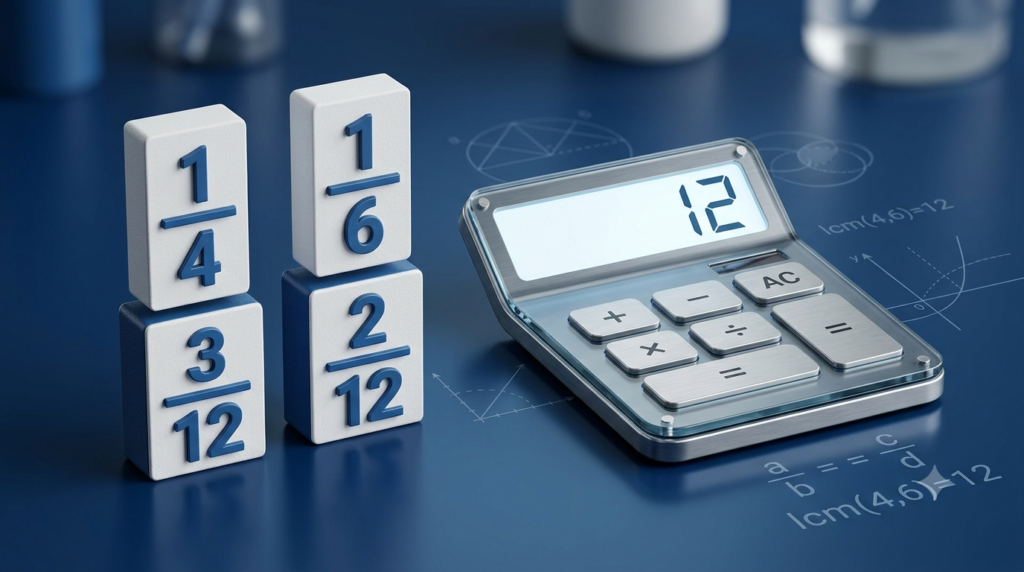
Fraction Comparison Calculator
Compare two fractions easily and find which fraction is greater, smaller, or equal.
First Fraction
Second Fraction
Comparison Result
First Fraction:
Second Fraction:
First Simplified Fraction:
Second Simplified Fraction:
Cross Multiplication:
Greater Fraction:
Smaller Fraction:
Enter whole numbers. Denominators cannot be zero.
Comparing fractions is an important part of mathematics. It helps us understand which fraction represents a greater value, which one represents a smaller value, and whether two fractions are equal. Although comparing fractions with the same denominator is usually simple, comparing fractions with different numerators and denominators can sometimes be confusing, especially when the numbers are large.
A Fraction Comparison Calculator makes this process easier by allowing users to enter two fractions and compare their values instantly. It determines whether the first fraction is greater than, less than, or equal to the second fraction. It can also display decimal values, simplified fractions, and the cross multiplication used to compare them.
This online calculator is useful for students, teachers, parents, and anyone who wants to understand fractions or check mathematical calculations. Instead of performing every calculation manually, users can enter the numerator and denominator of each fraction and get an accurate comparison result within seconds.
In this article, you will learn what a Fraction Comparison Calculator is, how it works, how to use it, and how different methods can be used to compare fractions.
What Is a Fraction Comparison Calculator?
A Fraction Comparison Calculator is an online mathematical tool designed to compare two fractions and identify their relative values.
A fraction represents a part of a whole and consists of two numbers:
Numerator: The number written above the fraction line. It represents how many parts are being considered.
Denominator: The number written below the fraction line. It represents the total number of equal parts into which the whole is divided.
For example, in the fraction 3/4, the numerator is 3 and the denominator is 4. It means that three out of four equal parts are being considered.
When comparing two fractions, the calculator determines their mathematical relationship using one of three comparison symbols:
Greater than (>): Indicates that the first fraction has a larger value.
Less than (<): Indicates that the first fraction has a smaller value.
Equal to (=): Indicates that both fractions represent the same value.
For example:
3/4 > 2/3
This means that three-fourths is greater than two-thirds.
The calculator performs the necessary mathematical operations automatically, making fraction comparison faster and easier.
How to Use the Fraction Comparison Calculator
Using the Fraction Comparison Calculator is simple. You only need to enter the numerator and denominator of two fractions.
Follow these steps to compare fractions:
Step 1: Enter the First Fraction
Enter the numerator of the first fraction in the Numerator field and its denominator in the Denominator field.
For example, if your first fraction is 3/4, enter:
Numerator: 3
Denominator: 4
Step 2: Enter the Second Fraction
Enter the numerator and denominator of the second fraction in their respective fields.
For example, if your second fraction is 2/3, enter:
Numerator: 2
Denominator: 3
Step 3: Click the Compare Fractions Button
After entering all four values, click the Compare Fractions button.
The calculator will process the values and determine the relationship between the two fractions.
Step 4: View the Comparison Result
The result section displays the comparison symbol between the two fractions.
For example:
3/4 > 2/3
This indicates that the first fraction is greater than the second fraction.
Step 5: Check the Additional Results
The calculator also provides additional information, including:
Decimal value of the first fraction.
Decimal value of the second fraction.
Simplified form of both fractions.
Cross multiplication values.
Greater fraction.
Smaller fraction.
This information helps users understand how the comparison was performed.
How Does a Fraction Comparison Calculator Work?
A Fraction Comparison Calculator uses mathematical operations to determine which of two fractions has a greater value.
One of the most common methods is cross multiplication. This method is particularly useful when two fractions have different denominators.
Consider the following fractions:
3/4 and 2/3
To compare them, multiply the numerator of each fraction by the denominator of the other fraction.
First multiplication:
3 × 3 = 9
Second multiplication:
2 × 4 = 8
Now compare the two results:
9 > 8
Therefore:
3/4 > 2/3
The calculator performs these operations automatically and displays the appropriate comparison symbol.
It also accounts for negative numerators and denominators so that the comparison remains mathematically correct.
Methods of Comparing Fractions
There are several ways to compare fractions. Understanding these methods helps users learn the mathematical principles behind fraction comparison.
1. Comparing Fractions with the Same Denominator
When two fractions have the same denominator, comparing them is straightforward.
Simply compare their numerators. The fraction with the larger numerator has the greater value.
For example:
3/8 and 5/8
Both fractions have the same denominator, which is 8.
Compare their numerators:
3 < 5
Therefore:
3/8 < 5/8
This method is useful when fractions represent parts divided into the same number of equal sections.
2. Comparing Fractions with the Same Numerator
When two positive fractions have the same numerator but different denominators, the fraction with the smaller denominator has the greater value.
For example:
2/3 and 2/5
Both fractions have the same numerator, which is 2.
However, the whole is divided into three equal parts in the first fraction and five equal parts in the second fraction.
Each third is larger than each fifth.
Therefore:
2/3 > 2/5
This rule applies to positive fractions with the same non-zero numerator.
3. Comparing Fractions Using Cross Multiplication
Cross multiplication is one of the most convenient methods for comparing fractions with different denominators.
Consider:
4/5 and 5/7
Multiply the numerator of the first fraction by the denominator of the second fraction:
4 × 7 = 28
Multiply the numerator of the second fraction by the denominator of the first fraction:
5 × 5 = 25
Now compare the results:
28 > 25
Therefore:
4/5 > 5/7
This method avoids the need to find a common denominator and is especially useful for larger fractions.
4. Comparing Fractions Using Decimal Values
Another method is to convert both fractions into decimal numbers.
To convert a fraction into a decimal, divide its numerator by its denominator.
For example:
3/4 = 3 ÷ 4 = 0.75
2/3 = 2 ÷ 3 = 0.6667 approximately
Now compare the decimal values:
0.75 > 0.6667
Therefore:
3/4 > 2/3
This method is easy to understand and useful when working with decimal numbers.
However, rounded decimal values can sometimes make two different fractions appear equal. For exact comparisons, cross multiplication or equivalent fraction methods are more reliable.
Understanding the Comparison Symbols
Fraction comparison uses three main mathematical symbols. Each symbol explains the relationship between two numerical values.
Greater Than Symbol (>)
The greater than symbol indicates that the value on the left side is larger than the value on the right side.
Example:
5/6 > 2/3
This means that five-sixths is greater than two-thirds.
Less Than Symbol (<)
The less than symbol indicates that the value on the left side is smaller than the value on the right side.
Example:
1/4 < 3/4
This means that one-fourth is smaller than three-fourths.
Equal To Symbol (=)
The equal to symbol indicates that both fractions represent exactly the same numerical value.
Example:
1/2 = 2/4
Although their numerators and denominators are different, both fractions represent one-half.
Understanding these symbols is essential for learning fractions and solving mathematical comparison problems.
What Is Cross Multiplication in Fraction Comparison?
Cross multiplication is a mathematical technique used to compare two fractions without converting them into decimals.
Suppose two fractions are represented as:
a/b and c/d
For positive denominators, compare the following products:
a × d
c × b
The results determine the relationship between the original fractions.
If a × d is greater than c × b, then a/b is greater than c/d.
If a × d is smaller than c × b, then a/b is smaller than c/d.
If both products are equal, the fractions are equal.
For example, compare 5/8 and 3/4.
First multiplication:
5 × 4 = 20
Second multiplication:
3 × 8 = 24
Since 20 is smaller than 24:
5/8 < 3/4
This technique is particularly useful when comparing fractions with different denominators.
Examples of Fraction Comparison
The following examples demonstrate how different fractions can be compared.
Example 1: Comparing Two Fractions with Different Denominators
Compare:
2/5 and 3/5
Both fractions have the same denominator.
Compare their numerators:
2 < 3
Result:
2/5 < 3/5
Example 2: Comparing Fractions with Different Denominators
Compare:
3/4 and 5/8
Cross multiplication:
3 × 8 = 24
5 × 4 = 20
Since 24 is greater than 20:
3/4 > 5/8
Example 3: Comparing Equivalent Fractions
Compare:
2/3 and 4/6
Cross multiplication:
2 × 6 = 12
4 × 3 = 12
Both products are equal.
Therefore:
2/3 = 4/6
Example 4: Comparing Fractions with Negative Values
Compare:
-2/3 and -1/2
Convert them into decimal values:
-2/3 = -0.6667 approximately
-1/2 = -0.5
Since -0.6667 is smaller than -0.5:
-2/3 < -1/2
Negative fractions require careful comparison because a value farther below zero is smaller.
Features of the Fraction Comparison Calculator
The calculator provides several useful features that make fraction comparison easier.
Instant Fraction Comparison
Users can enter two fractions and receive the comparison result immediately. There is no need to perform manual calculations.
Greater Than, Less Than, and Equal To Results
The calculator automatically identifies the correct comparison relationship and displays the appropriate mathematical symbol.
Decimal Conversion
It displays the decimal value of each fraction. This allows users to understand the numerical value of fractions in decimal form.
Fraction Simplification
The calculator also displays the simplified form of each fraction. This helps users understand whether a fraction can be expressed using smaller numerator and denominator values.
For example:
6/8 = 3/4
Both fractions represent the same value, but 3/4 is the simplified form.
Cross Multiplication Details
The tool displays the cross multiplication values used to compare the fractions. This is helpful for students who want to understand the calculation rather than simply view the answer.
Error Validation
The calculator checks the entered values and displays an error message if any required field is empty, contains an invalid number, or has a denominator of zero.
Mobile-Friendly Design
The calculator is designed to work on different screen sizes, including smartphones, tablets, laptops, and desktop computers.
Applications of Fraction Comparison
Fraction comparison is used in many areas of mathematics and everyday life.
Education and Mathematics Learning
Students regularly compare fractions while studying arithmetic, equivalent fractions, ratios, and other mathematical topics.
A comparison calculator helps students verify their answers and understand the relationship between different fractions.
Cooking and Recipes
Fractions are commonly used in cooking measurements.
For example, a recipe may require 3/4 cup of flour, while another recipe requires 2/3 cup.
Comparing these quantities helps determine which recipe requires more flour.
Shopping and Measurements
Fractions are useful when comparing product quantities, lengths, and measurements.
For example, comparing 5/8 metre and 3/4 metre helps identify which measurement is longer.
Construction and Engineering
Measurements involving fractions are often used in woodworking, construction, and other practical activities.
Comparing fractional measurements helps maintain accuracy when selecting dimensions and materials.
Daily Calculations
Fractions can represent portions of time, quantities, distances, and many other measurements.
Understanding how to compare fractions makes these everyday calculations easier.
Advantages of Using an Online Fraction Comparison Calculator
An online fraction comparison calculator offers several advantages over performing every calculation manually.
Saves Time: It compares fractions within seconds.
Reduces Calculation Errors: Automatic calculations help avoid common arithmetic mistakes.
Easy to Use: Users only need to enter the numerator and denominator of each fraction.
Supports Learning: Cross multiplication and decimal results help explain the comparison process.
Useful for Different Skill Levels: Beginners and advanced learners can use the calculator.
Accessible Across Devices: The responsive design makes it convenient to use on smartphones and computers.
Provides Additional Information: Simplified fractions and decimal values offer a better understanding of the results.
Although the calculator makes comparison easier, learning the underlying mathematical methods is also important. Students should practise comparing fractions manually to strengthen their mathematical understanding.
Common Mistakes When Comparing Fractions
Fraction comparison can become confusing when users do not understand the relationship between numerators and denominators.
Some common mistakes include:
Comparing Only the Numerators
A larger numerator does not always mean a larger fraction.
For example:
3/4 and 5/8
Although 5 is greater than 3, 5/8 is smaller than 3/4.
Both the numerator and denominator must be considered.
Comparing Only the Denominators
A larger denominator does not always mean a larger fraction.
For positive fractions with the same numerator, a larger denominator produces a smaller fraction. However, this rule cannot be applied blindly when the numerators are different.
Forgetting to Find a Common Denominator
When using the equivalent fraction method, both fractions must be converted correctly using a common denominator.
Incorrect multiplication can lead to an incorrect comparison.
Ignoring Negative Signs
Negative fractions behave differently from positive fractions. Their signs must be considered when determining which value is greater or smaller.
Assuming Rounded Decimals Are Exact
Two fractions may have decimal values that appear equal after rounding, even when their exact values are different.
Using exact cross multiplication avoids this problem.
Conclusion
A Fraction Comparison Calculator is a useful online mathematics tool that helps users compare two fractions quickly and accurately. It identifies whether one fraction is greater than, smaller than, or equal to another fraction while also providing useful information such as decimal values, simplified forms, and cross multiplication results.
Understanding fraction comparison is an important mathematical skill that supports learning in arithmetic, algebra, measurements, and everyday calculations. Methods such as comparing numerators, finding equivalent fractions, cross multiplication, and converting fractions into decimals make the process easier to understand.
Whether you are a student practising mathematics, a teacher explaining fractions, or someone checking a calculation, this calculator provides a convenient way to compare fractions and understand their values.
FAQs
1. What is a Fraction Comparison Calculator?
A Fraction Comparison Calculator is an online mathematical tool used to compare two fractions and determine which one has a greater or smaller value. It can also identify whether two fractions are equal. Users simply enter the numerators and denominators of both fractions, and the calculator displays the result using comparison symbols such as greater than (>), less than (<), or equal to (=). It may also provide decimal values, simplified fractions, and cross multiplication details to help users understand how the comparison works.
2. How do you compare two fractions?
To compare two fractions, you can use cross multiplication, equivalent fractions, or decimal conversion. Cross multiplication is one of the easiest methods when denominators are different. Multiply the numerator of the first fraction by the denominator of the second fraction. Then multiply the numerator of the second fraction by the denominator of the first fraction. Compare the two products. For positive denominators, the larger product belongs to the greater fraction. If both products are equal, the fractions have the same value.
3. What do the symbols greater than, less than, and equal to mean?
These three mathematical symbols represent the relationship between two numerical values. The greater than symbol (>) means the value on the left is larger than the value on the right. The less than symbol (<) means the left value is smaller. The equal to symbol (=) indicates that both values are exactly the same. For example, 3/4 > 1/2 means three-fourths is greater than one-half. These symbols are essential for understanding fraction comparisons and solving mathematical problems.
4. Can I compare fractions with different denominators?
Yes, you can compare fractions with different denominators using cross multiplication or by converting them into equivalent fractions with a common denominator. For example, consider 2/3 and 3/4. Cross multiplication gives 2 × 4 = 8 and 3 × 3 = 9. Since 8 is smaller than 9, 2/3 is less than 3/4. A Fraction Comparison Calculator performs these calculations automatically, making it easier to compare fractions without finding a common denominator manually.
5. How do you compare fractions with the same denominator?
Comparing fractions with the same denominator is simple because both fractions represent parts divided into an equal number of sections. You only need to compare their numerators. The fraction with the larger numerator has the greater value. For example, consider 3/8 and 5/8. Both fractions have a denominator of 8. Since 5 is greater than 3, 5/8 is greater than 3/8. This method is one of the simplest ways to compare positive fractions.
6. How do you compare fractions with the same numerator?
When two positive fractions have the same non-zero numerator but different denominators, the fraction with the smaller denominator has the greater value. For example, compare 2/3 and 2/5. Both fractions have a numerator of 2, but their denominators are different. Since each third is larger than each fifth, 2/3 is greater than 2/5. This method is useful for quickly comparing fractions without performing lengthy calculations.
7. Can a Fraction Comparison Calculator compare equivalent fractions?
Yes, a Fraction Comparison Calculator can identify equivalent fractions. Equivalent fractions have different numerators and denominators but represent the same numerical value. For example, 1/2, 2/4, and 3/6 are equivalent fractions. When two equivalent fractions are compared, the calculator displays the equal to symbol (=). It can also show their decimal values and simplified forms. This makes it easier to understand how different fractions can represent the same part of a whole.
8. Can I compare negative fractions using this calculator?
Yes, negative fractions can also be compared using a Fraction Comparison Calculator. However, negative values require special attention because their numerical order differs from positive values. For example, -1/2 is greater than -3/4 because -0.5 is closer to zero than -0.75. The calculator considers negative numerators and denominators when determining the correct comparison result. This makes it useful for comparing both positive and negative fractions.
9. Why is cross multiplication useful for comparing fractions?
Cross multiplication is useful because it allows you to compare two fractions without converting them into decimals or finding a common denominator. It involves multiplying the numerator of each fraction by the denominator of the other fraction. For example, when comparing 3/5 and 2/3, calculate 3 × 3 = 9 and 2 × 5 = 10. Since 9 is smaller than 10, 3/5 is less than 2/3. This method provides an efficient way to compare fractions.
10. Is an online Fraction Comparison Calculator accurate?
An online Fraction Comparison Calculator can provide accurate results when valid numerical inputs are entered and its calculations are implemented correctly. It uses mathematical operations such as cross multiplication to determine the relationship between fractions. It can also display decimal values, simplified fractions, and comparison symbols. Users should enter valid numerators and non-zero denominators to obtain meaningful results. The calculator is useful for checking homework, practising mathematics, and verifying fraction comparison problems.