The history of science is the story of how humans have explored the natural world, developed explanations for different phenomena, and gradually expanded their understanding of the universe. From observing the stars and discovering the properties of plants to developing modern computers and exploring distant planets, scientific knowledge has changed significantly over thousands of years. Early humans relied mainly on observation, experience, and practical skills to understand their surroundings. Over time, these methods developed into more systematic approaches involving experiments, mathematical calculations, and evidence-based reasoning. Scientific discoveries have transformed medicine, agriculture, transportation, communication, and many other aspects of everyday life. Understanding the history of science helps us learn how scientific ideas develop, why older explanations sometimes change, and how curiosity and evidence continue to shape human knowledge.
What Is the History of Science?
The history of science is the study of how scientific knowledge, methods, ideas, and institutions have developed over time. It examines how people in different civilizations understood nature, investigated problems, and shared discoveries with others.
Science did not begin at a single moment or in one particular country. It developed gradually through the contributions of many societies, including those of Mesopotamia, ancient Egypt, India, China, Greece, the Islamic world, Europe, and other regions.
Early scientific knowledge often emerged from practical needs. People needed to predict seasonal changes, grow crops, measure land, construct buildings, treat illnesses, and navigate across oceans. These activities encouraged them to observe patterns and develop useful explanations.
As knowledge accumulated, people began to investigate questions more systematically. They developed mathematical techniques, designed experiments, created scientific instruments, and established methods for checking whether an explanation was supported by evidence.
The history of science therefore describes not only important discoveries but also the gradual development of the methods used to produce reliable knowledge.
How Did Science Begin in Early Human Societies?
Early Observations of Nature
The earliest forms of scientific understanding developed through everyday experience. Early humans observed the movement of the Sun, the phases of the Moon, changing weather patterns, animal behavior, and the growth of plants.
These observations helped people recognize patterns in nature. They learned which plants were useful for food, which materials could be used to make tools, and how seasonal changes affected hunting and agriculture.
Although these activities did not always involve formal scientific theories, they established an important foundation for later scientific development: learning about the world through observation and experience.
The Development of Agriculture and Measurement
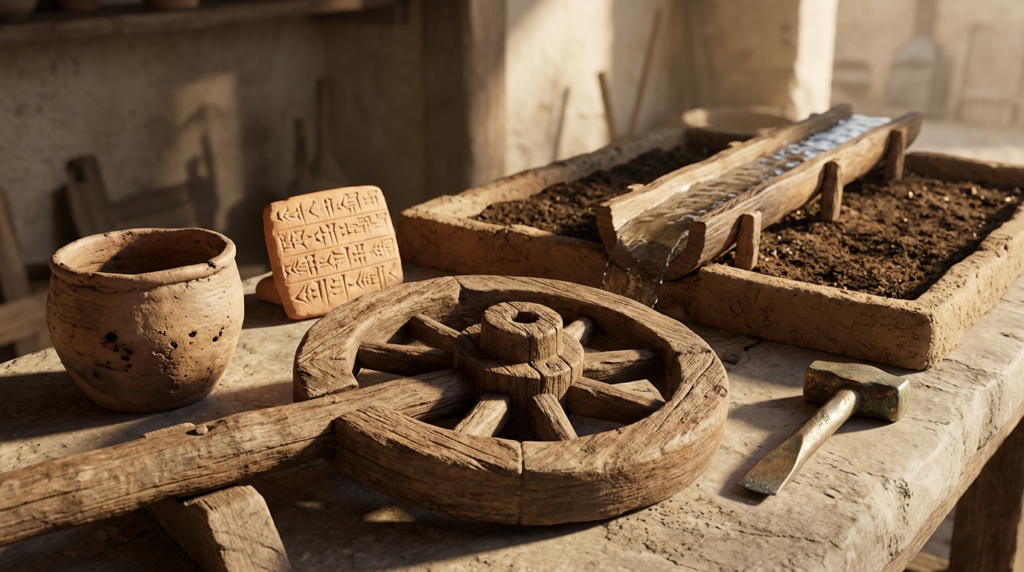
The development of agriculture encouraged people to understand seasons, rainfall, soil conditions, and the timing of planting and harvesting.
As permanent settlements grew, communities also needed methods for measuring land, constructing buildings, storing food, and managing water. These needs encouraged the development of arithmetic, geometry, calendars, and practical engineering.
Early knowledge was often passed from one generation to another through experience, oral traditions, and written records. Over time, these records allowed communities to preserve observations and improve their techniques.
Astronomy in Ancient Civilizations
Ancient civilizations carefully observed the sky to develop calendars, plan agricultural activities, and navigate across land and water.
Mesopotamian astronomers recorded celestial movements and identified recurring patterns. Ancient Egyptians developed calendars and used mathematical knowledge in construction and land measurement. Chinese astronomers maintained records of celestial events, including eclipses and unusual astronomical observations.
These achievements demonstrate that systematic observation existed long before modern scientific institutions appeared.
How Did Ancient Civilizations Contribute to Science?
Scientific knowledge developed in different regions according to local needs, intellectual traditions, and available resources. Many ancient civilizations made important contributions to mathematics, medicine, astronomy, and engineering.
Science in Ancient Mesopotamia and Egypt
Mesopotamian scholars developed mathematical systems that supported trade, administration, and astronomical calculations. Their base-60 number system influenced the way time and angles are measured today. For example, one hour contains 60 minutes, and a circle is divided into 360 degrees.
Ancient Egyptian civilization made significant advances in surveying, architecture, medical practices, and calendar development. The construction of large monuments required practical knowledge of geometry, materials, organization, and structural techniques.
These achievements were based largely on accumulated experience, observation, and practical problem-solving.
Science in Ancient India
Ancient India made important contributions to mathematics, astronomy, medicine, and philosophy.
Indian mathematicians helped develop the decimal place-value system and advanced the use of zero as a number within a positional numeral system. These developments eventually became central to mathematics around the world.
Scholars such as Aryabhata made important contributions to mathematical astronomy, including calculations involving planetary movements and eclipses. Brahmagupta later developed influential rules for working with zero and negative numbers.
Indian medical traditions, including Ayurveda, also developed extensive knowledge of medicinal plants, health practices, and the human body. These historical contributions should be understood in their original context, while individual medical claims must still be evaluated using modern scientific evidence.
Science in Ancient China
Ancient China contributed to several areas of practical science and technology. Chinese inventors and craftspeople developed papermaking, printing, the magnetic compass, and gunpowder, although these technologies emerged through processes of development rather than a single isolated invention in every case.
Chinese scholars also studied astronomy, recorded earthquakes, developed agricultural techniques, and advanced engineering.
The compass eventually became especially important for navigation, while papermaking and printing helped make the preservation and circulation of information easier.
Science in Ancient Greece
Ancient Greek thinkers contributed to the development of logical reasoning, mathematics, natural philosophy, and systematic explanations of nature.
Thales and other early thinkers attempted to explain natural phenomena without relying entirely on traditional mythological accounts. Pythagoras and later mathematicians explored relationships between numbers and geometric forms.
Hippocrates is associated with an influential tradition of medical observation and reasoning. Aristotle studied subjects such as biology, physics, logic, and the classification of living things.
However, ancient Greek explanations were not always correct. Some ideas remained influential for centuries despite limited experimental evidence. Their importance lies partly in their attempts to develop general explanations and organized systems of knowledge.
How Did Science Develop During the Medieval Period?
The medieval period saw the preservation, translation, expansion, and transmission of scientific knowledge across several regions. Scientific activity continued in the Islamic world, India, China, Europe, and elsewhere.
The Islamic Golden Age
During the period often called the Islamic Golden Age, scholars made major contributions to mathematics, astronomy, medicine, optics, and other fields.
Al-Khwarizmi helped establish influential methods in algebra, and his writings contributed to the transmission of mathematical knowledge. The word algorithm is historically connected to the Latinized form of his name.
Ibn al-Haytham made important contributions to optics and emphasized the role of systematic investigation in understanding vision and light. Physicians such as Al-Razi and Ibn Sina contributed to medical knowledge, with Ibn Sina’s The Canon of Medicine becoming influential in several regions for centuries.
Scholars working in major centers of learning translated earlier Greek, Persian, and Indian works, criticized existing ideas, and developed new knowledge. This process helped preserve and expand scientific traditions.
Scientific Knowledge in Medieval India and China
Scientific activity also continued across Asia. Indian scholars advanced mathematical astronomy, numerical methods, and medical traditions. Chinese inventors and scholars contributed to printing, navigation, engineering, and astronomical observation.
These developments show that scientific progress was not restricted to Europe. Knowledge moved across cultural and geographical boundaries through trade, travel, translation, and scholarly exchange.
Science in Medieval Europe
European monasteries, universities, and other centers of learning helped preserve and study classical texts. From the twelfth century onward, translations of Arabic and Greek scientific works became increasingly important to European intellectual life.
Universities provided settings for studying subjects such as mathematics, medicine, astronomy, and natural philosophy. Although many explanations still relied on established authorities, scholars increasingly encountered competing ideas and new sources of knowledge.
This exchange helped prepare the ground for later transformations in European science.
What Was the Scientific Revolution?
The Scientific Revolution was a period of major changes in scientific thought that took place mainly in Europe during the sixteenth and seventeenth centuries. It changed how many scholars studied nature and evaluated explanations.
Rather than relying exclusively on inherited authorities, investigators increasingly emphasized mathematical descriptions, systematic observations, experiments, and the comparison of competing explanations.
Nicolaus Copernicus and the Heliocentric Model
For centuries, the widely accepted European astronomical model placed Earth near the center of the universe. Nicolaus Copernicus proposed a model in which Earth and the other planets orbit the Sun.
His model challenged established beliefs and encouraged new investigations into planetary motion. Although the original model had limitations, it contributed to a major transformation in astronomy.
Galileo Galilei and Observational Evidence
Galileo Galilei used telescopes to study the sky and observed features that challenged traditional astronomical ideas. These included mountains on the Moon, numerous stars in the Milky Way, and moons orbiting Jupiter.
His observations showed that not every celestial object revolved around Earth. Galileo also investigated motion and helped advance the mathematical study of physical phenomena.
His work illustrated the importance of using instruments and observations to test established explanations.
Johannes Kepler and Isaac Newton
Johannes Kepler developed mathematical laws describing planetary motion. His work showed that planets travel in elliptical orbits rather than perfect circles.
Isaac Newton later formulated laws of motion and the law of universal gravitation. These ideas provided a mathematical framework for explaining both terrestrial motion and the movement of celestial bodies.
Newton’s work demonstrated how a relatively small set of general principles could explain many different physical phenomena.
The Growth of the Scientific Method
The Scientific Revolution helped strengthen several practices that remain central to science:
Observing natural phenomena carefully.
Developing explanations that can be examined and tested.
Using experiments to investigate cause-and-effect relationships.
Applying mathematics to describe patterns in nature.
Comparing predictions with actual results.
Revising explanations when evidence contradicts them.
Modern scientific research uses many different methods, depending on the question being studied. Nevertheless, systematic investigation and evidence-based reasoning remain fundamental principles.
How Did Science Evolve During the Industrial Revolution?
The Industrial Revolution, which began in Britain during the eighteenth century and spread to other regions, transformed manufacturing, transportation, energy use, and society.
Scientific knowledge and practical engineering increasingly influenced one another. New machines created problems that encouraged scientific investigation, while advances in physics and chemistry supported technological development.
Advances in Physics and Engineering
The development of steam engines improved the ability to convert heat into mechanical work. Improvements in engines, machinery, and manufacturing helped expand factories, mining, and railway transportation.
During the nineteenth century, research into electricity and magnetism led to technologies that transformed communication and industry. Scientists such as Michael Faraday investigated electromagnetic phenomena, while James Clerk Maxwell developed equations that unified important aspects of electricity and magnetism.
These developments eventually supported technologies such as electric motors, generators, and electrical communication systems.
Advances in Chemistry
Chemistry became increasingly systematic as scientists developed more precise methods for measuring substances and studying chemical reactions.
Antoine Lavoisier helped establish modern chemical principles through careful measurement and a clearer explanation of combustion. The development of atomic theory provided a framework for understanding matter in terms of atoms and their combinations.
Chemical knowledge contributed to industrial manufacturing, agriculture, medicine, materials science, and the production of new substances.
The Relationship Between Science and Technology
Science and technology are closely connected, but they are not identical. Science aims to develop and test explanations about the natural world, while technology applies knowledge and practical skills to solve problems or meet human needs.
For example, scientific investigations into electricity helped engineers develop electrical systems. In turn, improved instruments and machines allowed scientists to perform more precise experiments.
This relationship continues to drive innovation today.
How Did Modern Science Transform Our Understanding of Life and the Universe?
The nineteenth and twentieth centuries brought major discoveries that changed biology, physics, astronomy, and medicine.
Charles Darwin and Evolution
In the nineteenth century, Charles Darwin presented evidence supporting evolution by natural selection. His work helped explain how populations change over generations and how living organisms share evolutionary relationships.
Modern evolutionary biology combines natural selection with evidence from genetics, fossils, comparative anatomy, and molecular biology.
Evolution has become a central framework for understanding the diversity of life on Earth.
The Development of Germ Theory
Scientists such as Louis Pasteur and Robert Koch helped establish the relationship between microorganisms and certain diseases.
Germ theory transformed medicine by showing that specific microorganisms can cause particular infectious diseases. This understanding supported improvements in sanitation, sterilization, vaccination, and disease prevention.
Medical knowledge has continued to develop through microbiology, immunology, genetics, and clinical research.
Albert Einstein and Modern Physics
At the beginning of the twentieth century, Albert Einstein developed the special and general theories of relativity. These theories changed scientific understanding of space, time, gravity, and the relationship between energy and mass.
Quantum mechanics also emerged as scientists investigated the behavior of matter and energy at atomic and subatomic scales.
Classical physics remains extremely useful in many everyday applications, but relativity and quantum mechanics provide more accurate explanations in situations where classical models are insufficient.
The Discovery of DNA’s Structure
In 1953, James Watson and Francis Crick published a model of DNA’s double-helical structure, building on important experimental evidence, including X-ray diffraction work by Rosalind Franklin and Raymond Gosling and contributions from Maurice Wilkins.
Understanding DNA’s structure helped explain how genetic information is stored and copied. Later advances in molecular biology enabled researchers to investigate genes, inherited traits, genetic diseases, and the relationships between organisms.
Today, genetics supports research in medicine, agriculture, biotechnology, and evolutionary biology.
Space Exploration and Modern Astronomy
Developments in telescopes, rocketry, and space technology greatly expanded our understanding of the universe.
The launch of artificial satellites, human spaceflight, robotic planetary missions, and space telescopes allowed scientists to study Earth and other celestial bodies in new ways.
Observations of distant galaxies, cosmic background radiation, and the expansion of the universe have strengthened the modern scientific model of cosmology, including the Big Bang theory.
Space exploration continues to reveal new information about planets, stars, black holes, and the possibility of life beyond Earth.
How Has Science Changed in the Digital Age?
The late twentieth century and the twenty-first century have introduced powerful tools for collecting, analyzing, and sharing scientific information.
Computers and Data Analysis
Computers allow researchers to process large amounts of information, perform complex calculations, simulate physical systems, and identify patterns that might otherwise remain difficult to detect.
Scientists use computational models to study weather, climate, molecular structures, galaxies, and many other systems.
However, a computer model is not automatically correct. Its results depend on the quality of the data, the assumptions used, and whether its predictions agree with observations.
Artificial Intelligence and Machine Learning
Artificial intelligence is increasingly used to support scientific research. Machine-learning systems can help identify patterns in medical images, analyze biological data, predict properties of materials, and examine large scientific datasets.
These tools can make some research tasks faster, but their outputs still require appropriate evaluation. AI systems can produce inaccurate results, reflect limitations in training data, or identify patterns that do not establish a genuine cause-and-effect relationship.
Human judgment, experimental testing, and independent verification remain important.
Biotechnology and Genetic Research
Modern biotechnology includes techniques for studying genes, developing diagnostic tests, producing certain medicines, and modifying genetic material.
Technologies such as CRISPR-based gene editing have created new possibilities for biological research and potential medical applications. At the same time, they raise questions about safety, fairness, privacy, and the ethical limits of genetic intervention.
Scientific progress therefore requires not only technical knowledge but also careful consideration of possible consequences.
Climate Science and Environmental Research
Modern instruments, satellites, computer models, and long-term measurements allow researchers to investigate changes in Earth’s climate and ecosystems.
Scientists examine temperature records, atmospheric gases, ocean conditions, ice sheets, and biological changes to understand environmental processes.
This research helps explain the causes and consequences of climate change and supports the development of strategies for reducing emissions, adapting to environmental risks, and protecting ecosystems.
Why Does Scientific Knowledge Change Over Time?
Scientific knowledge evolves because new observations, experiments, instruments, and methods can reveal limitations in existing explanations.
A scientific theory may explain many observations successfully but fail when researchers discover evidence that it cannot adequately account for. Scientists then investigate whether the theory needs refinement or whether a different explanation is required.
For example, Newton’s laws of motion remain highly effective for describing most everyday mechanical systems. However, Einstein’s theories provide a more accurate account of motion at very high speeds and gravity in extreme conditions.
This does not mean that every earlier scientific idea was useless or that all scientific explanations are equally uncertain. Many established findings have been supported by extensive, independent evidence. New discoveries often refine existing knowledge rather than replace it completely.
Scientific understanding also depends on the quality of evidence and the methods used to evaluate it. Repeated testing, independent replication, critical discussion, and the correction of mistakes help science become more reliable over time.
The willingness to revise an explanation in response to strong evidence is one of the most important features of scientific inquiry.
What Are the Main Lessons from the History of Science?
The history of science offers several important lessons about knowledge, discovery, and human progress.
Science Develops Through Collaboration
Major discoveries rarely emerge entirely from the work of one person. Scientists build on earlier research, share methods, examine one another’s results, and collaborate across institutions and countries.
Scientific progress is therefore a collective achievement that develops across generations.
Evidence Is More Reliable Than Assumptions
An explanation may seem reasonable or agree with popular beliefs, but it must still be examined against evidence. Scientific investigation helps distinguish explanations supported by observations from those that lack sufficient support.
Scientific Ideas Can Be Improved
Scientific knowledge is not a fixed collection of statements. It develops as researchers obtain better evidence and create more accurate models.
Changing an explanation in response to reliable evidence is a strength of science, not necessarily a sign of failure.
Science Influences Society
Scientific discoveries have contributed to improved healthcare, food production, communication, transportation, and access to information. However, scientific and technological developments can also create environmental, ethical, and social challenges.
Responsible scientific progress requires careful consideration of both benefits and risks.
Curiosity Encourages Discovery
Many scientific advances begin with simple questions about familiar things: Why does an object fall? How do plants grow? What causes disease? How did the universe begin?
Asking questions, investigating possible answers, and examining evidence help people develop a deeper understanding of the world.
Conclusion
The history of science shows how human understanding has developed from early observations of nature to sophisticated theories, experiments, and technologies. Ancient civilizations contributed essential knowledge in mathematics, astronomy, medicine, and engineering. Medieval scholars preserved and expanded these traditions, while the Scientific Revolution strengthened the use of observation, experimentation, and mathematical reasoning. Later advances in physics, chemistry, biology, medicine, and astronomy transformed our understanding of matter, life, and the universe. Today, computers, artificial intelligence, biotechnology, and space exploration continue to expand scientific possibilities. Throughout this history, one principle has remained essential: scientific knowledge grows when people ask questions, investigate evidence, test explanations, and remain willing to correct mistakes. Understanding this process helps us appreciate past discoveries and approach future scientific challenges with curiosity and critical thinking.
FAQs
1. What is the history of science?
The history of science is the study of how humans have developed knowledge about the natural world over time. It explores the discoveries, theories, experiments, and methods that have shaped our understanding of nature. Early humans learned through observation and practical experience, while later civilizations developed mathematics, astronomy, medicine, and engineering. During the Scientific Revolution, systematic experimentation and mathematical reasoning became increasingly important. Modern science uses advanced instruments, computers, and research methods to investigate complex questions. Studying the history of science helps us understand how scientific knowledge develops, why explanations change, and how discoveries influence human civilization.
2. When did science begin?
Science did not begin on a single date because scientific understanding developed gradually throughout human history. Early humans observed weather, animal behavior, seasonal changes, and the movements of celestial objects to survive and organize their lives. With the development of agriculture and permanent settlements, people began creating calendars, measuring land, and improving practical technologies. Ancient civilizations in Mesopotamia, Egypt, India, China, and Greece contributed to mathematics, astronomy, medicine, and natural philosophy. These early achievements established foundations for later scientific investigation. Modern science developed much later through increasingly systematic observation, experimentation, mathematical analysis, and the evaluation of evidence.
3. Which ancient civilizations contributed to the development of science?
Several ancient civilizations made important contributions to scientific knowledge. Mesopotamians developed mathematical systems and recorded astronomical observations, while ancient Egyptians advanced surveying, construction, and practical medicine. Indian scholars contributed to mathematics, the decimal place-value system, astronomy, and medical traditions. Chinese civilizations developed important technologies, including papermaking, printing, and the magnetic compass. Greek thinkers explored logic, geometry, natural philosophy, and biological classification. These achievements emerged from different cultural traditions and practical needs. Knowledge also traveled between societies through trade, translation, and scholarly exchange. Together, these civilizations helped establish foundations for later developments in mathematics, medicine, astronomy, and engineering.
4. What was the Scientific Revolution?
The Scientific Revolution was a period of major changes in scientific thinking that took place mainly in Europe during the sixteenth and seventeenth centuries. During this period, scholars increasingly used systematic observation, experimentation, and mathematics to investigate natural phenomena. Nicolaus Copernicus proposed a Sun-centered model of the planetary system, Galileo Galilei used telescopic observations to challenge established astronomical beliefs, and Johannes Kepler developed mathematical laws of planetary motion. Isaac Newton later formulated influential laws of motion and universal gravitation. These developments transformed scientific understanding and encouraged researchers to test explanations against evidence rather than relying entirely on traditional authorities.
5. How has scientific knowledge evolved over time?
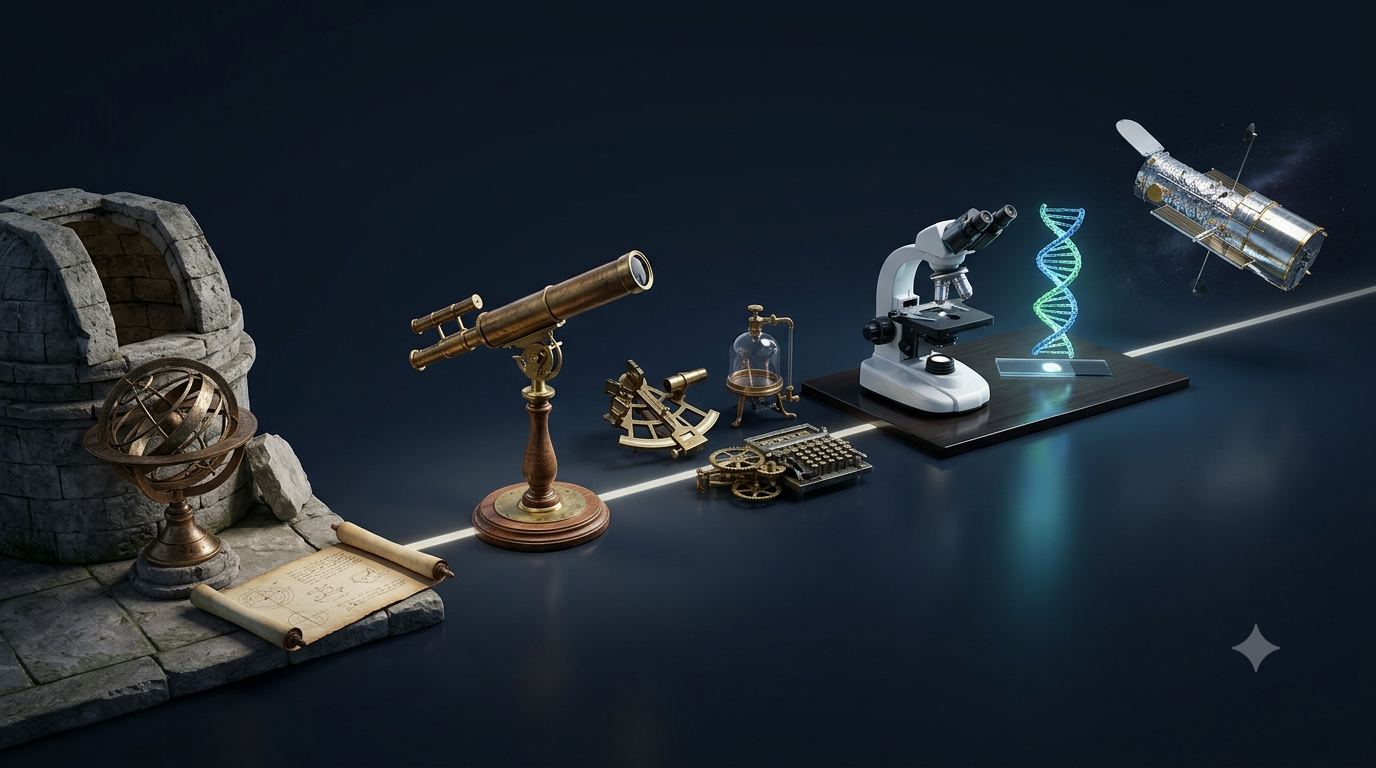
Scientific knowledge has evolved through continuous observation, experimentation, discovery, and the revision of explanations. Early societies developed practical knowledge about agriculture, medicine, construction, and astronomy. Later, mathematical reasoning and organized scientific investigations improved understanding of natural processes. Discoveries in physics, chemistry, and biology transformed explanations of matter, energy, living organisms, and disease. Modern technologies, including powerful telescopes, microscopes, computers, and genetic research tools, allow scientists to investigate questions that were previously difficult to answer. When new evidence reveals limitations in an existing explanation, scientists may refine or replace it. This process helps scientific understanding become more accurate and comprehensive.
6. Why does scientific knowledge change over time?
Scientific knowledge changes because researchers continually collect new evidence, develop improved instruments, and test existing explanations. An idea that explains available observations may become incomplete when new discoveries reveal previously unknown details. For example, Newton’s laws accurately describe many everyday motions, but Einstein’s theories provide more precise explanations in situations involving very high speeds or strong gravitational fields. Scientific change does not mean that all earlier knowledge was incorrect. Often, newer discoveries improve existing explanations or clarify the conditions under which they apply. Repeated testing, independent verification, and critical evaluation help scientists distinguish reliable conclusions from ideas that need further investigation.
7. What is the difference between ancient science and modern science?
Ancient science relied heavily on practical experience, observation, mathematical calculations, and philosophical reasoning. Ancient civilizations developed useful knowledge about astronomy, agriculture, medicine, and engineering, although some explanations lacked reliable experimental testing. Modern science places greater emphasis on systematic investigation, controlled experiments where appropriate, quantitative measurements, reproducible results, and critical evaluation by other researchers. Modern scientists also use advanced instruments, computers, and specialized research methods. However, ancient and modern science are connected because modern discoveries often build on earlier knowledge. The main difference lies in the development of more systematic methods for testing explanations and evaluating evidence.
8. How did the Industrial Revolution influence scientific development?
The Industrial Revolution significantly influenced scientific development by increasing the demand for improved machines, energy systems, manufacturing processes, and transportation. Steam engines encouraged advances in mechanical engineering, while investigations into electricity and magnetism supported the development of generators, electric motors, and communication technologies. Progress in chemistry contributed to industrial materials, fertilizers, and manufacturing methods. Scientific discoveries also helped engineers improve the efficiency and reliability of machines. In return, industrial technologies provided scientists with better instruments and experimental opportunities. This relationship between scientific research and technological innovation continues today, supporting developments in computing, renewable energy, medicine, transportation, and environmental monitoring.
9. How have computers and artificial intelligence changed modern science?
Computers and artificial intelligence have transformed scientific research by helping scientists process large datasets, perform complex calculations, simulate natural processes, and identify patterns. In medicine, these technologies can assist with analyzing medical images and biological information. In astronomy, computers help researchers examine observations from telescopes and space missions. Artificial intelligence can also support climate research, materials discovery, and genetic analysis. However, computer-generated results are not automatically accurate. They depend on the quality of the data, the assumptions used, and the reliability of the methods. Scientists must evaluate results carefully and use experiments, observations, and independent verification whenever appropriate.
10. Why is learning the history of science important?
Learning the history of science helps us understand how human knowledge develops and how discoveries influence society. It shows how observations, experiments, mathematical reasoning, and collaboration have improved our understanding of the natural world. Historical examples also demonstrate that scientific explanations can change when new evidence becomes available. Studying earlier discoveries helps readers appreciate contributions from different civilizations and understand the connections between science, technology, and culture. It also encourages curiosity, critical thinking, and evidence-based decision-making. By learning how scientific knowledge evolved, people can better understand modern discoveries, evaluate scientific claims, and recognize the importance of continued research in addressing future challenges.