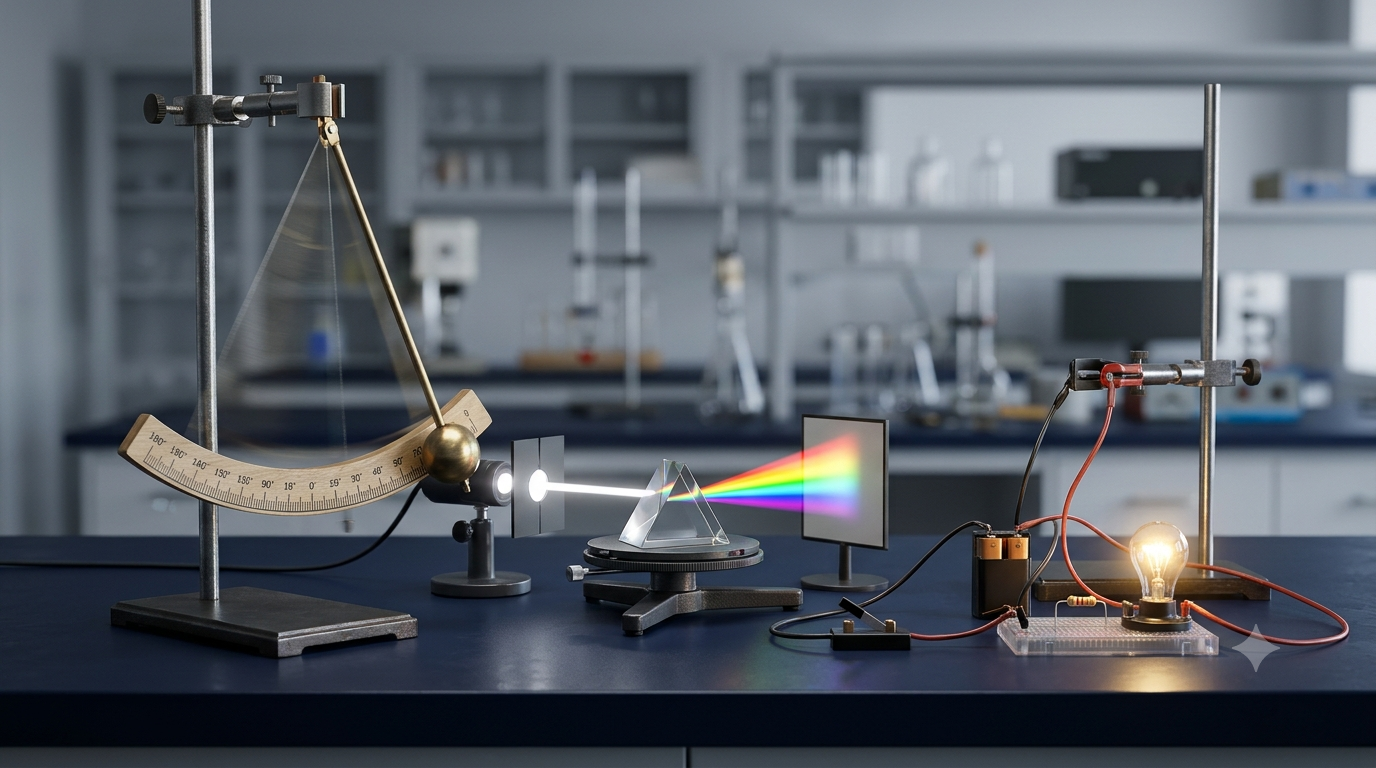
Physics is the branch of science that helps us understand how the natural world works. It explains why objects fall toward the ground, how light travels, why magnets attract certain materials, and how electricity powers our homes. However, understanding these phenomena requires more than reading theories or memorizing formulas. Scientists need to observe nature, test ideas, and examine evidence. This is where physics experiments become important. A physics experiment is a planned investigation designed to study a physical phenomenon, test a scientific idea, or discover a relationship between different quantities. Experiments allow scientists to check whether their explanations agree with real-world observations. From simple activities performed in classrooms to complex investigations conducted in advanced laboratories, physics experiments help us learn about nature, improve technology, and develop a deeper understanding of the universe.
What Are Physics Experiments?
Physics experiments are systematic investigations used to observe, measure, and understand physical phenomena. They involve studying how matter, energy, forces, motion, light, sound, electricity, magnetism, and other physical quantities behave under particular conditions.
During an experiment, a scientist may change one factor, measure its effect, and compare the results with an expected outcome. This process helps determine whether a scientific explanation is supported by evidence.
For example, imagine dropping a ball from a certain height. By measuring the time it takes to reach the ground, you can investigate how gravity affects falling objects. Similarly, you can use a spring and different weights to study how the extension of a spring changes when a force is applied.
Physics experiments can be simple or highly advanced. A student can investigate reflection using a mirror, while professional scientists may use powerful lasers, particle detectors, telescopes, or specialized instruments to study phenomena that cannot be observed directly.
The main purpose of a physics experiment is to obtain reliable evidence that helps explain how the physical world behaves.
Why Are Physics Experiments Important?
Physics experiments are essential because they connect scientific ideas with observable evidence. They help scientists move beyond assumptions and determine whether an explanation accurately describes a natural phenomenon.
1. Testing Scientific Theories
A scientific theory provides an explanation for observed phenomena. Experiments allow scientists to test the predictions made by that theory.
For example, Newton’s laws of motion predict how objects respond to forces. Scientists can test these predictions by measuring the motion of carts, balls, or other objects under controlled conditions.
If experimental results consistently disagree with a theory’s predictions, scientists investigate the possible reasons. The theory may need refinement, or the experimental method may contain errors.
Testing theories makes scientific knowledge more reliable and helps researchers improve existing explanations.
2. Discovering New Phenomena
Experiments sometimes produce unexpected results that reveal something previously unknown.
For instance, research into electricity and magnetism helped scientists discover important relationships between electric currents and magnetic fields. These discoveries contributed to the development of electric motors, generators, and many modern electrical technologies.
Unexpected observations can lead researchers to ask new questions and design further experiments. In this way, experiments help expand our knowledge of the natural world.
3. Measuring Physical Quantities
Physics depends heavily on measurement. Experiments allow scientists to determine quantities such as mass, time, distance, temperature, electric current, and velocity.
For example, a student investigating the motion of a toy car can measure the distance it travels and the time taken. These measurements can then be used to calculate its average speed.
Measurements also allow scientists to compare observations made by different researchers. Standard units, such as metres, kilograms, and seconds, make these comparisons meaningful.
4. Developing New Technologies
Many modern technologies depend on discoveries made through physics experiments.
Research into electricity contributed to electrical power systems. Experiments involving electromagnetic waves helped develop radio communication. Investigations into semiconductor materials supported the development of computers, smartphones, and other electronic devices.
Similarly, experiments in optics have improved cameras, microscopes, telescopes, and medical imaging equipment.
Physics experiments do not always lead immediately to a useful invention. Some discoveries become technologically important only after years of additional research and development.
How Do Physics Experiments Help Us Understand Nature?
Physics experiments help us understand nature by revealing patterns, relationships, and fundamental principles that govern physical phenomena.
1. Understanding Motion and Forces
Motion is one of the most familiar aspects of everyday life. Cars accelerate, balls fall, bicycles turn, and planets travel through space. Physics experiments help explain why these movements occur.
Consider an experiment in which a trolley is pushed with different forces while its motion is measured. The results can help demonstrate how the applied force affects acceleration.
By repeating the experiment with different masses, students can also investigate how an object’s mass influences its response to a force.
Such investigations help explain Newton’s laws of motion and show how these principles apply to transportation, sports, machinery, and planetary motion.
2. Understanding Energy and Its Transformations
Energy is involved in almost every physical process. It can exist in forms such as kinetic energy, potential energy, thermal energy, electrical energy, and light energy.
Experiments help scientists understand how energy moves between objects and changes from one form to another.
For example, when a ball rolls down a slope, its gravitational potential energy decreases while its kinetic energy increases. In a real experiment, some energy may also be transferred to the surroundings through friction and sound.
Studying these changes helps scientists understand energy conservation and improve the efficiency of machines, engines, batteries, and renewable energy systems.
3. Understanding Light and Sound
Light and sound allow us to observe our surroundings and communicate with others. Physics experiments reveal how these forms of energy behave.
A simple mirror experiment can demonstrate the reflection of light. By changing the angle at which a light ray strikes a mirror and measuring the reflected ray, students can investigate the relationship between the angles of incidence and reflection.
Sound experiments can explore how vibrations produce sound and how sound travels through different materials. For example, a vibrating ruler held at the edge of a table can demonstrate the connection between vibration and sound.
These investigations help explain the working principles of musical instruments, optical devices, microphones, speakers, and communication systems.
4. Understanding Electricity and Magnetism
Electricity and magnetism are closely related physical phenomena that play important roles in modern life.
Using a simple circuit, students can investigate how the brightness of a bulb changes when the number of cells or the arrangement of components changes. With suitable measuring instruments, they can examine the relationship between voltage, current, and resistance.
Magnetism experiments can demonstrate how magnets attract certain materials, how magnetic poles interact, and how a compass responds to a magnetic field.
More advanced experiments investigate electromagnetic induction, in which a changing magnetic field can produce an electric current in a suitable circuit.
These principles help explain how electric motors, generators, transformers, and many electronic devices operate.
5. Understanding Heat and Temperature
Heat and temperature are related but different concepts. Temperature describes how hot or cold something is, while heat refers to energy transferred because of a temperature difference.
Experiments can investigate how quickly different materials warm up or cool down. For example, equal amounts of water in identical containers can be heated under similar conditions, and their temperature changes can be measured over time.
Such investigations help explain thermal energy transfer, specific heat capacity, insulation, and the behaviour of materials when their temperatures change.
The findings are useful in designing refrigerators, heating systems, cooking equipment, insulated buildings, and industrial machinery.
6. Understanding the Universe
Physics experiments and observations help scientists investigate phenomena far beyond the limits of ordinary human experience.
Telescopes collect light from distant stars and galaxies, allowing astronomers to study their properties and movements. Spacecraft carry instruments that measure radiation, magnetic fields, and particles in space.
Particle accelerators allow researchers to investigate the fundamental particles that make up matter. Experiments involving highly sensitive detectors also help scientists study cosmic rays and search for evidence about the structure of the universe.
Although some of these investigations are called experiments and others are observational studies, both contribute to testing physical theories and understanding nature on the largest and smallest scales.
The Main Steps of a Physics Experiment
A well-designed physics experiment follows a systematic process. The exact procedure depends on the research question, but most experiments include several common steps.
1. Identify the Research Question
Every experiment begins with a question about a physical phenomenon.
For example, a researcher might ask, “How does the length of a pendulum affect its time period?”
A clearly defined question helps determine what needs to be measured and how the investigation should be conducted.
2. Form a Hypothesis
A hypothesis is a testable prediction about what may happen during an experiment.
For the pendulum investigation, a possible hypothesis is that a longer pendulum will take more time to complete one oscillation.
The hypothesis should be specific enough to compare with experimental results.
3. Plan the Experiment
The next step is to decide which equipment is required, what measurements will be taken, and which conditions must remain constant.
In the pendulum experiment, the length of the string can be changed while the pendulum’s starting angle and other relevant conditions are kept as consistent as possible.
Careful planning makes the results easier to interpret.
4. Perform the Experiment and Collect Data
The experiment is then conducted according to the planned procedure. Measurements should be recorded accurately, including the units used.
Repeating measurements is important because individual readings may be affected by reaction time, instrument limitations, or other sources of variation.
Scientists often record their observations in tables and use graphs to identify patterns.
5. Analyze the Results
After collecting the data, scientists examine the measurements to determine whether a pattern exists.
They may calculate averages, compare different conditions, draw graphs, or use mathematical relationships to interpret the results.
For example, plotting a pendulum’s length against its measured time period can help reveal how these quantities are related.
6. Draw a Conclusion
The final step is to compare the results with the original hypothesis.
The evidence may support the prediction, contradict it, or show that additional investigation is necessary.
A conclusion should be based on the collected data rather than on what the researcher hoped to observe.
Scientists may repeat the experiment, improve the equipment, or change the procedure to investigate uncertainties.
Types of Physics Experiments
Physics experiments can be classified according to their purpose, method, or the phenomena they investigate.
1. Classroom Experiments
Classroom experiments introduce basic physical principles through simple equipment and direct observation.
Examples include measuring the density of an object, studying the reflection of light, observing the motion of a pendulum, and testing simple electrical circuits.
These activities help students connect textbook concepts with real-world experiences.
2. Laboratory Experiments
Laboratory experiments are conducted using specialized equipment and carefully controlled conditions.
Researchers may use sensors, electronic instruments, optical devices, vacuum chambers, or precision measuring tools to investigate physical relationships.
Laboratory settings help scientists reduce unwanted influences and obtain more accurate measurements.
3. Field Experiments
Field experiments take place outside traditional laboratories, often in natural or real-world environments.
For example, researchers may measure temperature changes in different environments, investigate how sound travels outdoors, or study the physical properties of soil and rocks.
Field conditions can be difficult to control, but they provide information about how physical processes operate in natural settings.
4. Computational Experiments and Simulations
Some physical systems are too complex, expensive, dangerous, or inaccessible to investigate easily through direct experiments.
Scientists can use computer models and numerical simulations to explore possible outcomes, test mathematical models, and identify patterns.
For example, simulations can help researchers study fluid motion, weather-related physical processes, or the behaviour of materials under extreme conditions.
Computational results depend on the assumptions and accuracy of the model. They are not automatically equivalent to measurements from a real-world experiment, so comparisons with experimental evidence remain important whenever possible.
What Makes a Physics Experiment Reliable?
A reliable experiment produces results that are sufficiently consistent and supported by good evidence. Several factors help improve reliability.
Controlled Variables
A controlled variable is a factor kept constant during an investigation so that its influence does not confuse the results.
For example, when studying how the length of a pendulum affects its time period, the starting angle should be kept small and reasonably consistent.
Accurate Measurements
Suitable measuring instruments and correct techniques reduce measurement errors.
A ruler may be sufficient for a basic classroom activity, while a precision instrument may be necessary for advanced research.
Repeated Trials
Repeating measurements helps reveal random variations and makes it possible to calculate an average.
If repeated results differ considerably, scientists investigate the possible causes rather than simply selecting the preferred result.
Clear Records
Scientists should record their methods, measurements, equipment, and relevant observations. Clear records help other researchers understand how the experiment was performed and evaluate its findings.
Reproducibility
An important feature of scientific research is the ability of other researchers to repeat an experiment or test its conclusions independently.
Reproducibility helps identify errors, verify findings, and build confidence in scientific explanations.
The Role of Physics Experiments in Everyday Life
Physics experiments influence daily life in many ways, even when we do not recognize their contribution.
The development of safer vehicles depends partly on experiments involving motion, impact forces, materials, and energy absorption. Engineers test vehicle components and safety systems to understand how they perform under different conditions.
Medical technologies also benefit from physics research. X-ray imaging, ultrasound, magnetic resonance imaging, and radiation-based treatments rely on physical principles investigated through experiments and carefully developed engineering.
In communication, research into electromagnetic waves and semiconductor devices has helped make wireless networks, computers, and smartphones possible.
Renewable energy technologies also depend on experimental research. Scientists test solar cells, wind turbine designs, battery materials, and energy storage systems to improve their performance and reliability.
These examples demonstrate that physics experiments are not limited to laboratories or classrooms. They contribute to technologies that support health, transportation, communication, energy production, and modern industry.
Challenges and Limitations of Physics Experiments
Although experiments are powerful scientific tools, they have limitations.
Some measurements are affected by unavoidable uncertainty. For example, measuring a very short time interval with a basic stopwatch may produce results that are less precise than those obtained with electronic sensors.
Other experiments are difficult to perform because they require expensive equipment, extreme temperatures, high pressures, or conditions that are difficult to reproduce.
Scientists must also consider systematic errors, which can arise from incorrectly calibrated instruments or flaws in the experimental method. Repeating the same procedure does not necessarily eliminate these errors.
In addition, an experiment may investigate only a limited range of conditions. A relationship observed in one situation may not apply under every possible circumstance.
For these reasons, scientists carefully evaluate their methods, report uncertainties, compare results with other evidence, and avoid drawing conclusions that go beyond what the data support.
Conclusion
Physics experiments are essential for understanding how nature works. They allow scientists to test theories, measure physical quantities, discover new phenomena, and investigate the relationships between matter, energy, forces, and motion. Through systematic observation, careful measurement, repeated trials, and evidence-based analysis, experiments transform scientific questions into meaningful knowledge. They also provide the foundation for technologies used in medicine, communication, transportation, energy production, and space exploration. Although experiments have limitations and measurements always involve some degree of uncertainty, careful scientific methods help researchers produce dependable results. Whether it is a simple classroom activity or an advanced investigation of the universe, every well-designed physics experiment offers an opportunity to explore nature, question assumptions, and develop a deeper understanding of the physical world.
FAQs
1. What is a physics experiment?
A physics experiment is a systematic investigation designed to study physical phenomena, test scientific ideas, or understand relationships between physical quantities. It involves observing events, taking measurements, and analyzing results to discover how nature behaves. For example, dropping a ball from a certain height can help investigate gravity and motion. Experiments may be simple activities performed in classrooms or advanced investigations conducted in scientific laboratories. They help scientists collect evidence instead of relying only on assumptions. By conducting experiments, researchers can test theories, discover new phenomena, improve scientific explanations, and develop technologies that make everyday life easier.
2. Why are physics experiments important?
Physics experiments are important because they help scientists understand how the natural world works. They provide evidence to test scientific theories, measure physical quantities, and investigate relationships between different phenomena. For example, experiments involving electricity help explain how electric circuits function, while experiments involving motion demonstrate how forces affect moving objects. These investigations also support the development of modern technologies, including medical imaging equipment, communication devices, electric motors, and renewable energy systems. Experiments encourage critical thinking and problem-solving by requiring researchers to observe carefully and analyze evidence. Without experiments, many scientific explanations would remain untested, and technological progress would be more difficult.
3. How do physics experiments help us understand nature?
Physics experiments help us understand nature by revealing patterns and relationships in physical phenomena. Scientists investigate motion, gravity, heat, light, sound, electricity, and magnetism through observation and measurement. For example, a pendulum experiment helps demonstrate how its length affects the time required for one complete oscillation. Similarly, studying falling objects helps explain the effects of gravity. These observations allow scientists to develop mathematical relationships and test scientific theories. Experiments also reveal unexpected results that may lead to new discoveries. By comparing experimental evidence with theoretical predictions, researchers gradually improve their understanding of natural processes occurring on Earth and throughout the universe.
4. What are the main steps involved in a physics experiment?
A physics experiment generally involves several important steps. First, the researcher identifies a question about a physical phenomenon. Next, a hypothesis is developed to predict the possible outcome. The researcher then plans the procedure, selects suitable equipment, and identifies the variables that need to be controlled or measured. After performing the experiment, observations and measurements are recorded systematically. The collected data are analyzed using calculations, comparisons, or graphs. Finally, the researcher draws a conclusion based on the evidence and determines whether the hypothesis is supported. Repeating measurements and improving the procedure can increase reliability and help identify possible experimental errors.
5. What are some examples of simple physics experiments?
Simple physics experiments can demonstrate important scientific principles using everyday materials. A pendulum made from a string and a small weight can help investigate oscillatory motion. A mirror and a light source can demonstrate the reflection of light. A basic electrical circuit can show how electric current flows through connected components. Dropping objects can help investigate gravitational motion, while rubbing certain materials together can demonstrate static electricity. A vibrating ruler placed at the edge of a table can illustrate the relationship between vibration and sound. These activities make physics easier to understand because learners can directly observe phenomena and compare their observations with scientific explanations.
6. What is the difference between a physics experiment and a physics observation?
A physics observation involves examining a phenomenon and recording information about what happens, often without deliberately changing the conditions. For example, astronomers observe the movement of planets and the light emitted by distant stars. A physics experiment, however, usually involves a planned investigation in which researchers control or change specific variables to test a prediction. For example, a student can change the length of a pendulum and measure its time period. Both methods are important in science. Observations help identify patterns and generate questions, while experiments provide ways to test explanations and investigate relationships under defined conditions.
7. What equipment is used in physics experiments?
The equipment used in physics experiments depends on the phenomenon being investigated. Common instruments include rulers, measuring tapes, stopwatches, thermometers, balances, spring balances, and measuring cylinders. Electrical experiments may require batteries, connecting wires, switches, ammeters, and voltmeters. Experiments involving light may use mirrors, lenses, prisms, and light sources. More advanced research can require lasers, electronic sensors, oscilloscopes, telescopes, vacuum chambers, or particle detectors. Each instrument serves a particular purpose, such as measuring distance, temperature, force, voltage, or time. Selecting appropriate equipment and using it correctly helps researchers collect reliable measurements and draw meaningful conclusions from experimental results.
8. How do scientists make physics experiments reliable?
Scientists improve the reliability of physics experiments through careful planning, accurate measurement, repeated trials, and systematic data recording. They control relevant variables so that the effects of the factor being investigated can be identified more clearly. Suitable instruments are selected and checked for correct calibration. Repeating measurements helps reveal random variations and allows researchers to calculate averages when appropriate. Scientists also record experimental procedures so that other researchers can evaluate or repeat the investigation. Measurement uncertainties and possible sources of error should be considered when interpreting results. These practices help scientists determine whether their findings are consistent and whether the evidence supports their conclusions.
9. How do physics experiments contribute to modern technology?
Physics experiments contribute to modern technology by helping scientists discover physical principles and engineers develop practical applications. Research involving electricity and magnetism has supported the development of generators, electric motors, and power systems. Experiments involving electromagnetic waves have contributed to radio, television, wireless communication, and radar. Studies of light and radiation have helped improve cameras, lasers, microscopes, and medical imaging technologies. Research into semiconductor materials has made modern computers and smartphones possible. Experiments involving solar cells, batteries, and wind turbines also help improve renewable energy systems. By testing materials, measuring performance, and identifying limitations, scientists and engineers develop technologies that are more efficient, reliable, and useful.
10. What are the limitations of physics experiments?
Physics experiments have several limitations that scientists must consider when interpreting results. Measurements may contain uncertainty because instruments have limited precision or because experimental conditions are difficult to control. Some investigations require expensive equipment, specialized laboratories, or extreme conditions that are difficult to reproduce. Systematic errors can also affect results if instruments are incorrectly calibrated or procedures are poorly designed. Additionally, an experiment conducted under specific conditions may not describe every possible situation. Repeating an experiment cannot automatically eliminate every source of error. Scientists address these limitations by improving methods, reporting uncertainties, comparing independent findings, and ensuring that conclusions remain consistent with the available experimental evidence.