Physics helps us understand how the natural world works, from the motion of falling objects to the behavior of light, electricity, and the planets. Many of the scientific principles we use today were established through experiments that changed how people understood nature. These experiments are known as classic physics experiments. They helped scientists test ideas, challenge existing beliefs, discover new laws, and develop explanations for physical phenomena. Some were simple investigations using everyday objects, while others required carefully designed instruments and precise measurements. Their importance extends beyond the discoveries themselves because they also demonstrate how scientific knowledge develops through observation, experimentation, and evidence. Understanding classic physics experiments provides a strong foundation for learning physics and appreciating how scientific discoveries have shaped modern technology.
What Are Classic Physics Experiments?
Classic physics experiments are historically important scientific investigations that helped establish, test, or significantly improve our understanding of fundamental physical principles. They often focus on subjects such as motion, forces, gravity, light, electricity, magnetism, heat, and the structure of matter.
These experiments are called classic because of their lasting influence on scientific knowledge. Their results have helped scientists develop important theories and laws that remain central to physics education and research.
For example, Galileo’s investigations into falling objects challenged traditional ideas about motion. Isaac Newton’s work on motion and gravity helped establish the foundations of classical mechanics. Michael Faraday’s electromagnetic experiments contributed to the development of electric generators and motors.
Classic experiments do not all belong to the distant past. Some relatively modern investigations, such as the double-slit experiment and the Michelson–Morley experiment, have also become essential parts of physics because of their influence on our understanding of light, space, and matter.
The main purpose of these experiments is to investigate physical questions through observable evidence rather than relying entirely on assumptions or established beliefs.
Why Were Classic Physics Experiments Important in the Development of Science?
Before experimental methods became central to scientific investigation, many explanations of nature were based on philosophical arguments, traditional beliefs, and observations that had not been tested systematically.
The development of experimental physics changed this approach. Scientists began designing investigations to test specific questions, measuring results, comparing observations with predictions, and revising their explanations when the evidence did not support them.
Classic physics experiments helped establish this evidence-based approach to understanding nature.
Challenging Existing Beliefs
One important contribution of classic experiments was their ability to challenge widely accepted ideas.
For centuries, many people accepted the view that heavier objects naturally fell faster than lighter objects. Galileo’s investigations of falling bodies helped demonstrate that objects can fall with the same acceleration when the effects of air resistance are negligible.
This did not mean that every earlier explanation was incorrect. Instead, it showed that scientific ideas must be examined carefully and tested against observations.
Discovering New Physical Laws
Experiments also helped scientists identify consistent relationships between physical quantities.
For example, Robert Boyle investigated the relationship between the pressure and volume of a gas under controlled conditions. His findings contributed to what is now known as Boyle’s law.
Similarly, experiments involving electric currents, magnetic fields, and moving charges helped scientists develop the laws of electromagnetism.
These discoveries transformed individual observations into general principles that could be tested and applied in different situations.
Improving Scientific Theories
A scientific theory is not simply a guess. It is a well-supported explanation that connects observations, experimental results, and established principles.
Experiments allow scientists to evaluate whether a theory accurately describes the natural world. When new evidence reveals limitations in an existing theory, scientists may improve it or develop a more comprehensive explanation.
This process is especially clear in the development of modern physics, where discoveries involving light, atoms, and subatomic particles revealed limitations in some classical explanations.
Famous Classic Physics Experiments and Their Contributions
Several experiments are particularly important because they changed scientific understanding and influenced later discoveries.
1. Galileo’s Experiments on Falling Objects
<text preserveWhitespace={true}> </text>
Galileo Galilei made important contributions to the study of motion during the late sixteenth and early seventeenth centuries. He investigated how objects move when they fall and how their motion changes over time.
Rather than relying only on ordinary observations of freely falling objects, Galileo used inclined-plane experiments to study motion more slowly and measure it more carefully.
These investigations supported the conclusion that falling objects have the same gravitational acceleration when air resistance is negligible, regardless of their mass.
Galileo’s work helped establish the importance of measurement and mathematical reasoning in physics. His investigations also contributed to the development of classical mechanics and influenced later work by Isaac Newton.
2. Newton’s Investigations of Motion and Gravity
Isaac Newton developed three laws of motion and a theory of universal gravitation that transformed the study of physical movement.
Although Newton is widely associated with these discoveries, they were not the result of one single experiment. His work combined mathematical reasoning, observations, and earlier findings from scientists such as Galileo and Johannes Kepler.
Newton’s laws explain how forces affect motion, while universal gravitation describes the attractive force between objects with mass.
Together, these principles helped explain phenomena ranging from falling objects on Earth to the motion of planets around the Sun.
Newton’s work became the foundation of classical mechanics and remains important in engineering, astronomy, and many areas of everyday technology.
3. Young’s Double-Slit Experiment
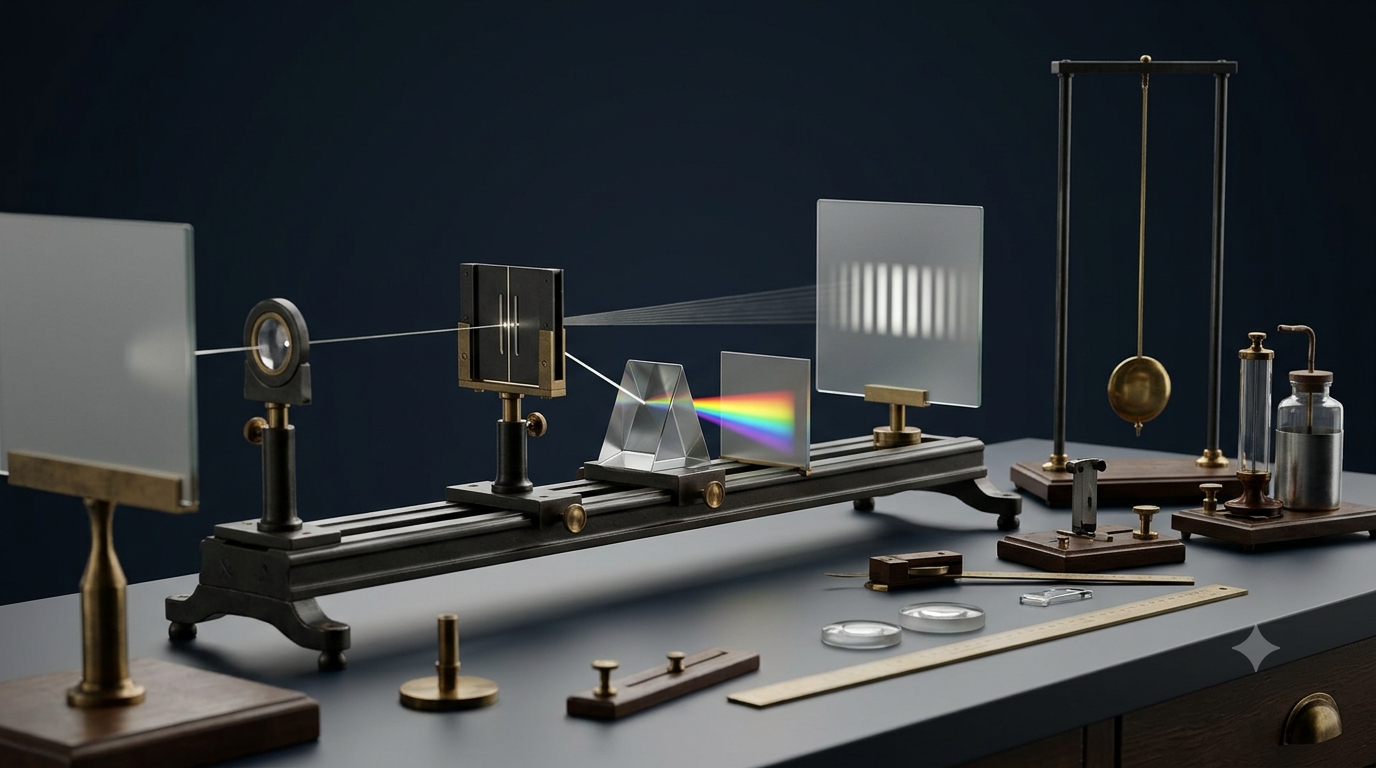
Thomas Young performed his famous double-slit experiment in the early nineteenth century to investigate the nature of light.
In the experiment, light passes through two narrow slits and produces a pattern of alternating bright and dark regions on a screen. This pattern is explained by the interference of light waves.
Bright regions form where the waves reinforce each other, while dark regions form where they cancel each other.
The experiment provided strong evidence for the wave behavior of light and challenged the idea that light could be explained only as a stream of particles.
Later developments in quantum physics gave the double-slit experiment an even broader significance. Modern versions demonstrate that quantum objects, including individual photons and electrons, can produce interference patterns under suitable experimental conditions.
The experiment remains one of the most important demonstrations in the study of wave behavior and quantum mechanics.
4. Faraday’s Electromagnetic Induction Experiment
Michael Faraday discovered electromagnetic induction in 1831 through experiments involving magnets and coils of wire.
He found that changing the magnetic field linked with a conductor can produce an electric current. For example, moving a magnet relative to a coil can induce an electrical response.
This discovery established a fundamental connection between magnetism and electricity.
Electromagnetic induction became the scientific foundation for technologies such as electric generators, transformers, and many types of electrical equipment.
The principle is especially important in power generation, where mechanical energy is converted into electrical energy through electromagnetic induction.
Faraday’s experiments demonstrate how a carefully investigated physical effect can eventually support technologies used by millions of people.
5. The Michelson–Morley Experiment
The Michelson–Morley experiment was conducted in 1887 by Albert A. Michelson and Edward W. Morley.
At the time, some physicists proposed that light traveled through a hypothetical medium called the luminiferous ether. The experiment was designed to detect Earth’s motion relative to this proposed medium by comparing the travel times of light along different paths.
The expected effect was not observed at the predicted level. The result challenged important assumptions behind the ether hypothesis, although its interpretation developed through subsequent theoretical and experimental work.
The experiment later became historically significant in discussions leading to the development of modern theories of space and time, including special relativity.
It illustrates an essential feature of science: an experiment can be valuable even when it fails to produce the result researchers originally expected.
6. Millikan’s Oil-Drop Experiment
Robert A. Millikan conducted his famous oil-drop experiment in the early twentieth century to investigate the electric charge of individual oil droplets.
By observing tiny droplets suspended between electrically charged plates, Millikan and his collaborators measured the relationship between electrical forces and the droplets’ motion.
The results provided a measurement of the elementary electric charge and strong evidence that electric charge occurs in discrete units.
This finding helped scientists improve their understanding of atomic structure and the behavior of charged particles.
The experiment is also an important example of how precise measurements can reveal properties of nature that cannot be observed directly with the naked eye.
7. Rutherford’s Gold-Foil Experiment
Ernest Rutherford’s research group, including Hans Geiger and Ernest Marsden, conducted the gold-foil scattering experiments in the early twentieth century.
They directed alpha particles toward a very thin sheet of gold and observed how the particles scattered.
Most particles passed through the foil with little deflection, but a small number were deflected through large angles.
These surprising observations led Rutherford to propose that an atom contains a very small, dense, positively charged nucleus. Most of the atom’s volume is comparatively empty space.
The results challenged the earlier plum-pudding model of the atom and helped establish the nuclear model.
This experiment became a major milestone in the development of atomic physics and contributed to later investigations of the structure of matter.
What Do Classic Physics Experiments Teach Us?
Classic physics experiments are valuable not only because of their discoveries but also because they demonstrate how scientific investigations should be conducted.
The Importance of Observation
Scientific investigations often begin with a question about something that happens in nature.
For example, a scientist might ask why a magnet attracts certain materials or why an object changes direction when a force acts on it.
Careful observation helps identify patterns, unexpected effects, and questions that can be investigated through experiments.
The Importance of Evidence
An explanation may sound reasonable without being correct. Experiments help determine whether an idea agrees with measurable results.
Scientists collect evidence, compare observations with predictions, and evaluate alternative explanations before drawing conclusions.
This approach helps reduce the influence of personal opinions and unsupported assumptions.
The Role of Measurement
Many physical principles depend on relationships between measurable quantities, such as distance, time, mass, temperature, voltage, and electric current.
Accurate measurements help scientists identify these relationships and determine whether experimental results agree with theoretical predictions.
For instance, measuring how far an object travels over a known period can help researchers calculate its average speed.
Measurement also involves uncertainty. Instruments have limitations, observations may vary, and experimental conditions can affect results. Recognizing these limitations is an important part of reliable scientific work.
Learning from Unexpected Results
Experiments do not always produce the outcomes researchers anticipate.
An unexpected result may reveal an experimental error, an overlooked factor, or a limitation in the original explanation.
Instead of automatically dismissing such results, scientists investigate them, repeat measurements, and consider alternative possibilities.
The history of physics shows that unexpected observations can sometimes lead to major scientific advances.
How Classic Physics Experiments Influence Modern Technology
Many technologies used today depend on principles established or clarified through experimental physics.
Electricity Generation and Distribution
Faraday’s discovery of electromagnetic induction helped make modern electrical power generation possible.
Electric generators use electromagnetic induction to convert mechanical energy into electrical energy. Transformers also rely on changing magnetic fields to transfer electrical energy between circuits and adjust voltage levels.
These principles are essential to power stations, electrical grids, and many renewable energy systems.
Computers and Electronic Devices
Research into electric charge, atomic structure, and the behavior of materials contributed to the scientific foundations of modern electronics.
Semiconductors, transistors, integrated circuits, and computer processors depend on an understanding of how electric charges behave in different materials.
Although these technologies were developed through many later discoveries, the experimental tradition established by earlier physicists helped create the foundation for their development.
Astronomy and Space Exploration
Newton’s laws of motion and universal gravitation are essential for understanding planetary motion and planning spacecraft trajectories.
Scientists use these principles to calculate orbital paths, estimate gravitational forces, and guide spacecraft through the Solar System.
More advanced theories are necessary in certain situations, but classical mechanics remains extremely useful for many practical calculations.
Medical and Scientific Instruments
Experimental discoveries involving electricity, magnetism, waves, and atomic structure have contributed to technologies used in medical diagnosis and scientific research.
For example, magnetic resonance imaging uses principles related to nuclear magnetic resonance, while X-ray imaging relies on the interaction of X-rays with matter.
These technologies emerged from extensive research beyond the classic experiments discussed here, but they demonstrate how foundational physical knowledge can contribute to practical applications.
Can Students Perform Classic Physics Experiments?
Yes. Many important physics principles can be explored through simple, safe activities using everyday materials.
Students do not need expensive laboratory equipment to begin learning how experiments work.
Investigating Motion with a Ramp
A small ball, a ramp, and a measuring tape can help demonstrate how an object’s motion changes as it rolls down an inclined surface.
Students can change the ramp’s height, measure the distance traveled, and record the time taken over a defined section.
Repeating the experiment helps them compare results and understand why consistent procedures are important.
Observing Light Through a Narrow Opening
A safe classroom demonstration using a light source and narrow openings can help introduce the concepts of light propagation, diffraction, and interference.
A laser should never be directed toward anyone’s eyes, and demonstrations involving lasers should follow appropriate safety precautions.
More advanced double-slit experiments may require carefully prepared equipment and controlled lighting conditions.
Exploring Electromagnetism
A simple electromagnet can be made using an insulated wire, an iron nail, and a suitable low-voltage battery.
When current flows through the wire wrapped around the nail, a magnetic field is produced that can attract small iron objects.
The activity demonstrates the relationship between electric current and magnetism.
The wire should not be left connected for extended periods because it may become hot. Mains electricity must never be used for this experiment.
Testing Reflection with a Mirror
A plane mirror, a sheet of paper, and a light source can help students investigate how light reflects from a surface.
By recording the angles of incidence and reflection, students can explore the law of reflection, which states that the angle of incidence equals the angle of reflection when measured from the normal to the surface.
These activities encourage learners to make predictions, collect measurements, and explain their observations using physical principles.
Are Classic Physics Experiments Still Relevant Today?
Classic physics experiments remain relevant because they provide the foundation for understanding both established scientific principles and newer discoveries.
Many introductory physics courses use these experiments to explain concepts that may otherwise seem abstract. Students can connect mathematical equations with observable effects and understand how scientists developed the ideas presented in textbooks.
Researchers also continue to use improved versions of classic experiments to test physical theories with greater precision.
For example, modern interference experiments investigate quantum behavior, while increasingly precise measurements test fundamental physical constants and predictions of established theories.
However, not every classic experiment can be reproduced in its original form, and not every historical conclusion remains accepted in its original interpretation. Scientific understanding develops as new evidence becomes available.
Studying these experiments therefore helps learners understand both the reliability of well-tested scientific knowledge and the importance of continued investigation.
Conclusion
Classic physics experiments are an essential part of the history and development of science. Investigations by Galileo, Young, Faraday, Michelson and Morley, Millikan, Rutherford, and other scientists helped establish fundamental principles governing motion, light, electricity, and the structure of matter. Their discoveries changed scientific thinking and contributed to technologies used in modern life. More importantly, these experiments demonstrate how observation, measurement, evidence, and critical thinking work together to build reliable knowledge. By studying classic physics experiments, learners can understand not only what scientists discovered but also how those discoveries were made. These investigations continue to inspire curiosity, strengthen scientific reasoning, and provide a foundation for exploring the physical world.
FAQs
1. What are classic physics experiments?
Classic physics experiments are important scientific investigations that helped scientists understand the fundamental laws and principles of nature. They explore topics such as motion, gravity, light, electricity, magnetism, and atomic structure. These experiments use observation, measurement, and evidence to test scientific ideas. Famous examples include Galileo’s investigations of falling objects, Young’s double-slit experiment, Faraday’s electromagnetic induction experiment, and Rutherford’s gold-foil experiment. Their discoveries helped establish the foundations of modern physics and influenced the development of many technologies. Studying these experiments helps learners understand how scientific knowledge develops through systematic investigation and careful analysis.
2. Why are classic physics experiments important?
Classic physics experiments are important because they help explain how scientists discovered and tested fundamental physical principles. They challenged incorrect assumptions, established scientific laws, and improved our understanding of natural phenomena. For example, Galileo’s investigations contributed to the understanding of falling objects, while Faraday’s experiments helped establish electromagnetic induction. These discoveries influenced later scientific research and technological development. Classic experiments also teach students how to observe phenomena, measure quantities, analyze results, and draw evidence-based conclusions. By studying them, learners develop scientific reasoning skills and understand why experiments are essential for testing theories and expanding human knowledge.
3. What is the most famous experiment in physics?
There is no single experiment universally considered the most famous in physics. Several investigations are widely recognized because of their scientific importance. Galileo’s studies of falling objects helped transform the understanding of motion, while Young’s double-slit experiment demonstrated the wave behavior of light. Rutherford’s gold-foil experiment revealed important information about atomic structure. The Michelson–Morley experiment challenged the traditional ether hypothesis, and Millikan’s oil-drop experiment helped determine the elementary electric charge. Each experiment contributed to a different area of physics. Their importance depends on the scientific question being studied and their influence on subsequent discoveries.
4. What did Galileo’s experiments on falling objects demonstrate?
Galileo’s investigations of falling objects helped establish that objects fall with the same gravitational acceleration when air resistance is negligible, regardless of their mass. He used inclined planes to slow down motion and make measurements easier to perform. His investigations challenged traditional explanations that heavier objects must always fall faster than lighter ones. Galileo’s work also emphasized the importance of mathematical analysis, observation, and experimentation in studying physical phenomena. These contributions helped establish the foundations of classical mechanics and influenced Isaac Newton’s later work. Today, Galileo’s investigations remain important examples of how experimental evidence can change scientific understanding.
5. What is the purpose of Young’s double-slit experiment?
Young’s double-slit experiment was designed to investigate the nature of light. When light passes through two narrow slits, it produces alternating bright and dark bands on a screen under suitable conditions. This pattern results from interference, in which light waves reinforce or cancel one another. The experiment provided strong evidence for the wave behavior of light and challenged explanations based exclusively on a particle model. Modern versions also help scientists investigate quantum phenomena involving photons and electrons. The double-slit experiment remains a fundamental demonstration in physics because it connects wave interference with important questions about the behavior of matter and light.
6. How did Faraday’s experiment contribute to modern technology?
Michael Faraday’s electromagnetic induction experiments demonstrated that a changing magnetic field can produce an electric current in a conductor. This discovery established an important relationship between electricity and magnetism. The principle became fundamental to the operation of electric generators and transformers. Generators use electromagnetic induction to convert mechanical energy into electrical energy, while transformers transfer electrical energy between circuits and change voltage levels. These technologies are essential to power stations, electrical distribution systems, and many industrial applications. Faraday’s work also helped inspire further research into electromagnetism, demonstrating how a fundamental scientific discovery can eventually support technologies used in everyday life.
7. What did Rutherford’s gold-foil experiment discover?
Rutherford’s gold-foil experiment helped reveal the structure of the atom. In the experiment, researchers directed alpha particles toward a thin sheet of gold and observed how they scattered. Most particles passed through with little deflection, but a small number changed direction significantly. These results suggested that an atom contains a tiny, dense, positively charged nucleus surrounded by a much larger region of space. The findings challenged the earlier plum-pudding model of atomic structure. Rutherford’s nuclear model became an important milestone in atomic physics and influenced later investigations into the arrangement of particles within atoms and the fundamental structure of matter.
8. Can classic physics experiments be performed at home?
Some classic physics principles can be explored at home using simple materials and appropriate safety precautions. For example, a ball rolling down a ramp can demonstrate motion, while a plane mirror can help illustrate reflection. A simple electromagnet made with insulated wire, an iron nail, and a low-voltage battery can demonstrate the relationship between electric current and magnetism. These activities allow learners to make predictions, observe results, and compare measurements. However, experiments involving high voltage, powerful lasers, hazardous chemicals, or specialized equipment should only be performed in properly equipped settings with appropriate supervision. Safety should always come first.
9. How do classic physics experiments help students learn science?
Classic physics experiments help students connect scientific theories with observable events. Instead of memorizing laws and definitions alone, learners can investigate how physical principles work in practice. Experiments encourage students to ask questions, form hypotheses, collect measurements, identify patterns, and interpret results. They also demonstrate that scientific conclusions depend on evidence rather than personal opinions. For example, studying a simple motion experiment can make concepts such as distance, time, speed, and acceleration easier to understand. Learning about historical experiments also shows students how scientific knowledge develops through repeated testing, collaboration, and improvements in measurement techniques.
10. Are classic physics experiments still relevant in modern science?
Yes, classic physics experiments remain relevant because they established principles that continue to support scientific education, research, and technology. Their findings help explain motion, electricity, magnetism, light, and atomic structure. Modern scientists also perform improved versions of several classic experiments to test theories with greater precision and investigate questions that earlier researchers could not answer. For example, modern double-slit experiments explore quantum behavior, while advanced measurements test fundamental physical principles. Although scientific explanations can change when new evidence emerges, classic experiments remain valuable for understanding how knowledge develops. They provide a foundation for studying modern physics and appreciating scientific progress.