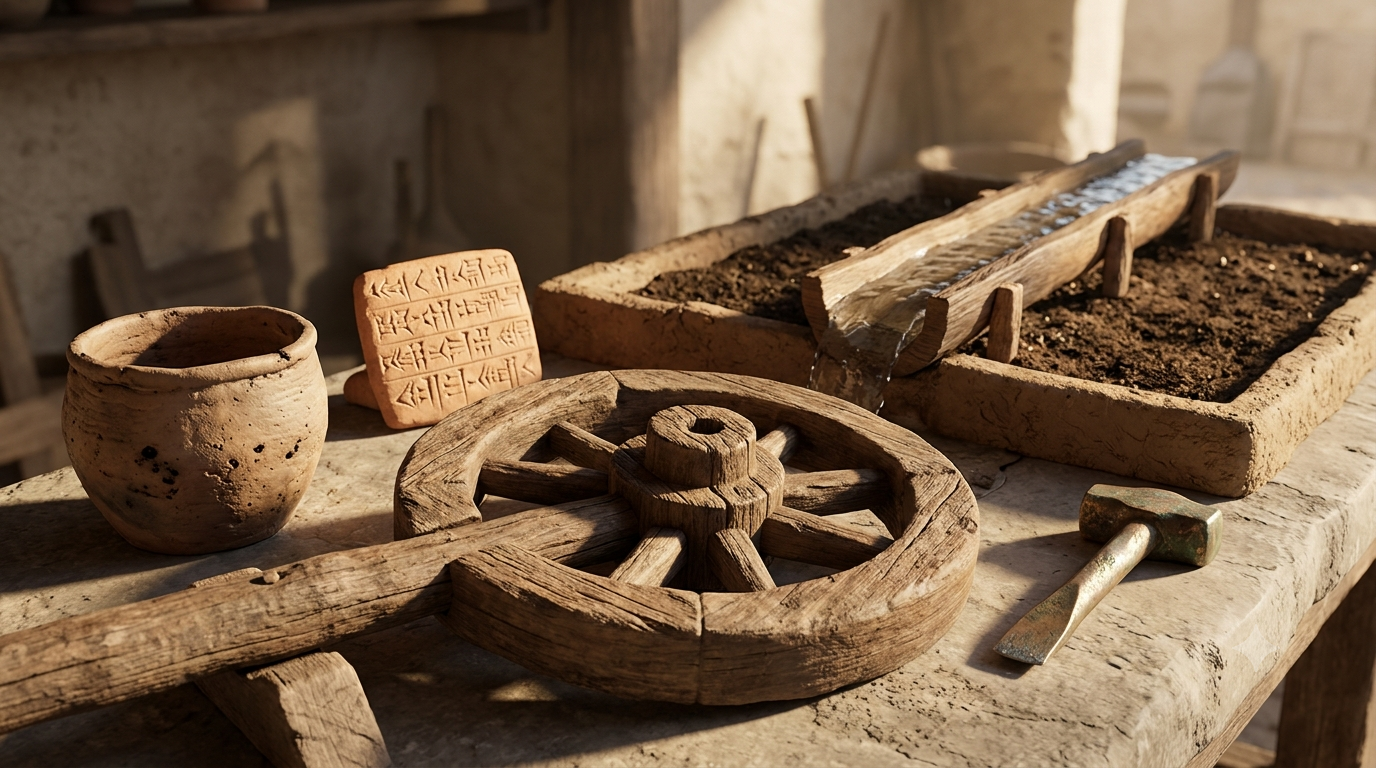
Ancient inventions are among the most important achievements in human history. They helped early people solve everyday problems, produce food, build homes, communicate, travel, and understand the world around them. From the invention of the wheel to the development of writing, these early innovations transformed human life and laid the foundation for modern civilization. Many technologies used today have roots in ideas developed thousands of years ago.
Understanding ancient inventions helps us discover how human creativity developed over time. It also shows how people from different civilizations used their knowledge, skills, and available resources to overcome challenges. Some inventions emerged through careful observation and experimentation, while others developed gradually as people improved existing tools and methods. In this article, we will learn what ancient inventions are, where they originated, why they were created, and explore some important examples that changed the course of human history.
What Are Ancient Inventions?
Ancient inventions are tools, techniques, machines, materials, and systems created or developed by people in the distant past to solve practical problems or meet human needs. They include simple objects, such as stone tools, as well as complex achievements, such as irrigation systems, calendars, and early forms of writing.
The word invention refers to the creation of something new or the development of a new method for performing a task. An invention does not always appear as a completely new object. Sometimes, it involves improving an existing tool, combining different ideas, or discovering a more effective way to complete a task.
Ancient inventions developed across many regions, including Mesopotamia, ancient Egypt, the Indus Valley, China, Greece, Rome, and the Americas. Some were created independently in different places, while others spread through trade, migration, and cultural exchange.
These inventions were closely connected to the needs of ancient societies. Farmers required better ways to grow crops, builders needed stronger materials, traders needed systems for measuring and recording goods, and rulers needed methods for organizing large communities.
Although ancient inventions often appear simple compared with modern technology, many required considerable observation, practical knowledge, and experimentation.
When Did Ancient Inventions Begin?
The history of ancient inventions began long before the development of cities and written records. Early humans created tools from stone, wood, bones, and other natural materials to improve their chances of survival.
Early Stone Tools
Stone tools are among the earliest known examples of human technology. Archaeological discoveries indicate that stone tools were being made approximately 3.3 million years ago, before the appearance of the genus Homo as currently understood by scientists.
Early toolmakers shaped stones to produce sharp edges that could cut plants, process animal remains, and perform other useful tasks. Over time, stone tools became more specialized and sophisticated.
The development of these tools demonstrates an important feature of invention: people learned to modify natural materials to make them more useful.
The Discovery and Use of Fire
The control and use of fire was another major development in early human history. Evidence for early fire use extends back hundreds of thousands of years, although the timing and regularity of controlled fire use remain subjects of scientific research.
Fire provided warmth, light, and protection. Cooking also made many foods easier to chew and digest. Later, people used fire to produce pottery, work metals, and manufacture other materials.
Unlike a single object invented at a specific moment, the use of fire developed over a long period as humans learned how to create, maintain, and control it.
The Beginning of Agriculture
Around 10,000 BCE, farming began to develop in several regions, including parts of Southwest Asia. Agriculture emerged independently in other parts of the world at different times.
People gradually learned to cultivate plants, manage animals, store crops, and settle in one place for longer periods. These changes supported the growth of permanent settlements and, eventually, cities.
Agriculture also encouraged the development of new inventions, including improved farming tools, irrigation channels, storage containers, and methods of measuring land.
Where Did Ancient Inventions Originate?
Ancient inventions did not originate from one civilization or one geographical location. Different societies developed technologies according to their environments, resources, needs, and cultural practices.
Mesopotamia
Mesopotamia was located mainly between the Tigris and Euphrates rivers, in parts of present-day Iraq and neighboring areas. It became an important center of early urban civilization.
Mesopotamian societies contributed to the development of writing, administrative recordkeeping, mathematics, and irrigation systems. Cuneiform writing emerged around the late fourth millennium BCE and was initially used for practical recordkeeping.
The region’s agricultural communities also developed methods for managing water and organizing large-scale farming.
Ancient Egypt
Ancient Egypt developed along the Nile River, where agriculture benefited from the river’s seasonal flooding.
Egyptians became known for their achievements in architecture, surveying, medicine, mathematics, and the organization of large construction projects. They used tools, ropes, measuring methods, and transport systems to construct monumental buildings.
Egyptian papyrus also became an important writing material, supporting the recording and preservation of information.
The Indus Valley Civilization
The Indus Valley Civilization flourished in parts of present-day Pakistan and northwestern India during the third millennium BCE.
Its major urban centers, including Harappa and Mohenjo-daro, featured carefully planned streets, drainage systems, wells, and standardized building practices.
These achievements demonstrate advanced knowledge of urban planning, construction, water management, and measurement.
The Indus script remains undeciphered, so many aspects of the civilization’s written communication and administration are still uncertain.
Ancient China
Ancient China developed numerous technologies over thousands of years. Important achievements included advances in bronze casting, silk production, papermaking, and agricultural equipment.
Papermaking is traditionally associated with Cai Lun’s improvements to the process during the Han dynasty, around 105 CE, although earlier paper-like materials have also been discovered.
Chinese inventions and technical knowledge later influenced other regions through trade and cultural exchange.
Ancient Greece and Rome
Ancient Greek thinkers contributed significantly to mathematics, geometry, mechanics, astronomy, and philosophy. Their work helped shape the development of scientific reasoning.
The Romans were particularly known for engineering, road construction, aqueducts, concrete technology, and large public buildings.
Their achievements show that ancient inventions included not only objects but also construction methods, infrastructure, and systems designed to serve entire populations.
Important Examples of Ancient Inventions
Many ancient inventions influenced how people lived and how societies developed. The following examples illustrate their importance.
1. The Wheel
The wheel is one of the most influential inventions in human history. The earliest known evidence of wheeled vehicles dates to around 3500 BCE in parts of Europe and Mesopotamia, although the precise history of its development is complex.
Wheels made it possible to transport heavy goods more efficiently using carts and wagons. They also became essential components of many machines and devices.
The potter’s wheel helped craftspeople produce pottery more efficiently and consistently. Over time, wheel technology became important in transportation, manufacturing, agriculture, and engineering.
The invention of the wheel did not immediately transform every society. Its usefulness depended on factors such as roads, animals suitable for pulling vehicles, and local environmental conditions.
2. Writing
Writing allowed people to record information using symbols and organized systems.
Some of the earliest known writing developed in Mesopotamia around 3400–3200 BCE. Egyptian hieroglyphic writing also emerged during the late fourth millennium BCE.
Early writing was often used to record trade, agricultural production, taxes, religious practices, and government activities. As writing systems developed, people could preserve laws, stories, scientific observations, and historical accounts.
Writing made it easier to communicate information across generations. It became essential for administration, education, literature, and the development of organized knowledge.
3. Irrigation Systems
Irrigation is the artificial supply of water to agricultural land. Ancient farmers developed irrigation methods to provide crops with water when rainfall was insufficient or unreliable.
In Mesopotamia, communities constructed canals and channels to direct river water toward fields. Other ancient societies also developed methods for storing, lifting, and distributing water.
Irrigation increased the amount of land that could be cultivated in suitable environments. It also supported larger settlements and more organized agricultural production.
However, irrigation required maintenance and careful management. Poorly managed systems could cause problems such as waterlogging and soil salinity.
4. The Plough
The plough improved the preparation of agricultural land by cutting, loosening, or turning soil. Early ploughs were relatively simple and were often pulled by people or animals.
As farming communities expanded, plough technology developed to suit different soils, crops, and working conditions.
The use of animal-drawn ploughs helped farmers cultivate larger areas in some regions. It also influenced settlement patterns, agricultural productivity, and the organization of rural labor.
The plough illustrates how a practical invention can transform an entire economic system rather than simply make one task easier.
5. Papyrus
Papyrus was a writing material made from the pith of the papyrus plant, which grew abundantly in ancient Egypt.
Workers processed the plant’s inner material into sheets that could be used for writing. Papyrus became important for administrative records, letters, religious texts, and literary works.
Compared with writing on large stone surfaces, papyrus was more portable and suitable for recording lengthy documents.
Although papyrus was not the only writing material used in the ancient world, it played a major role in preserving Egyptian and Mediterranean written culture.
6. Pottery
Pottery developed when people learned to shape clay and harden it through heating. Some of the earliest known fired pottery dates back more than 20,000 years, although its origins and uses varied across regions.
Pottery vessels were useful for storing water, preparing food, keeping grains, and transporting materials. Ceramic objects also served decorative, ceremonial, and cultural purposes.
The development of pottery improved food storage and supported settled communities. Later, specialized ceramic production became an important craft and trade activity.
7. Concrete and Roman Construction Techniques
Ancient Romans developed construction techniques that made extensive use of concrete. Roman concrete often combined lime-based materials with aggregates, and some formulations included volcanic materials that contributed to durability.
Roman builders used concrete in structures such as baths, bridges, harbors, and monumental buildings. They also developed sophisticated arches, vaults, and domes.
These methods allowed builders to create large and complex structures that would have been difficult to construct using only smaller stone blocks.
Roman construction technology influenced later architectural traditions, and surviving structures continue to provide evidence of ancient engineering skills.
8. The Calendar
Calendars were developed to organize time according to repeating natural patterns, particularly the cycles of the Sun and Moon.
Ancient societies used calendars to plan agricultural activities, organize festivals, track seasons, and manage religious ceremonies.
Egyptian timekeeping included a 365-day civil calendar, while Babylonian and other ancient traditions developed different systems based on lunar and solar observations.
The creation of calendars required careful observation of the sky and an understanding of recurring astronomical patterns.
Modern calendars developed through many historical changes, so today’s systems cannot be attributed to a single ancient invention.
9. The Compass
The magnetic compass developed in ancient China. Early magnetic devices were associated with lodestone and were not necessarily designed for maritime navigation.
Over time, compass technology became increasingly useful for determining direction. Magnetic compasses eventually became important tools for navigation and travel.
The compass helped navigators establish direction when familiar landmarks or clear views of the Sun and stars were unavailable.
Its later development and spread contributed to long-distance navigation and the expansion of maritime trade.
10. Water Clocks
Water clocks were used in several ancient societies to measure the passage of time through the controlled movement of water.
Some designs measured time as water flowed out of a container, while others measured the rise of water in a vessel.
Water clocks were useful when sundials were less practical, including at night or indoors. Their accuracy depended on the design, water flow, temperature, and other conditions.
These devices demonstrate how ancient people developed mechanical methods to measure time before modern clocks existed.
Why Were Ancient Inventions Created?
Ancient inventions developed primarily because people needed practical solutions to everyday problems. Although the needs of different societies varied, several common factors encouraged innovation.
Survival and Daily Life
Early humans developed tools to obtain food, prepare materials, protect themselves, and adapt to changing environments. Cooking methods, cutting tools, containers, and shelters improved their ability to survive.
As societies became more complex, inventions also helped people organize domestic activities and improve living conditions.
Agriculture and Food Production
Farming created new challenges, including preparing soil, managing water, storing crops, and transporting harvests.
Tools such as ploughs, irrigation systems, and storage containers helped communities manage these tasks. Reliable food supplies could support larger populations and allow some people to specialize in crafts, trade, administration, and other activities.
Trade and Communication
Growing trade networks increased the need for measurement, accounting, transportation, and recordkeeping.
Writing systems helped merchants and administrators document goods and transactions. Standardized weights and measures supported exchanges, while improved transport technologies made moving products easier.
These developments helped connect communities over increasingly long distances.
Religion, Government, and Knowledge
Religious practices and government responsibilities also encouraged invention. Societies needed buildings, calendars, measuring systems, and methods of preserving records.
Astronomical observations supported calendar-making, while mathematical techniques helped with construction, land measurement, and administration.
Ancient inventions therefore developed through a combination of practical necessity, cultural traditions, organized work, and the desire to understand the natural world.
How Did Ancient Inventions Change Human Civilization?
Ancient inventions changed civilization by making it possible for people to accomplish tasks more efficiently and organize larger communities.
First, agricultural technologies helped many societies produce and store more food. In favorable conditions, this supported population growth and permanent settlements.
Second, writing enabled information to be recorded and shared across generations. People could preserve laws, business transactions, stories, and observations rather than depending entirely on memory and spoken communication.
Third, engineering and construction technologies supported roads, bridges, irrigation networks, public buildings, and urban infrastructure. These developments helped communities manage water, transportation, and public activities.
Fourth, inventions encouraged specialization. When food production became sufficiently reliable, some people could focus on crafts, trade, administration, and intellectual work.
Finally, inventions spread between societies. Merchants, travelers, migrants, and scholars carried knowledge across regions, where people adapted it to their own circumstances.
These changes did not occur everywhere at the same time, and technological progress was not always continuous. Nevertheless, ancient inventions created foundations on which later generations built increasingly complex societies.
How Do We Know About Ancient Inventions?
Researchers learn about ancient inventions through archaeology, historical documents, scientific analysis, and comparisons between different cultures.
Archaeological Discoveries
Archaeologists study objects such as tools, pottery, building remains, and machines. Their shape, materials, and location can reveal how objects were made and used.
For example, the discovery of ancient wheels, pottery fragments, and irrigation structures provides evidence of early technological knowledge.
Written Records
Ancient inscriptions, manuscripts, and administrative documents can explain how people described technologies and used them in daily life.
However, written evidence survives unevenly. Many early societies left few readable records, and some writing systems remain undeciphered.
Scientific Dating and Material Analysis
Scientists use techniques such as radiocarbon dating, stratigraphy, and the analysis of materials to estimate the age of archaeological finds.
Researchers may also examine tool marks, metal composition, and residues to understand manufacturing methods and the functions of objects.
By combining several types of evidence, researchers can develop more reliable explanations of how ancient inventions originated and changed over time.
Ancient Inventions and Modern Technology
Many modern technologies share principles with inventions developed in ancient times. The connection is not always a direct line of development, but ancient achievements helped establish important ideas and practices.
Modern transportation still relies on wheels, although engines, electronic systems, and advanced materials have transformed vehicles.
Writing has evolved from inscriptions and manuscripts into printed books, digital documents, and electronic communication. The underlying purpose of preserving and sharing information remains important.
Modern agricultural systems use advanced machinery, sensors, and automated irrigation, but the basic challenge of supplying crops with water remains similar to that faced by ancient farmers.
Likewise, modern construction uses sophisticated materials and computer-based design, while principles of load distribution, structural stability, and durable building remain central to engineering.
Studying ancient inventions therefore helps us understand not only the past but also the long-term development of technology.
Conclusion
Ancient inventions were important creations that helped humans overcome practical challenges and build increasingly complex societies. From stone tools and pottery to writing, irrigation, calendars, and construction techniques, these achievements transformed how people obtained food, communicated, measured time, traveled, and organized their communities.
Ancient inventions emerged in different parts of the world, often developing independently in response to local needs and resources. Their history demonstrates that innovation is a gradual process shaped by observation, experimentation, cooperation, and the exchange of knowledge.
Many technologies used today have connections to these early achievements. By learning about ancient inventions, we gain a deeper understanding of human creativity and the foundations of modern civilization. Most importantly, their history reminds us that even a simple idea can have a lasting influence when it solves an important problem.
FAQs
1. What are ancient inventions?
Ancient inventions are tools, techniques, machines, and systems developed by people in the distant past to solve problems and improve their lives. Examples include the wheel, writing, pottery, irrigation systems, calendars, and water clocks. These inventions helped early societies produce food, transport goods, construct buildings, measure time, and preserve information. Some ancient inventions were simple, while others required considerable knowledge and planning. They developed in different civilizations according to people’s needs and available resources. Many ancient inventions also influenced later technologies, making them important for understanding the development of human civilization and modern technology.
2. When did ancient inventions begin?
Ancient inventions began long before the development of cities and written records. Early humans and their ancestors created stone tools millions of years ago to process food and work with natural materials. The controlled use of fire developed much later in human history, while agriculture began to emerge around 10,000 BCE in several regions. As people established permanent settlements, they developed pottery, farming tools, irrigation systems, and storage methods. Later, growing communities created writing systems, calendars, and construction techniques. Therefore, ancient inventions did not begin during a single period but developed gradually as humans gained experience and knowledge.
3. Which civilization created the first inventions?
No single civilization created the first inventions. Early tools were developed by ancient human populations long before organized civilizations appeared. Later, societies in Mesopotamia, Egypt, the Indus Valley, China, and other regions developed important technologies independently. Mesopotamia contributed to early writing and irrigation systems, while ancient Egypt developed papyrus writing materials and advanced construction methods. The Indus Valley Civilization demonstrated sophisticated urban planning and drainage systems. Ancient China made important contributions to papermaking and other technologies. These achievements show that invention was a worldwide process shaped by different environments, resources, experiences, and human needs.
4. What are some important examples of ancient inventions?
Important examples of ancient inventions include the wheel, writing, pottery, the plough, irrigation systems, calendars, papyrus, water clocks, and concrete construction techniques. Each invention helped solve a particular problem. The wheel improved transportation, while writing allowed people to preserve information and maintain records. Pottery provided useful containers for storing food and water. Irrigation systems helped farmers supply water to their crops, and calendars supported agricultural and religious activities. Water clocks offered a way to measure time, while construction techniques enabled the development of large buildings and infrastructure. Together, these inventions transformed daily life and supported the growth of ancient societies.
5. Why were ancient inventions important?
Ancient inventions were important because they improved survival, increased productivity, and helped societies become more organized. Farming tools and irrigation systems supported food production, while storage containers helped preserve essential supplies. Writing made it possible to record laws, transactions, and knowledge for future generations. Transportation technologies helped people move goods and travel between settlements. Construction methods supported roads, bridges, houses, and public buildings. These developments also encouraged trade, specialization, and cultural exchange. Without many of these early innovations, the development of large settlements and complex civilizations would have followed a very different path. Their influence continues through modern technology and engineering.
6. How did ancient people develop new inventions?
Ancient people developed inventions by observing nature, experimenting with materials, learning from experience, and improving existing tools. For example, early humans discovered that certain stones could be shaped into sharp cutting tools. Farmers learned to direct water toward crops and improve the preparation of soil. Craftspeople experimented with clay, heat, and different materials to produce useful objects. Inventions also developed through cooperation, as communities shared skills and knowledge across generations. Trade and migration helped spread ideas between regions. Many inventions were not created by one identifiable person but emerged gradually through repeated experimentation and improvements made by different people over long periods.
7. How do historians know about ancient inventions?
Historians and archaeologists study ancient inventions through physical objects, building remains, written records, and scientific investigations. Archaeologists examine tools, pottery, weapons, and other artifacts to understand how people lived and worked. Ancient buildings and irrigation channels provide evidence of engineering and construction methods. Inscriptions and manuscripts reveal information about writing, administration, trade, and cultural practices. Scientists use techniques such as radiocarbon dating and the study of archaeological layers to estimate the age of discoveries. Researchers also analyze materials and manufacturing marks to understand how objects were produced. By combining different sources of evidence, they can reconstruct the history of ancient technology.
8. What was the most important ancient invention?
There is no single ancient invention that everyone agrees was the most important because different inventions solved different problems. Stone tools were essential for early human survival, while the controlled use of fire improved food preparation, warmth, and protection. Agriculture supported permanent settlements and larger populations. The wheel improved transportation, and writing allowed people to preserve information beyond individual memory. Each invention influenced human development in a different way. Their importance also depended on the environment and needs of a particular society. Rather than selecting one invention as universally the greatest, it is more useful to understand how several major innovations worked together to transform civilization.
9. Are ancient inventions still used today?
Yes, many ancient inventions and their underlying principles remain important today. The wheel is still essential for transportation and machinery, although modern versions use advanced materials and engineering. Writing continues to preserve and communicate information through books, computers, and digital devices. Irrigation remains important in agriculture, while calendars help people organize time and plan activities. Pottery and ceramics are still used in household products, construction, laboratories, and industrial applications. Modern buildings also use principles of structural engineering that developed through centuries of construction experience. Although these technologies have changed considerably, their ancient foundations demonstrate how early innovations can influence human life for thousands of years.
10. What is the difference between an ancient invention and a modern invention?
An ancient invention was developed in the distant past, often using locally available materials and practical knowledge. Examples include stone tools, pottery, early writing systems, and irrigation channels. A modern invention is generally associated with more recent periods and may use advanced scientific knowledge, specialized manufacturing, electronics, or digital technology. Smartphones, computers, and modern medical imaging systems are examples of modern inventions. However, the difference is not simply that ancient inventions were simple and modern inventions are complex. Ancient engineers created sophisticated structures and machines using the knowledge available to them. Both ancient and modern inventions reflect human creativity and the desire to solve problems.