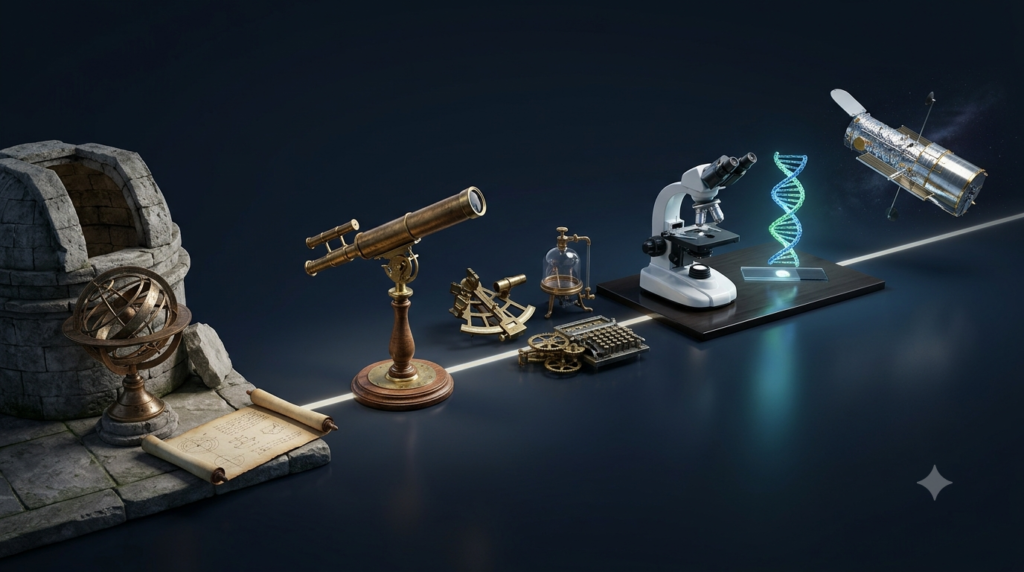
Physics is the branch of science that helps us understand how the natural world works. It explains the movement of objects, the behavior of light, the flow of electricity, the structure of matter, and the forces that shape the universe. Over time, scientists have made many discoveries that changed how people understand these natural processes. A scientific discovery in physics occurs when researchers identify a previously unknown phenomenon, uncover a new physical principle, or find evidence that changes an existing scientific explanation. Some discoveries explain things that people observe in everyday life, while others reveal processes that occur inside atoms or across distant galaxies. These discoveries do more than add new information to scientific knowledge. They can challenge established beliefs, inspire new technologies, and open entirely new areas of research. Understanding scientific discoveries helps us appreciate how physics develops and why our knowledge of nature continues to grow.
What Is a Scientific Discovery in Physics?
A scientific discovery in physics is the identification of a previously unknown physical phenomenon, property, relationship, or process through observation, experimentation, measurement, or theoretical investigation.
For example, the discovery of radioactivity revealed that certain materials release energy and particles from their atomic structures. The discovery of electromagnetic waves helped scientists understand how electrical and magnetic effects can travel through space. Similarly, the discovery of the expanding universe changed our understanding of the universe’s history and development.
A discovery does not always happen suddenly. Sometimes, scientists notice an unexpected result during an experiment. In other cases, they spend years collecting evidence, developing mathematical models, and testing predictions before recognizing a new physical principle.
Scientific discoveries must be supported by reliable evidence. An interesting idea or an unusual observation may lead to a discovery, but scientists need to investigate whether the finding is accurate and whether other researchers can confirm it.
In physics, discoveries are important because they help explain natural phenomena and reveal relationships that were previously unknown or poorly understood.
How Are Scientific Discoveries Made in Physics?
Scientific discoveries usually emerge through a combination of curiosity, observation, logical reasoning, experimentation, and careful analysis. Although the exact process varies, several common steps help scientists investigate unfamiliar physical phenomena.
1. Observing Nature
Many discoveries begin with an observation. Scientists examine the behavior of objects, materials, energy, or natural events and look for patterns that existing explanations cannot fully describe.
For example, observing the motion of planets helped astronomers develop better explanations of how celestial bodies move. Studying the behavior of falling objects contributed to the development of classical mechanics.
Observations may involve the unaided senses, laboratory instruments, telescopes, microscopes, detectors, or advanced measuring systems.
2. Asking Scientific Questions
After observing something unusual, scientists develop questions about what causes it and how it works.
A physicist studying electricity might ask why some materials conduct electric current easily while others resist its flow. Another researcher might investigate why light behaves like a wave in certain experiments but produces particle-like results in others.
Clear scientific questions help researchers identify what evidence they need and how they can investigate a problem.
3. Developing Hypotheses and Theories
A hypothesis is a proposed explanation that can be tested through observation or experimentation. Scientists may develop several possible explanations for the same phenomenon.
When sufficient evidence supports a broad explanation, it may contribute to the development or refinement of a scientific theory.
In physics, theories provide structured explanations of natural processes. They are not simply guesses. A well-supported scientific theory is based on evidence and must remain open to testing and refinement.
For example, the theory of relativity explains aspects of space, time, gravity, and motion that cannot be fully described by classical mechanics.
4. Conducting Experiments and Measurements
Experiments allow scientists to test predictions and investigate whether an explanation matches physical reality.
Researchers may change one variable while controlling others, measure the results, and repeat the experiment to determine whether the findings are consistent.
Modern physics experiments can be extremely complex. Particle physicists may use large accelerators and sophisticated detectors to study the fundamental components of matter. Researchers investigating gravitational waves use highly sensitive instruments to measure extremely small changes in distance.
Accurate measurements are essential because even small errors can affect the interpretation of experimental results.
5. Analyzing Evidence and Confirming Results
Scientists analyze collected data to determine whether the results support their explanations. They also consider alternative interpretations, possible measurement errors, and the limitations of their methods.
Other researchers may independently repeat experiments or use different methods to investigate the same phenomenon.
When the evidence consistently supports a finding, confidence in the discovery increases. If new evidence contradicts the original interpretation, scientists may revise their conclusions.
This process helps make physics a reliable and self-correcting scientific discipline.
Major Scientific Discoveries That Changed Our Understanding of Nature
Several discoveries have transformed physics by revealing important features of the natural world. These examples show how new evidence can change scientific explanations and create opportunities for further research.
The Discovery of Gravity and the Laws of Motion
Isaac Newton developed the laws of motion and the law of universal gravitation during the seventeenth century. His work provided a mathematical framework for explaining how objects move and how gravitational attraction acts between masses.
Newton’s ideas connected events that might otherwise appear unrelated. The motion of a falling apple and the motion of the Moon around Earth could be understood using the same general principles.
This was a major change in scientific thinking because it demonstrated that the motion of objects on Earth and the movement of celestial bodies follow related physical laws.
Newtonian mechanics became essential to engineering, astronomy, construction, and the study of motion.
However, Newton’s framework is not sufficient for every situation. Einstein’s theory of relativity provides a more complete description of gravity and motion under extreme conditions, such as strong gravitational fields or speeds approaching the speed of light.
The Discovery of Electromagnetism
Electricity and magnetism were once studied as separate phenomena. Research by scientists such as Michael Faraday and James Clerk Maxwell revealed the deep connections between them.
Faraday’s experiments demonstrated electromagnetic induction, in which a changing magnetic field can produce an electric current. Maxwell later developed equations that unified electricity and magnetism into a comprehensive theoretical framework.
This work showed that electric and magnetic fields are interconnected aspects of electromagnetism. Maxwell’s theory also predicted electromagnetic waves, which travel at the speed of light in a vacuum.
The discovery and understanding of electromagnetism transformed technology. Electric motors, generators, radio communication, television, wireless networks, and many modern electronic systems depend on electromagnetic principles.
It also changed the scientific understanding of light by identifying it as an electromagnetic wave.
The Discovery of Radioactivity
In 1896, Henri Becquerel discovered that uranium salts could emit radiation without being exposed to sunlight. This unexpected observation led to further investigations by Marie Curie, Pierre Curie, and other scientists.
Their research helped establish radioactivity as a natural property of certain atomic nuclei.
The discovery challenged the idea that atoms were always stable and indivisible in the way many earlier models suggested. It helped scientists understand that atoms have internal structures and can undergo changes that release energy and particles.
Radioactivity became important in nuclear physics, medical imaging, cancer treatment, geological dating, and the study of Earth’s history.
It also contributed to the development of nuclear energy and a deeper understanding of atomic nuclei.
The Discovery of Quantum Mechanics
During the early twentieth century, scientists found that classical physics could not adequately explain several phenomena involving atoms and subatomic particles.
Investigations into blackbody radiation, the photoelectric effect, atomic spectra, and other observations led to the development of quantum theory.
Quantum mechanics describes the behavior of matter and energy at very small scales. It reveals that physical systems can behave in ways that differ significantly from everyday experience.
For example, energy in certain atomic systems can occupy specific discrete levels rather than any possible value. Quantum theory also helps explain the behavior of electrons in atoms and the interactions between light and matter.
This discovery transformed our understanding of the microscopic world and made modern technologies such as semiconductor electronics, lasers, and many medical imaging techniques possible.
Quantum mechanics remains one of the foundational theories of modern physics.
The Discovery of Relativity
In 1905, Albert Einstein published his special theory of relativity, which changed the understanding of space, time, energy, and motion. His general theory of relativity, published in its mature form in 1915, described gravity in terms of the curvature of spacetime.
According to special relativity, measurements of time and distance depend on the relative motion of observers. The theory also established the relationship between mass and energy expressed by the famous equation E = mc².
General relativity explains gravity differently from Newtonian mechanics. Massive objects influence the geometry of spacetime, and this geometry affects how objects and light move.
Relativity has been tested through many observations and experiments. Its predictions are important for understanding black holes, gravitational waves, the behavior of light near massive objects, and the large-scale structure of the universe.
Relativistic corrections are also necessary for the accurate operation of modern Global Positioning System (GPS) technology.
The Discovery of the Expanding Universe
For much of history, many people imagined the universe as unchanging on the largest scales. During the twentieth century, astronomical observations provided evidence that the universe is expanding.
Edwin Hubble’s observations, published in 1929, helped establish a relationship between the distances of galaxies and their recession speeds. Earlier theoretical work by Georges Lemaître had also contributed to the development of expanding-universe models.
These findings changed the scientific picture of the cosmos. Instead of treating the universe as a static system, scientists began investigating how it evolves over time.
The expanding-universe model became a foundation of modern cosmology and contributed to the development of the Big Bang model.
Today, scientists continue to study the expansion rate, the early universe, dark matter, dark energy, and the processes that shaped galaxies.
The Detection of Gravitational Waves
Gravitational waves are disturbances in spacetime produced by accelerating masses under suitable conditions. Einstein’s general theory of relativity predicted their existence.
In 2015, the LIGO Scientific Collaboration announced the first direct detection of gravitational waves, produced by the merger of two black holes. The signal was observed on September 14, 2015, and the discovery was announced in February 2016.
This achievement provided strong evidence for a major prediction of general relativity and opened a new way to study the universe.
Before gravitational-wave astronomy, scientists mainly investigated distant cosmic objects through electromagnetic radiation, such as visible light, radio waves, and X-rays. Gravitational-wave detectors made it possible to study certain cosmic events through the ripples they produce in spacetime.
This approach has helped scientists investigate black hole mergers, neutron stars, and other extreme astrophysical systems.
How Do Scientific Discoveries Change Our Understanding of Nature?
Scientific discoveries can influence more than a single area of physics. They can change scientific theories, challenge familiar assumptions, and create new ways of investigating the natural world.
They Challenge Existing Ideas
A new discovery may reveal that an established explanation is incomplete or works only under certain conditions.
For example, Newtonian mechanics remains highly accurate for many everyday situations, but it does not fully explain motion at speeds close to the speed of light. Relativity provides a broader framework for these situations.
This does not mean that Newton’s work became useless. Instead, scientists gained a clearer understanding of where his laws apply and where more advanced theories are needed.
Scientific progress often involves refining earlier knowledge rather than discarding everything that came before it.
They Reveal Hidden Processes
Many physical processes cannot be observed directly with the human eye. Scientific discoveries help researchers understand what happens inside atoms, within stars, or in regions of space far beyond Earth.
Particle detectors reveal evidence of interactions between fundamental particles. Telescopes collect radiation from distant galaxies. Gravitational-wave observatories detect extremely small changes associated with powerful cosmic events.
These methods allow scientists to investigate parts of nature that would otherwise remain inaccessible.
They Connect Different Areas of Science
A discovery in physics can influence chemistry, biology, astronomy, geology, and other fields.
Quantum mechanics helps explain the structure of atoms and the behavior of chemical bonds. Nuclear physics contributes to understanding the energy produced inside stars. The physics of radiation supports medical imaging and some forms of cancer treatment.
These connections demonstrate that the natural world does not follow completely separate rules for every scientific discipline. Many scientific fields depend on shared physical principles.
They Improve Predictions
One important goal of physics is to predict how natural systems will behave under specific conditions.
A successful discovery can improve the accuracy of these predictions. Understanding electromagnetic induction allows engineers to design generators. Relativity helps scientists calculate the motion of objects in strong gravitational fields. Quantum mechanics helps researchers predict the properties of materials.
Better predictions make it possible to test scientific theories more precisely and develop practical applications.
They Create New Questions
A discovery often leads to further questions rather than providing a final answer to every problem.
For example, the discovery that the universe is expanding raised questions about its early history, its ultimate fate, and the physical processes responsible for its changing expansion rate.
Similarly, quantum mechanics has helped explain many atomic phenomena while raising continuing questions about measurement, quantum information, and the relationship between quantum theory and gravity.
Each major discovery can therefore become the starting point for another generation of research.
The Role of Technology in Discovering New Physics
Technology plays an increasingly important role in modern physics. Many discoveries depend on instruments capable of measuring phenomena that are too small, distant, fast, or weak to detect using ordinary methods.
Telescopes allow astronomers to observe distant stars and galaxies. Particle accelerators help researchers investigate the fundamental components of matter. Electron microscopes reveal structures too small for conventional optical microscopes to resolve. Atomic clocks measure time with extraordinary precision.
Computers also help scientists analyze large datasets, simulate complex physical systems, and compare experimental results with theoretical predictions.
However, advanced technology alone does not guarantee a discovery. Scientists must still ask meaningful questions, design suitable experiments, evaluate evidence, and interpret results carefully.
The combination of improved instruments and scientific reasoning continues to expand the range of physical phenomena that researchers can investigate.
Why Are Scientific Discoveries Important in Everyday Life?
Although some discoveries seem abstract, many have practical effects on daily life.
The development of electromagnetism made modern electricity generation and communication systems possible. Quantum physics contributed to semiconductors, computer processors, LEDs, and lasers. Nuclear physics has applications in medical diagnosis, cancer treatment, and energy production.
Research in optics supports cameras, fiber-optic communication, and many scientific instruments. Understanding heat transfer and fluid mechanics helps engineers design vehicles, buildings, refrigeration systems, and industrial equipment.
Not every discovery produces an immediate practical benefit. Some discoveries primarily improve our understanding of the universe and may not have an obvious application for many years.
Nevertheless, basic research can provide the scientific foundation for future technologies that cannot yet be predicted.
Scientific discoveries also help people make informed decisions about energy, technology, the environment, and other issues influenced by physical processes.
Can Scientific Discoveries Be Wrong?
Scientific discoveries are based on evidence, but scientific knowledge is not beyond revision. Sometimes, an early result is affected by measurement errors, incomplete data, or incorrect assumptions.
Researchers may initially interpret an observation in one way and later discover a better explanation. Independent verification helps identify such problems and improves the reliability of scientific conclusions.
It is also important to distinguish between a discovery and the explanation proposed for it. Scientists may correctly observe a new phenomenon but misunderstand its cause. Later experiments may confirm the observation while changing the explanation.
For example, Newtonian mechanics was extremely successful in explaining many forms of motion. Relativity later showed that Newton’s framework has limits, while preserving its usefulness in conditions where relativistic effects are negligible.
This ability to correct and refine explanations is a strength of science. Physics develops through evidence, testing, criticism, and continued investigation.
The Future of Scientific Discoveries in Physics
Physics continues to investigate questions that remain unanswered. Researchers are studying the nature of dark matter and dark energy, the behavior of matter under extreme conditions, the origins of cosmic structures, and the relationship between quantum mechanics and gravity.
Other areas of active research include quantum computing, fusion energy, advanced materials, neutrino physics, and the detection of planets beyond our solar system.
Future discoveries may improve our understanding of the universe or reveal physical processes that scientists have not yet recognized.
Some investigations may confirm existing theories with greater precision. Others may require scientists to revise current models or develop new mathematical frameworks.
It is impossible to predict exactly which discovery will have the greatest impact. However, the history of physics shows that careful observations, new instruments, and unexpected experimental results can transform scientific knowledge.
Conclusion
A scientific discovery in physics reveals new information about the physical world or provides evidence that changes how scientists explain a natural phenomenon. From gravity and electromagnetism to quantum mechanics, relativity, and gravitational waves, major discoveries have repeatedly expanded our understanding of nature. They have challenged existing assumptions, improved predictions, connected different scientific fields, and contributed to technologies used in everyday life. Scientific discoveries are not always sudden breakthroughs; they often result from years of observation, experimentation, and collaboration. They can also be refined when new evidence becomes available. As researchers continue to explore matter, energy, space, and time, physics will keep developing new explanations for the universe. Each discovery brings us closer to understanding how nature works while revealing new questions that future scientists can investigate.
FAQs
1. What is a scientific discovery in physics?
A scientific discovery in physics is the identification of a previously unknown physical phenomenon, property, relationship, or process. It helps scientists understand how nature works and may provide new evidence about matter, energy, motion, space, or time. Discoveries can result from experiments, observations, mathematical calculations, or improved scientific instruments. For example, the discovery of radioactivity revealed that certain atomic nuclei can release energy and particles. A scientific discovery must be supported by reliable evidence and careful investigation. It may also lead to new theories, further research, and technological developments that improve our understanding of the physical world.
2. How do scientists make discoveries in physics?
Scientists make discoveries in physics by observing natural phenomena, asking questions, developing hypotheses, conducting experiments, and analyzing evidence. They use instruments to measure physical quantities and investigate relationships between different variables. When experimental results differ from existing predictions, researchers examine the findings carefully to determine their significance. Other scientists may repeat the experiments to check whether the results are reliable. Mathematical models and computer simulations can also help explain observations and predict new phenomena. Scientific discoveries often require years of research rather than a single experiment. Curiosity, accurate measurements, critical thinking, and collaboration are important parts of this process.
3. What is the difference between a scientific discovery and an invention?
A scientific discovery reveals something that already exists in nature or identifies a previously unknown physical principle or phenomenon. An invention involves creating a new device, method, or technology to solve a problem or perform a task. For example, understanding electromagnetic induction was a scientific achievement, while designing an electric generator was an engineering invention that applied this principle. Discoveries improve knowledge, whereas inventions use knowledge to create practical solutions. However, the two are closely connected. Scientific discoveries often make new inventions possible, and new inventions provide instruments that help scientists investigate nature and make additional discoveries.
4. Which scientific discoveries changed our understanding of nature?
Several discoveries have significantly changed our understanding of nature. Newton’s laws of motion and universal gravitation explained the movement of objects on Earth and celestial bodies. The discovery of electromagnetism revealed the relationship between electricity and magnetism. Research into radioactivity showed that atoms can undergo changes and release energy. Quantum mechanics transformed our understanding of matter and energy at microscopic scales, while Einstein’s theories of relativity changed our understanding of space, time, and gravity. The discovery of the expanding universe also transformed cosmology. These discoveries helped scientists develop more accurate explanations of natural phenomena and created foundations for modern scientific research and technology.
5. Why are experiments important for scientific discoveries in physics?
Experiments are important because they allow scientists to test explanations and determine whether predictions agree with physical reality. Researchers measure quantities, control relevant conditions, collect data, and compare their results with theoretical expectations. Experiments can confirm existing ideas, reveal unexpected phenomena, or show that an accepted explanation needs revision. For example, carefully designed experiments helped establish the properties of electromagnetic radiation and the behavior of subatomic particles. Repeating experiments also helps researchers identify errors and improve confidence in their findings. Although some discoveries begin with theoretical predictions or astronomical observations, experimental testing and independent verification are essential for building reliable scientific knowledge.
6. How do scientific discoveries change existing scientific theories?
Scientific discoveries can strengthen, refine, or challenge existing scientific theories. When new evidence reveals limitations in an established explanation, scientists investigate whether the theory needs modification or replacement. For example, Newtonian mechanics explains many everyday situations accurately, but Einstein’s relativity provides a more complete description of motion at very high speeds and gravity under extreme conditions. Newton’s laws remain useful within their appropriate range. This demonstrates that scientific progress does not always mean rejecting earlier knowledge completely. Instead, discoveries help scientists understand when a theory works, where its limitations lie, and what additional principles are needed to explain more complex natural phenomena.
7. What role does technology play in scientific discoveries in physics?
Technology helps scientists investigate physical phenomena that are difficult or impossible to observe directly. Telescopes collect information from distant stars and galaxies, while particle accelerators allow researchers to study fundamental particles and their interactions. Sensitive detectors measure gravitational waves, and advanced microscopes reveal structures at extremely small scales. Computers help scientists analyze large datasets, simulate physical systems, and compare experimental results with theoretical predictions. Improved measuring instruments can also reveal effects that earlier equipment could not detect. However, technology alone does not guarantee a discovery. Researchers must develop meaningful questions, design reliable investigations, interpret evidence correctly, and compare their findings with existing scientific knowledge.
8. How do discoveries in physics affect everyday life?
Discoveries in physics influence everyday life through electricity, communication, transportation, healthcare, and computing. Electromagnetic principles make electric motors, generators, radio communication, and wireless technologies possible. Quantum mechanics provides the foundation for semiconductor devices, computer processors, LEDs, and lasers. Research in nuclear physics supports medical imaging, certain cancer treatments, and nuclear energy technologies. The principles of mechanics and thermodynamics help engineers design vehicles, buildings, refrigerators, and industrial equipment. Some discoveries take decades to produce practical applications, while others improve scientific understanding without immediately creating a new technology. Even so, fundamental research often provides the knowledge needed for future innovations and useful applications.
9. Can a scientific discovery in physics be proven wrong?
A scientific discovery may be reinterpreted or corrected when new evidence becomes available. Sometimes, researchers discover that an earlier result was affected by measurement errors, incomplete information, or an incorrect explanation. Independent experiments help scientists evaluate whether a finding is reliable. It is also important to distinguish between observing a phenomenon and explaining its cause. An observation may be correct even when the original explanation is incomplete. Scientific knowledge therefore remains open to revision as measurement methods improve and new evidence emerges. This does not mean that all scientific findings are equally uncertain. Well-tested discoveries supported by multiple independent observations can be extremely reliable.
10. What are scientists trying to discover in physics today?
Scientists are investigating many unanswered questions about the universe and the fundamental laws of nature. Researchers are studying dark matter and dark energy, which are important to our understanding of cosmic structure and expansion. Other investigations explore black holes, gravitational waves, neutrinos, quantum computing, advanced materials, and nuclear fusion. Scientists are also working to understand how quantum mechanics and general relativity might fit into a more comprehensive theoretical framework. New telescopes, particle detectors, and powerful computing systems help researchers investigate these problems. Although the results of future research are uncertain, new discoveries may reveal previously unknown physical processes and improve our understanding of the universe.